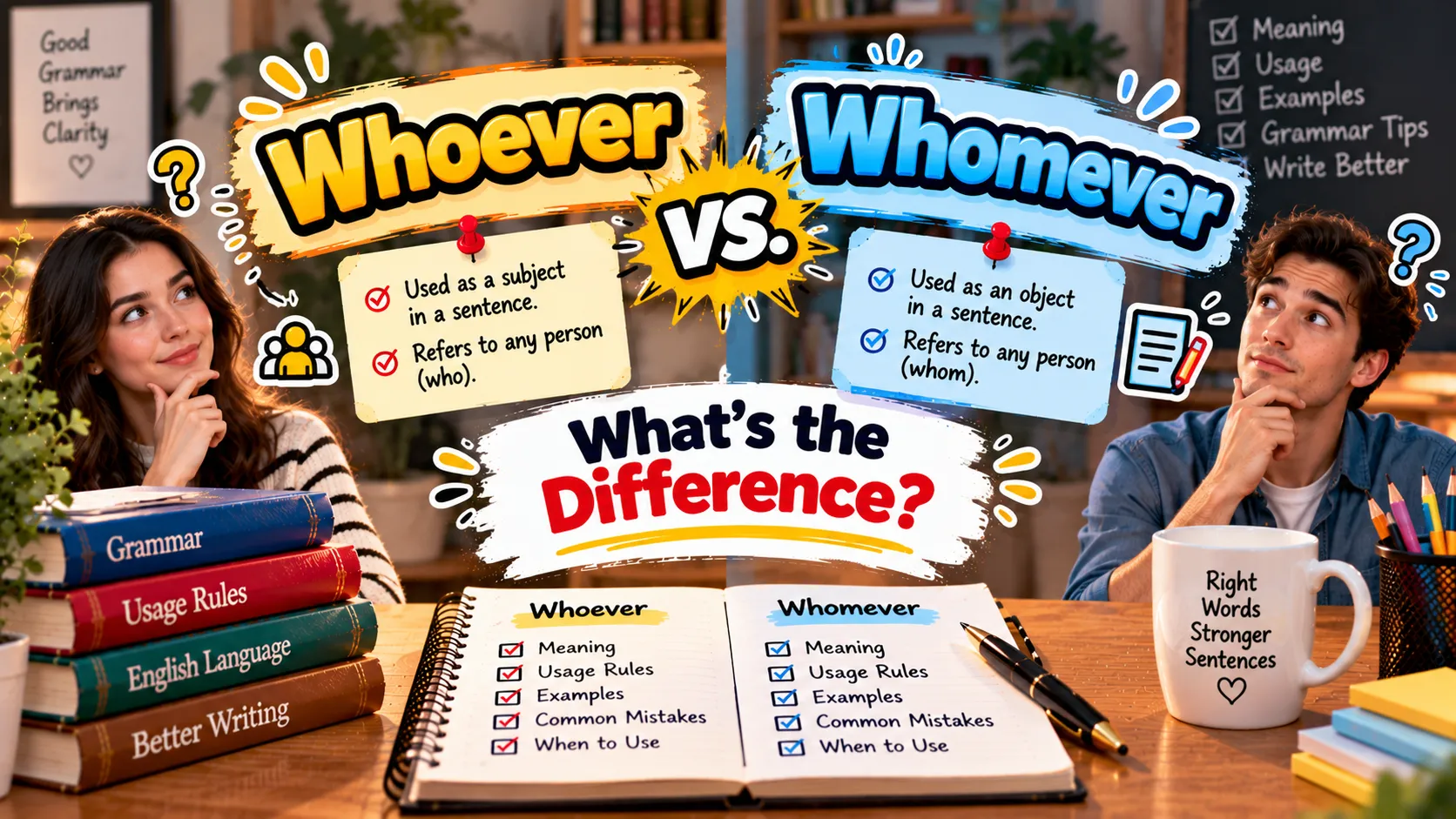
Have you ever paused while writing a sentence because you weren’t sure whether to use whoever or whomever? You’re not alone! These two words look similar and have almost the same general meaning, but they serve different grammatical purposes. Choosing the right one can make your writing clearer, more polished, and grammatically accurate.
The main difference is that whoever traditionally functions as a subject, while whomever functions as an object. Think of whoever as similar to he, she, or they, and whomever as similar to him, her, or them.
However, modern English is more flexible than this simple rule might suggest. People frequently use whoever in situations where traditional grammar recommends whomever. Understanding both the traditional rule and everyday usage will help you choose the right word for essays, emails, professional documents, and casual conversations.
📚 What Does Whoever Mean?
Whoever means any person who or the person who. It refers to an unspecified person whose identity may be unknown or unimportant to the sentence.
In traditional English grammar, whoever is used when the person performs an action or serves as the subject of a clause. It can introduce a statement about someone without identifying that person by name.
For example:
- Whoever arrives first can choose a seat.
- Whoever wins the competition will receive a trophy.
- Whoever called this morning left a message.
- Whoever wants to participate should register today.
- Whoever made this cake deserves a compliment.
- Whoever finishes the assignment can leave early.
In these sentences, whoever identifies the person performing the action. The person arrives, wins, calls, participates, makes something, or finishes an assignment.
The word can also introduce a complete clause that acts as a subject in a larger sentence. For example, in “Whoever finishes first will receive a reward,” the entire clause whoever finishes first serves as the subject of will receive.
Quick tip: Use whoever when the person is the subject of the relevant clause.
✍️ What Does Whomever Mean?
Whomever also refers to an unspecified person, but traditional grammar uses it in object positions. An object is the person or thing that receives an action or follows a preposition.
For example:
- Invite whomever you want to the party.
- Give the package to whomever you trust.
- The director will interview whomever the committee recommends.
- Send the invitation to whomever you select.
- We will support whomever the team chooses.
- She can consult whomever she considers qualified.
In these examples, whomever refers to the person being invited, trusted, interviewed, selected, supported, or consulted.
The difference becomes clearer when you examine the verb. In “Invite whomever you want,” the person is the object of invite. Inside the clause you want, the implied object is also the person being wanted.
Quick tip: In traditional formal grammar, use whomever when the person is functioning as an object.
🔍 Whoever vs. Whomever: Key Differences
Although both words refer to people, their traditional grammatical roles are different.
| Feature | Whoever | Whomever |
|---|---|---|
| Traditional grammatical role | Subject | Object |
| Similar pronouns | He, she, they | Him, her, them |
| Common function | Performing an action | Receiving an action |
| Example | Whoever calls can leave a message. | Call whomever you prefer. |
| Typical tone | Natural in everyday English | Often more formal |
For example, “Whoever calls will receive a response” uses whoever because the person performs the action of calling.
On the other hand, “Call whomever you prefer” traditionally uses whomever because the person is the object of the verb call.
Remember that the grammatical role depends on the clause in which the word appears. A clause can function as the subject of a sentence even when the pronoun inside that clause is an object.
💡 An Easy Trick to Remember the Difference
One of the easiest ways to distinguish these words is to replace them with personal pronouns.
- If he, she, or they fits, use whoever.
- If him, her, or them fits, use whomever.
This method works best when you examine the specific clause in which the word appears.
Example: Whoever Calls
Sentence: “Whoever calls first will receive the information.”
Try replacing whoever with they:
“They call first.”
The subject pronoun they fits, so whoever is the traditional choice.
Example: Whomever You Invite
Sentence: “You can invite whomever you prefer.”
Replace the person inside the clause with them:
“You prefer them.”
The object pronoun them fits, so traditional formal grammar favors whomever.
Example: Whoever Wins
Sentence: “Whoever wins will receive the prize.”
The person performs the action of winning. You can say, “They win.” Therefore, whoever is correct.
Example: To Whomever It May Concern
The familiar formal expression is “To Whom It May Concern.” The word whom follows the preposition to, so the objective form is traditionally used.
The same principle helps explain why whomever can appear after prepositions in other constructions.
📝 When to Use Whoever
Use whoever when the word functions as the subject of its own clause. This commonly happens when an unspecified person performs an action or satisfies a condition.
When Someone Performs an Action
- Whoever knocks on the door can come inside.
- Whoever sent this letter forgot to sign it.
- Whoever breaks the rules may face consequences.
- Whoever finds my keys should let me know.
- Whoever called earlier can try again.
Someone Meets a Condition
- Whoever completes the test can leave.
- Whoever finishes the project first will receive recognition.
- Whoever qualifies for the program may apply.
- Whoever arrives before noon can join the meeting.
- Whoever submits the form on time will be considered.
When Expressing a General Principle
- Whoever works hard can improve their skills.
- Whoever takes responsibility earns trust.
- Whoever speaks honestly deserves to be heard.
- Whoever helps others can make a difference.
- Whoever respects others is more likely to build strong relationships.
In all these examples, whoever identifies the person who performs the action or fulfills the stated condition.
🎯 When to Use Whomever
Use whomever when traditional grammar requires an object pronoun. It often appears after verbs or prepositions.
After Verbs
Some verbs take an object because the action is directed toward a person.
Examples include:
- Choose whomever you trust.
- Contact whomever the manager recommends.
- Invite whomever you wish.
- Reward whomever the committee selects.
- Help whomever you can.
- Consult whomever you consider qualified.
In these examples, the person is the object of the action.
After Prepositions
Prepositions such as to, with, for, and from often take object pronouns.
Examples include:
- Give the keys to whomever you choose.
- Work with whomever the supervisor assigns.
- Prepare a report for whomever the director names.
- Take advice from whomever you trust.
- Send the documents to whomever you select.
These examples illustrate traditional formal usage. In everyday English, whoever is also widely used in many of these constructions.
⚖️ Is It Whoever You Want or Whomever You Want?
This is one of the most common grammar questions because both versions appear in everyday writing.
Consider these sentences:
- You can invite whoever you want.
- You can invite whomever you want.
Traditional formal grammar favors whomever you want because the person is the object of want and, in the larger sentence, the object of invite.
However, whoever you want is extremely common in contemporary English. Many speakers use whoever in object positions because whom and its related forms are becoming less common in everyday conversation.
The same pattern appears in these examples:
- Hire whoever you think is best.
- Hire whomever you think is best.
- Choose whoever you prefer.
- Choose whomever you prefer.
For a formal grammar test, traditional writing exercise, or style guide that explicitly requires the subject-object distinction, whomever may be expected when the pronoun functions as an object.
For everyday conversation, blogs, and informal writing, whoever often sounds more natural and is widely accepted.
The important thing is to understand the traditional rule while recognizing that modern English usage is more flexible.
🌟 Whoever or Whomever Wins?
The correct choice in traditional grammar is whoever wins.
Why? Because the person performs the action of winning. The word functions as the subject of the verb wins.
Examples:
- Whoever wins the race will receive a medal.
- Whoever wins the election will lead the organization.
- Whoever wins the game will advance to the next round.
- Whoever wins the contest will be announced tomorrow.
Using whomever in these sentences would be incorrect under the traditional subject-object rule because the person is performing the action rather than receiving it.
A useful way to remember this is to ask who is doing the winning. If the answer is the person referred to by the word, whoever is the appropriate choice.
🧩 Whoever or Whomever I Choose?
This question can be tricky because the pronoun may be part of a clause that functions as the object of another verb.
Consider this sentence:
“I will support whoever I choose.”
Inside the clause whoever I choose, the implied person is the object of choose. Traditional formal grammar therefore favors:
“I will support whomever I choose.”
However, both versions appear in contemporary English, and the version with whoever is common in everyday speech.
Now consider a slightly different sentence:
“Whoever I choose will represent the group.”
Here, the entire clause whoever I choose acts as the subject of will represent. Yet inside that clause, the person is still the object of choose. Traditional formal grammar may therefore favor:
“Whomever I choose will represent the group.”
This example demonstrates an important principle: the word’s role inside its own clause matters more than its position in the entire sentence.
📖 How Whoever and Whomever Work in Complex Sentences
Longer sentences can make the distinction more difficult because the pronoun may appear inside a clause that serves a different function in the complete sentence.
Consider this example:
“Whoever the committee chooses will receive the scholarship.”
The entire clause whoever the committee chooses acts as the subject of the sentence. Inside that clause, however, the committee performs the action of choosing, and the person being chosen is the object of the verb.
Traditional formal grammar may therefore favor:
“Whomever the committee chooses will receive the scholarship.”
Another example is:
“I will support whoever proves the proposal is worthwhile.”
In this sentence, whoever proves the proposal is worthwhile refers to the person performing the action of proving. The word whoever serves as the subject of proves, even though the entire clause follows the verb support.
A useful approach is to identify the relevant clause, locate its verb, and determine whether the person is performing the action or receiving it.
💬 Is Whoever More Common Than Whomever?
Yes. In contemporary English, whoever is much more common in everyday conversation and informal writing.
Many speakers use whoever in object positions where traditional grammar prescribes whomever. This reflects a broader shift in English: the objective form whom has become less common in ordinary conversation, and many people prefer who even in situations where formal grammar recommends whom.
For example, people commonly say:
- Whoever you choose is fine with me.
- Give it to whoever needs it.
- Invite whoever you want.
- Work with whoever you trust.
These expressions are natural in everyday English. However, formal grammar exercises and some style guides may expect whomever when the word functions as an object.
If you are writing for an academic assignment or taking a grammar test, follow the traditional distinction when it is being assessed. For everyday communication, prioritize clarity and natural phrasing.
🚫 Common Mistakes to Avoid
Even experienced writers sometimes confuse these words. Understanding a few common mistakes can help you avoid them.
Using Whomever as a Subject
Incorrect in traditional grammar: “Whomever arrives first will receive a prize.”
Correct: “Whoever arrives first will receive a prize.”
The person performs the action of arriving, so whoever is the traditional choice.
Using Whoever as an Object in Formal Writing
Traditional formal version: “Please invite whomever you select.”
Common everyday version: “Please invite whoever you select.”
The first follows the traditional object rule. The second is widely used in modern English and is often accepted in informal writing.
Looking Only at the Main Verb
A sentence may contain several clauses, each with its own grammatical structure. Do not automatically choose whoever or whomever based only on the main verb.
For example, in “Whoever you choose will lead the group,” the entire clause functions as the subject of will lead, but the person is the object of choose. Traditional formal grammar may favor whomever inside that clause.
Forgetting About Prepositions
In traditional grammar, object forms normally follow prepositions.
For example:
- Traditional formal usage: “Send the invitation to whomever you select.”
- Everyday usage: “Send the invitation to whoever you select.”
Knowing the traditional rule helps you choose the version that best fits your audience and purpose.
✨ Examples of Whoever and Whomever in Everyday Writing
Here are additional examples to help you recognize the difference in realistic situations.
- Whoever answers the phone should take a message. The person performs the action of answering.
- You may speak to whomever you prefer. Traditional formal grammar uses the object form after to.
- Whoever finishes the report can leave early. The person performs the action of finishing.
- The coach will select whomever the team recommends. The person is the object of select.
- Whoever created this design has excellent skills. The person performs the action of creating.
- Send the invitation to whomever you trust. The person follows the preposition to in traditional formal usage.
- Whoever needs additional help can contact the office. The person performs the action of needing.
- We will support whomever the committee appoints. The person is the object of appoints.
These examples reinforce the traditional rule while showing how both words work in everyday contexts.
🧠 Practice Quiz: Whoever or Whomever?
Test your understanding by choosing the correct word for each sentence. The answers follow traditional formal grammar.
1. _____ finishes the assignment first can leave early.
A. Whoever
B. Whomever
Answer: Whoever. The person performs the action of finishing, so whoever is the subject of the verb.
2. Give the package to _____ you trust.
A. Whoever
B. Whomever
Answer: Whomever. Traditional formal grammar uses whomever as the object of the preposition to.
3. _____ wins the competition will receive a trophy.
A. Whoever
B. Whomever
Answer: Whoever. The person performs the action of winning, making whoever the subject of the verb.
4. The manager will promote _____ the team recommends.
A. Whoever
B. Whomever
Answer: Whomever. The person being promoted is the object of the verb recommends in traditional formal grammar.
5. _____ calls tonight should leave a message.
A. Whoever
B. Whomever
Answer: Whoever. The person performs the action of calling, so the subject form is appropriate.
6. You may work with _____ the supervisor assigns.
A. Whoever
B. Whomever
Answer: Whomever. In traditional formal grammar, the person is the object of the preposition with.
7. _____ you choose will represent the group.
A. Whoever
B. Whomever
Answer: Whomever, in traditional formal grammar. Inside the clause, the person is the object of choose, even though the whole clause functions as the subject of the sentence. Whoever is common in everyday English.
8. _____ wants to attend should register online.
A. Whoever
B. Whomever
Answer: Whoever. The person performs the action of wanting, so the subject form is correct.
❓ Frequently Asked Questions About Whoever and Whomever
Is whoever or whomever grammatically correct?
Both words are grammatically correct, but they serve different functions in traditional grammar. Whoever is the subject form, while whomever is the object form. Modern English often favors whoever in both positions.
Is it whoever or whomever you want?
Traditional formal grammar favors whomever you want because the person is the object of want. However, whoever you want is extremely common in everyday English and informal writing.
Is it whoever or whomever wins?
The correct choice is whoever wins. The person performs the action of winning, so the subject form is appropriate.
Is it whoever or whomever I choose?
Traditional formal grammar favors whomever I choose, because the person is the object of choose. Nevertheless, whoever I choose is common in contemporary English.
Can I use whoever instead of whomever?
In everyday English, whoever is often used in object positions where traditional grammar prescribes whomever. For formal assignments or grammar tests, follow the traditional distinction if required.
What is the easiest way to remember the difference?
Replace the word with he or they to test for whoever. Replace it with him or them to test for whomever. Always examine the word’s role inside the clause where it appears.
Why does whomever sound so formal?
Whomever is less common in everyday conversation because English speakers increasingly prefer whoever and who in many contexts. As a result, whomever often sounds more formal or literary.
Is whomever becoming obsolete?
It is not obsolete, but it is less common than whoever in everyday speech. It remains useful in formal writing, particularly when the traditional subject-object distinction matters.
🌟 Final Thoughts
The difference between whoever and whomever becomes easier when you focus on the role each word plays inside its clause. In traditional grammar, whoever is used as a subject, while whomever is used as an object.
Use whoever in sentences such as “Whoever arrives first can begin.” Choose whomever in formal constructions such as “Give the award to whomever you select.”
At the same time, remember that contemporary English often favors whoever in everyday conversation and informal writing. Understanding both the traditional rule and modern usage will help you write more naturally and confidently.

Olivia Bennett is a writer and language enthusiast at Vocabsteria. She is passionate about exploring word meanings, name origins, and cultural expressions from around the world.