Finding the right synonyms for a lot can make your English more precise, natural, and polished. The phrase “a lot” is extremely common in everyday conversation, but it is not always the best choice for formal writing, academic essays, professional communication, or descriptive sentences. Depending on what you want to express, you can replace it with words such as many, much, numerous, plenty, abundant, substantial, considerable, extensive, greatly, or significantly.
The important thing is that “a lot” can have several meanings. It can describe a large number of people or things, a large amount of something, a high degree of an action or feeling, or simply an abundance. For example, “a lot of students” can become “many students,” while “I like it a lot” can become “I like it very much” or “I greatly appreciate it.”
This guide explores the most useful a lot synonyms, including formal alternatives, academic vocabulary, words for “a lot of,” alternatives for “lots of,” and different ways to say “a lot” in writing. Each section includes examples so you can choose the right expression for your sentence.
🔤 What Are Synonyms for a Lot?
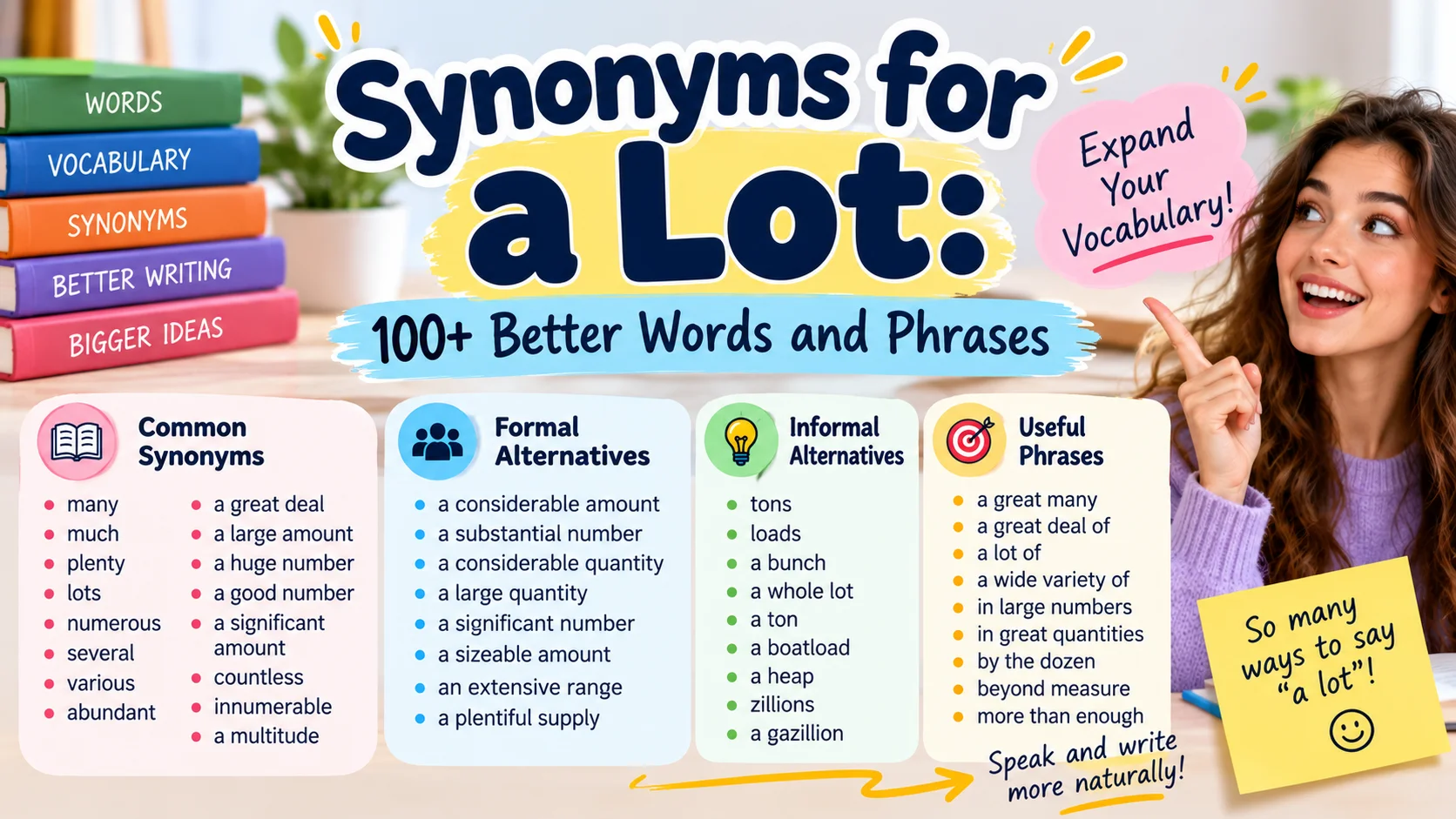
Synonyms for a lot are words and phrases that express a large quantity, number, degree, or frequency. Common alternatives include many, much, plenty, numerous, abundant, substantial, considerable, extensive, greatly, significantly, and a great deal.
The correct synonym depends on what follows “a lot.” Use many with countable nouns, such as “many books,” and much with uncountable nouns, such as “much time.” Words like numerous are useful for formal writing, while plenty of is natural in conversational English.
When “a lot” means “very much,” you may need a different type of replacement. For example, “She enjoyed the movie a lot” could become “She greatly enjoyed the movie,” although “She enjoyed the movie very much” is often more natural.
📚 Common Synonyms for a Lot
There are many alternatives to “a lot,” but some are more natural than others depending on the sentence.
- Many
- Much
- Plenty
- Plenty of
- Numerous
- Several
- Abundant
- Ample
- Considerable
- Substantial
- Extensive
- Copious
- Countless
- Numerous amounts
- A great deal
- A large amount
- A large number
- A considerable amount
- A substantial amount
- A significant amount
For example, instead of saying “There are a lot of reasons,” you can say “There are many reasons” or “There are numerous reasons.”
Instead of “We have a lot of time,” you can say “We have plenty of time” or “We have ample time.”
📝 A Lot Synonyms by Meaning
The phrase a lot does not have one replacement that works everywhere. Its synonym depends on whether you are discussing quantity, number, degree, or frequency.
| Meaning | Useful Synonyms | Example |
|---|---|---|
| Large number | Many, numerous, countless | Numerous people attended. |
| Large amount | Much, substantial, considerable | A substantial amount was spent. |
| Plenty | Ample, abundant, plentiful | We have ample resources. |
| High degree | Greatly, significantly, considerably | The results improved significantly. |
| Frequency | Often, frequently, regularly | She frequently visits the library. |
| Strong feeling | Very much, greatly, deeply | I greatly appreciate your help. |
| Large quantity | Abundant, copious, extensive | The region has abundant resources. |
| Importance or effect | Significant, considerable | It had a significant effect. |
Understanding this difference helps you select the right word for a lot instead of simply replacing the phrase without considering context.
🔢 Synonyms for a Lot of People or Things
When “a lot of” refers to a large number of countable people or objects, many and numerous are among the most useful choices.
Other alternatives include:
- Many
- Numerous
- Several
- Countless
- Dozens of
- Scores of
- Various
- A large number of
- A considerable number of
- A substantial number of
- An abundance of
- A multitude of
- Plenty of
- A wide range of
- A host of
Examples
- A lot of students joined the program.
- Many students joined the program.
- Numerous students joined the program.
- A large number of students joined the program.
- A multitude of students joined the program.
For everyday English, many is usually the simplest option. For formal writing, numerous or a large number of may be more suitable.
💧 Synonyms for a Lot of Something
When “a lot of” describes an uncountable noun, alternatives such as much, a great deal of, a substantial amount of, considerable, abundant, and plenty of can work well.
Examples include:
- A lot of water → A large amount of water
- A lot of money → A substantial amount of money
- A lot of time → Plenty of time
- A lot of information → A great deal of information
- A lot of experience → Extensive experience
- A lot of energy → A great deal of energy
- A lot of effort → Considerable effort
- A lot of attention → Significant attention
The noun matters because some alternatives sound natural with certain types of nouns but awkward with others.
🎓 Formal Synonyms for a Lot
If you are looking for formal synonyms for a lot, avoid relying too heavily on casual expressions such as “lots of.” Formal writing usually benefits from more precise vocabulary.
Useful formal alternatives include:
- Numerous
- Considerable
- Substantial
- Significant
- Extensive
- Abundant
- Ample
- Copious
- A great deal
- A large number
- A substantial amount
- A considerable amount
- A significant number
- A wide range
- A multitude
| Casual | Formal Alternative |
|---|---|
| A lot of people | Numerous people |
| A lot of money | A substantial amount of money |
| A lot of research | Extensive research |
| A lot of information | A great deal of information |
| A lot of problems | Numerous problems |
| A lot of effort | Considerable effort |
| A lot of resources | Extensive resources |
| A lot of attention | Significant attention |
| A lot of experience | Extensive experience |
| A lot of evidence | Substantial evidence |
These alternatives can make business reports, academic papers, professional documents, and formal correspondence sound more precise.
🎓 Academic Synonyms for a Lot
Students often search for academic synonyms for a lot because the phrase can sound too conversational in essays and research papers.
Depending on the context, consider:
- Numerous
- Significant
- Substantial
- Considerable
- Extensive
- A considerable amount
- A substantial number
- A large proportion
- A significant proportion
- A wide range
- A great deal
- Abundant
- Extensive evidence
- Numerous studies
- Considerable research
Examples
Instead of:
A lot of studies have examined this issue.
Write:
Numerous studies have examined this issue.
Instead of:
A lot of evidence supports this argument.
Write:
Substantial evidence supports this argument.
Instead of:
A lot of research has been conducted.
Write:
Extensive research has been conducted.
These alternatives are generally more appropriate for formal academic writing.
✍️ Synonyms for a Lot in an Essay
If you need synonyms for a lot in an essay, choose a replacement according to the noun and meaning.
| Original Phrase | Better Essay Alternative |
|---|---|
| A lot of people | Many people / Numerous people |
| A lot of studies | Numerous studies |
| A lot of evidence | Substantial evidence |
| A lot of research | Extensive research |
| A lot of money | A substantial amount of money |
| A lot of information | A great deal of information |
| A lot of problems | Numerous problems |
| A lot of resources | Extensive resources |
| A lot of attention | Considerable attention |
| A lot of time | A considerable amount of time |
For academic writing, avoid replacing every instance of “a lot” with the same word. Variety is useful, but accuracy is more important than simply sounding sophisticated.
💼 Professional Ways to Say a Lot
Professional communication often requires concise and precise language. Instead of repeatedly writing “a lot,” consider these alternatives:
- Numerous
- Significant
- Substantial
- Considerable
- Extensive
- Ample
- Major
- Abundant
- A large number of
- A substantial amount of
- A significant amount of
- A considerable number of
- A wide range of
- A great deal of
- An extensive amount of
For example:
Less formal:
“We received a lot of applications.”
Professional:
“We received a large number of applications.”
More concise:
“We received numerous applications.”
Another example:
Less formal:
“The project required a lot of work.”
Professional:
“The project required considerable effort.”
🔥 Strong Synonyms for a Lot
Sometimes you want to emphasize that the quantity or degree is especially high. Stronger alternatives can help communicate that meaning.
- Enormous amount
- Vast amount
- Substantial amount
- Considerable amount
- Tremendous amount
- Extensive amount
- Abundant supply
- Countless
- Innumerable
- A multitude
- A wealth
- An abundance
- A great deal
- A vast number
- A considerable number
Examples:
- The project required a tremendous amount of effort.
- The organization has a wealth of experience.
- The website provides a vast amount of information.
- There are countless opportunities available.
These expressions are stronger than simply saying “a lot,” but they should still match the actual context.
🌟 Sophisticated Words for a Lot
If you want your vocabulary to sound more polished, several sophisticated alternatives can replace “a lot” without making the sentence unnecessarily complicated.
- Abundant
- Ample
- Considerable
- Substantial
- Extensive
- Copious
- Numerous
- Countless
- Innumerable
- Plentiful
- Profuse
- Multitudinous
- A multitude
- An abundance
- A wealth
For example:
The museum contains a wealth of historical information.
This sounds more descriptive than:
The museum has a lot of information.
However, sophisticated vocabulary should always remain clear. A simple word such as many is often better than an unnecessarily complicated alternative.
🔄 Another Way to Say a Lot
There are many natural ways to say a lot in English.
- Many
- Much
- Plenty
- Plenty of
- Lots of
- Numerous
- A great deal
- A large amount
- A large number
- A substantial amount
- A considerable amount
- A significant amount
- An abundance of
- A wealth of
- A multitude of
- Countless
- Ample
- Extensive
- Abundant
- Plentiful
The choice depends on the grammar of the sentence.
For example:
- A lot of books → Many books
- A lot of money → A substantial amount of money
- A lot of experience → Extensive experience
I like it a lot → I like it very much
📖 Synonyms for a Lot in Writing
Good writing does not require eliminating the phrase “a lot” completely. It simply means using more precise alternatives when they improve the sentence.
Consider these examples:
- A lot of information → Extensive information
- A lot of questions → Numerous questions
- A lot of pressure → Considerable pressure
- A lot of support → Strong support
- A lot of interest → Significant interest
- A lot of experience → Extensive experience
- A lot of time → A considerable amount of time
- A lot of effort → Considerable effort
- A lot of evidence → Substantial evidence
- A lot of opportunities → Numerous opportunities
The best replacement depends on what you want the reader to notice: quantity, importance, intensity, range, or abundance.
🧠 Many vs. Much vs. A Lot
One of the most common questions about a lot synonyms is when to use many, much, and a lot of.
| Expression | Used With | Example |
|---|---|---|
| Many | Countable plural nouns | Many books |
| Much | Uncountable nouns | Much time |
| A lot of | Countable and uncountable nouns | A lot of books / a lot of time |
| Plenty of | Countable and uncountable nouns | Plenty of books / plenty of time |
| Numerous | Countable plural nouns | Numerous books |
| A great deal of | Uncountable nouns | A great deal of time |
Examples
Countable:
There are many students in the class.
Uncountable:
We do not have much time.
Both:
We have a lot of students.
We have a lot of time.
This grammatical distinction is important when selecting a replacement.
⚖️ A Lot vs. Lots of
A lot of and lots of are both commonly used to mean a large quantity or number. They can generally be used with countable and uncountable nouns.
Examples:
- There are a lot of people here.
- There are lots of people here.
- We have a lot of work to do.
- We have lots of work to do.
However, lots of often sounds more casual and conversational. In formal academic writing, alternatives such as numerous, substantial, considerable, or extensive may be more appropriate.
🚫 A Lot vs. Alot: Which Is Correct?
The correct expression is “a lot,” written as two separate words.
✅ I have a lot of work.
❌ I have alot of work.
“Alot” is not considered the standard spelling in formal English. When writing an essay, article, email, report, or professional document, always use a lot as two words.
This is an important distinction for anyone searching for how to use a lot correctly in English.
❤️ Synonyms for “I Like It a Lot”
When “a lot” means very much, quantity-based synonyms such as “numerous” or “many” do not work.
Instead, use:
- Very much
- Greatly
- Deeply
- Strongly
- Extremely
- Tremendously
- Immensely
- Especially
- Thoroughly
- Intensely
Examples:
- I like this song very much.
- I really like this design.
- She greatly appreciates your support.
- He deeply values their friendship.
- We strongly recommend this approach.
The most natural everyday alternative is often very much or really.
💰 Synonyms for a Lot of Money
There are several ways to express a large amount of money.
- A substantial amount of money
- A considerable amount of money
- A large sum of money
- A significant amount of money
- A fortune
- A wealth of money
- Considerable funds
- Extensive financial resources
- A sizable sum
- A hefty amount
Examples:
The company invested a substantial amount of money in research.
She inherited a large sum of money.
The project requires considerable financial resources.
The appropriate phrase depends on whether you want to emphasize the amount, available resources, or financial impact.
⏰ Synonyms for a Lot of Time
When discussing time, natural alternatives include:
- Plenty of time
- Ample time
- A great deal of time
- A considerable amount of time
- An extended period
- Extensive time
- A significant amount of time
- Sufficient time
- More than enough time
Examples:
We have plenty of time to finish.
The researchers spent a considerable amount of time collecting data.
The project required an extended period of preparation.
Plenty of time is particularly natural in everyday English, while a considerable amount of time works better in formal writing.
🔢 Synonyms for a Large Number
If you specifically mean a lot of people or things, use:
- Many
- Numerous
- Countless
- Innumerable
- Several
- Dozens of
- Scores of
- A large number of
- A considerable number of
- A substantial number of
- A multitude of
- A host of
- An abundance of
For example:
Numerous researchers have studied the issue.
Countless people have benefited from the program.
A considerable number of participants completed the survey.
These expressions are particularly useful when looking for different words for a lot of people.
🌿 Synonyms for a Large Amount
When “a lot” refers to an uncountable quantity, consider:
- Much
- Plenty
- Abundance
- Abundant
- Substantial
- Considerable
- Extensive
- Ample
- Copious
- A great deal
- A large amount
- A significant amount
- A substantial amount
- A considerable amount
- A wealth of
Examples:
The region has an abundance of natural resources.
The report contains a great deal of useful information.
The company has substantial financial resources.
📊 Quick Reference: Best Synonyms for a Lot
| If You Mean… | Use These Words |
|---|---|
| Many people | Many, numerous, countless |
| Many objects | Many, numerous, countless |
| Large amount | Substantial, considerable, much |
| Plenty | Ample, abundant, plentiful |
| Large quantity | Abundant, copious, substantial |
| Strong degree | Greatly, significantly, considerably |
| Lots of information | Extensive information, a wealth of information |
| Lots of experience | Extensive experience |
| Lots of money | A substantial amount, a large sum |
| Lots of time | Plenty of time, ample time |
| Lots of research | Extensive research |
| Lots of evidence | Substantial evidence |
| Lots of opportunities | Numerous opportunities |
| Lots of problems | Numerous problems |
| Very much | Greatly, deeply, very much |
💡 How to Choose the Right Synonym for a Lot
The easiest way to choose an alternative is to ask what “a lot” means in your sentence.
If you are talking about people or objects, many or numerous may be appropriate. If you are describing an uncountable quantity, much, a great deal of, or a substantial amount of can work.
So If you are describing something that is available in abundance, plenty of, ample, or abundant may sound natural. And Also If “a lot” means “very much,” use expressions such as greatly, deeply, or very much instead.
You should also consider your audience. Casual conversation allows phrases such as lots of, while academic and professional writing may benefit from numerous, substantial, considerable, or extensive.
❓ Frequently Asked Questions About Synonyms for a Lot
What is another word for a lot?
Common alternatives include many, much, numerous, plenty, substantial, considerable, abundant, extensive, and a great deal. The correct option depends on the sentence.
What is a formal synonym for a lot?
Formal alternatives include numerous, substantial, considerable, significant, extensive, abundant, and a large number of.
What is a better word for a lot in an essay?
For an essay, words such as numerous, substantial, considerable, significant, and extensive are often useful. The best choice depends on whether you are describing a number, amount, degree, or effect.
What are synonyms for a lot of?
Common synonyms for a lot of include many, much, numerous, plenty of, a great deal of, a large number of, a substantial amount of, abundant, and extensive.
How do you say a lot in formal writing?
Depending on the context, you can use numerous, substantial, considerable, significant, extensive, or a large number/amount of instead of “a lot.”
What is a sophisticated word for a lot?
Words such as abundant, copious, numerous, considerable, substantial, extensive, and multitudinous can express the idea of a lot, although each has a different grammatical use.
What is another word for lots of?
You can use many, numerous, plenty of, a great deal of, a large number of, an abundance of, or a multitude of.
Is “a lot” formal English?
“A lot” is correct English, but it is generally more conversational than alternatives such as numerous, substantial, considerable, or extensive. It is not grammatically wrong to use it in ordinary writing.
Is “alot” a correct word?
No. In standard English, the correct form is a lot, written as two separate words.
What is another word for a lot of people?
Common alternatives include many people, numerous people, countless people, a large number of people, and a multitude of people.
What is another word for a lot of money?
You can say a substantial amount of money, a considerable sum, a large sum of money, significant funds, or a sizable amount of money.
What is another word for a lot of time?
Natural alternatives include plenty of time, ample time, a great deal of time, and a considerable amount of time.
What is another word for “I like it a lot”?
You can say “I like it very much,” “I really like it,” or “I greatly appreciate it,” depending on the exact meaning.
🎯 Final Thoughts on Synonyms for a Lot
There are many useful synonyms for a lot, but the right choice depends on what you are trying to communicate. Use many and numerous for countable nouns, much and a great deal of for uncountable nouns, and plenty of when you want to emphasize that something is available in a sufficient or generous quantity.
For formal and academic writing, alternatives such as substantial, considerable, significant, extensive, and numerous can make your writing more precise. In everyday English, however, a lot of and lots of remain natural and completely understandable.
The key is not to replace “a lot” with the most complicated word possible. Instead, choose the expression that accurately matches the quantity, number, degree, tone, and grammatical context of your sentence.

Olivia Bennett is a writer and language enthusiast at Vocabsteria. She is passionate about exploring word meanings, name origins, and cultural expressions from around the world.