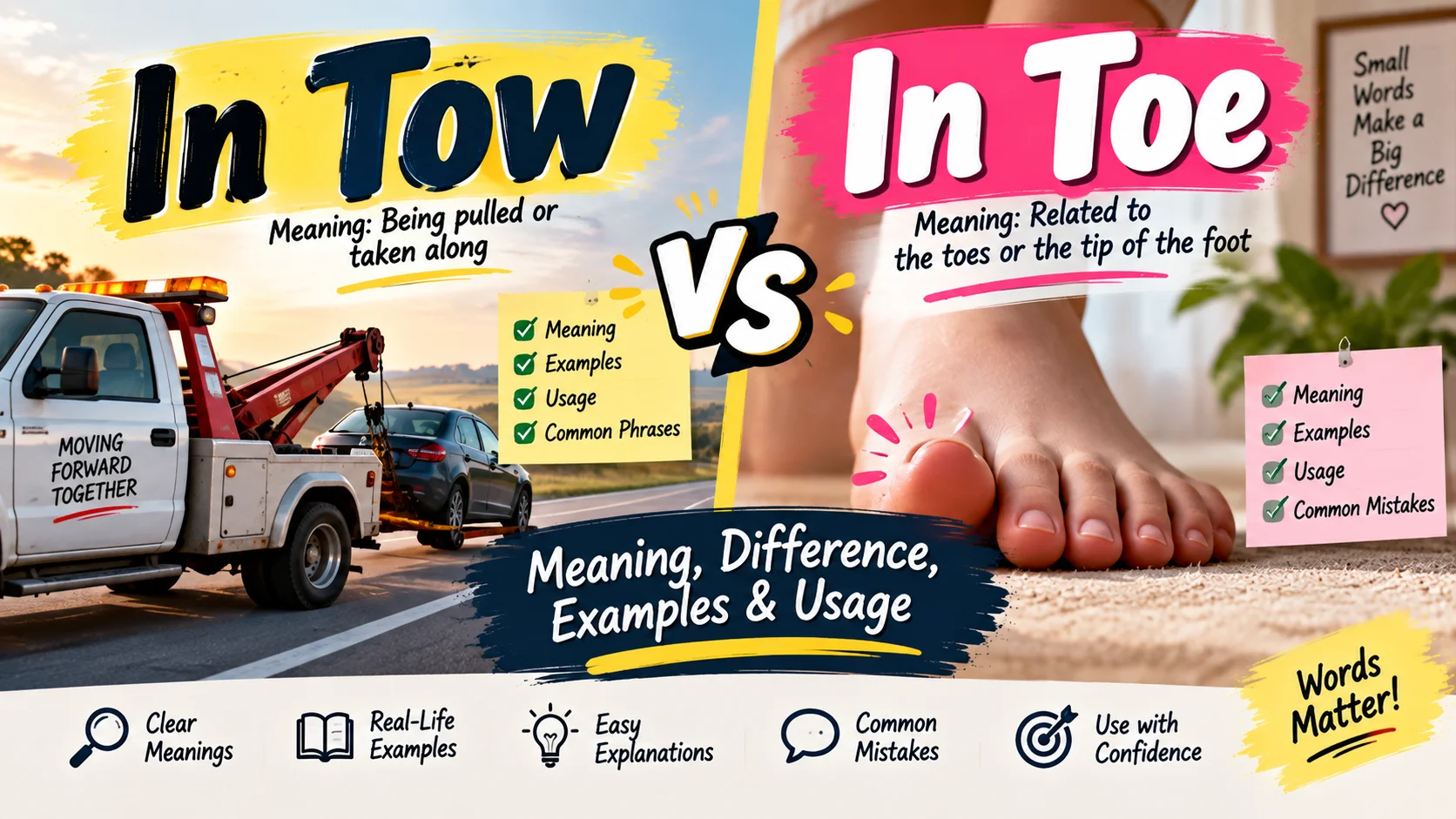
In tow vs in toe is a common English confusion because tow and toe sound exactly alike but have completely different meanings. The correct expression is in tow, which means that someone or something is following another person or being pulled along behind them.
For example, if a parent goes shopping with two children following behind, you can say the parent went shopping with the children in tow. The word tow is connected to the idea of pulling or being taken along.
In toe is not the standard spelling of this idiom. The word toe refers to one of the digits on your foot, so it has a completely different meaning. Although you may occasionally see in toe written by mistake, it should not be used when you mean that someone is following or accompanying another person.
This guide explains in tow vs in toe, their meanings, correct usage, examples, grammar, common mistakes, pronunciation, and easy memory tricks.
In Tow vs In Toe at a Glance
The basic difference is simple:
| Expression | Meaning | Correct? | Example |
|---|---|---|---|
| In tow | Following or being pulled along | Yes | She arrived with her children in tow. |
| In toe | Refers literally to a toe only if used separately | Not the standard idiom | ❌ He arrived with his children in toe. |
The Simple Rule
When you mean following, accompanying, or being pulled along, use:
In tow
Not:
In toe
Quick Example
Correct:
The teacher walked down the hallway with several students in tow.
Incorrect:
The teacher walked down the hallway with several students in toe.
The correct expression is always in tow when describing people or things following someone.
What Does In Tow Mean?
The phrase in tow means following behind someone or being taken along with them.
It can describe:
- People following someone
- Children accompanying a parent
- Pets following their owner
- Groups following a leader
- Vehicles being pulled by another vehicle
- Objects being dragged or pulled
Examples
- She went shopping with her children in tow.
- He arrived at the meeting with his assistant in tow.
- The mother walked into the store with three kids in tow.
- The truck traveled down the highway with a trailer in tow.
- The manager entered the room with several employees in tow.
The phrase often gives the impression that the person or thing behind is being brought along as part of the main person’s movement.
What Does Tow Mean?
The word tow is related to pulling something behind another vehicle, person, or object.
As a verb, tow means to pull something behind you, usually using a rope, chain, cable, or another connection.
Examples
- The truck towed the broken car.
- We had to tow the boat to the lake.
- The damaged vehicle was towed away.
- The car can tow a small trailer.
As a noun, tow can refer to the act or process of pulling something.
Tow and Towing
| Word | Meaning | Example |
|---|---|---|
| Tow | Pull something behind | The truck can tow the trailer. |
| Towed | Pulled behind | The car was towed. |
| Towing | The act of pulling | The towing service arrived. |
| In tow | Following or being pulled along | She arrived with her children in tow. |
This connection helps explain why in tow refers to someone or something following behind.
What Does Toe Mean?
A toe is one of the digits on a person’s or animal’s foot.
Humans normally have five toes on each foot.
Examples
- I stubbed my toe on the table.
- She hurt her big toe.
- He injured his toe while playing soccer.
- My shoes are too tight around my toes.
- The child walked carefully on his toes.
Because toe refers to a body part, it has nothing to do with the idiom in tow.
Is In Toe Correct?
If you are trying to use the idiom meaning following or accompanying someone, then in toe is incorrect.
For example:
Incorrect:
She went to the store with her children in toe.
Correct:
She went to the store with her children in tow.
The mistake happens because tow and toe have the same pronunciation.
When Can Toe Be Used?
Toe is correct when you are literally talking about a foot or a toe.
For example:
- My toe hurts.
- I injured my toe.
- He stood on his toes.
- The shoe pressed against my toe.
But none of these examples creates the idiom in toe.
In Tow vs In Toe: The Main Difference
| Feature | In Tow | In Toe |
|---|---|---|
| Standard idiom | Yes | No |
| Meaning | Following or accompanying | Not a standard idiomatic expression |
| Related word | Tow = pull | Toe = foot digit |
| Common use | People, animals, vehicles, objects | Literal body-part references |
| Example | Kids in tow | Hurt toe |
| Pronunciation | Same as in toe | Same as in tow |
The spelling is different because the meanings are different.
Why Do People Confuse In Tow and In Toe?
The main reason is pronunciation.
Tow and toe are homophones. They sound the same but have different spellings and meanings.
| Word | Pronunciation | Meaning |
|---|---|---|
| Tow | /toʊ/ | Pull or drag behind |
| Toe | /toʊ/ | Digit of the foot |
Because you cannot hear the spelling difference, you need to understand the meaning to choose the correct word.
A Useful Question
Whenever you want to write in tow, ask:
Is someone or something following behind?
If yes, write:
in tow
Examples of In Tow
Here are natural examples of the correct expression.
Family and Children
- She went shopping with her two children in tow.
- The father arrived with his kids in tow.
- We explored the city with our young daughter in tow.
- The grandmother traveled with several grandchildren in tow.
Work and Business
- The executive arrived with several assistants in tow.
- The manager entered the conference room with his team in tow.
- The celebrity attended the event with a group of staff members in tow.
Animals
- The hiker walked along the trail with his dog in tow.
- She visited the park with two excited puppies in tow.
- The farmer headed toward the barn with several dogs in tow.
Vehicles and Objects
- The truck drove north with a trailer in tow.
- The boat traveled across the lake with a smaller vessel in tow.
- The car continued down the road with a damaged trailer in tow.
In Tow in Different Contexts
The expression is flexible and can describe many situations.
| Context | Example |
|---|---|
| Family | She traveled with her children in tow. |
| Work | He arrived with his team in tow. |
| Travel | We toured the city with our guide in tow. |
| Pets | She went hiking with her dog in tow. |
| Vehicles | The truck had a trailer in tow. |
| Groups | The leader entered with supporters in tow. |
| Objects | The boat moved with another boat in tow. |
In Tow Can Mean Following Behind
One important feature of in tow is that the person or thing described is generally behind or accompanying the main person.
For example:
The mother walked through the airport with her children in tow.
This creates a picture of the mother moving ahead while the children follow along.
Similarly:
The truck drove down the highway with a trailer in tow.
The trailer is behind the truck and is being pulled along.
In Tow Does Not Always Mean Physically Pulled
The phrase can have a broader figurative meaning.
A person can be in tow simply because they are accompanying someone.
For example:
He went to the party with his younger brother in tow.
The brother is not necessarily being physically pulled. He is simply following or accompanying him.
This is why in tow is useful in everyday writing.
In Tow vs With Someone
In tow and with someone can sometimes communicate a similar idea, but they have different tones.
| Expression | Tone | Example |
|---|---|---|
| With his children | Neutral | He went shopping with his children. |
| With his children in tow | More descriptive | He went shopping with his children in tow. |
The phrase in tow often emphasizes the idea of someone following along.
It can also sound slightly humorous depending on the context.
Compare
She arrived with three children.
This is straightforward.
She arrived with three children in tow.
This emphasizes that the children accompanied her as she moved around.
Common Mistakes With In Tow
Mistake 1: Writing In Toe
Incorrect:
He arrived with his friends in toe.
Correct:
He arrived with his friends in tow.
Mistake 2: Thinking Toe Means Following
The word toe has nothing to do with following.
A toe is part of the foot.
Mistake 3: Using Tow When Talking About Feet
Incorrect:
I hurt my tow.
Correct:
I hurt my toe.
Here, the context is a body part, so toe is correct.
Tow vs Toe
Understanding the individual words makes the idiom much easier.
Tow
Tow means to pull something behind you.
Examples:
- tow a car
- tow a trailer
- tow a boat
- tow a vehicle
Toe
Toe is a digit on the foot.
Examples:
- big toe
- little toe
- injured toe
- stubbed toe
| Word | Think About |
|---|---|
| Tow | Pulling |
| Toe | Foot |
Then:
In tow = following along
Tow vs Toe Memory Trick
Here is a simple trick:
Tow = Towing
Think:
Tow → Towing a trailer
A trailer follows a vehicle.
Therefore:
In tow → Following behind
Toe = Foot
Think:
Toe → Foot
If the sentence is about your foot, use toe.
This gives you a quick mental shortcut:
Tow = pull
Toe = foot
Another Memory Trick for In Tow
Imagine a truck pulling a trailer.
The truck is moving forward.
The trailer is in tow.
Now imagine a child following a parent through a store.
The child is also in tow.
So remember:
If something follows you, it can be in tow.
In Tow vs Towed
These expressions are related but not identical.
Towed describes the action of pulling something.
In tow describes something that is being brought or pulled along behind.
Examples
The truck towed the trailer.
This focuses on the action.
The truck traveled with the trailer in tow.
This focuses on the trailer’s position or accompanying role.
| Expression | Focus |
|---|---|
| Towed | Action of pulling |
| In tow | Being pulled or accompanying |
Is In Tow Formal?
In tow is a standard English idiom and can appear in both formal and informal writing.
However, it often has a descriptive or conversational flavor.
You may see it in:
- News writing
- Travel writing
- Magazine articles
- Stories
- Everyday conversation
- Business writing
- Casual writing
For example:
The CEO arrived with several advisers in tow.
This can work perfectly well in professional journalism or business writing.
In Tow in Professional Writing
The phrase can make professional writing more vivid without becoming overly informal.
Examples
- The director arrived with several department heads in tow.
- The consultant visited the facility with a team of engineers in tow.
- The executive traveled overseas with a small support team in tow.
- The manager entered the meeting with members of the project team in tow.
The phrase gives readers a clearer picture of the situation.
In Tow in Casual Conversation
It is also common in everyday speech.
For example:
- I went shopping with the kids in tow.
- She showed up with her dog in tow.
- We went to the beach with all the little ones in tow.
- He came over with his younger brother in tow.
These sentences sound natural and descriptive.
Practice: Choose Tow or Toe
Choose the correct word in each sentence.
- She arrived with her children in ___.
- I accidentally hit my ___ against the table.
- The truck had a trailer in ___.
- My big ___ is swollen.
- He walked into the office with his assistant in ___.
- The mechanic had to ___ the broken car.
- She injured her ___ while running.
- The boat had a smaller boat in ___.
Answers
- tow
- toe
- tow
- toe
- tow
- tow
- toe
- tow
The easiest clue is meaning:
Following or pulling → tow
Foot → toe
Frequently Asked Questions
Is it in tow or in toe?
The correct expression is in tow when you mean that someone or something is following, accompanying, or being pulled along.
What does in tow mean?
In tow means following behind or being brought along by someone or something. For example, She arrived with her children in tow means her children accompanied her.
Is in toe ever correct?
In toe is not the standard spelling of the idiom. The expression is in tow. Toe is used when referring to a digit of the foot.
Why is it called in tow?
The phrase comes from the idea of towing or pulling something behind another object. Over time, in tow also came to describe people or animals who accompany someone.
What is the difference between tow and toe?
Tow means to pull something behind you, while toe refers to one of the digits on a foot.
Are tow and toe pronounced the same?
Yes. Tow and toe are homophones and are generally pronounced /toʊ/.
Can people be in tow?
Yes. People can be in tow when they accompany or follow someone.
For example:
She traveled with her children in tow.
Can animals be in tow?
Yes. You can say:
He went hiking with his dog in tow.
This means the dog accompanied him.
Can a vehicle be in tow?
Yes. A trailer, boat, or another vehicle can be in tow when it is being pulled behind another vehicle.
What is an easy way to remember in tow?
Think of a trailer being towed behind a truck. The trailer is in tow.
Final In Tow vs In Toe Comparison
| Point | In Tow | In Toe |
|---|---|---|
| Standard expression | Yes | No |
| Meaning | Following or accompanying | Not a standard idiom |
| Related word | Tow | Toe |
| Meaning of root word | Pull | Foot digit |
| Used for people | Yes | No |
| Used for vehicles | Yes | No |
| Used for body parts | No | Yes |
| Example | Kids in tow | Hurt toe |
| Pronunciation | /toʊ/ | /toʊ/ |
Conclusion
The difference between in tow and in toe is easy once you connect each word with its meaning. In tow is the correct English expression when someone or something is following, accompanying, or being pulled along behind another person or object.
For example, you can say:
She went shopping with her children in tow.
You can also say:
The truck traveled with a trailer in tow.
The word toe, meanwhile, refers to a digit on the foot. That is why in toe is not the standard spelling of the idiom.
The easiest memory trick is:
Tow = pull or follow.
Toe = foot.
So when you mean following along, always choose in tow.

Olivia Bennett is a writer and language enthusiast at Vocabsteria. She is passionate about exploring word meanings, name origins, and cultural expressions from around the world.