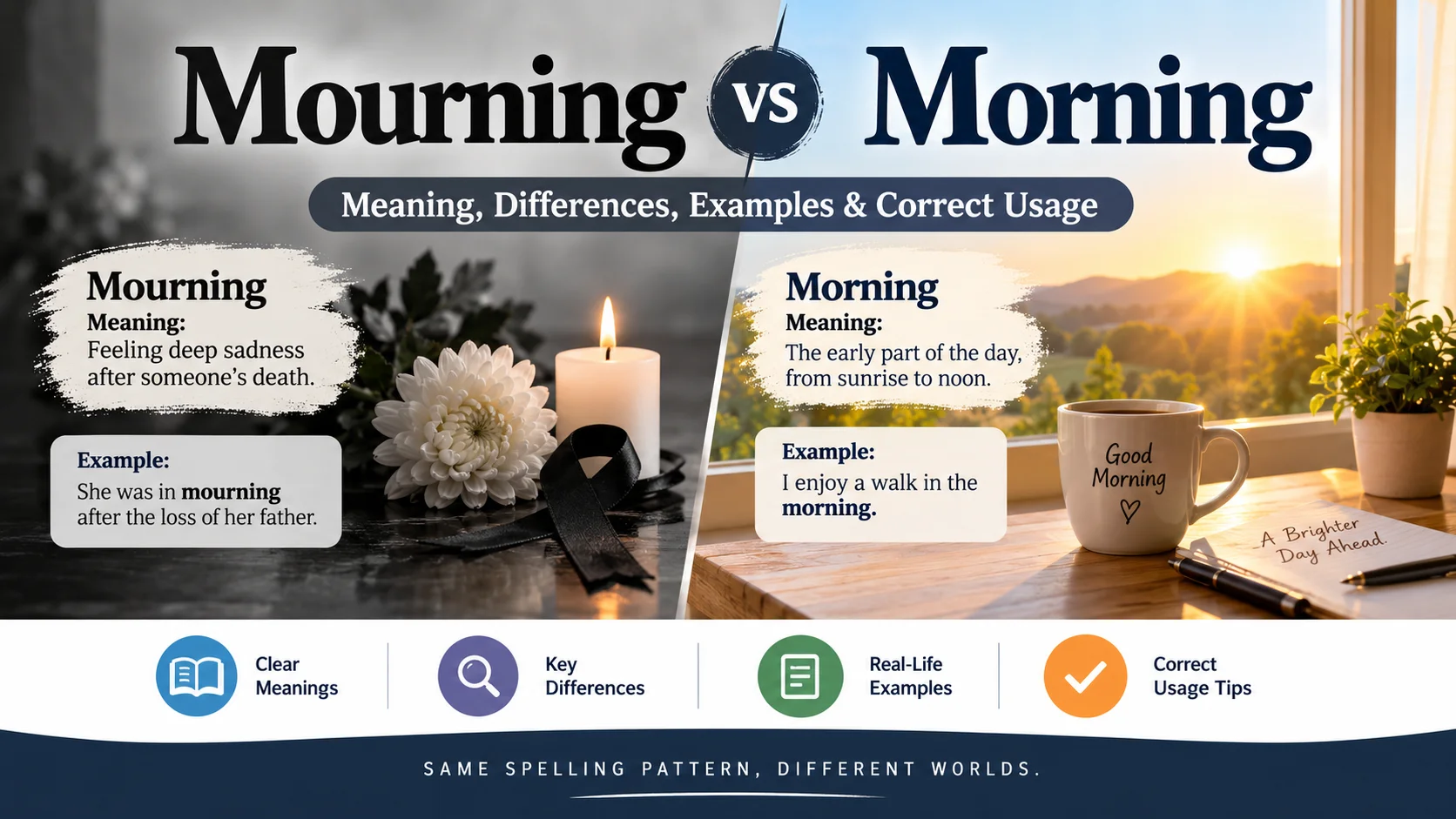
Mourning and morning sound exactly the same when spoken, but they have completely different meanings and uses. This makes them a common source of confusion in English. One word is connected to grief and loss, while the other refers to the early part of the day.
Morning is the period between midnight and noon, especially the time after waking up and before the afternoon. Mourning, on the other hand, describes the expression of grief after someone’s death or another significant loss.
The two words are pronounced the same, making them homophones. However, their spelling, meaning, and grammatical functions are different. Understanding this distinction will help you use each word correctly in writing.
Mourning vs. Morning: Quick Answer
The easiest way to remember the difference is:
- Morning = the early part of the day
- Mourning = the expression of grief after a loss
For example:
I drink coffee every morning.
The family is mourning the loss of their loved one.
The pronunciation is the same, but the meanings are completely different.
What Does Morning Mean?
Morning is the part of the day that comes after night and before afternoon. It generally refers to the hours from midnight until noon, although in everyday conversation it usually means the time after people wake up.
Examples:
- I go for a walk every morning.
- She called me this morning.
- We have a meeting tomorrow morning.
- The weather was beautiful this morning.
Morning is a noun.
Morning in Everyday Expressions
You will often see morning in common expressions such as:
- Good morning
- Tomorrow morning
- This morning
- Every morning
- Early morning
- Late morning
- Morning routine
- Morning coffee
- Morning walk
- Morning news
For example:
Good morning! How are you today?
I usually exercise in the early morning.
What Does Mourning Mean?
Mourning refers to the outward expression of grief or sadness following someone’s death or another significant loss.
It comes from the verb mourn, which means to feel or express deep sorrow after a loss.
Examples:
- The family is mourning the loss of their father.
- She wore black while mourning her husband.
- The community is mourning the victims.
- He spent several months mourning after the loss.
Mourning can involve emotional grief as well as cultural, religious, or social practices.
Mourning in Different Contexts
People may express mourning through:
- Wearing traditional clothing
- Attending a funeral
- Holding memorial services
- Sharing memories
- Observing a mourning period
- Praying or participating in religious ceremonies
- Spending time with family and friends
The specific customs vary across cultures and individuals.
Mourning vs. Morning: Side-by-Side Comparison
| Feature | Morning | Mourning |
|---|---|---|
| Meaning | Early part of the day | Expression of grief after a loss |
| Pronunciation | Same | Same |
| Part of speech | Noun | Noun or present participle |
| Related word | Morn | Mourn |
| Common context | Time, daily routines | Death, grief, loss |
| Example | I exercise every morning. | She is mourning her father. |
| Opposite or contrast | Evening/night | Joy/celebration, depending on context |
Why Do Mourning and Morning Sound the Same?
Mourning and morning are pronounced the same in standard English. Words that have the same pronunciation but different meanings or spellings are called homophones.
Other common English homophones include:
- To / too / two
- There / their / they’re
- Your / you’re
- Flour / flower
- Right / write
- Sea / see
Mourning and morning belong to the same category.
The spelling gives you an important clue:
Morning → connected to the day
Mourning → connected to mourn and grief
Morning: Examples in Sentences
Here are some natural examples using morning:
- I wake up early every morning.
- She reads the newspaper in the morning.
- We are leaving tomorrow morning.
- He called me this morning.
- The children walked to school in the morning.
- I usually have tea after breakfast.
- The morning air felt cool and fresh.
- They arrived in the early morning.
- We scheduled the appointment for Monday morning.
- She enjoys taking a morning walk.
In each example, morning refers to a time of day.
Mourning: Examples in Sentences
Now consider these examples:
- The family is mourning their loss.
- She spent weeks mourning her mother.
- The community was mourning the victims.
- He was still mourning after his brother’s death.
- The country observed a period of mourning.
- Friends gathered to support the mourning family.
- She returned home while mourning her loss.
- The ceremony honored those who were mourning.
- Everyone respected his period of mourning.
- The town was mourning the sudden loss of a beloved resident.
In these examples, mourning relates to grief and loss.
Morning vs. Mourning in Questions
These words can completely change the meaning of a sentence.
Correct:
What are you doing this morning?
This asks about someone’s activities during the early part of the day.
Different meaning:
The family is mourning their loss.
This describes grief after a loss.
Because the words sound identical, context is essential when listening.
Morning vs. Mourning in Writing
Spelling becomes especially important in written English.
Consider:
I went for a walk this morning.
Here, morning is correct because the sentence refers to a time of day.
Now consider:
The family is mourning their grandfather.
Here, mourning is correct because the sentence describes grief.
Using the wrong spelling can completely change the meaning.
Morning: Common Phrases
The word morning appears in many everyday expressions.
Good Morning
A common greeting used during the morning.
Example:
Good morning! I hope you have a wonderful day.
This Morning
Refers to the current day’s morning.
Example:
I spoke with her this morning.
Tomorrow Morning
Refers to the morning of the next day.
Example:
The meeting starts tomorrow morning.
Every Morning
Refers to something that happens regularly during the morning.
Example:
He goes jogging every morning.
Early Morning
Refers to the beginning part of the morning.
Example:
We caught an early morning flight.
Late Morning
Refers to the later part of the morning, usually approaching noon.
Example:
I’ll call you in the late morning.
Mourning: Common Phrases
Mourning is also used in several common expressions.
Period of Mourning
A period during which someone observes grief following a death or loss.
Example:
The family observed a period of mourning.
In Mourning
Describes someone who is grieving.
Example:
The entire community was in mourning.
Mourning Period
A period associated with grieving or traditional mourning practices.
Example:
The mourning period lasted several weeks.
Mourning Clothes
Traditional clothing worn during a period of grief in some cultures.
Example:
The family wore traditional mourning clothes.
Morning vs. Mourning: Grammar
Although the words sound alike, they function differently.
Morning as a Noun
Morning is primarily a noun.
Examples:
- The morning was peaceful.
- I love the morning.
- Tomorrow morning will be busy.
Mourning as a Noun
Mourning can function as a noun describing the expression or period of grief.
Example:
Her mourning lasted for many months.
Mourning as a Verb Form
Mourning can also be the present participle of mourn.
Example:
They are mourning the loss of their friend.
Here, mourning forms part of the verb phrase are mourning.
A Simple Memory Trick
Use the spelling to remember the difference.
Morning
Think:
Morning = Morn + ing
Morn is an old word meaning morning or the early part of the day.
Mourning
Think:
Mourning = Mourn + ing
To mourn means to feel or express grief after a loss.
So:
Morn → Morning → Daytime
Mourn → Mourning → Grief
This simple connection makes the spelling easier to remember.
Common Mistakes With Mourning and Morning
Mistake 1: Using Mourning for Time
Incorrect:
I wake up early every mourning.
Correct:
I wake up early every morning.
The sentence refers to the time of day, so morning is correct.
Mistake 2: Using Morning for Grief
Incorrect:
The family is morning the loss of their father.
Correct:
The family is mourning the loss of their father.
The sentence describes grief, so mourning is correct.
Mistake 3: Confusing the Words Because They Sound Identical
When speaking, the listener must use context to understand which word is intended.
When writing, the spelling must communicate the intended meaning.
Mourning vs. Grieving
Mourning and grieving are closely related, but they are not exactly the same.
Grieving often refers to the internal emotional experience of loss.
Mourning can refer more specifically to the outward expression of grief and the practices associated with it.
For example:
She is grieving after her father’s death.
The family is mourning together.
Both words relate to loss, but they can emphasize different aspects of the experience.
Morning vs. Dawn
Morning and dawn are also related, but they are not identical.
Dawn refers specifically to the time when daylight begins to appear.
Morning covers a broader period after night and before afternoon.
For example:
We watched the sunrise at dawn.
We went for a walk in the morning.
Morning vs. Afternoon
Morning ends around noon, while afternoon follows it.
A simple sequence is:
Night → Morning → Noon → Afternoon → Evening → Night
For example:
The appointment is scheduled for 10 a.m.
This is morning.
The appointment is scheduled for 2 p.m.
This is afternoon.
Is Mourning Always Related to Death?
Not necessarily.
Mourning is most commonly associated with death, but people can mourn other significant losses as well.
For example, someone may experience mourning after:
- The loss of a relationship
- The loss of a home
- The end of an important life chapter
- A major personal loss
- The loss of a community or tradition
However, the word is most strongly associated with grief following someone’s death.
Why Is Mourning Spelled With U?
The spelling mourning comes from the word mourn, which has a historical spelling and pronunciation distinct from morning even though modern English pronunciation makes them homophones.
Remember:
mourn + ing = mourning
The extra u helps distinguish the word from morning in writing.
Quick Practice: Mourning or Morning?
Choose the correct word in each sentence.
- I like to exercise every ___.
- The family is ___ the loss of their loved one.
- We have a meeting tomorrow ___.
- She was still ___ after the funeral.
- He drinks coffee every ___.
- The community is ___ the victims.
- I called you this ___.
- They observed a period of ___.
Answers
- Morning
- Mourning
- Morning
- Mourning
- Morning
- Mourning
- Morning
- Mourning
Mourning vs. Morning: Quick Reference
| Word | Remember It As | Meaning | Example |
|---|---|---|---|
| Morning | Morn + ing | Time of day | Good morning! |
| Mourning | Mourn + ing | Grief after loss | They are mourning. |
People Also Ask
What is the difference between mourning and morning?
Morning refers to the early part of the day, while mourning refers to the expression of grief after a loss. They sound the same but have different spellings and meanings.
Is mourning and morning pronounced the same?
Yes. In standard English, mourning and morning are homophones and are pronounced the same.
What does mourning mean?
Mourning means the expression or period of grief following a death or significant loss.
What does morning mean?
Morning is the part of the day between night and afternoon, generally ending around noon.
Is mourning a noun or a verb?
Mourning can be a noun meaning a period or expression of grief. It can also be the present participle of the verb mourn, as in they are mourning.
How do you remember the spelling of mourning?
Connect mourning with mourn. If the sentence involves grief or loss, use mourning. If it involves the time of day, use morning.
Is Good Mourning correct?
No, not when you are greeting someone at the beginning of the day. The correct expression is Good morning.
Is mourning only used after death?
Mourning is most strongly associated with death, but it can also describe grief following other significant losses.
Frequently Asked Questions
What is the easiest way to remember morning and mourning?
Remember that morning relates to the day, while mourning comes from mourn, which relates to grief.
Can mourning and morning be used interchangeably?
No. Although they sound the same, they have completely different meanings and cannot be substituted for each other.
Is morning a noun?
Yes. Morning is primarily used as a noun to identify a period of the day.
Is mourning a present participle?
Yes. Mourning is the present participle of mourn, as in they are mourning their loss.
What is the opposite of morning?
There is no single exact opposite, but evening or night may serve as contrasting times of day.
What is the difference between mourning and grief?
Grief often refers to the emotional response to loss, while mourning can describe the outward expression and practices associated with that grief.
Why do morning and mourning sound alike?
They developed from different word histories but came to have the same pronunciation in modern English.
Conclusion
The difference between mourning vs. morning is easy to understand once you connect each word with its meaning. Morning refers to a period of the day, while mourning describes grief or the expression of sorrow following a loss.
The two words are pronounced the same, which makes them homophones, but their spellings provide an important clue. Think of morning as part of your daily schedule and mourning as something connected to mourn and grief.
Use morning when talking about time:
I walk every morning.
Use mourning when talking about loss:
The family is mourning their loved one.
Once you remember this simple distinction, you can easily avoid one of the most common spelling mistakes in English.

Olivia Bennett is a writer and language enthusiast at Vocabsteria. She is passionate about exploring word meanings, name origins, and cultural expressions from around the world.