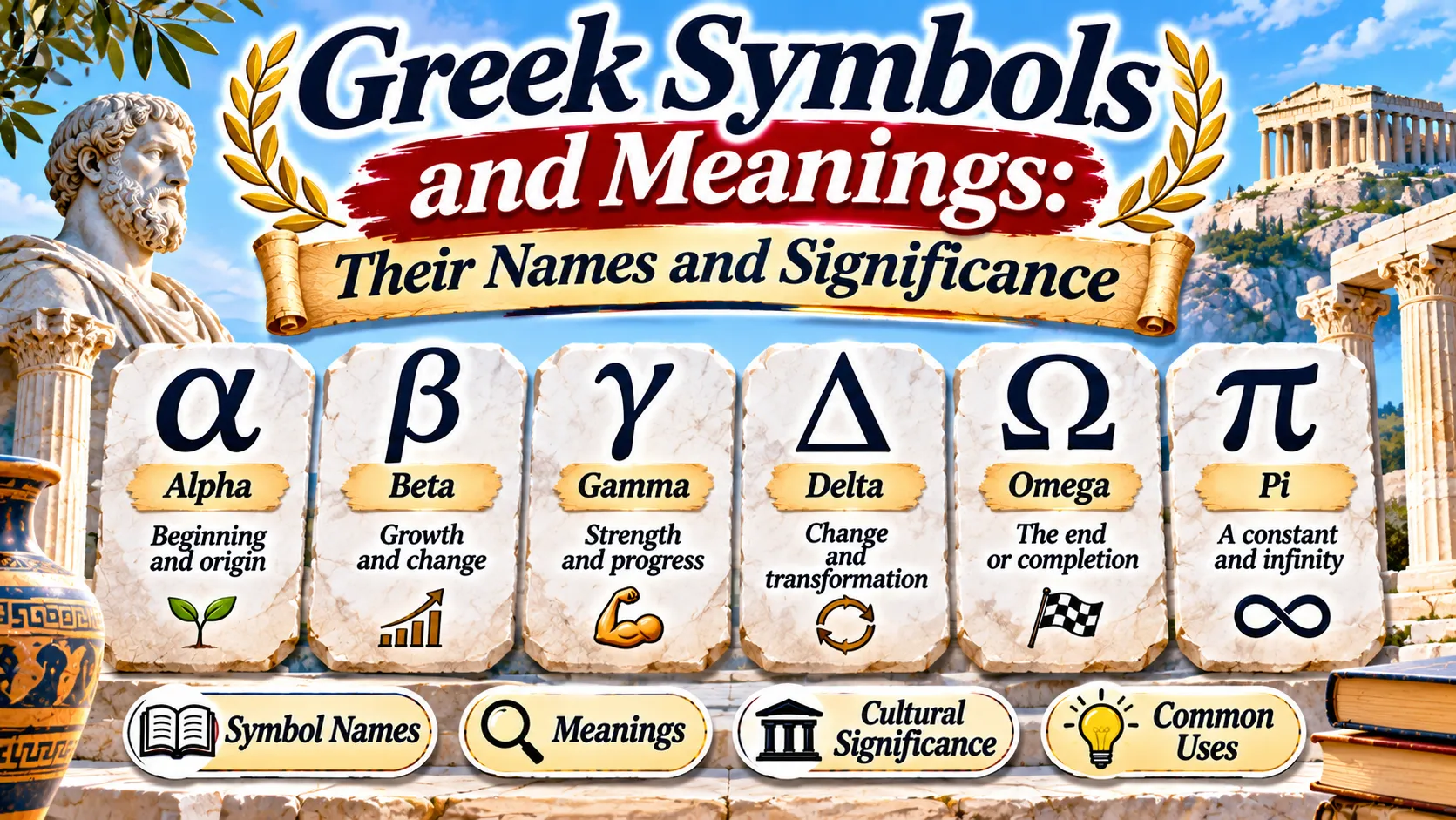
Greek symbols and meanings reveal the fascinating history of ancient Greece, its mythology, philosophy, religion, mathematics, and cultural traditions. From the first letter Alpha (Α) to the final letter Omega (Ω), Greek symbols have influenced the way people communicate ideas, represent scientific concepts, and understand ancient beliefs. Many familiar signs, including the Greek key, laurel wreath, owl of Athena, and Rod of Asclepius, carry historical and cultural significance that continues to inspire people today.
Some Greek symbols represent wisdom, strength, love, victory, and protection, while others have specific meanings in mathematics, science, and medicine. Ancient Greeks also used symbolic objects, animals, plants, and geometric patterns to express religious beliefs and tell mythological stories. Understanding these symbols helps you explore the connections between ancient traditions and modern life.
In this guide, you will discover more than 100 Greek symbols and their meanings, including ancient Greek symbols, mythology symbols, alphabet letters, symbols of love, symbols of strength, and scientific Greek characters. Each section explains what the symbols represent and where their significance comes from.
🏛️ What Are Greek Symbols and What Do They Represent?
Greek symbols are letters, signs, objects, patterns, and images associated with Greek history and culture. They developed through different periods of ancient Greek civilization and became important in writing, mythology, architecture, religion, philosophy, and scientific communication.
Some Greek symbols originated from stories about gods and goddesses. Others came from religious practices, traditional artwork, and everyday objects. The Greek alphabet also became an essential part of mathematics and science because scholars adopted its letters to represent measurements, constants, and variables.
Greek symbols generally represent several important ideas:
- Wisdom and knowledge: The owl associated with Athena represents intelligence and thoughtful judgment.
- Victory and achievement: The laurel wreath represents honor, success, and recognition.
- Love and beauty: The rose, dove, and seashell are associated with Aphrodite and romantic symbolism.
- Strength and courage: The lion, shield, and lightning bolt represent power and bravery.
- Healing and protection: The Rod of Asclepius represents medicine and healing.
- Beginning and completion: Alpha and Omega symbolize the first and final positions.
- Change and transformation: Delta represents change in mathematical and scientific contexts.
These meanings are not always universal. A symbol can have different interpretations depending on its historical period, cultural setting, and modern use.
🔱 Popular Greek Symbols and Their Meanings
Greek symbols appear in ancient artwork, historical buildings, mythology, scientific writing, and modern designs. Some are recognized worldwide because they represent familiar concepts such as wisdom, victory, love, and power.
Here are some popular Greek symbols and their commonly associated meanings.
| Greek Symbol | Name | Common Meaning |
|---|---|---|
| Α | Alpha | Beginning and leadership |
| Β | Beta | Second position |
| Δ | Delta | Change and difference |
| Θ | Theta | Angles and mathematical relationships |
| Λ | Lambda | Wavelength and scientific measurement |
| Π | Pi | Mathematical constant |
| Σ | Sigma | Summation and total |
| Φ | Phi | Proportion and mathematical relationships |
| Ψ | Psi | Psychology and the mind |
| Ω | Omega | Completion and finality |
| 🦉 | Owl of Athena | Wisdom and knowledge |
| 🌿 | Laurel Wreath | Victory and honor |
| 🔱 | Trident | Power of the sea |
| ⚕ | Rod of Asclepius | Medicine and healing |
| ☤ | Caduceus | Trade and communication |
| 🛡️ | Greek Shield | Protection and defense |
| 🕊️ | Dove | Peace and affection |
| 🌹 | Rose | Love and beauty |
| 🦚 | Peacock | Majesty and beauty |
| 🦅 | Eagle | Power and authority |
The Greek alphabet letters have established linguistic and technical uses, while the meanings of mythological and cultural symbols often depend on historical context.
🔤 Greek Alphabet Symbols and Their Meanings
The Greek alphabet contains 24 letters and remains one of the most influential writing systems in history. It developed from the Phoenician alphabet around the eighth century BCE and introduced a systematic set of vowel letters.
Today, Greek letters appear in mathematics, physics, engineering, astronomy, statistics, and academic organizations. Each letter has an uppercase and lowercase form, although some letters have additional forms depending on their position in a word.
1. Alpha (Α, α) – Beginning and Leadership
Alpha is the first letter of the Greek alphabet. It commonly represents beginnings, leadership, excellence, and the first position in a sequence.
The word alpha also appears in modern expressions such as alpha version, alpha testing, and alpha personality. In mathematics and science, the letter represents different variables and measurements depending on the subject.
2. Beta (Β, β) – Second Position and Development
Beta is the second letter of the Greek alphabet. Its position makes it a common representation of something that follows an initial stage.
In software development, a beta version is a product released for testing before its final version. Scientists also use beta in statistics, physics, and mathematics.
3. Gamma (Γ, γ) – Energy and Scientific Measurement
Gamma is the third letter of the Greek alphabet. It appears in physics, mathematics, and engineering.
Gamma rays are high-energy electromagnetic radiation, making the letter especially familiar in scientific discussions. Uppercase Gamma and lowercase gamma can represent different mathematical quantities.
4. Delta (Δ, δ) – Change and Difference
Delta is the fourth letter of the Greek alphabet. In mathematics and science, uppercase Delta commonly represents a change or difference in a measured quantity.
For example, ΔT can represent a change in temperature, while Δx can represent a change in position.
5. Epsilon (Ε, ε) – Small Quantity and Precision
Epsilon is the fifth letter of the Greek alphabet. Mathematicians often use lowercase epsilon to represent a small positive quantity.
It plays an important role in calculus, mathematical analysis, and the study of limits. In some scientific contexts, epsilon also represents other physical or mathematical properties.
6. Zeta (Ζ, ζ) – Mathematical Relationships
Zeta is the sixth letter of the Greek alphabet. It is widely recognized through the Riemann zeta function, an important concept in number theory.
The letter also appears in mathematics, physics, and scientific formulas.
7. Eta (Η, η) – Efficiency
Eta is the seventh Greek letter. In engineering and physics, lowercase eta often represents efficiency or a coefficient.
For example, engineers may use eta to describe how effectively a machine converts energy from one form into another.
8. Theta (Θ, θ) – Angles and Geometry
Theta is the eighth letter of the Greek alphabet. It commonly represents an angle in geometry and trigonometry.
It also appears in physics, statistics, and mathematical equations. Its meaning depends on the subject and the formula.
9. Iota (Ι, ι) – A Very Small Amount
Iota is the ninth Greek letter. The word iota has also entered English as a term meaning a very small amount.
In the expression “not one iota,” it emphasizes that something has not changed even slightly.
10. Kappa (Κ, κ) – Coefficients and Curvature
Kappa is the tenth Greek letter. Scientists and mathematicians use it for different coefficients, parameters, and measurements.
In certain mathematical contexts, it represents curvature or a related quantity.
11. Lambda (Λ, λ) – Wavelength
Lambda is the eleventh Greek letter. Lowercase lambda is widely used in physics to represent wavelength.
It also appears in computer science, mathematics, statistics, and engineering.
12. Mu (Μ, μ) – Micro and Mean
Mu is the twelfth Greek letter. Lowercase mu represents the prefix micro in the International System of Units, meaning one-millionth.
In statistics, μ commonly represents a population mean. It can also represent other quantities in scientific formulas.
13. Nu (Ν, ν) – Frequency
Nu is the thirteenth Greek letter. In physics, lowercase nu commonly represents frequency.
It also appears in mathematics and scientific notation.
14. Xi (Ξ, ξ) – Variables and Advanced Mathematics
Xi is the fourteenth Greek letter. It appears in probability, statistics, physics, and other advanced mathematical subjects.
Its specific meaning depends on the formula in which it appears.
15. Omicron (Ο, ο) – Small O
Omicron is the fifteenth letter of the Greek alphabet. Its name means “small O,” distinguishing it from Omega, which means “large O.”
The letter is also used in modern scientific and public naming systems.
16. Pi (Π, π) – Circles and Mathematics
Pi is the sixteenth letter of the Greek alphabet. The lowercase symbol π represents a mathematical constant approximately equal to 3.14159.
It describes the relationship between a circle’s circumference and diameter and appears in geometry, engineering, and physics.
17. Rho (Ρ, ρ) – Density
Rho is the seventeenth Greek letter. In physics, lowercase rho commonly represents density.
It can also represent electrical resistivity, probability-related quantities, and other variables depending on the scientific field.
18. Sigma (Σ, σ, ς) – Summation and Standard Deviation
Sigma is the eighteenth Greek letter. Uppercase Sigma (Σ) represents summation in mathematics.
Lowercase sigma (σ) often represents standard deviation in statistics. The letter also has a special final form, ς, when it appears at the end of a Greek word.
19. Tau (Τ, τ) – Time and Mathematical Constants
Tau is the nineteenth letter of the Greek alphabet. In physics, lowercase tau may represent a time constant, torque, or another quantity.
Some mathematicians also use tau (τ) for the circle constant equal to 2π.
20. Upsilon (Υ, υ) – Greek Language and Science
Upsilon is the twentieth Greek letter. It appears in Greek vocabulary, scientific writing, and mathematical notation.
Its pronunciation and transliteration have changed throughout the history of the Greek language.
21. Phi (Φ, φ) – Proportion and the Golden Ratio
Phi is the twenty-first letter of the Greek alphabet. It is widely associated with the golden ratio, approximately 1.618, although the letter has other technical uses.
Mathematicians, architects, and designers may use phi when discussing proportions, angles, and geometric relationships.
22. Chi (Χ, χ) – Statistics and Mathematics
Chi is the twenty-second Greek letter. It appears in statistics, especially in the chi-square test.
The symbol χ² represents the chi-square statistic, which helps researchers evaluate relationships between observed and expected data.
23. Psi (Ψ, ψ) – Mind and Psychology
Psi is the twenty-third Greek letter. It is commonly associated with psychology because the word psyche has Greek origins connected with the mind or soul.
The symbol also appears in quantum physics and advanced mathematics.
24. Omega (Ω, ω) – Completion and Finality
Omega is the final letter of the Greek alphabet. It commonly represents endings, completion, and the final stage of a process.
In physics, uppercase Omega (Ω) represents electrical resistance measured in ohms. Lowercase omega (ω) often represents angular velocity or frequency-related quantities.
Complete Greek Alphabet Reference Table
| Letter | Uppercase | Lowercase |
|---|---|---|
| Alpha | Α | α |
| Beta | Β | β |
| Gamma | Γ | γ |
| Delta | Δ | δ |
| Epsilon | Ε | ε |
| Zeta | Ζ | ζ |
| Eta | Η | η |
| Theta | Θ | θ |
| Iota | Ι | ι |
| Kappa | Κ | κ |
| Lambda | Λ | λ |
| Mu | Μ | μ |
| Nu | Ν | ν |
| Xi | Ξ | ξ |
| Omicron | Ο | ο |
| Pi | Π | π |
| Rho | Ρ | ρ |
| Sigma | Σ | σ / ς |
| Tau | Τ | τ |
| Upsilon | Υ | υ |
| Phi | Φ | φ |
| Chi | Χ | χ |
| Psi | Ψ | ψ |
| Omega | Ω | ω |
🦉 Ancient Greek Symbols and Their Meanings
Ancient Greek symbols often represented religious beliefs, mythological stories, social values, and important cultural traditions. People used symbolic objects and designs in pottery, temples, coins, jewelry, clothing, and public ceremonies.
Many of these symbols remain popular because they communicate recognizable ideas such as wisdom, victory, protection, and eternity.
1. Owl of Athena – Wisdom and Knowledge
The owl was closely associated with Athena, the Greek goddess of wisdom, strategic warfare, and crafts. It became a symbol of intelligence, knowledge, and thoughtful judgment.
Ancient Athenian coins frequently displayed an owl, making it one of the most recognizable images from classical Greek history. Today, the owl continues to represent learning and academic achievement.
2. Laurel Wreath – Victory and Honor
The laurel wreath represented victory, achievement, and public recognition in ancient Greece. People awarded laurel crowns to winners of certain athletic and cultural competitions.
The wreath was also connected with Apollo, the god associated with music, prophecy, and poetry. Modern interpretations commonly associate it with success, excellence, and accomplishment.
3. Greek Key – Eternity and Continuity
The Greek key, also known as the meander pattern, is a decorative design made from continuous, repeated lines. It appeared on ancient pottery, architecture, mosaics, and other decorative objects.
Modern interpretations often connect the pattern with eternity, unity, and continuity. However, it is important to understand that the design had different uses and interpretations throughout Greek history.
4. Trident of Poseidon – Power and Authority
The trident was the weapon of Poseidon, the Greek god of the sea, earthquakes, and horses. Its three pointed ends made it one of the most recognizable objects associated with the ancient sea god.
The trident represents divine authority, ocean power, and control over the natural world in Greek mythology.
5. Rod of Asclepius – Medicine and Healing
The Rod of Asclepius features a single serpent wrapped around a staff. It is associated with Asclepius, the Greek god of medicine and healing.
The symbol remains an important medical emblem. Its single serpent distinguishes it from the Caduceus, which has two snakes and is associated with Hermes.
6. Caduceus – Trade and Communication
The Caduceus is a staff decorated with two intertwined serpents and wings. It belongs to Hermes, the messenger of the Greek gods.
Hermes was associated with communication, commerce, travel, and negotiation. Although the Caduceus appears in some modern healthcare branding, the Rod of Asclepius has the stronger historical connection to medicine.
7. Amphora – Ancient Greek Culture
An amphora was a traditional Greek vessel with two handles, a narrow neck, and a large body. Ancient Greeks used these containers to store and transport wine, olive oil, and other goods.
Many amphorae featured artwork showing mythological characters, athletic competitions, and everyday activities. These objects provide valuable information about ancient Greek life.
8. Greek Theater Masks – Drama and Performance
Theater played an important role in ancient Greek society. Masks helped actors portray different characters and emotions during performances.
Modern theater masks often represent comedy and tragedy, reflecting the lasting influence of Greek drama on performing arts.
9. Olive Branch – Peace and Prosperity
The olive branch has a long history in ancient Greek culture. It commonly represents peace, prosperity, reconciliation, and abundance.
Olive trees were also important to Greek agriculture and trade. Their branches appeared in religious and cultural settings.
10. Greek Shield – Protection and Courage
Greek warriors used shields to protect themselves during battles. The round hoplite shield, known as the aspis, became an important part of ancient Greek military equipment.
Today, shields commonly symbolize protection, bravery, defense, and unity.
⚡ Greek Mythology Symbols and Their Meanings
Greek mythology is filled with objects, animals, plants, and weapons connected with gods and legendary heroes. These symbols helped communicate the powers, responsibilities, and personalities of different mythological figures.
The following table introduces some of the most recognizable Greek mythology symbols.
| Symbol | Associated Figure | Meaning |
|---|---|---|
| Lightning Bolt | Zeus | Power and divine authority |
| Owl | Athena | Wisdom and intelligence |
| Trident | Poseidon | Sea power |
| Lyre | Apollo | Music and harmony |
| Bow and Arrow | Artemis | Hunting and independence |
| Caduceus | Hermes | Communication and trade |
| Peacock | Hera | Majesty and beauty |
| Torch | Hecate | Guidance and crossroads |
| Grapevine | Dionysus | Celebration and fertility |
| Club | Heracles | Strength and heroism |
| Spear | Athena and Ares | Warfare and defense |
| Dove | Aphrodite | Love and affection |
| Golden Fleece | Jason and the Argonauts | Adventure and achievement |
| Aegis | Zeus and Athena | Divine protection |
| Eagle | Zeus | Authority and power |
1. Zeus’s Lightning Bolt – Power and Authority
Zeus was the king of the Greek gods and the ruler of Mount Olympus. His lightning bolt represented divine authority, strength, and control over the sky.
In Greek mythology, Zeus used his thunderbolts as weapons and as expressions of his power. Today, the lightning bolt remains a familiar symbol of energy and strength.
2. Apollo’s Lyre – Music and Harmony
The lyre was a stringed musical instrument associated with Apollo. It represented music, poetry, artistic expression, and harmony.
Apollo’s connection with the lyre made it an important symbol in ancient Greek art and cultural traditions.
3. Artemis’s Bow and Arrow – Independence and Hunting
Artemis was the goddess of hunting, wilderness, and childbirth. Her bow and arrows represented hunting skills, independence, and protection.
The bow also reflects her connection with nature and her role as a skilled huntress.
4. Hera’s Peacock – Beauty and Majesty
The peacock was associated with Hera, the queen of the Greek gods. It commonly represents beauty, royalty, dignity, and majesty.
The bird’s colorful feathers made it a suitable symbol for a goddess connected with marriage and royal authority.
5. Dionysus’s Grapevine – Celebration and Fertility
Dionysus was the god of wine, theater, celebration, and ecstatic rituals. Grapevines, wine cups, and ivy were associated with his worship.
These symbols represented celebration, abundance, fertility, and the enjoyment of life.
6. Hermes’s Winged Sandals – Speed and Travel
Hermes was known as the messenger of the gods. His winged sandals represented speed, movement, communication, and travel.
The image remains popular in modern illustrations of Greek mythology.
7. Heracles’ Club – Strength and Heroism
Heracles, known in Roman mythology as Hercules, was famous for extraordinary physical strength and heroic adventures. His wooden club became a recognizable symbol of courage, determination, and power.
It represents the challenges he faced during his legendary Twelve Labors.
8. Athena’s Spear – Strategy and Defense
Athena was associated with wisdom and strategic warfare. Her spear represented disciplined strength, protection, and intelligent decision-making.
Unlike the uncontrolled violence sometimes associated with Ares, Athena’s military symbolism emphasizes planning and strategy.
❤️ Greek Symbols of Love and Beauty
Greek mythology includes many symbols associated with love, romance, attraction, and beauty. Several of these symbols connect with Aphrodite, the goddess of love and beauty, while others are linked with Eros, the god of love and desire.
| Symbol | Common Meaning | Mythological Connection |
|---|---|---|
| Dove | Love and peace | Aphrodite |
| Rose | Beauty and romance | Aphrodite |
| Seashell | Birth and beauty | Aphrodite |
| Myrtle | Love and marriage | Aphrodite |
| Apple | Desire and beauty | Greek mythology |
| Eros’s Bow | Attraction and desire | Eros |
| Golden Apple | Beauty and rivalry | Judgment of Paris |
| Swan | Beauty and grace | Greek mythology |
| Pomegranate | Fertility and abundance | Greek mythology |
| Wedding Torch | Marriage and ceremony | Greek traditions |
1. Dove – Love and Peace
The dove is commonly associated with Aphrodite and represents affection, peace, and romantic devotion. Its gentle appearance makes it a popular symbol in modern wedding decorations and romantic artwork.
2. Rose – Beauty and Romance
The rose is widely connected with Aphrodite and represents beauty, love, and passion. Its association with romance continues in modern literature, art, and decorative traditions.
3. Seashell – Birth and Beauty
Aphrodite is famously connected with the sea and is often depicted emerging from a seashell. This imagery became one of the most recognizable representations of the goddess in classical art.
The seashell commonly represents beauty, femininity, and the mysteries of the ocean in modern interpretations.
4. Myrtle – Love and Marriage
Myrtle was a plant associate with Aphrodite. Ancient traditions connected it with love, marriage, and beauty.
Its historical associations make it a meaningful plant symbol in discussions of Greek mythology.
5. Eros’s Bow – Attraction and Desire
Eros was the Greek god of love and attraction. His bow and arrows represented the power of desire and romantic feelings.
In mythology, his arrows could cause people to fall in love, making the bow a recognizable symbol of attraction.
🛡️ Greek Symbols of Strength, Courage, and Protection
Ancient Greek culture celebrated courage, military achievement, physical strength, and protection. Mythological heroes and gods often carried objects that represented these qualities.
| Symbol | Meaning | Greek Connection |
|---|---|---|
| Lion | Strength and bravery | Greek mythology |
| Shield | Defense and protection | Greek warriors |
| Helmet | Courage and warfare | Greek soldiers |
| Spear | Strength and combat | Athena and warriors |
| Eagle | Power and authority | Zeus |
| Lightning Bolt | Divine strength | Zeus |
| Club | Physical power | Heracles |
| Aegis | Divine protection | Zeus and Athena |
| Gorgon Head | Protection and intimidation | Medusa |
| Trident | Authority and sea power | Poseidon |
1. Lion – Strength and Bravery
The lion commonly represents courage, power, and leadership. In Greek mythology, the Nemean Lion was a powerful creature defeated by Heracles as the first of his Twelve Labors.
Its story made the lion a lasting image of bravery and heroic strength.
2. Gorgon Head – Protection and Fear
The Gorgon head, especially the image of Medusa, appeared on ancient Greek shields, armor, and buildings. This frightening image was used as a protective design intended to ward off danger.
It is commonly associated with protection, intimidation, and the power to repel evil.
3. Aegis – Divine Protection
The Aegis was a protective object associated with Zeus and Athena. Ancient descriptions and artistic depictions vary, but it is often shown as a shield or protective garment decorated with the Gorgon head.
It represents divine protection and authority.
4. Greek Helmet – Courage and Defense
Ancient Greek helmets protected soldiers during battles. The Corinthian helmet became one of the most recognizable examples of Greek military equipment.
Today, Greek helmets often represent courage, discipline, military history, and warrior identity.
🌿 Greek Symbols Inspired by Nature
Nature influenced ancient Greek mythology, religious practices, and everyday traditions. Animals, plants, trees, and natural elements often represented gods, sacred qualities, and human experiences.
| Nature Symbol | Common Meaning | Greek Association |
|---|---|---|
| Olive Branch | Peace and prosperity | Athena |
| Laurel Leaf | Victory and honor | Apollo |
| Owl | Wisdom | Athena |
| Peacock | Beauty and majesty | Hera |
| Dolphin | Sea and protection | Poseidon |
| Eagle | Power and authority | Zeus |
| Rose | Love and beauty | Aphrodite |
| Grapevine | Celebration and fertility | Dionysus |
| Oak Tree | Strength and endurance | Zeus |
| Snake | Healing and renewal | Asclepius |
| Myrtle | Love and marriage | Aphrodite |
| Cypress Tree | Mourning and remembrance | Greek traditions |
| Wheat | Agriculture and harvest | Demeter |
| Pomegranate | Fertility and abundance | Persephone |
Olive Tree – Peace and Prosperity
The olive tree was economically and culturally important in ancient Greece. Its fruit and oil supported everyday life, agriculture, trade, and religious traditions.
The olive branch became a familiar representation of peace, prosperity, and reconciliation.
Oak Tree – Strength and Endurance
The oak tree was sacred to Zeus and was associated with strength and divine power. The sanctuary of Dodona, an important ancient Greek religious site, was famous for its sacred oak.
Today, the oak commonly represents endurance, stability, and resilience.
Snake – Healing and Renewal
The snake was associated with Asclepius, the Greek god of medicine and healing. Its presence in the Rod of Asclepius connects it with medical traditions.
Modern interpretations may also associate snakes with renewal because they shed their skin.
🔺 Greek Geometric Symbols and Their Meanings
Ancient Greek artists and architects used geometric designs in pottery, buildings, mosaics, and decorative objects. These patterns helped create balance, repetition, and visual harmony.
Some geometric shapes have modern symbolic interpretations, although these meanings should not automatically be treated as fixed ancient Greek beliefs.
| Shape or Pattern | Common Interpretation |
|---|---|
| Circle | Unity and completeness |
| Triangle | Balance and structure |
| Spiral | Movement and growth |
| Greek Key | Continuity and repetition |
| Meander Pattern | Repeated movement |
| Labyrinth | Complexity and journey |
| Star Pattern | Order and celestial imagery |
| Wave Pattern | Sea and movement |
| Rosette | Decoration and symmetry |
| Interlocking Circles | Connection and unity |
Greek Spiral – Growth and Movement
Spiral patterns appeared in ancient Greek decorative artwork. Today, people often interpret them as symbols of growth, movement, development, and the cycles of life.
Labyrinth – Journey and Complexity
The labyrinth is connected with the Greek myth of the Minotaur and the story of Theseus. It represents a complicated path, a difficult challenge, or a journey toward a goal in modern interpretations.
Greek Key Pattern – Continuity and Repetition
The Greek key is a repeated geometric design that appears in ancient and modern decorative art. Its continuous lines make it a popular choice for borders, jewelry, architecture, and interior decoration.
✝️ Greek Religious Symbols and Their Meanings
Greek religious symbols reflect different periods of Greek history. Ancient Greek religion included worship of many gods and goddesses, while modern Greek religious culture is strongly connected with Eastern Orthodox Christianity.
These traditions have different beliefs and symbols, although some ancient Greek letters also became important in Christian writing.
| Symbol | Meaning | Religious Connection |
|---|---|---|
| Cross | Faith and salvation | Greek Orthodox Christianity |
| Ichthys | Christian faith | Early Christianity |
| Alpha and Omega | Beginning and end | Christian scripture |
| Chi-Rho | Christ | Early Christianity |
| IC XC | Jesus Christ | Orthodox Christianity |
| Laurel Wreath | Honor and sacred achievement | Ancient Greek traditions |
| Owl | Wisdom | Athena |
| Trident | Divine sea power | Poseidon |
Alpha and Omega – Beginning and End
Alpha and Omega are the first and final letters of the Greek alphabet. In Christian scripture, they symbolize God’s eternal nature and are associated with the beginning and the end.
The expression emphasizes the idea of completeness and eternity.
Chi-Rho – Christ
Chi-Rho combines the Greek letters Chi (Χ) and Rho (Ρ), the first two letters of the Greek word Christos.
Early Christians used this symbol to represent Jesus Christ. It became an important sign of Christian identity in historical artwork and religious objects.
Greek Orthodox Cross – Faith and Salvation
The cross is the central symbol of Christianity, including the Greek Orthodox tradition. It represents the crucifixion and resurrection of Jesus Christ, along with faith, sacrifice, and salvation.
Orthodox Christian crosses may feature additional decorative details or inscriptions.
🏺 Greek Cultural Symbols and Their Meanings
Greek cultural symbols represent the country’s historical heritage, artistic traditions, architecture, and national identity. Some originated in ancient times, while others became recognizable through modern Greek culture.
| Symbol | Common Meaning or Association |
|---|---|
| Greek Key Pattern | Traditional decoration and continuity |
| Laurel Wreath | Victory and honor |
| Olive Branch | Peace and prosperity |
| Amphora | Ancient Greek daily life |
| Doric Column | Classical architecture |
| Ionic Column | Classical architecture and design |
| Corinthian Column | Decorative craftsmanship |
| Theater Mask | Drama and performance |
| Olive Tree | Agriculture and heritage |
| Blue and White Colors | Greek national identity |
| Ancient Greek Coin | Trade and historical heritage |
| Greek Pottery | Art and everyday life |
Doric Columns – Strength and Simplicity
Doric columns are among the oldest and simplest classical Greek architectural styles. They feature sturdy proportions and relatively plain capitals.
They are commonly associated with strength, balance, and classical architecture.
Ionic Columns – Elegance and Proportion
Ionic columns are recognizable by their scroll-shaped capitals, called volutes. They represent one of the major architectural styles developed in ancient Greece.
Their elegant appearance makes them popular in classical buildings and modern architectural references.
Corinthian Columns – Beauty and Decoration
Corinthian columns feature elaborate capitals decorated with acanthus leaves. They are among the most ornate styles in classical Greek architecture.
Modern interpretations often associate them with elegance, craftsmanship, and artistic detail.
🌀 Greek Symbols Used in Mathematics and Science
Greek letters have an important place in modern mathematics and scientific research. Researchers use them to represent variables, constants, angles, measurements, and physical properties.
A single letter may have several meanings depending on its subject. The following table covers common examples.
| Symbol | Name | Common Scientific Use |
|---|---|---|
| π | Pi | Circle constant |
| Δ | Delta | Change or difference |
| Σ | Sigma | Summation |
| α | Alpha | Angle or coefficient |
| β | Beta | Parameter or coefficient |
| θ | Theta | Angle |
| λ | Lambda | Wavelength |
| μ | Mu | Mean or micro-prefix |
| ρ | Rho | Density |
| Ω | Omega | Electrical resistance |
| φ | Phi | Angle or mathematical function |
| χ² | Chi-square | Statistical test |
| σ | Sigma | Standard deviation |
| ω | Omega | Angular velocity |
| ν | Nu | Frequency |
| ε | Epsilon | Small quantity or permittivity |
Why Do Scientists Use Greek Letters?
Scientists use Greek letters because they provide a standardized way to represent different values in equations. They also help distinguish variables when ordinary Latin letters are already in use.
For example, physicists use lambda for wavelength, while mathematicians use pi for the circle constant. Statisticians commonly use sigma for standard deviation and mu for a population mean.
This system makes scientific communication more concise and easier to recognize across different fields.
💎 Greek Symbols Commonly Used in Jewelry and Tattoos
Greek symbols have become popular in jewelry, tattoos, pendants, bracelets, and decorative accessories. People often choose them because they connect a simple design with a historical idea or personal meaning.
However, a symbol’s modern interpretation may differ from its original historical purpose.
| Symbol | Common Modern Interpretation |
|---|---|
| Alpha (Α) | Leadership and confidence |
| Omega (Ω) | Completion and eternity |
| Greek Key | Continuity and connection |
| Laurel Wreath | Success and achievement |
| Owl | Wisdom and intelligence |
| Trident | Strength and authority |
| Phi (Φ) | Proportion and harmony |
| Delta (Δ) | Change and transformation |
| Rose | Love and beauty |
| Chi-Rho (☧) | Christian faith |
| Rod of Asclepius | Healing and medicine |
| Olive Branch | Peace and reconciliation |
Alpha and Omega Tattoos
Alpha and Omega tattoos often represent life’s beginning and end, personal transformation, and the idea of completeness. In Christian contexts, they may also express faith in God’s eternal nature.
Greek Key Jewelry
The Greek key pattern is popular in rings, bracelets, necklaces, and other accessories. Its repeated design gives jewelry a traditional appearance and is often interpreted as a symbol of continuity.
Laurel Wreath Tattoos
Laurel wreath tattoos commonly represent personal achievements, victory, determination, and honor. Some people choose them to celebrate an important milestone or personal accomplishment.
📚 Greek Symbols and Their Meanings: Quick Reference List
If you want to find a specific symbol quickly, this reference list summarizes popular Greek symbols and their common associations.
| Greek Symbol | Meaning |
|---|---|
| Alpha | Beginning and leadership |
| Beta | Second position |
| Gamma | Scientific measurement |
| Delta | Change and difference |
| Epsilon | Small quantity |
| Zeta | Mathematical function |
| Eta | Efficiency |
| Theta | Angle and geometry |
| Iota | Tiny amount |
| Kappa | Coefficient |
| Lambda | Wavelength |
| Mu | Micro and population mean |
| Nu | Frequency |
| Xi | Mathematical variable |
| Omicron | Small O |
| Pi | Circle constant |
| Rho | Density |
| Sigma | Summation and standard deviation |
| Tau | Time constant |
| Upsilon | Greek alphabet letter |
| Phi | Golden ratio association |
| Chi | Chi-square statistic |
| Psi | Psychology and mind |
| Omega | Completion and finality |
| Owl | Wisdom |
| Laurel Wreath | Victory |
| Trident | Sea power |
| Olive Branch | Peace |
| Greek Key | Continuity |
| Rod of Asclepius | Healing |
| Caduceus | Trade and communication |
| Lyre | Music |
| Peacock | Majesty |
| Eagle | Authority |
| Lion | Strength |
| Dove | Love and peace |
| Rose | Beauty |
| Amphora | Ancient Greek culture |
| Gorgon Head | Protection |
| Aegis | Divine protection |
| Labyrinth | Journey and complexity |
❓ Frequently Asked Questions About Greek Symbols and Meanings
What is the most famous Greek symbol?
Alpha, Omega, and Pi are among the most recognizable Greek alphabet symbols. Outside the alphabet, the owl of Athena, laurel wreath, and Greek key pattern are also famous symbols connected with ancient Greek culture.
What is the Greek symbol for wisdom?
The owl is one of the best-known symbols of wisdom in Greek mythology. It is associated with Athena, the goddess of wisdom and strategic thinking.
What does Alpha mean in Greek symbolism?
Alpha is the first letter of the Greek alphabet. It commonly represents beginnings, leadership, first place, and the starting point of something.
What does Omega symbolize?
Omega is the last letter of the Greek alphabet. It commonly represents completion, endings, finality, and the ultimate stage of a process.
What is the Greek symbol for love?
The rose, dove, seashell, and myrtle are commonly associated with love and beauty in Greek mythology. Several of these symbols connect with Aphrodite, the goddess of love.
What is the Greek symbol for strength?
The lion, shield, club of Heracles, and lightning bolt are commonly associated with strength and power in Greek mythology.
What is the Greek symbol for healing?
The Rod of Asclepius is the traditional Greek symbol associated with medicine and healing. It features a single serpent wrapped around a staff.
What does the Greek key symbol mean?
The Greek key, also known as the meander pattern, is a repeated decorative design. Modern interpretations often associate it with continuity, eternity, unity, and the endless flow of life.
How many letters are in the Greek alphabet?
The Greek alphabet contains 24 letters. It starts with Alpha and ends with Omega, and each letter has uppercase and lowercase forms.
What is the difference between the Rod of Asclepius and the Caduceus?
The Rod of Asclepius has one snake wrapped around a staff and represents medicine and healing. The Caduceus has two snakes and wings and is associated with Hermes, trade, travel, and communication.
Are Greek symbols still used today?
Yes. Greek symbols appear in mathematics, physics, medicine, psychology, engineering, education, architecture, and religious traditions. Ancient Greek designs also remain popular in jewelry, tattoos, and decorative artwork.
What Greek symbol represents eternity?
The Greek key pattern is commonly interprete as a symbol of eternity and continuity because its repeated lines create an uninterrupted design. Alpha and Omega can also represent completeness and eternity in Christian contexts.
🏛️ Conclusion
Greek symbols and meanings offer a fascinating look into the history, mythology, philosophy, and cultural traditions of ancient Greece. From the Greek alphabet’s 24 letters to the owl of Athena, laurel wreath, trident, and Rod of Asclepius, each symbol provides insight into the ideas and beliefs that shaped Greek civilization.
Some symbols represent wisdom, love, strength, protection, and victory, while others serve practical purposes in mathematics and science. Their continued use in education, architecture, religion, jewelry, and modern design demonstrates the lasting influence of Greek culture.
Whether you are researching ancient Greek history, exploring mythology, studying scientific notation, or looking for meaningful symbols for a creative project, understanding these signs helps you appreciate the stories and traditions behind them.

Olivia Bennett is a writer and language enthusiast at Vocabsteria. She is passionate about exploring word meanings, name origins, and cultural expressions from around the world.