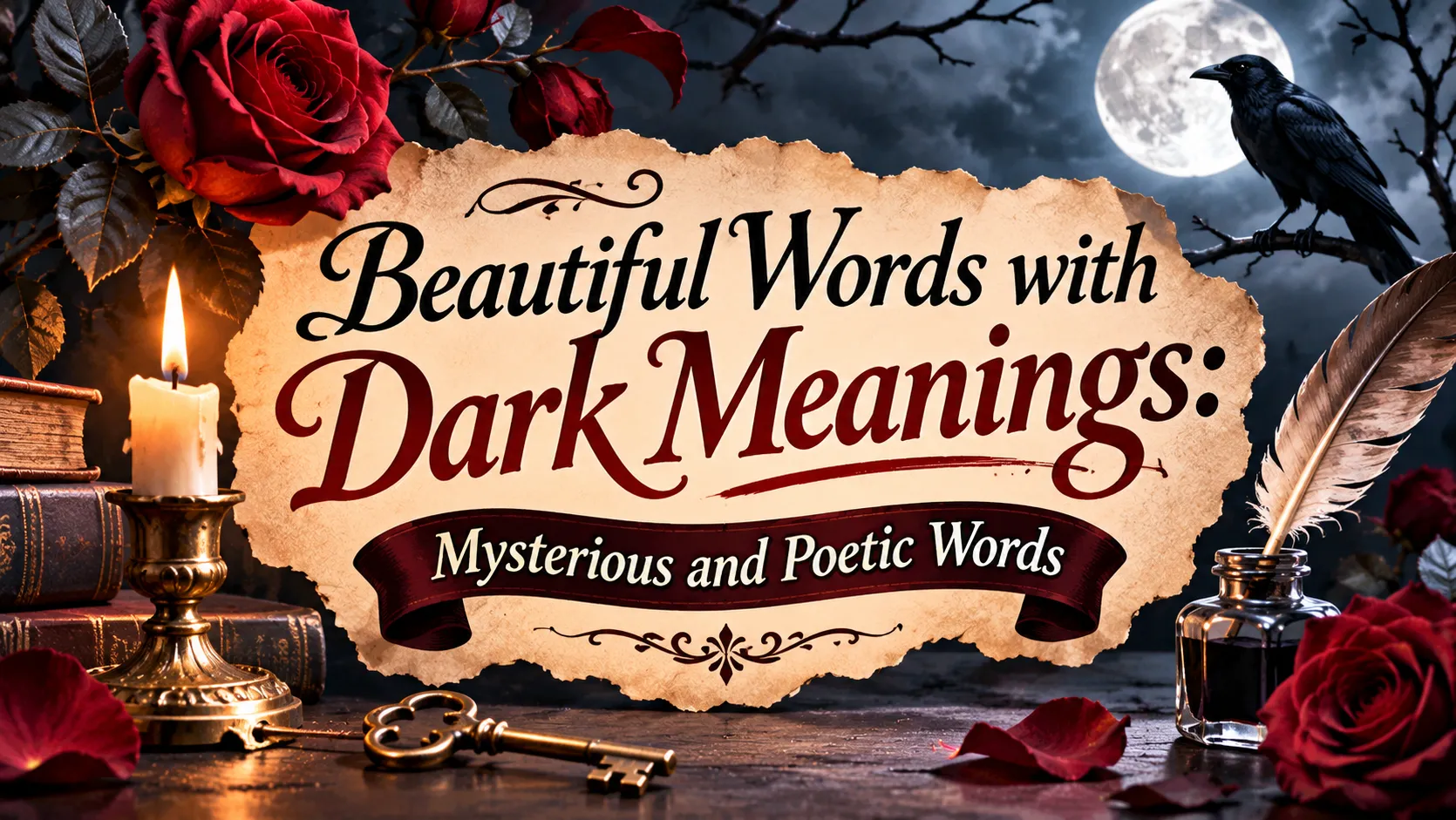
Beautiful words with dark meanings reveal a fascinating side of the English language. Some words sound delicate, romantic, and graceful but describe grief, death, loneliness, obsession, or the temporary nature of life. Others carry mysterious associations with shadows, forgotten memories, supernatural experiences, and hidden fears. Their unusual combination of beauty and darkness makes them especially interesting for writers, poets, and language lovers.
Think about a word like Evanescence. It sounds elegant, almost musical, yet describes the quality of gradually disappearing. Similarly, Melancholy has a soft, poetic sound but represents a deep and thoughtful sadness. These expressions show that beautiful language does not always have cheerful meanings.
Whether you are searching for pretty words with dark meanings, rare vocabulary for gothic writing, or short expressions that capture complicated emotions, this collection offers plenty of inspiration. You will discover mysterious words, haunting descriptions, literary expressions, and unusual vocabulary, along with clear definitions and example sentences. Some words describe genuine darkness, while others explore the bittersweet beauty of loss, longing, and impermanence.
🌑 What Makes a Word Beautiful but Dark?
A beautiful word with a dark meaning combines an attractive sound, interesting history, or poetic quality with an unsettling or emotionally heavy definition. The darkness may relate to death, grief, fear, abandonment, destruction, or the mysterious parts of human experience. Such words often appear in gothic literature, poetry, psychological writing, and stories that explore complicated emotions.
Not every dark word describes something evil. Some communicate ordinary experiences, such as missing someone, remembering the past, or accepting that beautiful moments cannot last forever. Their meanings become powerful because they express feelings that simple vocabulary cannot always capture.
Three qualities often make these words memorable:
- Sound and pronunciation: Words such as Ethereal and Limerence have graceful sounds that make them appealing.
- Emotional depth: Expressions such as Melancholy and Desolation communicate complicated feelings.
- Imagery and symbolism: Words such as Stygian and Oblivion create powerful pictures of darkness, mystery, and disappearance.
The contrast between appearance and meaning is what makes this vocabulary so interesting. A word can sound peaceful while describing something painful.
🖤 Beautiful Words with Dark Meanings and Definitions
Some beautiful words with dark meanings describe sadness, mortality, emotional suffering, and the disappearance of things we once valued. These expressions are especially useful when you want to communicate a mysterious or poetic atmosphere without relying on ordinary words such as sad, lonely, or frightening.
Here are carefully selected examples with their meanings.
| Word | Meaning |
|---|---|
| Melancholy | A deep, thoughtful sadness |
| Evanescence | The quality of gradually disappearing |
| Desolation | Complete emptiness, loneliness, or devastation |
| Solitude | The condition of being alone |
| Oblivion | The state of being forgotten or unaware |
| Elegy | A poem expressing sorrow, often for someone who has died |
| Ethereal | Delicate or seemingly belonging to another world |
| Lament | An expression of grief or regret |
| Tenebrous | Dark, shadowy, or obscure |
| Sepulchral | Relating to a tomb or having a gloomy atmosphere |
| Wistful | Full of gentle sadness or longing |
| Forsaken | Abandoned or deserted |
| Eulogy | A speech honoring someone who has died |
| Despondency | A state of hopelessness or discouragement |
| Morose | Gloomy, unhappy, or withdrawn |
| Lachrymose | Tearful or inclined to cry |
| Forlorn | Lonely, abandoned, or hopeless |
| Dolorous | Expressing or causing sorrow |
| Ineffable | Too powerful or profound to express in words |
| Ephemeral | Lasting for a very short time |
For example, you could describe a forgotten childhood home as a place filled with melancholy and desolation. The words communicate more than physical emptiness; they suggest memories, loss, and emotional distance.
🥀 Dark Words That Describe Sadness, Grief, and Heartbreak
Not all dark words are frightening. Some are beautiful because they give a name to difficult human emotions. Vocabulary related to heartbreak, grief, and loneliness can help you express feelings with greater precision, especially in poetry, personal writing, and emotional storytelling.
These words explore different shades of sadness.
| Word | Meaning |
|---|---|
| Anguish | Severe emotional or mental suffering |
| Sorrow | Deep sadness caused by loss or disappointment |
| Despair | A complete loss of hope |
| Heartache | Emotional pain caused by love or loss |
| Grief | Deep sadness following a significant loss |
| Remorse | Painful regret about something you have done |
| Nostalgia | A sentimental longing for the past |
| Alienation | Feeling disconnected from others |
| Estrangement | Emotional distance or separation |
| Yearning | A strong desire for something absent |
| Pining | Longing sadly for someone or something |
| Ruefulness | A feeling of regret or disappointment |
| Despondency | A state of low spirits and hopelessness |
| Torment | Intense physical or emotional suffering |
| Woe | Great sorrow or distress |
| Misery | Extreme unhappiness or suffering |
| Bereavement | The experience of losing someone through death |
| Languor | A state of tiredness, weakness, or low energy |
| Dejection | A feeling of sadness and discouragement |
| Woebegone | Looking deeply unhappy or distressed |
A useful distinction: Grief usually describes sadness following a major loss, while remorse refers specifically to regret about one’s own actions. Alienation describes disconnection from people or society, whereas solitude simply means being alone.
Understanding these differences helps you select the right word instead of using several similar expressions interchangeably.
🌘 Unique Words with Dark Meanings You Rarely Hear
Some of the most interesting dark words are rarely used in everyday conversations. Their unusual origins, specialized meanings, and distinctive sounds make them excellent choices for literary writing, mysterious character descriptions, and advanced vocabulary.
Here are unique words with dark meanings worth adding to your vocabulary.
| Word | Meaning |
|---|---|
| Chthonic | Relating to the underworld or underground spirits |
| Stygian | Extremely dark or gloomy |
| Cimmerian | Extremely dark or shadowy |
| Eldritch | Strange, eerie, or supernatural |
| Lugubrious | Excessively gloomy or mournful |
| Atramentous | Ink-black or very dark |
| Malediction | A curse or expression wishing harm |
| Execration | An expression of intense hatred or condemnation |
| Anathema | Something intensely disliked or rejected |
| Nefarious | Wicked or criminal |
| Pernicious | Causing serious harm, often gradually |
| Baleful | Threatening or suggesting evil |
| Obfuscation | The act of making something unclear |
| Misanthropy | Dislike or distrust of humankind |
| Dolor | Great sorrow or emotional pain |
| Inexorable | Impossible to stop or prevent |
| Atrophy | Gradual weakening or wasting away |
| Abjection | A state of humiliation or degradation |
| Deleterious | Causing damage or harm |
| Moribund | Approaching death or becoming inactive |
A word like Chthonic creates an association with the underworld, while Atramentous describes an ink-black appearance. Both can make descriptions more distinctive when used in the right setting.
🕯️ Pretty Words with Dark Meanings That Sound Almost Romantic
Pretty words with dark meanings are particularly appealing because their pronunciation may feel gentle even when their definitions involve obsession, sorrow, death, or disappearance. They are often useful in romantic poetry, gothic fiction, aesthetic writing, and descriptions of complicated relationships.
Explore these elegant but emotionally complex expressions.
| Word | Meaning |
|---|---|
| Limerence | Intense romantic infatuation that can involve obsessive thoughts |
| Saudade | A deep longing for someone or something absent |
| Hiraeth | A Welsh term for longing for a home or past that may be lost |
| Evanescent | Quickly fading or disappearing |
| Lachrymose | Tearful or inclined to cry |
| Wistfulness | Gentle sadness mixed with longing |
| Elegiac | Expressing sorrow or mourning |
| Bittersweet | Containing both happiness and sadness |
| Pensive | Deeply thoughtful, often with a sad mood |
| Forlorn | Abandoned, lonely, or hopeless |
| Requiem | Music or a service for the dead |
| Serein | Fine rain falling from a clear sky after sunset |
| Vesper | Evening or an evening prayer |
| Nocturne | A musical composition inspired by nighttime |
| Ephemeral | Beautiful but short-lived or temporary |
| Languishing | Gradually losing strength or vitality |
| Rueful | Expressing regret or sorrow |
| Solemn | Serious, quiet, and often associated with mourning |
| Melancholic | Characterized by sadness or melancholy |
| Threnody | A song or poem expressing grief for the dead |
One particularly interesting word is Saudade. It describes a longing that includes affection, sadness, and the awareness that something or someone may never return. That combination makes it difficult to replace with a single ordinary English word.
🦇 Beautiful Gothic Words for Dark Literature and Aesthetics
Gothic vocabulary brings together mystery, ancient settings, supernatural imagery, emotional intensity, and themes of mortality. These beautiful gothic words can help create the atmosphere of a haunted mansion, abandoned church, forgotten cemetery, or mysterious fictional world.
| Word | Meaning |
|---|---|
| Grimoire | A book of magical spells or occult knowledge |
| Sepulchre | A tomb or burial chamber |
| Catacomb | An underground burial place |
| Mausoleum | A large and impressive tomb |
| Spectral | Ghostlike or resembling a spirit |
| Apparition | A supernatural appearance, often thought to be a ghost |
| Wraith | A ghostlike figure or spirit |
| Phantasm | An illusion, apparition, or ghostlike image |
| Charnel | Relating to death or human remains |
| Threnody | A mournful song or poem |
| Dirge | A solemn song for the dead |
| Penumbral | Relating to a partial shadow |
| Umbral | Relating to a shadow |
| Obsidian | Dark volcanic glass |
| Sable | Black or very dark in literary descriptions |
| Nocturnal | Relating to the night |
| Crepuscular | Relating to twilight |
| Umbrageous | Shady or providing deep shade |
| Funereal | Having the solemn atmosphere of a funeral |
| Macabre | Disturbingly associated with death |
For gothic storytelling, words such as sepulchre, spectral, and funereal are especially useful because they create a recognizable mood. However, you do not need to use all of them in one paragraph. A few carefully chosen expressions can make a scene much more effective.
🌑 Short Beautiful Words with Dark Meanings
Short beautiful words with dark meanings are perfect when you want to express a strong emotion using only a few letters. These words work well in minimalist poetry, aesthetic captions, creative usernames, character concepts, and short descriptions.
| Word | Meaning |
|---|---|
| Void | An empty or seemingly limitless space |
| Dusk | The fading light after sunset |
| Woe | Great sadness or distress |
| Ash | The remains left after something burns |
| Bane | A source of distress or destruction |
| Grim | Gloomy, harsh, or frightening |
| Hex | A spell or curse |
| Dirge | A mournful song |
| Doom | A terrible or inevitable fate |
| Mire | Deep mud or a difficult situation |
| Gloom | Darkness or sadness |
| Crypt | An underground burial chamber |
| Rift | A serious break or division |
| Blight | Something that damages or destroys |
| Wraith | A ghostlike figure |
| Sable | A literary term for black |
| Ruin | Destruction or the remains of something destroyed |
| Hush | A sudden or deliberate silence |
| Scar | A mark left by an injury |
| Bled | Past tense of bleed; can evoke loss of blood |
Short words can be powerful because readers understand them quickly. Void, for example, can describe a physical empty space or a feeling of emotional emptiness.
🕸️ Dark Mysterious Words with Deep Meaning
Dark mysterious words with deep meaning often describe things that cannot be easily explained. Some relate to supernatural experiences, hidden knowledge, uncertainty, and the unknown. Others create a feeling of danger or suggest that something is not quite right.
These words are particularly useful for mystery novels, fantasy stories, horror writing, and dark academic aesthetics.
| Word | Meaning |
|---|---|
| Arcane | Mysterious or understood by very few people |
| Occult | Related to hidden or supernatural knowledge |
| Esoteric | Intended for a small group with specialized knowledge |
| Enigma | Something difficult to understand |
| Cryptic | Mysterious or unclear |
| Ominous | Suggesting that something bad may happen |
| Uncanny | Strange in an unsettling way |
| Phantasmal | Resembling a phantom or illusion |
| Preternatural | Beyond what is considered normal or natural |
| Malevolent | Having an intention to cause harm |
| Sinister | Suggesting danger or evil |
| Diabolical | Extremely wicked or associated with the devil |
| Obscure | Hidden, unclear, or difficult to understand |
| Otherworldly | Seeming to belong to another world |
| Specter | A ghost or frightening apparition |
| Unfathomable | Extremely difficult or impossible to understand |
| Haunting | Powerful, memorable, or emotionally unsettling |
| Eldritch | Eerie, strange, or supernatural |
| Malefic | Harmful or believed to bring evil |
| Mysterious | Difficult to explain or understand |
These words are not interchangeable. Cryptic usually means difficult to interpret, while ominous suggests that something unpleasant may happen. Choosing the right one makes your writing more precise.
🩶 Beautiful Words That Represent Loneliness and Isolation
Loneliness is not always about being physically alone. It can also describe feeling disconnected from people, missing someone, or struggling to find a sense of belonging. These words offer different ways to describe isolation and emotional distance.
| Word | Meaning |
|---|---|
| Solitude | The state of being alone |
| Seclusion | Separation from other people |
| Isolation | Being separated or disconnected |
| Alienation | Feeling distant from society or others |
| Estrangement | A loss of closeness between people |
| Forlornness | The feeling of being abandoned or hopeless |
| Desolation | Emptiness or loneliness |
| Lonesome | Feeling lonely |
| Reclusion | The condition of living away from other people |
| Detachment | Emotional distance or lack of involvement |
| Disconnection | A lack of connection or belonging |
| Exile | Being forced away from one’s home or community |
| Abandonment | Being left behind or deserted |
| Solitariness | The condition of being alone |
| Emptiness | A feeling of having nothing meaningful inside |
| Separated | Kept apart from someone or something |
| Forsakenness | The condition of being abandoned |
| Estranged | No longer close or connected |
| Withdrawn | Avoiding social contact or interaction |
| Desolate | Empty, deserted, or deeply lonely |
A helpful difference exists between solitude and loneliness. Solitude can be peaceful and chosen, whereas loneliness usually suggests an unwanted lack of connection.
🥀 Words That Describe Death, Decay, and the Passage of Time
Some of the most meaningful dark words explore mortality and the fact that everything eventually changes or disappears. These expressions appear frequently in philosophy, literature, mythology, and poetry because they help writers examine the temporary nature of life.
| Word | Meaning |
|---|---|
| Mortality | The condition of being capable of dying |
| Memento mori | A reminder that death is inevitable |
| Thanatology | The study of death and dying |
| Thanatopsis | Reflection or contemplation on death |
| Necropolis | A large cemetery or ancient burial ground |
| Requiem | A musical composition or service for the dead |
| Necrosis | Death of body tissue |
| Decay | The process of rotting or breaking down |
| Decomposition | The process of organic matter breaking down |
| Entropy | A measure of disorder in a physical system |
| Obsolescence | The process of becoming outdated |
| Desuetude | A state of disuse |
| Ruination | The process or condition of being destroyed |
| Dissolution | The process of breaking apart or ending |
| Transience | The quality of lasting only briefly |
| Impermanence | The condition of not lasting forever |
| Vanishing | The process of disappearing |
| Extinction | The complete disappearance of a species or thing |
| Withering | Gradually drying up or losing vitality |
| Evanescence | The process or quality of fading away |
The phrase memento mori is especially important in art and philosophy. It reminds people that life is temporary and encourages reflection on how they spend their time.
🕯️ Words with Dark Connotations but Beautiful Symbolism
Some words have dark connotations because of the images or emotions they commonly evoke. Their literal definitions may be neutral, but writers use them symbolically to communicate secrecy, loss, fear, or transformation.
| Word | Literal meaning | Possible dark symbolism |
|---|---|---|
| Shadow | An area where light is blocked | Hidden fears or secrets |
| Mirror | A reflective surface | Identity or a distorted self |
| Veil | A covering | Concealment or mystery |
| Raven | A large black bird | Death, prophecy, or mystery |
| Thorn | A sharp plant projection | Pain hidden within beauty |
| Eclipse | One celestial body obscuring another | Loss or overshadowing |
| Winter | The coldest season | Emotional distance or endings |
| Ashes | Powder left after burning | Destruction and what remains |
| Labyrinth | A complicated maze | Confusion or an inner struggle |
| Fog | A cloud near the ground | Uncertainty and confusion |
| Silence | Absence of sound | Isolation or unspoken pain |
| Chains | Linked metal rings | Captivity or emotional restriction |
| Broken | Damaged or separated | Emotional suffering |
| Storm | Disturbed weather | Conflict or inner turmoil |
| Candle | A source of light | Fragile hope in darkness |
Symbolism depends on context. A raven can represent death in one poem but intelligence or transformation in another. Similarly, winter may suggest loneliness in one story and peaceful renewal in another.
🦉 Dark Words Inspired by Greek and Roman Mythology
Ancient mythology has contributed many fascinating words and names associated with darkness, death, the underworld, and the supernatural. These expressions can add historical depth to fantasy writing, character creation, and literary descriptions.
| Word or Name | Meaning or association |
|---|---|
| Hades | Greek god and ruler of the underworld |
| Erebus | Greek personification of primordial darkness |
| Nyx | Greek goddess of night |
| Thanatos | Greek personification of death |
| Morpheus | Greek god associated with dreams |
| Hypnos | Greek personification of sleep |
| Lethe | River of forgetfulness in Greek mythology |
| Styx | Mythological river associated with the underworld |
| Charon | Ferryman who carries souls across the underworld river |
| Persephone | Greek goddess associated with the underworld and spring |
| Nemesis | Goddess associated with retribution |
| Acheron | River associated with sorrow in the underworld |
| Tartarus | Deep abyss used as a place of punishment |
| Cerberus | Three-headed dog guarding the underworld |
| Moirai | The Fates who determine the course of human life |
These mythological references are more than decorative vocabulary. They carry cultural and literary histories that can make a character or setting feel connected to ancient storytelling.
✨ Beautiful Dark Words for Poetry, Captions, and Creative Writing
A carefully chosen dark word can make a short sentence feel emotional, mysterious, or unforgettable. The key is to match the word to the mood instead of choosing an unusual expression simply because it looks impressive.
Here are some combinations and examples you can adapt.
For mysterious poetry:
- The tenebrous night swallowed the last trace of light.
- An ancient enigma waited behind the forgotten door.
- Her silence carried an almost spectral presence.
- The moon illuminated a world of beautiful shadows.
- A cryptic memory returned with the fading dusk.
Sad and emotional writing:
- Melancholy followed every memory of yesterday.
- Some goodbyes leave an emptiness that words cannot explain.
- Their happiness was beautiful, but painfully ephemeral.
- A quiet sense of saudade remained after she left.
- Even the brightest memories can become bittersweet.
For gothic descriptions:
- The sepulchral hall echoed with distant footsteps.
- An eldritch presence seemed to linger in the ruins.
- The old grimoire contained secrets no one dared reveal.
- A funereal silence settled over the abandoned estate.
- Beyond the catacombs lay an unfathomable darkness.
For short aesthetic expressions:
- Beautifully ephemeral.
- Lost in melancholy.
- A heart of shadows.
- Somewhere beyond oblivion.
- A little poetry, a little sorrow.
- The elegance of dusk.
- A quiet kind of chaos.
- Beneath a veil of silence.
These examples can inspire original writing, but using the words naturally is more important than making every sentence sound mysterious.
📚 How to Use Dark Vocabulary Without Making Your Writing Confusing
Unusual vocabulary can make writing more expressive, but too many unfamiliar words can leave readers confused. A professional writer chooses vocabulary based on the meaning, audience, and atmosphere of a passage.
Use these practical guidelines:
- Understand the definition first: Check whether a word describes sadness, danger, death, mystery, or something else.
- Consider the emotional intensity: Sorrow is not as intense as anguish, so choose according to the situation.
- Use rare vocabulary selectively: One distinctive word can be more effective than five unusual words in one sentence.
- Pay attention to context: Sable describes a dark color, while sinister suggests harmful intentions.
- Avoid unnecessary repetition: Alternate between related words when they genuinely communicate different meanings.
- Use examples to test your choice: Write a sentence and check whether the word sounds natural.
- Consider your audience: A general reader may understand melancholy more easily than atramentous.
- Do not confuse beauty with positivity: A beautiful-sounding word may have a genuinely unpleasant definition.
For example, instead of writing, “The room was dark, gloomy, sad, and mysterious,” you could write, “A tenebrous silence filled the abandoned room.” The second sentence communicates the atmosphere more efficiently.
🔍 Dark Words Compared: Understanding Similar Meanings
Some dark words appear similar but describe different experiences. Learning their distinctions can improve your vocabulary and help you avoid awkward word choices.
| Word pair | Main difference |
|---|---|
| Melancholy vs. Despair | Melancholy is thoughtful sadness; despair is a loss of hope. |
| Solitude vs. Isolation | Solitude means being alone; isolation emphasizes separation or disconnection. |
| Grief vs. Remorse | Grief follows a loss; remorse comes from regret over one’s actions. |
| Ominous vs. Sinister | Ominous suggests approaching danger; sinister suggests an evil or threatening quality. |
| Ephemeral vs. Evanescent | Both suggest impermanence; ephemeral emphasizes short duration, while evanescent emphasizes fading away. |
| Cryptic vs. Arcane | Cryptic means difficult to interpret; arcane means mysterious or known to few. |
| Elegy vs. Eulogy | An elegy is a work of mourning; a eulogy is a tribute, often delivered at a funeral. |
| Macabre vs. Morbid | Macabre relates disturbingly to death; morbid can describe an unhealthy interest in unpleasant subjects. |
| Wistful vs. Forlorn | Wistful expresses gentle longing; forlorn suggests abandonment or hopelessness. |
| Decay vs. Atrophy | Decay describes deterioration; atrophy describes wasting away or weakening. |
These distinctions are especially useful for students, bloggers, poets, and anyone who wants to build a more precise vocabulary.
❓ Frequently Asked Questions About Beautiful Words with Dark Meanings
Readers often search for words that combine elegance with mystery, sadness, or gothic imagery. These answers explain some common questions about dark vocabulary and its meanings.
What is the most beautiful word with a dark meaning?
Melancholy is one of the most recognizable examples. It sounds graceful and poetic but describes a deep, thoughtful sadness. Other possibilities include Evanescence, Elegy, Saudade, and Tenebrous.
What are some dark words with deep meaning?
Some examples include Desolation, Oblivion, Anguish, Mortality, Alienation, Remorse, Solitude, and Memento Mori. These words describe emotional suffering, loss, death, or the temporary nature of life.
What are unique words with dark meanings?
Unusual examples include Chthonic, Stygian, Cimmerian, Atramentous, Lugubrious, Eldritch, and Malediction. Their definitions relate to darkness, the supernatural, curses, or sorrow.
What are short beautiful words with dark meanings?
Some short choices are Void, Dusk, Woe, Ash, Bane, Grim, Hex, Sable, and Dirge. Each can communicate a dark image or emotion in a compact way.
What are beautiful words with sad meanings?
Saudade, Hiraeth, Melancholy, Wistfulness, Forlorn, and Elegy are good examples. They describe longing, nostalgia, loss, and sadness.
What is a word for beautiful but dark?
The phrase darkly beautiful describes something attractive while carrying mysterious, gloomy, or unsettling qualities. Tenebrous describes something shadowy, while macabre describes something disturbingly associated with death.
What are rare words that mean darkness?
Some literary words associated with darkness include Stygian, Cimmerian, Tenebrous, Atramentous, and Umbral. Each has a distinct meaning or association with shadows and gloom.
What are words with dark connotations?
Words such as Shadow, Grave, Decay, Ruin, Haunted, Hollow, Ominous, and Forgotten can carry dark connotations. Their emotional effect depends on how they are used.
What is a word for a beautiful but sad feeling?
Bittersweet is a useful word for an experience that contains both happiness and sadness. Wistful describes gentle longing, while melancholy communicates deeper sadness.
What are some beautiful gothic words?
Some beautiful gothic words include Eldritch, Sepulchral, Tenebrous, Nocturne, Grimoire, Spectral, Threnody, and Obsidian. They are useful for gothic fiction, dark aesthetics, and mysterious descriptions.
What is the difference between dark and sinister?
Dark can describe a lack of light, sadness, mystery, or something gloomy. Sinister specifically suggests danger, evil, or harmful intentions.
Can I use beautiful dark words for character names?
Yes. Words such as Sable, Nyx, Raven, Nocturne, and Obsidian can inspire fictional character names or creative identities. Check their origins and meanings before using them as personal names.
Are dark words always negative?
No. Some words describe neutral concepts, such as nocturnal or obscure. Others communicate sadness or mystery without suggesting evil. Their emotional meaning often depends on context.
🖤 Conclusion
Beautiful words with dark meanings show that language can be elegant, mysterious, and emotionally powerful at the same time. Words such as Melancholy, Evanescence, Saudade, Tenebrous, and Stygian offer different ways to describe sadness, loss, mortality, mystery, and the unknown.
Whether you are exploring dark words with deep meaning, searching for unique vocabulary, writing gothic fiction, or looking for pretty words with dark meanings for poetry and captions, the best choice depends on the feeling you want to express. Learn each word’s definition, understand its connotations, and use it naturally. Sometimes, one carefully chosen word can communicate more than an entire paragraph.

Olivia Bennett is a writer and language enthusiast at Vocabsteria. She is passionate about exploring word meanings, name origins, and cultural expressions from around the world.