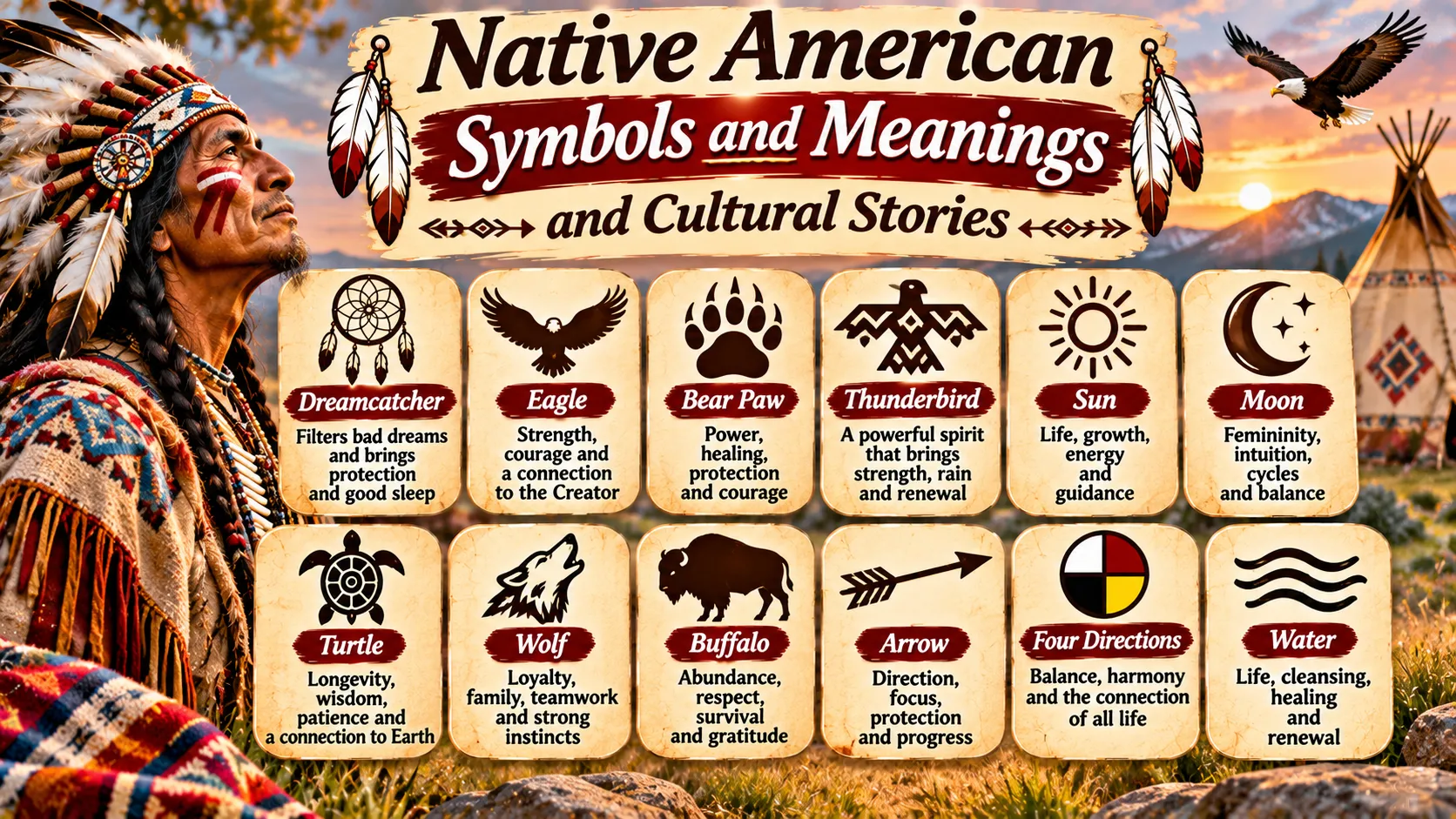
Native American symbols and meanings offer a fascinating look into the traditions, beliefs, stories, and artistic expressions of Indigenous peoples across North America. From the eagle and bear to the turtle, feather, spiral, and sun, many symbols connect with nature, community, spirituality, protection, and the relationship between people and the world around them.
However, Native American cultures do not share one universal symbol system. Hundreds of Indigenous nations and communities have their own languages, histories, ceremonies, art styles, and interpretations. A symbol that holds a particular meaning for one nation may have a different meaning—or no traditional meaning at all—for another.
Understanding this cultural diversity is essential when exploring Indigenous symbols. This guide introduces commonly discussed Native American symbols, their possible meanings, and the cultural context behind them. It also explains why certain animals, natural elements, and geometric designs appear in Indigenous art and storytelling.
🦅 Eagle Symbol – Strength, Vision, and Spiritual Connection
The eagle holds important cultural and spiritual significance in many Indigenous communities. Its ability to fly high above the land often connects it with vision, strength, freedom, and a relationship between the earthly and spiritual worlds.
Eagle feathers also hold special importance in many nations, although their use, ceremonial meaning, and protocols differ. They should never be treated as ordinary decorations or assumed to have one universal meaning.
- Strength: The eagle can represent courage, resilience, and personal power.
- Vision: Its sharp eyesight may symbolize awareness, wisdom, and the ability to see beyond immediate concerns.
- Spiritual connection: Some Indigenous traditions associate the eagle with communication between the human and spiritual worlds.
- Freedom: Its flight can represent independence and the ability to rise above challenges.
- Honor: Eagle feathers hold significant cultural and ceremonial value in many communities.
🐻 Bear Symbol – Courage, Protection, and Healing
The bear appears in the stories, artwork, and traditions of numerous Indigenous nations. Its strength, protective behavior, and connection with the natural world have inspired different cultural interpretations.
Some communities associate the bear with healing, courage, leadership, or protection. These meanings depend on the specific nation and its traditions rather than a single pan-Indigenous belief.
- Courage: The bear can represent bravery when facing difficult situations.
- Protection: Its powerful presence may symbolize defending family and community.
- Healing: Some Indigenous traditions connect bears with medicinal knowledge and healing.
- Strength: The bear represents physical power and resilience.
- Leadership: Its presence in certain stories may reflect responsibility and authority.
🐢 Turtle Symbol – Creation, Wisdom, and Longevity
The turtle has a meaningful place in several Indigenous creation stories and cultural traditions. Some Eastern Woodlands and Haudenosaunee traditions connect Turtle Island with stories about the formation of the land.
Turtle Island is not simply a decorative name for North America; it belongs to specific Indigenous storytelling traditions and should be understood within their cultural contexts.
- Creation: The turtle is connected with creation stories in some Indigenous nations.
- Wisdom: Its long life and steady movements can represent patience and experience.
- Longevity: The turtle may symbolize endurance and a lasting connection with nature.
- Stability: Its shell can suggest protection, security, and grounding.
- Earth: Turtle Island traditions connect the turtle with the land and the origins of the world.
🪶 Feather Symbol – Honor, Respect, and Connection
Feathers appear in many Indigenous artistic and ceremonial traditions. Their meanings depend on the bird, the community, the occasion, and the specific cultural practice.
An eagle feather, for example, may carry distinct significance that does not automatically apply to every feather. Some communities have established protocols for receiving, carrying, or displaying particular feathers.
- Honor: Certain feathers represent recognition and respect.
- Respect: They may be presented in meaningful cultural or community settings.
- Spiritual significance: Some traditions connect feathers with prayer or spiritual relationships.
- Connection with nature: Feathers reflect the relationship between people, animals, and the natural world.
- Responsibility: Receiving a culturally significant feather may involve expectations about how someone treats it.
☀️ Sun Symbol – Life, Energy, and Renewal
The sun plays an important role in the traditional knowledge, seasonal practices, stories, and artwork of many Indigenous nations. It provides warmth and light, supports plant growth, and helps mark the passage of time.
Its symbolic meaning differs between communities, so it is important not to assume that every circular sun design represents the same belief.
- Life: The sun supports living things and can represent the conditions that make life possible.
- Energy: Its warmth and light may symbolize vitality.
- Renewal: The daily sunrise can suggest new beginnings and continuation.
- Time: The sun helps communities understand daily and seasonal cycles.
- Balance: Some traditions connect the sun with the natural patterns that sustain the world.
🌙 Moon Symbol – Cycles, Time, and Change
The moon appears in Indigenous stories, calendars, seasonal observations, and artistic traditions. Different nations have their own names and teachings associated with lunar cycles.
Rather than representing one universal spiritual idea, the moon’s meaning often reflects local environments, community knowledge, and relationships with time.
- Cycles: The moon’s changing appearance can represent recurring natural patterns.
- Timekeeping: Lunar observations have helped communities track months and seasons.
- Change: Its phases may symbolize transformation and the passage of time.
- Nature: The moon connects with observations of the night sky and natural rhythms.
- Reflection: In some contemporary interpretations, it represents thought, observation, and renewal.
🐺 Wolf Symbol – Loyalty, Community, and Cooperation
Wolves feature in stories and traditions from various Indigenous nations. Their social behavior, family groups, and hunting strategies have inspired different interpretations of cooperation, responsibility, and relationships.
Some modern descriptions present the wolf as a universal Native American symbol of loyalty. That description is too broad, because individual nations have distinct wolf stories and teachings.
- Community: The wolf’s social behavior can suggest cooperation and shared responsibility.
- Loyalty: Some interpretations connect wolves with commitment to family or group.
- Communication: Wolf behavior may inspire ideas about awareness and communication.
- Adaptability: Wolves can represent the ability to respond to changing environments.
- Responsibility: Their group behavior can suggest the importance of working together.
🦌 Deer Symbol – Gentleness, Awareness, and Grace
Deer have practical, ecological, and cultural importance in many Indigenous communities. They appear in traditional stories, artwork, foodways, and teachings about relationships with the natural environment.
In some interpretations, deer represent gentleness and awareness. Their meaning varies according to the community and the particular story or design.
- Gentleness: The deer can suggest kindness and a peaceful presence.
- Awareness: Its alert behavior may symbolize attentiveness.
- Grace: Its movements can represent elegance and balance.
- Nature: Deer imagery can reflect a close relationship with local wildlife.
- Respect: In some traditions, deer stories communicate responsibilities toward animals and the land.
🐦 Raven Symbol – Transformation, Intelligence, and Trickster Stories
Ravens hold important roles in the oral traditions of several Indigenous peoples, especially in parts of the Northwest Coast and northern North America. Some stories portray Raven as a transformer, creator, culture hero, or trickster.
These roles are not identical across nations. Raven may be clever, disruptive, generous, or complicated depending on the story.
- Transformation: Raven appears in stories about changing the world or bringing important things into existence.
- Intelligence: Its clever behavior can represent creativity and problem-solving.
- Trickster qualities: Some stories use Raven to explore mistakes, humor, and unexpected consequences.
- Change: Raven may represent events that reshape a community or its surroundings.
- Storytelling: Raven narratives preserve teachings, history, and cultural knowledge.
🦅 Thunderbird Symbol – Power, Protection, and the Sky
The Thunderbird appears in the traditions and artistic expressions of several Indigenous peoples, particularly in parts of North America. It is often associated with powerful forces of the sky, including thunder and storms.
Its appearance and meaning vary across nations. In some traditions, Thunderbird is a powerful spiritual being, not merely an animal design or decorative motif.
- Power: Thunderbird can represent extraordinary strength.
- The sky: Its stories often connect it with thunder, storms, and the upper world.
- Protection: Some traditions associate Thunderbird with protective power.
- Transformation: Its presence in stories may signal major changes or powerful events.
- Spiritual significance: Thunderbird has specific sacred meanings in some communities.
🌽 Corn Symbol – Sustenance, Community, and Life
Corn is deeply important to many Indigenous nations, particularly in agricultural traditions across North America. It has provided food, supported communities, and shaped seasonal practices for generations.
Corn, beans, and squash are often discussed together as the Three Sisters in several Indigenous agricultural traditions. Their cultivation demonstrates knowledge of plant relationships and sustainable growing practices.
- Sustenance: Corn represents an important source of nourishment.
- Community: Growing, preparing, and sharing food can strengthen relationships.
- Agriculture: Corn reflects generations of Indigenous farming knowledge.
- Life: Its role as a food crop connects it with survival and continuity.
- Interdependence: The Three Sisters demonstrate how plants can support one another.
🌀 Spiral Symbol – Growth, Movement, and Continuity
Spiral designs appear in the art of different Indigenous cultures, as well as in many other artistic traditions around the world. Their meanings depend on the specific community, location, artwork, and historical period.
A spiral may suggest movement, growth, continuity, or natural patterns, but it should not automatically be labeled as a universal Native American symbol.
- Growth: A spiral can suggest development and expansion.
- Movement: Its curved form may represent motion or changing conditions.
- Continuity: The connected line can suggest an ongoing process.
- Nature: Spiral patterns appear in shells, plants, and other natural forms.
- Transformation: Some contemporary artists use spirals to explore change and identity.
🔺 Geometric Symbols – Patterns, Identity, and Artistic Tradition
Geometric designs are common in many Indigenous art forms, including pottery, weaving, beadwork, textiles, and architectural decoration. Their patterns can reflect local environments, family traditions, community identity, and artistic knowledge.
A triangle, diamond, or zigzag does not have one meaning across all Native American cultures. The design’s context matters more than a general online definition.
- Triangles: Their meanings depend on the artwork and the tradition in which they appear.
- Diamonds: Diamond patterns occur in many regional weaving and decorative traditions.
- Zigzags: These designs can create visual movement and may reflect particular artistic styles.
- Lines: Repeated lines can organize a composition or create a recognizable pattern.
- Circles: Circular forms appear in many artistic traditions, but their meanings vary.
🌧️ Rain Symbol – Renewal, Water, and Agricultural Life
Rain is essential to ecosystems, agriculture, and community life. Indigenous nations have developed different ceremonies, stories, and teachings related to water and rainfall, reflecting their environments and cultural practices.
Some contemporary descriptions interpret rain symbols as signs of renewal or abundance. However, specific ceremonial meanings belong to the communities that maintain those traditions.
- Renewal: Rain supports new plant growth.
- Water: It represents an essential natural resource.
- Agriculture: Rainfall affects planting, growing, and harvesting.
- Continuity: Water sustains ecosystems and communities.
- Seasonal change: Rain patterns help shape local environmental cycles.
🏹 Arrow Symbol – Direction, Movement, and Responsibility
Arrow designs appear in different Indigenous art forms, including beadwork, clothing, pottery, and contemporary artwork. Their meanings depend on the nation and the design’s context.
Online symbol lists often assign fixed meanings to arrow directions, such as peace, friendship, or protection. These explanations should not be treated as universal Indigenous teachings without a reliable community-specific source.
- Direction: An arrow naturally suggests movement toward a particular point.
- Movement: It can represent travel, action, or forward progress.
- Hunting traditions: Arrows reflect technologies and knowledge connected with hunting and survival.
- Skill: Arrow-making can demonstrate specialized craftsmanship.
- Responsibility: In historical and contemporary contexts, hunting tools connect with responsibilities toward animals and communities.
🪨 Medicine Wheel – Balance, Learning, and Relationships
The term Medicine Wheel describes several Indigenous teachings and visual frameworks, but it does not refer to one universal design shared by every nation. Some communities use circular arrangements to explore relationships among directions, seasons, colors, stages of life, or aspects of well-being.
The meanings and teachings differ by community. Some Medicine Wheel traditions are sacred or community-specific, so people should learn from the Indigenous nation that maintains the particular teaching.
- Balance: Some teachings explore relationships among different aspects of life.
- Seasons: Certain interpretations connect the circle with seasonal changes.
- Directions: Some traditions associate parts of the wheel with directions.
- Learning: The wheel may provide a framework for teaching and reflection.
- Community: Its teachings can emphasize relationships among individuals, families, and the wider world.
🪶 Native American Symbols and Their Meanings: Quick Reference Table
The following table summarizes common interpretations discussed in this guide. These are broad descriptions, not official definitions shared by all Indigenous nations.
| Symbol | Commonly discussed meaning | Important context |
|---|---|---|
| Eagle | Strength, vision, spiritual connection | Feather protocols differ by nation |
| Bear | Courage, protection, healing | Meanings vary across stories |
| Turtle | Creation, wisdom, longevity | Turtle Island belongs to specific creation traditions |
| Feather | Honor, respect, spiritual significance | Meaning depends on bird and community |
| Sun | Life, energy, seasonal cycles | Interpretations are nation-specific |
| Moon | Time, cycles, change | Lunar teachings differ by community |
| Wolf | Cooperation, loyalty, community | Wolf stories vary widely |
| Deer | Gentleness, awareness, grace | Context determines meaning |
| Raven | Transformation, intelligence, trickster stories | Especially significant in some Northwest Coast traditions |
| Thunderbird | Sky power, storms, protection | A powerful spiritual being in some traditions |
| Corn | Sustenance, agriculture, community | Central to many Indigenous foodways |
| Spiral | Growth, movement, continuity | Not a universal Indigenous symbol |
| Rain | Water, renewal, agricultural life | Ceremonial meanings vary |
| Arrow | Direction, movement, hunting knowledge | Direction-based meanings are not universal |
| Medicine Wheel | Balance, relationships, learning | Different nations maintain different teachings |
🧡 Why Are Native American Symbols Important?
Indigenous symbols can preserve knowledge, express cultural identity, and communicate relationships with the natural world. They may appear in stories, ceremonies, clothing, pottery, architecture, tools, and contemporary artwork.
Their importance goes beyond decoration. A design may carry family history, community teachings, spiritual significance, or knowledge passed between generations.
Several reasons explain their cultural value:
- Cultural identity: Symbols can express a community’s history and identity.
- Storytelling: Designs and images can communicate stories and teachings.
- Connection with nature: Animal and plant imagery often reflects relationships with the local environment.
- Artistic heritage: Traditional designs preserve knowledge of regional art forms and craftsmanship.
- Community relationships: Some symbols express shared responsibilities and connections.
- Historical continuity: Artistic traditions can connect contemporary generations with earlier cultural practices.
Respectful learning means recognizing that Indigenous peoples are living communities, not simply subjects of ancient history. Their art, languages, and traditions continue to develop today.
🌎 Are Native American Symbols the Same Across All Tribes?
No. Native American symbols are not identical across all Indigenous nations. The United States alone is home to many federally recognized tribes, alongside state-recognized and other Indigenous communities. Each nation has its own history, cultural practices, and artistic traditions.
For example, a design found in Haudenosaunee art may have a different history from a similar-looking pattern in Diné weaving or Northwest Coast carving. Visual similarities do not automatically mean that two communities share the same symbolic interpretation.
When researching a symbol, consider these questions:
- Which Indigenous nation created or uses it?
- Where does the design come from?
- Does it appear in a particular ceremony, artwork, or historical story?
- Is the meaning documented by the community itself?
- Is the symbol sacred, restricted, or intended for a particular cultural setting?
These questions help prevent misunderstandings and encourage more respectful appreciation.
🤝 How to Appreciate Native American Symbols Respectfully
Learning about Indigenous symbols requires more than memorizing short definitions. It involves understanding the people, histories, and traditions behind the artwork.
Use these practices when researching, sharing, or incorporating Indigenous designs into creative projects.
- Identify the nation: Whenever possible, learn which Indigenous community created or maintains the symbol.
- Use reliable sources: Prioritize tribal museums, cultural centers, Indigenous artists, and community publications.
- Avoid universal claims: Do not describe one interpretation as the meaning for every Native American nation.
- Respect sacred imagery: Some designs and ceremonial objects have cultural restrictions.
- Credit Indigenous creators: If you share artwork, acknowledge the artist and community when the information is available.
- Avoid stereotypes: Indigenous cultures are diverse and continue to thrive in contemporary life.
- Learn the history: Understand the purpose and context of a design before using it.
A respectful approach recognizes Indigenous peoples as the authorities on their own cultural knowledge.
❓ Frequently Asked Questions About Native American Symbols and Meanings
What is the most recognized Native American symbol?
The eagle, feather, turtle, and Medicine Wheel are among the symbols frequently discussed in general introductions to Indigenous cultures. However, no single symbol represents every Native American nation.
What does the eagle symbolize in Native American culture?
In several Indigenous traditions, the eagle is associated with strength, vision, honor, and spiritual significance. Eagle feathers also hold important ceremonial and cultural meanings in many communities.
What does the turtle symbolize?
The turtle appears in creation stories and cultural traditions of several Indigenous nations. Some Eastern Woodlands and Haudenosaunee traditions connect the turtle with Turtle Island and the formation of the land.
What does a Native American feather symbolize?
A feather may represent honor, respect, or spiritual significance, depending on the bird and the community. Eagle feathers have particular importance in many Indigenous traditions, and their handling may follow specific cultural protocols.
What does the bear symbolize?
Some Indigenous traditions associate the bear with strength, courage, protection, and healing. Its meaning depends on the stories and teachings of the specific nation.
What does the wolf symbolize?
Wolf imagery can connect with cooperation, family relationships, communication, and community in some Indigenous stories. Different nations tell their own wolf stories, so no single interpretation applies everywhere.
What is the meaning of the Thunderbird?
Thunderbird is a powerful being in the traditions of several Indigenous peoples. It is often connected with the sky, thunder, storms, and spiritual power, although its stories and significance differ between communities.
What does the Medicine Wheel represent?
Some Medicine Wheel teachings use a circular framework to explore balance, directions, seasons, relationships, and different aspects of life. The teachings are not universal, and individual Indigenous nations maintain their own interpretations.
Are Native American symbols spiritual?
Some symbols have spiritual or ceremonial significance, while others appear in everyday art, clothing, tools, and storytelling. Their purpose depends on the community and the context in which people use them.
Can anyone use Native American symbols in artwork?
Not every symbol is appropriate for unrestricted use. Some designs are sacred, community-specific, or connected with cultural responsibilities. Before using a design, research its origin and follow the guidance of the Indigenous community or artist associated with it.
🌺 Conclusion
Native American symbols and meanings reflect the diverse histories, artistic traditions, stories, and relationships with nature found among Indigenous peoples across North America. The eagle may represent strength and spiritual connection in some traditions, while the turtle appears in important creation stories. Bear, wolf, raven, Thunderbird, corn, feathers, and other symbols also carry meanings shaped by individual communities.
The most important point is that Native American cultures do not share one universal symbolic language. Every nation has its own teachings, and the meaning of a design depends on its cultural and historical context. By learning about specific Indigenous communities and respecting their traditions, you can appreciate these symbols more accurately and thoughtfully.

Olivia Bennett is a writer and language enthusiast at Vocabsteria. She is passionate about exploring word meanings, name origins, and cultural expressions from around the world.