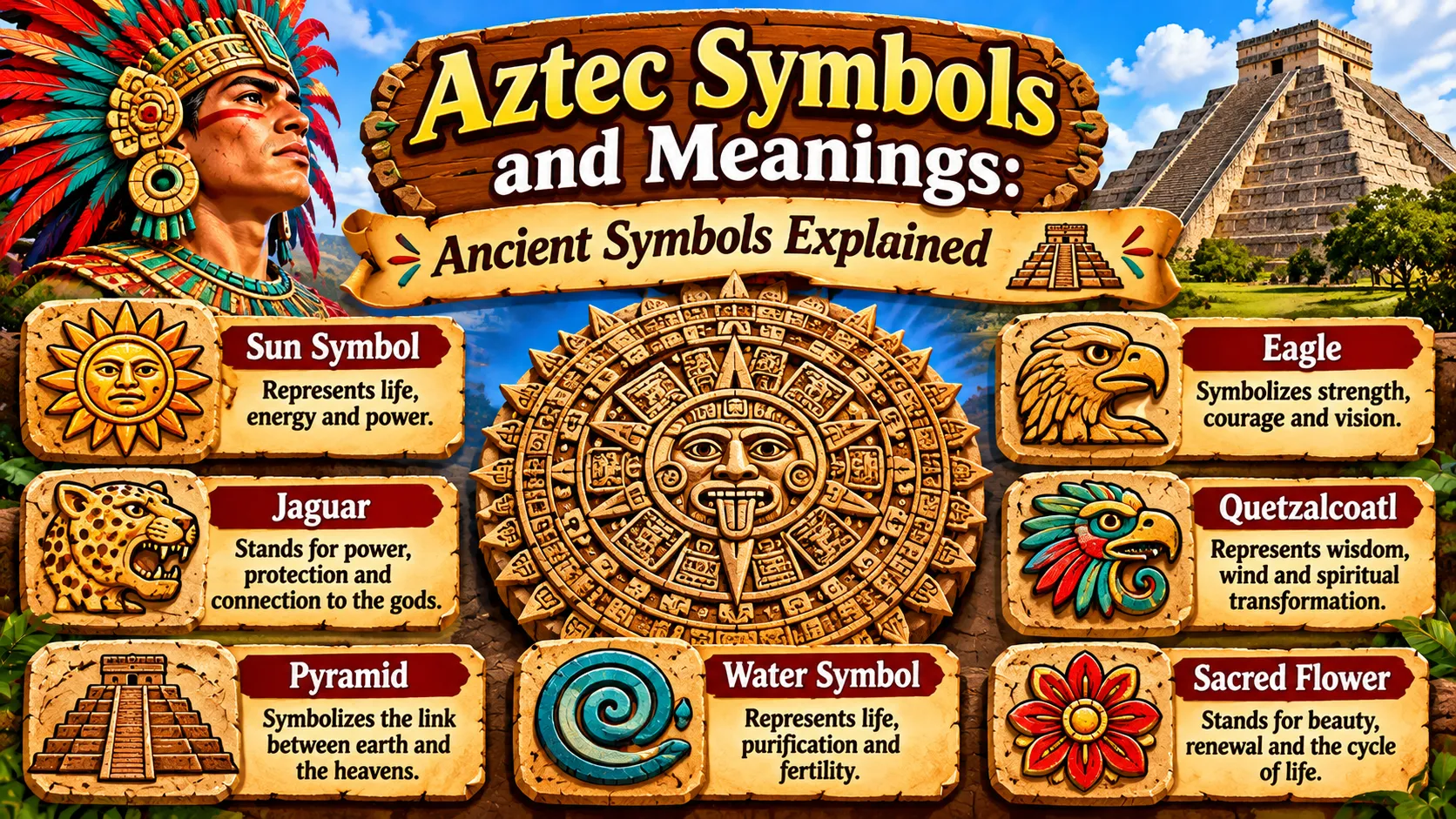
Aztec symbols and meanings offer a fascinating look into the beliefs, traditions, mythology, and everyday life of one of the most influential civilizations in ancient Mesoamerica. The Aztecs, also known as the Mexica, developed a rich visual language filled with images of gods, animals, natural elements, sacred objects, and geometric designs. These symbols appeared in temples, stone carvings, pottery, codices, clothing, jewelry, and ceremonial objects. Many represented powerful ideas such as life, death, creation, protection, warfare, fertility, and the movement of the universe.
Aztec symbolism was closely connected to religion and the natural world. For example, the eagle represented power and courage, while the serpent was associated with divine forces, renewal, and the earth. The sun symbolized cosmic energy and the movement of time, while the jaguar was connected with strength, warriors, and nighttime power. Some symbols also represented specific gods, calendar signs, or important events in Aztec history. In this guide, you’ll discover more than 75 Aztec symbols and their meanings, including famous Aztec gods, animal symbols, sacred designs, calendar signs, and traditional motifs. You’ll also learn how these symbols were used and what made them important to Aztec culture.
🏛️ What Are Aztec Symbols?
Aztec symbols were visual representations used by the Mexica and other Nahua-speaking peoples of central Mexico to communicate religious, historical, political, and cultural ideas. They appeared in codices, sculptures, murals, architecture, textiles, and ceremonial objects.
Unlike a simple alphabet, Aztec writing combined pictures, symbols, signs, and phonetic elements. Some images represented complete concepts, while others helped communicate names, places, dates, or sounds.
Aztec symbols often represented:
- Religion: Gods, sacred rituals, spiritual beliefs, and offerings.
- Nature: The sun, moon, rain, water, plants, and animals.
- War: Warriors, weapons, military victories, and courage.
- Time: Calendar signs, days, years, and cosmic cycles.
- Life and Death: Creation, fertility, sacrifice, rebirth, and the afterlife.
- Identity: Communities, rulers, cities, and family connections.
- Power: Leadership, divine authority, strength, and protection.
These images were more than decorations. They helped preserve the civilization’s history and communicate ideas across generations.
☀️ Aztec Sun Symbol and Its Meaning
The sun was one of the most important elements in Aztec religion and cosmology. It represented life, energy, time, and the movement of the universe. The Aztecs believed that the world had passed through different cosmic eras, known as Suns, and that their own era was the Fifth Sun.
The Aztec Sun Stone, often called the Aztec Calendar Stone, is one of the best-known examples of Aztec solar imagery. It contains several layers of symbols associated with time, creation, and cosmic order.
Important sun-related symbols include:
- Tonatiuh: The sun deity associated with the current cosmic era and the movement of the sun.
- Fifth Sun: The current world age in Aztec cosmology, known as Nahui Ollin.
- Solar Rays: Represent sunlight, energy, and the power of the sun.
- Solar Disc: Represents the sun and its central place in cosmic life.
- Four Previous Suns: Represent earlier world ages that ended through different forms of destruction.
- Sunstone Face: The central face on the famous Sun Stone, commonly identified with Tonatiuh or interpreted in relation to the sun’s cosmic role.
- Ollin Sign: Movement, change, and the motion associated with the Fifth Sun.
- Four Directions: The organization of the cosmos around central and directional points.
The sun symbol was connected with agriculture, religious ceremonies, timekeeping, and the continuation of life.
🐍 Aztec Snake Symbol and Its Meaning
Snakes played an important role in Aztec mythology and religious imagery. They were associated with the earth, fertility, water, renewal, and divine power. Their ability to shed their skin also made them powerful images of transformation.
Here are important Aztec serpent symbols:
- Quetzalcoatl: The Feathered Serpent deity associated with wind, knowledge, creation, and cultural development.
- Serpent: A broad symbol associated with earth, fertility, renewal, and supernatural power.
- Xiuhcoatl: The Fire Serpent associated with the sun, fire, and warfare.
- Serpent of Huitzilopochtli: Serpent imagery appears in accounts and artistic representations connected with the Mexica patron deity.
- Feathered Serpent: Combines the serpent with precious bird feathers to represent divine and earthly qualities.
- Two-Headed Serpent: A well-known Mesoamerican motif associated with ceremonial and elite art, although its exact meaning depends on the object and context.
- Serpent Coils: Can represent movement, power, and connections with the earth or water.
- Serpent Head: Often used in architecture and sculpture as a powerful divine or supernatural image.
Quetzalcoatl is among the most recognizable deities in Mesoamerican history. However, serpent imagery had several meanings, and not every serpent representation referred to the same god.
🦅 Aztec Eagle Symbol and Its Meaning
The eagle was an important animal in Aztec culture. It represented strength, courage, warfare, and the power of the sun. Eagles were also connected with elite warriors and the Mexica foundation story.
The eagle appears in the traditional story of the Mexica migration, in which an eagle perched on a cactus became an important sign associated with the location where Tenochtitlan would be established. This imagery remains part of Mexico’s national emblem today.
Important eagle symbols include:
- Eagle: Strength, courage, power, and leadership.
- Eagle Warrior: An elite warrior associated with military achievement and courage.
- Eagle on a Cactus: A foundational image associated with the establishment of Tenochtitlan.
- Eagle Feathers: Prestige, status, and ceremonial importance.
- Eagle Claws: Strength, power, and the ability to overcome enemies.
- Eagle in Flight: Movement, freedom, and connection with the sky.
- Golden Eagle: A powerful bird associated with solar imagery and the natural world.
The eagle was also associated with the sun and the military culture of the Aztec Empire.
🐆 Aztec Jaguar Symbol and Its Meaning
The jaguar was one of the most respected animals in Aztec culture. Its strength, stealth, and nighttime hunting habits made it an important symbol of power and military identity.
Jaguar imagery appeared in sculptures, ceremonial objects, clothing, and warrior traditions.
Common jaguar-related symbols include:
- Jaguar: Strength, courage, power, and nighttime energy.
- Jaguar Warrior: An elite military identity associated with bravery and fighting ability.
- Jaguar Skin: Prestige, authority, and warrior status.
- Jaguar Claws: Strength, defense, and aggression.
- Jaguar Head: Power, dominance, and supernatural associations.
- Jaguar Spots: A recognizable visual feature used in symbolic and artistic representations.
- Jaguar Throne Motifs: Connections with rulership, status, and authority in some Mesoamerican art.
- Jaguar at Night: Associations with darkness, the earth, and hidden power.
The jaguar was also important in wider Mesoamerican traditions, so its meaning was not exclusive to the Aztecs.
🌧️ Aztec Rain and Water Symbols
Water and rain were essential to agriculture and survival in the Aztec world. The Aztecs honored deities associated with rain, storms, rivers, lakes, and fertility.
Tlaloc was the major rain deity, and his imagery often included distinctive eyes, fangs, and other recognizable features.
Important rain and water symbols include:
- Tlaloc: Rain, storms, fertility, and agricultural nourishment.
- Water Streams: Flowing water, life, and abundance.
- Water Droplets: Rain, nourishment, and natural renewal.
- Blue Water Motifs: Water and aquatic environments in many artistic contexts.
- Shells: Aquatic life, water, and ceremonial associations.
- Snail Shell: Water, sound, and ritual significance.
- Frog: Rain, water, and fertility associations.
- Fish: Aquatic life and the importance of water.
- Clouds: Rain, storms, and changing weather.
- Lightning: Storm power and the forces associated with rain.
- Mountain With Water: A visual concept associated with altepetl, meaning a community or city-state.
- Water Vessel: Storage, nourishment, and ceremonial use.
Water imagery was particularly important because agriculture depended on seasonal rainfall and the management of lakes and waterways.
🔥 Aztec Fire Symbols and Their Meanings
Fire had religious, practical, and ceremonial importance in Aztec society. It was associated with warmth, transformation, renewal, and the cycles of time.
Xiuhtecuhtli was an important deity connected with fire, heat, and time. Fire also played a central role in ceremonies, including the New Fire ceremony associated with the completion of a 52-year calendar cycle.
Here are common fire-related symbols:
- Xiuhtecuhtli: Fire, heat, time, and renewal.
- Fire Serpent (Xiuhcoatl): A supernatural serpent associated with fire, the sun, and warfare.
- Flame: Energy, warmth, transformation, and ritual fire.
- Burning Wood: Fire ceremonies and renewal.
- Hearth: Domestic life, family, and the sacred importance of household fire.
- Fire Drill: The creation of sacred fire during ceremonies.
- New Fire: Renewal and the beginning of a new 52-year cycle.
- Red and Yellow Flames: Colors commonly used to represent fire and heat.
- Torch: Light, ritual activity, and illumination.
- Fire Offering: A ceremonial act connected with religious observance.
Fire symbolized both everyday survival and the larger cosmic cycles that shaped Aztec beliefs.
🪷 Aztec Flower Symbols and Their Meanings
Flowers were important in Aztec poetry, ceremonies, decoration, and religious imagery. They could represent beauty, fertility, life, preciousness, and the relationship between the human and divine worlds.
The flower symbol known as in xochitl in cuicatl, meaning “flower and song,” was a metaphor for poetry, art, and meaningful expression.
Important flower symbols include:
- Flower: Beauty, life, fertility, and preciousness.
- Four-Petaled Flower: A motif that can suggest the four directions or cosmic organization, depending on context.
- Marigold: Flowers used in Mesoamerican ceremonial and decorative traditions.
- Water Lily: Aquatic life and natural beauty.
- Flower and Song: Poetry, art, and creative expression.
- Flowering Tree: Growth, abundance, and life.
- Flower Garland: Celebration, beauty, and ceremonial honor.
- Flowering Cactus: Life and the natural environment of central Mexico.
- Red Flower: A color and floral motif that may carry ceremonial or artistic associations.
- Flower Offering: Respect, devotion, and ritual practice.
Flowers were not simply decorative objects. They could carry deep poetic and ceremonial meanings.
💀 Aztec Death Symbols and Their Meanings
Death was an important part of Aztec religion and worldview. The Aztecs believed that the destination of a person’s spirit after death depended on circumstances surrounding their death rather than simply on whether they had lived a good or bad life.
Their artistic traditions included images of skulls, bones, underworld deities, and other representations of mortality.
Here are notable death-related symbols:
- Skull: Mortality, death, and the human condition.
- Mictlantecuhtli: The deity associated with Mictlan, the land of the dead.
- Mictecacihuatl: A female figure associated with the realm of the dead.
- Bones: Mortality, ancestors, and the cycle of life.
- Mictlan: The underworld destination associated with many people who died natural deaths.
- Skull Rack (Tzompantli): A structure displaying human skulls, associated with ritual and political power.
- Obsidian Knife: A ceremonial object associated with sacrifice and ritual practices.
- Underworld Imagery: The afterlife, death, and spiritual journeys.
- Night Symbols: Darkness, mystery, and the unseen world.
- Funerary Offerings: Objects placed with the dead as part of burial or ritual traditions.
These symbols should be understood within the Aztec understanding of death and the afterlife, not simply through modern interpretations.
🗓️ Aztec Calendar Symbols and Their Meanings
The Aztec calendar system was an important part of religious ceremonies, agriculture, and everyday organization. The Mexica used interconnected calendar cycles, including the 260-day ritual calendar called tonalpohualli and the 365-day solar calendar called xiuhpohualli.
The 260-day calendar used 20 day signs combined with numbers from 1 to 13. These signs carried symbolic and divinatory associations.
The 20 day signs are:
- Cipactli (Crocodile): Associated with creation and the earth.
- Ehecatl (Wind): Associated with wind, movement, and the deity Ehecatl.
- Calli (House): Home, shelter, and stability.
- Cuetzpalin (Lizard): Movement, vitality, and natural life.
- Coatl (Serpent): Renewal, power, and fertility.
- Miquiztli (Death): Mortality, transformation, and the cycle of life.
- Mazatl (Deer): Nature, movement, and grace.
- Tochtli (Rabbit): Fertility, abundance, and associations with the moon.
- Atl (Water): Life, nourishment, and renewal.
- Itzcuintli (Dog): Companionship and guidance.
- Ozomatli (Monkey): Art, playfulness, and creativity.
- Malinalli (Grass): Growth, resilience, and natural cycles.
- Acatl (Reed): Growth and directional or calendrical associations.
- Ocelotl (Jaguar): Strength, nighttime power, and courage.
- Cuauhtli (Eagle): Power, courage, and the sky.
- Cozcacuauhtli (Vulture): Renewal and the natural cycle of life and death.
- Ollin (Movement): Motion, change, and cosmic movement.
- Tecpatl (Flint): Sacrifice, ritual, and sharpness.
- Quiahuitl (Rain): Rain, fertility, and agricultural nourishment.
- Xochitl (Flower): Beauty, creativity, and artistic expression.
These signs were used in divination and calendar calculations. Their meanings were more complex than simple one-word definitions.
🔷 Aztec Geometric Symbols and Their Meanings
Aztec art frequently used geometric designs in architecture, pottery, textiles, and ceremonial objects. These patterns helped communicate ideas about nature, movement, direction, and cosmic organization.
Here are common geometric motifs:
- Circle: Cycles, completeness, and cosmic movement in some contexts.
- Four-Petal Design: A pattern associated with fourfold organization and the directions in certain Mesoamerican imagery.
- Spiral: Movement, continuity, and natural cycles.
- Step-Fret Pattern: A geometric design found in Mesoamerican architecture and decorative art.
- Diamond Pattern: A decorative motif that can suggest order and repeated structure.
- Crossed Bands: Interconnection and geometric organization.
- Zigzag: Movement, energy, and lightning-like forms in some designs.
- Square: Structure and organized space.
- Interlocking Patterns: Repetition, connection, and decorative balance.
- Feather Pattern: Prestige, beauty, and associations with precious birds.
- Water Motif: Flowing water and natural movement.
- Cloud Pattern: Rain, weather, and atmospheric forces.
A geometric motif does not always have a single symbolic meaning. Its placement, surrounding imagery, and historical setting are important.
🪶 Aztec Symbols of Protection and Strength
Protection and strength were important themes in Aztec religious and military traditions. Symbols associated with powerful animals, weapons, and divine figures communicated authority, courage, and the ability to defend a community.
Here are notable symbols of strength and protection:
- Eagle: Courage, strength, and military achievement.
- Jaguar: Power, bravery, and warrior identity.
- Shield: Defense, protection, and military status.
- Macuahuitl: A traditional wooden weapon fitted with sharp obsidian blades.
- Obsidian: Sharpness, ritual significance, and craftsmanship.
- Quetzal Feathers: Beauty, prestige, and elite status.
- Huitzilopochtli: The Mexica patron deity associated with war and the sun.
- Xiuhcoatl: Fire, divine power, and warfare.
- Warrior Costume: Military identity, rank, and achievement.
- Eagle Warrior Attire: An elite military identity associated with the eagle.
- Jaguar Warrior Attire: An elite military identity associated with the jaguar.
- Shield Emblem: A visual representation of a warrior’s identity or military role.
These symbols reflect a society in which warfare, political authority, and religious belief were closely connected.
🐇 Aztec Animal Symbols and Their Meanings
Animals were central to Aztec mythology, religious practices, and artistic expression. Different creatures represented qualities such as courage, wisdom, fertility, movement, and supernatural power.
Here are important Aztec animal symbols:
- Eagle: Strength, courage, and the sun.
- Jaguar: Power, warfare, and nighttime energy.
- Serpent: Renewal, fertility, and divine forces.
- Rabbit: Fertility, abundance, and lunar associations.
- Dog: Companionship and guidance in the journey after death.
- Deer: Nature, movement, and grace.
- Coyote: Cleverness, adaptability, and trickster associations.
- Monkey: Playfulness, art, and creativity.
- Butterfly: Transformation and beauty.
- Hummingbird: Energy, movement, and associations with Huitzilopochtli.
- Owl: Night, darkness, and supernatural associations.
- Frog: Rain, water, and fertility.
- Crocodile: The earth and creation imagery.
- Vulture: Death, renewal, and the natural cycle of life.
- Lizard: Vitality, movement, and the natural world.
- Fish: Water, aquatic life, and nourishment.
- Quetzal Bird: Precious feathers, beauty, and prestige.
- Scorpion: Danger and natural power.
- Spider: Webs, connection, and natural patterns.
- Turtle: Water, earth, and endurance.
The symbolism of animals often depended on their relationship with specific gods, calendar signs, or myths.
🌵 Aztec Symbols of Life, Creation, and Fertility
The Aztec worldview connected life and creation with the earth, water, plants, fertility, and divine forces. Many symbols represented the relationship between human communities and the natural environment.
Here are symbols connected with life and creation:
- Cipactli: A crocodile-like creature associated with the earth and creation.
- Maize: Food, fertility, agriculture, and human survival.
- Corn Plant: Agricultural abundance and the foundation of daily life.
- Water: Nourishment, fertility, and life.
- Cactus: The natural landscape and the Mexica foundation story.
- Eagle on a Cactus: The traditional image associated with the founding of Tenochtitlan.
- Flower: Life, beauty, and creative expression.
- Seed: Potential, growth, and agricultural renewal.
- Tree: Life, connection, and the natural world.
- Rain: Fertility, nourishment, and harvest.
- Earth Monster: Creation and the earth’s powerful natural forces.
- Serpent: Fertility, renewal, and connections with the earth.
- Four Directions: Cosmic order and the organization of the world.
- Sun: Life, energy, and cosmic movement.
- New Fire: Renewal and the continuation of the cosmic cycle.
These symbols demonstrate how closely Aztec beliefs were connected to farming, seasonal changes, and the natural world.
🖤 Aztec Colors and Their Symbolic Meanings
Colors were important in Aztec art, clothing, religious objects, and ceremonial designs. They could communicate directions, divine associations, social status, and natural elements.
However, Aztec color symbolism was not always fixed. The meaning of a color could change depending on the object, deity, or historical context.
Common color associations include:
- Red: Blood, fire, warfare, and vitality.
- Blue: Water, precious materials, and certain divine associations.
- Green: Preciousness, vegetation, and growth.
- Yellow: Gold, brightness, and sunlight.
- Black: Darkness, night, and certain underworld associations.
- White: Purity, brightness, and ceremonial associations.
- Turquoise: Preciousness, prestige, and elite objects.
- Brown: Earth, soil, and natural materials.
- Orange: Fire, warmth, and bright natural colors.
These are broad associations rather than universal rules. Specific color meanings should be interpreted alongside the artwork in which they appear.
🏙️ Aztec Symbols of Tenochtitlan and Mexican Heritage
Tenochtitlan was the capital of the Mexica Empire and one of the most important cities in pre-Columbian Mesoamerica. Its founding story remains central to Mexican historical identity.
The traditional image of an eagle perched on a cactus, sometimes holding a snake, became one of the most recognizable symbols associated with Mexico.
Important related symbols include:
- Eagle: Strength, courage, and the Mexica identity.
- Nopal Cactus: The landscape and the founding story of Tenochtitlan.
- Eagle on a Nopal: The traditional sign associated with the location of the Mexica capital.
- Snake: A part of the familiar national emblem, with variations in historical and artistic representations.
- Lake Texcoco: The environment in which Tenochtitlan developed.
- Chinampas: Agricultural plots associated with the lake environment and intensive farming.
- Templo Mayor: A major religious and political center of Tenochtitlan.
- Stone Carvings: Historical, political, and religious visual records.
- Codices: Manuscripts that preserved historical, calendrical, and cultural information.
The eagle and cactus image continues to appear on Mexico’s national flag and coat of arms, connecting modern national identity with the history of the Mexica.
❓ Frequently Asked Questions About Aztec Symbols and Meanings
What is the most famous Aztec symbol?
The eagle perched on a cactus is one of the most famous symbols associated with the Aztec civilization. It comes from the traditional founding story of Tenochtitlan and remains part of Mexico’s national emblem.
What does the Aztec sun symbol mean?
The Aztec sun symbol represents life, energy, time, and cosmic movement. It is closely associated with Tonatiuh and the Aztec belief in successive world ages.
What does the Aztec serpent symbolize?
The serpent can represent renewal, fertility, the earth, and divine power. The Feathered Serpent, Quetzalcoatl, is particularly important in Mesoamerican mythology.
What does the Aztec eagle represent?
The eagle represents courage, strength, power, and warrior identity. It also appears in the traditional story associated with the founding of Tenochtitlan.
What does the Aztec jaguar symbolize?
The jaguar symbolizes strength, courage, military power, and associations with nighttime. It was closely connected with the elite Jaguar Warriors.
What does the Aztec butterfly symbolize?
Butterfly imagery can represent transformation and beauty. In Aztec and wider Mesoamerican traditions, butterflies could also have associations with souls, fire, and warfare, depending on the context.
What is the meaning of the Aztec calendar?
The Aztec calendar system organized time through ritual and solar cycles. It was used for ceremonies, agricultural activities, and divination. The 260-day tonalpohualli and 365-day xiuhpohualli worked together in the broader calendar system.
What does Quetzalcoatl symbolize?
Quetzalcoatl, the Feathered Serpent, is associated with wind, knowledge, creation, and cultural development. He is one of the most important deities in Mesoamerican religious traditions.
What does the Aztec skull symbol mean?
Skull imagery can represent death, mortality, ritual practices, and the afterlife. It appears in several Aztec ceremonial and political contexts.
What does the Aztec flower symbol mean?
Flowers can represent beauty, life, fertility, and preciousness. The expression “flower and song” is especially associated with poetry, art, and meaningful expression.
Are Aztec symbols still used today?
Yes. Aztec-inspired imagery appears in Mexican national symbolism, museums, art, jewelry, clothing, tattoos, architecture, and cultural celebrations. Some designs are also used in contemporary Indigenous and Mexican artistic expression.
What is the difference between Aztec and Mayan symbols?
Aztec and Maya civilizations developed distinct writing systems, religious traditions, artistic styles, and calendars. Although they shared some broader Mesoamerican themes, their symbols and meanings should not be treated as interchangeable.
✅ Conclusion: Understanding the Meaning of Aztec Symbols
Aztec symbols provide a window into the history, beliefs, and traditions of the Mexica civilization. From the powerful eagle and jaguar to the Feathered Serpent, sun, calendar signs, and sacred flowers, these images represented much more than decorative designs. They communicated ideas about creation, warfare, nature, spirituality, time, and the relationship between humans and the universe.
Understanding Aztec symbols and meanings also requires recognizing their cultural context. A serpent could represent different divine forces, while an eagle could communicate both military power and the founding story of Tenochtitlan. The same image might carry different meanings depending on its placement, accompanying figures, and historical period.
Today, Aztec symbolism remains an important part of Mexican heritage and the wider history of Mesoamerica. Studying these designs helps preserve an appreciation for the creativity, knowledge, and cultural achievements of an ancient civilization.

Olivia Bennett is a writer and language enthusiast at Vocabsteria. She is passionate about exploring word meanings, name origins, and cultural expressions from around the world.