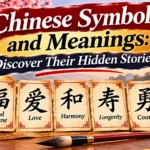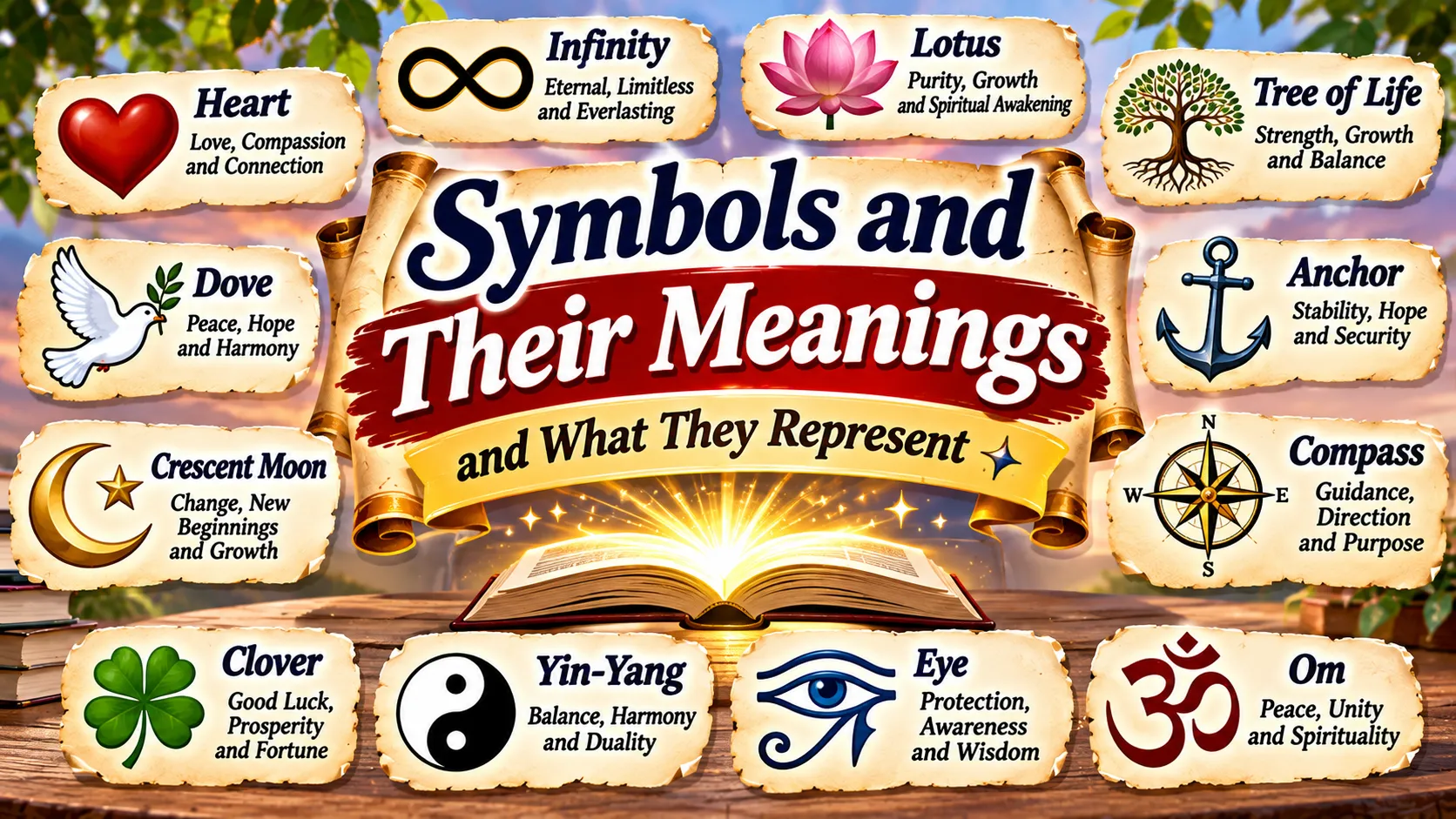
Have you ever wondered what different symbols mean and why certain shapes, signs, and images carry special messages? Symbols and their meanings are part of everyday life, appearing in art, literature, religion, cultures, jewelry, tattoos, architecture, and communication. A heart commonly represents love, a dove symbolizes peace, and a butterfly often represents transformation and new beginnings. These familiar images communicate ideas and emotions without requiring long explanations.
Throughout history, people have used symbols to express beliefs, identify communities, communicate important messages, and represent abstract concepts. Some symbols have meanings shared across many cultures, while others carry different interpretations depending on their historical or cultural background. For example, a circle can represent unity and wholeness, while a key may symbolize opportunity, knowledge, or access. In this guide, you’ll discover more than 150 popular symbols and their meanings, including ancient symbols, spiritual signs, cultural designs, nature symbols, geometric shapes, and everyday icons. You’ll also learn how symbols are used in different contexts and how to understand their meanings more accurately.
✨ What Are Symbols and Their Meanings?
A symbol is an image, sign, object, shape, or character that represents an idea, feeling, belief, or message. People use symbols to communicate information, express emotions, and represent concepts that may be difficult to explain through words alone.
Symbolism is the practice of using these images or objects to communicate deeper meanings.
For example:
- A heart represents love and affection.
- A dove commonly represents peace.
- A star can symbolize hope, guidance, or achievement.
- A key may represent opportunity and knowledge.
- A butterfly often represents transformation.
- A circle can represent unity and completeness.
- An anchor is commonly associated with stability and security.
- A tree may represent growth, strength, and life.
The meaning of a symbol depends on its context, culture, history, and use. The same image may communicate different ideas to different people.
❤️ Common Symbols and Their Meanings
Some symbols are widely recognized because people regularly encounter them in everyday communication, artwork, decorations, and popular culture.
Here are common symbols and their meanings:
- ❤️ Heart: Love, affection, compassion, and emotional connection.
- 🕊️ Dove: Peace, harmony, hope, and reconciliation.
- ⭐ Star: Hope, achievement, inspiration, and guidance.
- 🦋 Butterfly: Transformation, personal growth, beauty, and renewal.
- 🌙 Crescent Moon: Change, cycles, mystery, and spirituality.
- ☀️ Sun: Life, energy, warmth, happiness, and positivity.
- 🌳 Tree: Growth, stability, wisdom, and connection to nature.
- 🔑 Key: Opportunity, knowledge, access, and discovery.
- ⚓ Anchor: Stability, security, strength, and commitment.
- ♾️ Infinity: Endless possibilities, eternity, and everlasting connection.
- 🔥 Flame: Passion, energy, transformation, and determination.
- 🌈 Rainbow: Hope, diversity, happiness, and new beginnings.
- 💎 Diamond: Strength, beauty, clarity, and value.
- 🌹 Rose: Love, romance, beauty, and appreciation.
- 🪶 Feather: Freedom, lightness, spirituality, and inspiration.
- 🛡️ Shield: Protection, courage, safety, and defense.
- 🧭 Compass: Direction, guidance, exploration, and purpose.
- 🌻 Sunflower: Happiness, loyalty, positivity, and admiration.
- 🌊 Wave: Change, movement, emotions, and freedom.
- 🏹 Arrow: Direction, ambition, focus, and progress.
These symbols are especially popular in artwork, tattoos, greeting cards, social media, and personal accessories.
🌸 Symbols of Love and Relationships
Love symbols are commonly used to express affection, romance, friendship, devotion, and emotional connections. They appear in wedding decorations, jewelry, greeting cards, literature, and gifts.
Here are symbols associated with love and relationships:
- Heart: Romantic love, compassion, and affection.
- Red Rose: Passion, romance, and deep love.
- Pink Rose: Admiration, appreciation, and gentle affection.
- White Rose: Purity, sincerity, and new beginnings.
- Dove Pair: Partnership, peace, and devotion.
- Cupid’s Arrow: Romantic attraction and falling in love.
- Love Knot: Eternal connection, commitment, and unity.
- Infinity Symbol: Everlasting love and an unending bond.
- Claddagh Ring: Love, loyalty, and friendship in Irish tradition.
- Swan Pair: Romance, grace, and partnership.
- Two Interlocking Rings: Commitment, marriage, and unity.
- Red String: Connection and destiny in some cultural traditions.
- Butterfly: Emotional transformation and new beginnings.
- Tulip: Love, affection, and perfect love in some traditions.
- Apple: Love, desire, temptation, and knowledge in different stories.
- Pearl: Purity, elegance, and treasured relationships.
- Ribbon: Connection, remembrance, and support.
- Heart Lock: Commitment, trust, and emotional attachment.
- Wedding Band: Marriage, loyalty, and lifelong commitment.
- Pair of Swallows: Love, loyalty, and returning home.
The heart remains one of the most recognizable symbols of love, but cultural traditions can give other symbols equally meaningful interpretations.
🕊️ Symbols of Peace and Harmony
Peace symbols communicate calmness, cooperation, friendship, unity, and the desire to live without conflict. They are frequently used in public campaigns, artwork, international movements, and personal designs.
Here are symbols associated with peace:
- Dove: Peace, hope, and reconciliation.
- Olive Branch: Peace, forgiveness, and agreement.
- Peace Sign: Nonviolence, harmony, and peace movements.
- White Flag: Surrender, negotiation, or a request to stop fighting.
- White Poppy: Remembrance and peace advocacy in certain traditions.
- Yin-Yang: Balance and the relationship between complementary forces.
- Lotus Flower: Purity, spiritual growth, and enlightenment.
- Open Hands: Friendship, generosity, and peaceful intentions.
- Circle: Unity, wholeness, and connection.
- Rainbow: Hope, harmony, and diversity.
- Dove With an Olive Branch: Reconciliation and peaceful resolution.
- Calm Water: Tranquility, balance, and emotional peace.
- White Feather: Gentleness, peace, and innocence.
- Peace Crane: Hope and peace, particularly associated with Japanese paper-folding traditions.
- Interlocking Circles: Connection, cooperation, and unity.
These symbols can communicate peaceful intentions, although their exact meanings may vary across communities and historical periods.
🦋 Symbols of Transformation and New Beginnings
Transformation symbols represent personal growth, change, fresh opportunities, and the ability to move beyond difficult experiences.
Here are symbols commonly associated with transformation:
- Butterfly: Personal transformation, growth, and renewal.
- Phoenix: Rebirth, resilience, and rising after hardship.
- Snake: Renewal, healing, and transformation through shedding its skin.
- Lotus Flower: Spiritual development and growth through challenges.
- Rising Sun: Fresh starts, hope, and new opportunities.
- Cocoon: Preparation, development, and change.
- Dragonfly: Adaptability, transformation, and self-discovery.
- Seed: Potential, growth, and future possibilities.
- Sprouting Plant: New beginnings, development, and hope.
- Open Door: Opportunity, change, and new experiences.
- Spiral: Growth, development, and continuous movement.
- Sunrise: Renewal, optimism, and a fresh day.
- Molting Feather: Change, renewal, and personal development.
- Crescent Moon: Cycles, change, and new phases.
- Breaking Chain: Freedom, release, and overcoming limitations.
These symbols are especially meaningful in personal development, motivational artwork, literature, and tattoos.
🧠 Symbols of Wisdom and Knowledge
Wisdom symbols represent intelligence, learning, awareness, education, and the search for truth. Many have historical connections to philosophy, literature, and ancient traditions.
Here are symbols of wisdom and knowledge:
- Owl: Wisdom, observation, and knowledge.
- Open Book: Education, learning, and discovery.
- Tree of Knowledge: Understanding, growth, and intellectual development.
- Light Bulb: Ideas, creativity, and inspiration.
- Scroll: Knowledge, history, and written wisdom.
- Ouroboros: Cycles, renewal, and philosophical reflection.
- Eye: Awareness, observation, and perception.
- Owl Feather: Intelligence, learning, and insight.
- Compass: Direction, guidance, and thoughtful decisions.
- Quill: Writing, education, and intellectual expression.
- Library: Knowledge, learning, and preservation of information.
- Globe: Understanding, exploration, and worldwide knowledge.
- Sphinx: Mystery, intelligence, and ancient wisdom.
- Hourglass: Time, reflection, and the importance of experience.
- Magnifying Glass: Investigation, curiosity, and discovery.
The owl and open book are two of the most recognizable symbols of wisdom and education.
🛡️ Symbols of Strength, Courage, and Protection
Strength symbols often represent bravery, determination, resilience, security, and the ability to overcome obstacles.
Here are popular symbols associated with strength and protection:
- Lion: Courage, leadership, and confidence.
- Shield: Safety, protection, and defense.
- Sword: Bravery, justice, and strength.
- Mountain: Stability, endurance, and overcoming challenges.
- Oak Tree: Strength, longevity, and resilience.
- Bear: Power, protection, and determination.
- Dragon: Strength, wisdom, and protection in many traditions.
- Anchor: Stability, security, and perseverance.
- Eagle: Courage, freedom, and vision.
- Wolf: Loyalty, instinct, and resilience.
- Hammer: Strength, craftsmanship, and determination.
- Iron: Durability, firmness, and resilience.
- Fortress: Security, defense, and protection.
- Arrow: Focus, direction, and determination.
- Mountain Peak: Achievement, ambition, and persistence.
- Phoenix: Resilience and the ability to rise after adversity.
- Hercules’ Club: Strength and heroic power in Greek mythology.
- Spartan Helmet: Courage, discipline, and military strength.
- Bull: Power, determination, and persistence.
- Fist: Solidarity, resistance, and collective strength.
These symbols are often used in logos, sports designs, motivational artwork, and personal tattoos.
🌙 Spiritual Symbols and Their Meanings
Spiritual symbols represent beliefs, personal reflection, religious ideas, and connections to the sacred. Their meanings are often rooted in specific traditions, so it’s important to understand their cultural and religious backgrounds.
Here are several widely recognized spiritual symbols:
- Om (ॐ): A sacred sound and symbol in Hindu traditions, also used in some Buddhist contexts.
- Dharma Wheel: The teachings of Buddhism and the path toward awakening.
- Lotus: Spiritual purity, growth, and enlightenment in several Asian traditions.
- Ankh: Life and vitality in ancient Egyptian symbolism.
- Hamsa Hand: Protection and good fortune in several cultural and religious traditions.
- Tree of Life: Connection, growth, and the relationship between different forms of life.
- Yin-Yang: Complementary forces and balance in Chinese philosophy.
- Pentacle: A five-pointed star within a circle, with meanings that vary among spiritual traditions.
- Eye of Horus: Protection, restoration, and royal power in ancient Egyptian symbolism.
- Unalome: A symbol associated with the path toward enlightenment in some Buddhist and Hindu-inspired designs.
- Mandala: A symbolic representation of the universe and spiritual wholeness in several traditions.
Religious and spiritual symbols should be understood within their original traditions rather than assigned one universal meaning.
🏛️ Ancient Symbols and Their Meanings
Ancient civilizations used symbols to communicate religious beliefs, political authority, identity, protection, and ideas about life and death. Many ancient symbols continue to appear in modern jewelry, artwork, architecture, and popular culture.
Here are notable ancient symbols:
- Ankh: Life and vitality in ancient Egypt.
- Eye of Horus: Protection, restoration, and royal power.
- Eye of Ra: Solar power, protection, and divine authority.
- Scarab Beetle: Renewal, transformation, and rebirth in ancient Egypt.
- Ouroboros: A serpent or dragon eating its tail, symbolizing cycles and renewal.
- Greek Key: Continuity, infinity, and decorative order.
- Triskelion: Threefold movement, cycles, and progress in ancient and later Celtic-associated traditions.
- Labyrinth: A journey, challenge, and search for understanding.
- Caduceus: A staff with two intertwined serpents, associated with Hermes in Greek mythology.
- Rod of Asclepius: A staff with one serpent, associated with healing and medicine.
- Laurel Wreath: Victory, honor, and achievement in ancient Greece and Rome.
- Roman Eagle: Military authority, power, and imperial identity.
- Greek Owl: Wisdom and a traditional association with Athena.
- Winged Sun: A symbol of divine power and protection in several ancient Near Eastern and Egyptian contexts.
- Sphinx: Mystery, guardianship, and royal power in ancient Egyptian and Greek traditions.
- Lotus Motif: Creation, renewal, and life in ancient Egyptian and other cultural traditions.
- Solar Disc: The sun, life, and divine power.
- Greek Amphora: In art and cultural contexts, it can represent ancient craftsmanship and daily life.
- Thunderbolt: Divine power and authority, especially associated with Zeus.
- Trident: Power over the sea, particularly associated with Poseidon.
Ancient symbols can have several interpretations depending on the civilization and historical period in which they appeared.
🔺 Geometric Symbols and Their Meanings
Geometric symbols use basic shapes and patterns to represent abstract ideas. They appear in architecture, mathematics, design, spiritual artwork, and visual communication.
Here are common geometric symbols and their meanings:
- Circle: Unity, wholeness, eternity, and completeness.
- Triangle: Balance, direction, strength, and stability.
- Square: Structure, order, security, and foundation.
- Rectangle: Stability, organization, and practicality.
- Spiral: Growth, development, and continuous movement.
- Hexagon: Efficiency, structure, and natural patterns.
- Pentagon: Fivefold structure and balance.
- Star: Guidance, achievement, and inspiration.
- Diamond Shape: Clarity, value, strength, and elegance.
- Oval: Continuity, softness, and harmony.
- Cross: Intersection, connection, and, in religious contexts, specific sacred meanings.
- Concentric Circles: Unity, focus, and interconnectedness.
- Labyrinth Pattern: A journey, reflection, and the search for direction.
- Interlocking Shapes: Connection, cooperation, and unity.
- Waves: Movement, change, and flow.
- Vertical Line: Direction, stability, and connection.
- Horizontal Line: Calmness, balance, and continuity.
- Zigzag: Energy, movement, and unpredictability.
- Grid: Organization, structure, and order.
- Hexagram: A six-pointed geometric star with different meanings in different traditions.
Geometric shapes do not have one fixed symbolic meaning. Their interpretation depends on how they are used and the culture or design system behind them.
🌿 Nature Symbols and Their Meanings
Nature provides some of the most recognizable symbols of growth, renewal, beauty, strength, and balance. Plants, flowers, weather, and natural elements often appear in art and cultural traditions.
Here are nature-inspired symbols:
- Tree: Growth, strength, life, and connection.
- Oak Leaf: Endurance, strength, and longevity.
- Lotus Flower: Purity, growth, and enlightenment.
- Rose: Love, beauty, and passion.
- Sunflower: Positivity, loyalty, and happiness.
- Olive Branch: Peace, reconciliation, and hope.
- Mountain: Stability, achievement, and endurance.
- Ocean: Mystery, emotions, and vast possibilities.
- River: Change, movement, and the passage of time.
- Rain: Renewal, cleansing, and growth.
- Sun: Life, energy, and vitality.
- Moon: Cycles, mystery, and transformation.
- Stars: Guidance, hope, and inspiration.
- Rainbow: Hope, diversity, and optimism.
- Lightning: Power, sudden change, and energy.
- Snowflake: Uniqueness, delicacy, and individuality.
- Seed: Potential, growth, and new beginnings.
- Vine: Connection, persistence, and growth.
- Cactus: Resilience, protection, and survival.
- Fern: Renewal, natural beauty, and growth.
Nature symbols are especially useful in creative writing, environmental campaigns, personal artwork, and decorative designs.
🔢 Number Symbols and Their Meanings
Numbers can carry symbolic meanings in mathematics, religion, culture, literature, and popular traditions. Their interpretations differ widely, and some meanings are based on numerology rather than scientific evidence.
Here are common symbolic associations:
- One (1): Unity, beginnings, and individuality.
- Two (2): Partnership, balance, and duality.
- Three (3): Creativity, harmony, and completeness in some traditions.
- Four (4): Stability, structure, and foundations.
- Five (5): Change, freedom, and the five senses.
- Six (6): Harmony, responsibility, and balance in some traditions.
- Seven (7): Spirituality, reflection, and completeness in various traditions.
- Eight (8): Abundance, balance, and prosperity in some numerological systems.
- Nine (9): Completion, wisdom, and fulfillment.
- Ten (10): Wholeness, achievement, and completion.
- Twelve (12): Cycles, organization, and completeness.
- Thirteen (13): Change, transformation, or bad luck in certain cultural beliefs.
- Twenty-one (21): Achievement and maturity in some popular interpretations.
- Forty (40): A period of testing or transformation in several religious traditions.
- One hundred (100): Completeness, achievement, and a full amount.
Number symbolism depends heavily on the tradition or system being used. Avoid treating numerological meanings as universal facts.
💀 Symbols and Their Meanings in Tattoos
People often choose tattoos because a symbol represents a personal experience, belief, memory, or quality they want to express. Some designs have widely recognized associations, while others have meanings that are personal to the wearer.
Here are popular tattoo symbols and their common interpretations:
- Butterfly: Transformation, freedom, and personal growth.
- Lion: Courage, confidence, and leadership.
- Wolf: Loyalty, independence, and family.
- Rose: Love, beauty, and remembrance.
- Anchor: Stability, hope, and commitment.
- Infinity: Everlasting love and connection.
- Phoenix: Rebirth, resilience, and overcoming hardship.
- Arrow: Direction, ambition, and moving forward.
- Compass: Guidance, exploration, and finding your path.
- Lotus: Growth, purity, and spiritual development.
- Snake: Renewal, healing, and transformation.
- Feather: Freedom, lightness, and inspiration.
- Mountain: Strength, endurance, and achievement.
- Sun and Moon: Balance, duality, and complementary forces.
- Tree of Life: Family, growth, and connection.
- Dragon: Power, wisdom, and protection in many traditions.
- Dove: Peace, love, and hope.
- Star: Guidance, ambition, and dreams.
- Hourglass: Time, mortality, and the importance of the present.
- Semicolon: Continuation and hope, especially in mental health awareness and suicide-prevention contexts.
Before choosing a tattoo, research the symbol’s cultural and historical background. Some designs have specific meanings that may not be obvious from their appearance.
💻 Everyday Symbols and Their Meanings
Symbols are not limited to ancient traditions or artwork. Modern life uses signs and icons to communicate information quickly.
Here are everyday symbols and what they commonly represent:
- @ (At Sign): Used in email addresses and to identify people on many social platforms.
- # (Hashtag): Used to categorize social media content and represent a number sign in other contexts.
- & (Ampersand): Means “and.”
- % (Percent Sign): Represents a proportion out of 100.
- $ (Dollar Sign): Represents the US dollar and other currencies using the same symbol.
- € (Euro Sign): Represents the euro currency.
- © (Copyright): Indicates a copyright claim.
- ® (Registered Trademark): Identifies a registered trademark.
- ™ (Trademark): Indicates a claimed trademark.
- ✓ (Check Mark): Completion, correctness, or approval.
- ✗ (Cross Mark): An incorrect answer, rejection, or cancellation.
- ! (Exclamation Mark): Emphasis, urgency, or strong emotion.
- ? (Question Mark): A question or uncertainty.
- + (Plus Sign): Addition, positivity, or an increase.
- − (Minus Sign): Subtraction, reduction, or a negative value.
- = (Equals Sign): Equality or equivalence.
- ∞ (Infinity): An unending quantity or endless possibility.
- ⏻ (Power Symbol): Power or standby control on electronic devices.
- Wi-Fi Symbol: Wireless network connectivity.
- Bluetooth Symbol: Bluetooth wireless communication.
- Recycle Symbol: Recycling and material recovery.
- Battery Icon: Battery charge or power level.
- Airplane Symbol: Air travel or airplane mode on electronic devices.
- Magnifying Glass: Search or inspection.
- Bell Icon: Notifications or alerts.
These symbols help people navigate websites, devices, products, and public spaces without needing lengthy instructions.
⚠️ Symbols That Represent Warning, Danger, or Caution
Warning symbols help people recognize hazards, restricted areas, dangerous materials, and situations that require attention.
Here are common warning signs:
- ⚠️ Warning Triangle: General caution or potential danger.
- ☠️ Skull and Crossbones: Poison or severe toxicity in hazard labeling.
- 🔥 Flame: Flammable materials or fire hazards.
- ☢️ Radiation Symbol: Ionizing radiation hazards.
- ☣️ Biohazard Symbol: Biological hazards.
- High-Voltage Symbol: Risk of electric shock.
- Exclamation Mark in a Diamond: Certain chemical or product warnings.
- No Smoking Sign: Smoking is prohibited.
- Stop Sign: Stop or come to a complete halt.
- Do Not Enter Sign: Restricted entry.
- Slippery Surface Sign: Risk of slipping.
- Falling Objects Sign: Potential overhead hazards.
- Corrosive Symbol: Substances that can damage skin, eyes, or materials.
- Exploding Bomb Symbol: Explosive hazard.
- Environmental Hazard Symbol: Substances dangerous to aquatic environments under relevant labeling systems.
- Emergency Exit Sign: Indicates an emergency escape route.
- First Aid Cross: Medical assistance or first-aid facilities in some sign systems.
Warning symbols are designed to communicate safety information. Their exact appearance and legal meaning can depend on the relevant standards and country.
📚 Symbols and Their Meanings: Quick Reference Table
If you need a quick overview, this table includes some of the most recognizable symbols and their common associations.
| Symbol | Meaning |
|---|---|
| ❤️ Heart | Love and affection |
| 🕊️ Dove | Peace and harmony |
| ⭐ Star | Hope and guidance |
| 🦋 Butterfly | Transformation and growth |
| ♾️ Infinity | Eternity and endless possibilities |
| ⚓ Anchor | Stability and security |
| 🔑 Key | Opportunity and knowledge |
| 🌹 Rose | Love and beauty |
| 🌳 Tree | Growth and strength |
| 🔥 Flame | Passion and energy |
| 🌈 Rainbow | Hope and diversity |
| 🛡️ Shield | Protection and safety |
| 🧭 Compass | Direction and guidance |
| ☀️ Sun | Life and positivity |
| 🌙 Moon | Cycles and mystery |
| 🪶 Feather | Freedom and inspiration |
| 🐍 Snake | Renewal and transformation |
| 🦉 Owl | Wisdom and knowledge |
| 🦅 Eagle | Freedom and leadership |
| 🪷 Lotus | Purity and spiritual growth |
| 🗝️ Antique Key | Discovery and hidden opportunities |
| ⏳ Hourglass | Time and mortality |
| 🧿 Evil Eye | Protection from the evil eye in several traditions |
| ☯️ Yin-Yang | Balance and complementary forces |
| ⚜️ Fleur-de-lis | Heraldry, royalty, and French cultural associations |
| ☮️ Peace Sign | Peace and nonviolence |
| ☯️ Yin-Yang | Harmony and duality |
| ✡️ Star of David | Jewish identity and tradition |
| ☪️ Star and Crescent | Historical and cultural associations, often linked with Islam today |
| ✝️ Cross | Christianity and faith |
❓ Frequently Asked Questions About Symbols and Their Meanings
Here are answers to common questions about symbols, their interpretations, and how people use them.
What is the most recognized symbol of love?
The heart is one of the most widely recognized symbols of love and affection. Red roses, love knots, and intertwined rings are also associated with romantic relationships and commitment.
What symbol represents peace?
The dove carrying an olive branch is a widely recognized symbol of peace. The peace sign is also associated with nonviolence and peace movements.
What symbol represents strength?
The lion, shield, mountain, oak tree, and sword are commonly associated with strength, courage, protection, and resilience.
What symbol represents wisdom?
The owl is one of the most recognizable symbols of wisdom. Open books, scrolls, and the tree of knowledge also represent learning and intellectual growth.
What symbol represents new beginnings?
The rising sun, butterfly, phoenix, sprouting seed, and open door are common symbols of new beginnings, transformation, and fresh opportunities.
What is the meaning of the infinity symbol?
The infinity symbol (∞) represents something without an end. It is often associated with eternity, endless possibilities, lasting love, and continuous connection.
What does a butterfly symbolize?
A butterfly commonly represents transformation, personal growth, beauty, hope, and renewal. Its life cycle makes it a popular symbol of change.
What does an anchor symbolize?
An anchor commonly represents stability, security, hope, and commitment. It is also associated with maritime history and seafaring life.
What does the lotus flower symbolize?
The lotus flower is associated with purity, spiritual growth, and enlightenment in several Asian religious and cultural traditions. Its symbolism varies across traditions.
What does the evil eye symbol mean?
The evil eye is a protective symbol used in several cultural traditions. It is commonly believed to guard against harmful envy or negative attention, although beliefs and designs vary.
What is the difference between a symbol and a sign?
A sign generally communicates direct information or instructions, while a symbol often represents a broader idea, belief, or concept. However, the two categories can overlap.
Do symbols have the same meanings in every culture?
No. A symbol can have different meanings depending on cultural background, religion, historical period, and context. It is important to research the tradition behind a symbol before interpreting it.
✅ Conclusion: Understanding Symbols and Their Meanings
Symbols are powerful ways to communicate ideas, emotions, beliefs, and cultural values. A heart represents love, a dove commonly symbolizes peace, a butterfly suggests transformation, and an anchor represents stability. From ancient Egyptian symbols and spiritual signs to geometric shapes and modern digital icons, each symbol carries a meaning shaped by history and context.
Remember that symbols do not always have one universal interpretation. Their meanings can change depending on the culture, tradition, or situation in which they appear. Whether you’re researching symbolism, choosing a tattoo, creating artwork, or simply expanding your knowledge, understanding these symbols can help you appreciate the deeper messages behind everyday images and signs.

Olivia Bennett is a writer and language enthusiast at Vocabsteria. She is passionate about exploring word meanings, name origins, and cultural expressions from around the world.