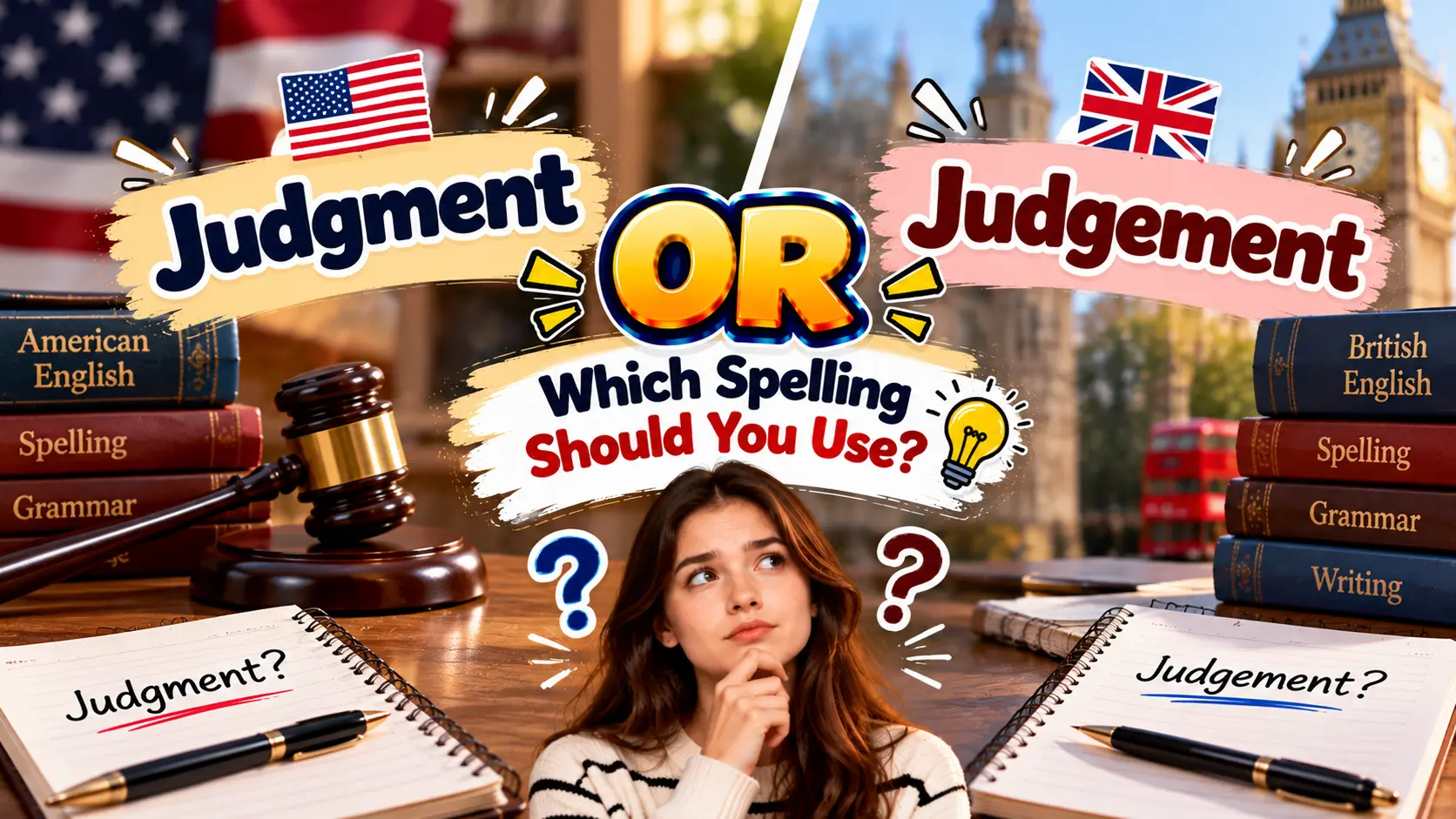
Judgment or judgement—why do you sometimes see the word written with an extra e? Both spellings appear in English, but your choice can depend on the variety of English you’re writing.
In American English, judgment is the standard and preferred spelling. Judgement is also a recognized spelling, especially in British English, but it is less common in American usage.
The difference is small, yet it matters if you’re writing for a US audience, preparing professional documents, creating website content, or trying to maintain consistent American English spelling.
⚖️ Judgment or Judgement? The Quick Answer
For standard American English, use judgment without the extra e.
| Spelling | American English | British English | Example |
|---|---|---|---|
| Judgment | ✅ Preferred | ✅ Used | Use good judgment. |
| Judgement | ⚠️ Less common | ✅ Common | His judgement was questioned. |
Simple rule:
US English → judgment
British English → judgement is common
If your website targets American readers, judgment is generally the spelling to use.
📖 What Does Judgment Mean?
Judgment is a noun referring to the ability to make a decision, opinion, or assessment after considering information.
It can describe:
- decision-making
- personal opinions
- evaluations
- conclusions
- legal decisions
- practical wisdom
- critical thinking
Examples:
She showed excellent judgment.
The court issued its judgment.
Good judgment is important in difficult situations.
The exact meaning depends on the context.
🇺🇸 Why Does American English Use Judgment?
American English generally prefers judgment without the e.
This spelling follows a broader tendency in American English to simplify certain spellings that retain additional letters in some British forms.
For example:
| American English | British English |
|---|---|
| judgment | judgement |
| acknowledgment | acknowledgement |
| abridgment | abridgement |
However, spelling differences are not always completely consistent, and judgment is especially well established in American usage.
🇬🇧 Is Judgement Wrong?
Not necessarily.
Judgement is a legitimate spelling and is widely used in British English. It is not simply a random misspelling.
However, if your intended audience uses standard American English, judgment is the more appropriate choice.
So the distinction is mainly about English variety and style, rather than one spelling being universally right and the other universally wrong.
⚖️ Judgment vs Judgement at a Glance
| Feature | Judgment | Judgement |
|---|---|---|
| Standard US spelling | ✅ Yes | Less common |
| Common UK spelling | Used | ✅ Yes |
| Extra “e” | No | Yes |
| Meaning | Decision, assessment, opinion | Same |
| Legal context | Very common | Common in UK contexts |
| Professional US writing | Preferred | Usually avoided |
The meaning does not normally change because of the spelling.
🧠 Easy Memory Trick for Judgment
If you’re writing for an American audience, remember:
American judgment drops the “e.”
Think:
judge → judgment
The spelling becomes:
J-U-D-G-M-E-N-T
not:
J-U-D-G-E-M-E-N-T
The missing e is the detail that often causes confusion.
✍️ How to Use Judgment in a Sentence
Here are some natural American English examples:
- She used good judgment.
- His judgment was questioned.
- You should trust your own judgment.
- The decision required careful judgment.
- The manager showed sound judgment.
- Good judgment comes with experience.
- The court issued its final judgment.
- The incident raised questions about professional judgment.
👩⚖️ Judgment in Legal Writing
Judgment is especially common in legal contexts.
A judgment can refer to a formal decision made by a court.
Examples:
The judge entered judgment in favor of the plaintiff.
The court’s judgment was issued yesterday.
The parties agreed to comply with the judgment.
In American legal writing, judgment without the extra e is the standard form.
🧾 Judgment in Everyday Decision-Making
The word can also describe someone’s ability to make sensible decisions.
Examples:
She showed excellent judgment under pressure.
His poor judgment caused unnecessary problems.
The job requires sound professional judgment.
I trust her judgment.
In these sentences, judgment refers to decision-making ability rather than a legal ruling.
💭 Judgment as an Opinion or Assessment
Judgment can also mean an opinion or evaluation.
For example:
Don’t make a judgment before hearing the whole story.
His judgment of the situation was accurate.
The teacher’s judgment was based on the available evidence.
This meaning is common in everyday communication.
📝 Judgment in Professional Writing
American business writing frequently uses judgment when discussing decisions, evaluations, and professional responsibility.
Common phrases include:
- professional judgment
- sound judgment
- good judgment
- poor judgment
- reasonable judgment
- independent judgment
- careful judgment
- business judgment
- personal judgment
Examples:
The position requires strong professional judgment.
Employees are expected to exercise good judgment.
The decision should be based on careful business judgment.
🔎 Judgment vs Judgement in American English
If you’re writing specifically for a US audience, consistency is important.
Preferred:
The committee used its best judgment.
Less typical for US English:
The committee used its best judgement.
The second spelling may still be understood, but it can look like British spelling in an otherwise American English document.
🌍 American vs British Spelling
English has several spelling differences between American and British varieties.
Some familiar examples include:
| American English | British English |
|---|---|
| color | colour |
| honor | honour |
| center | centre |
| organize | organise |
| traveled | travelled |
| judgment | judgement |
These differences don’t necessarily indicate different meanings. They often reflect different spelling conventions.
🧩 Common Mistake: Adding the Extra E
A common American English spelling mistake is:
❌ judgement
when the intended style is standard US English.
Preferred:
✅ judgment
For example:
❌ The employee demonstrated excellent judgement.
✅ The employee demonstrated excellent judgment.
If you’re writing an American English article, essay, resume, report, or business document, judgment is usually the better choice.
🔤 Judgment and Related Words
The word judgment belongs to a family of related terms.
| Word | Meaning |
|---|---|
| judge | Person who decides or evaluates |
| judgment | Decision or evaluation |
| judging | Making an evaluation |
| judged | Evaluated or decided |
| judicial | Related to courts or judges |
Examples:
The judge delivered the judgment.
She was judging the situation carefully.
These related forms can make the spelling easier to remember.
⚖️ Judgment vs Decision
Although judgment and decision are related, they aren’t always identical.
A decision is a choice made after considering alternatives.
Judgment can emphasize the reasoning, evaluation, or assessment involved in reaching that decision.
Compare:
The manager made a decision.
The manager showed good judgment.
The first focuses on the choice. The second emphasizes the quality of the person’s evaluation or reasoning.
🧠 How to Remember Judgment Without the E
Try this visual trick:
JUDGE + MENT = JUDGMENT
The word is built around judge and -ment.
Notice that the final form is:
judgment
rather than:
judgement
For American English, remember that the e disappears before -ment.
📊 Correct Spelling by Context
| Context | Recommended US Spelling |
|---|---|
| Business writing | judgment |
| Academic writing | judgment |
| American legal writing | judgment |
| Website content for US readers | judgment |
| Resume | judgment |
| Professional email | judgment |
| British English content | judgement is common |
| International content | Choose one style and remain consistent |
✏️ Correct and Incorrect Examples
American English:
The manager showed excellent judgment.
British English:
The manager showed excellent judgement.
Both communicate the same basic idea.
For a US-focused article:
Judgment is the preferred spelling.
📚 Judgment in Academic Writing
In academic writing, judgment may refer to an evaluation, conclusion, or decision based on evidence.
Examples:
The researchers used professional judgment when interpreting the results.
The study requires careful judgment of the available evidence.
The author’s judgment was influenced by the available data.
When following American English conventions, use judgment consistently.
💼 Judgment in Workplace Communication
You may encounter the word in workplace evaluations and professional discussions.
Examples:
- good judgment
- sound judgment
- professional judgment
- independent judgment
- poor judgment
- judgment call
A judgment call is a decision made using personal assessment when there is no completely obvious answer.
Example:
Choosing the launch date was ultimately a judgment call.
📣 What Does “Use Your Judgment” Mean?
The phrase use your judgment means to make a sensible decision based on the circumstances.
For example:
Use your judgment when deciding whether to continue.
It suggests that the person should assess the situation and choose an appropriate action.
Other common expressions include:
- trust your judgment
- exercise your judgment
- use good judgment
- show good judgment
- question someone’s judgment
- rely on your judgment
🔍 Judgment in Different Sentences
Here are several examples showing different meanings:
Her judgment was excellent.
Meaning: Her decision-making ability was good.
The court issued its judgment.
Meaning: The court made a formal legal decision.
Don’t make a judgment too quickly.
His Meaning: Don’t form an opinion too soon.
It was a judgment call.
Meaning: The decision required personal assessment.
🎯 Quick Practice: Judgment or Judgement?
Choose the spelling that fits standard American English.
- She showed excellent ___.
Answer: judgment - The court issued its final ___.
Answer: judgment - Good ___ is essential in leadership.
Answer: judgment - The manager used professional ___.
Answer: judgment - The decision required careful ___.
Answer: judgment - Which spelling is preferred in American English?
Answer: judgment - Which spelling is common in British English?
Answer: judgement
❓ Frequently Asked Questions About Judgment vs Judgement
Is it judgment or judgement?
Both spellings exist, but judgment is the standard and preferred spelling in American English. Judgement is especially common in British English.
Is judgement wrong?
No. Judgement is an established spelling, particularly in British English. It is simply less common in standard American English.
Which spelling should Americans use?
American writers should generally use judgment.
Why does American English spell it judgment?
American English traditionally uses the shorter spelling judgment, without the extra e.
Is judgment used in legal writing?
Yes. Judgment is the standard spelling in American legal contexts.
Is “good judgment” correct?
Yes. Good judgment is a common phrase meaning the ability to make sensible decisions.
Is “judgment call” correct?
Yes. A judgment call is a decision that requires personal assessment, especially when the answer is not obvious.
Does judgment mean opinion?
It can. Depending on context, judgment can refer to an opinion, assessment, decision, or formal court ruling.
What is the difference between judgment and judgement?
The primary difference is spelling convention. Judgment is preferred in American English, while judgement is common in British English.
Should I use judgment or judgement on a US website?
If the website targets American English readers, judgment is generally the preferred spelling.
Does the pronunciation change?
No meaningful pronunciation difference is normally intended. The main distinction is spelling, not meaning or pronunciation.
How do I remember the American spelling?
Remember:
judge + ment = judgment
The American spelling drops the extra e.
🏁 Final Takeaway
When choosing between judgment or judgement, the right spelling depends largely on the English variety you’re using.
For American English, use:
judgment ✅
For British English, you will commonly see:
judgement ✅
The meaning is essentially the same: a decision, evaluation, opinion, or formal ruling.
If you’re writing for a US audience, consistency is the key. Choose judgment and use it throughout your article, essay, website, report, or professional document.

Olivia Bennett is a writer and language enthusiast at Vocabsteria. She is passionate about exploring word meanings, name origins, and cultural expressions from around the world.