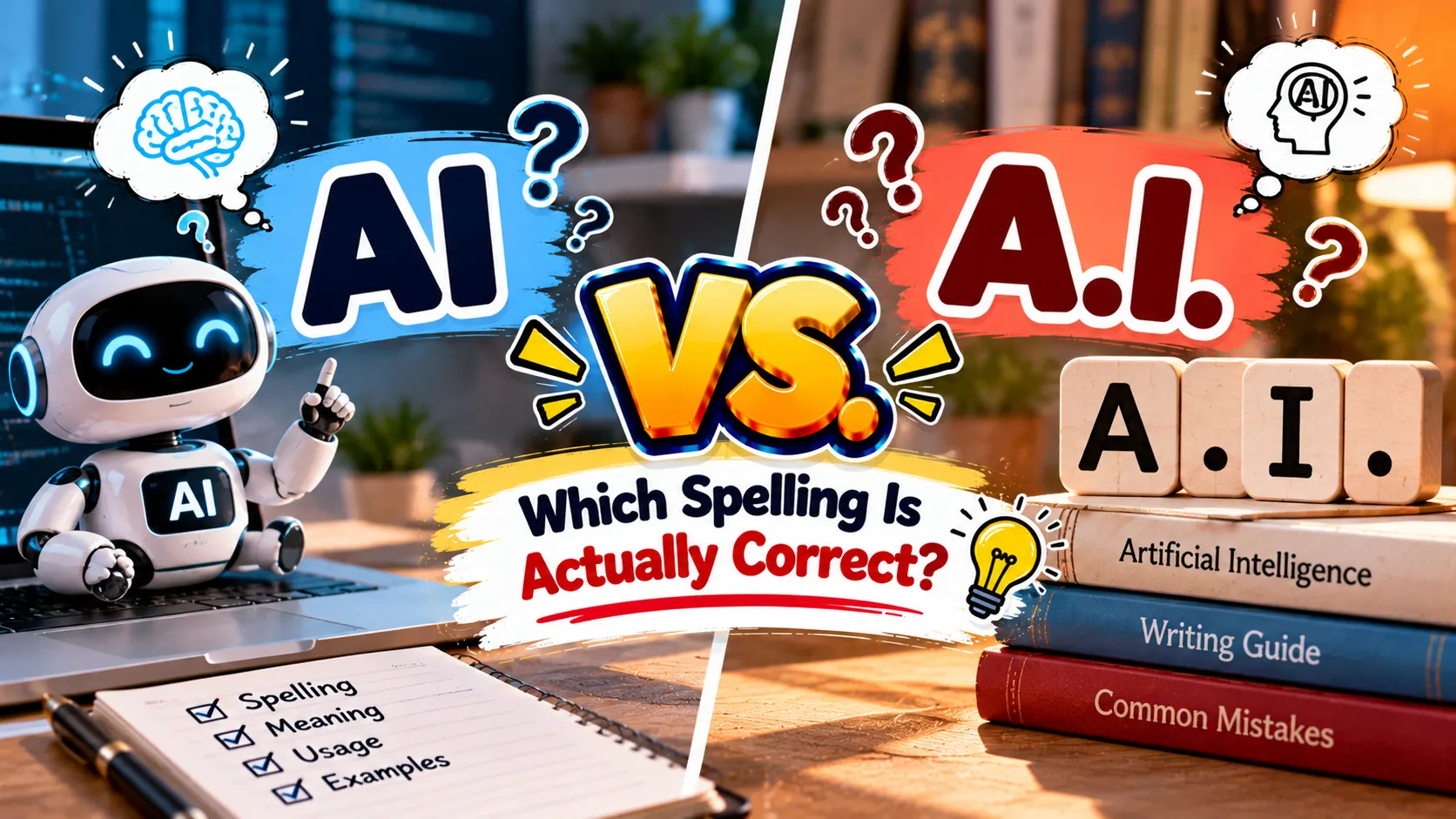
Should you write AI or A.I.? Both forms have appeared in English for years, but modern usage has changed enough to make this small punctuation choice surprisingly confusing.
The abbreviation comes from artificial intelligence, and both AI and A.I. can be understood. However, AI is now the standard and much more common form in modern American English, especially in technology, business, journalism, education, and online content.
If you’re writing a website article, school assignment, professional report, product description, or social media post for a US audience, AI is generally the cleaner and more current choice.
🤖 AI or A.I.? The Quick Answer
For modern American English, use AI in most situations.
| Form | Usage | Example |
|---|---|---|
| AI | Modern standard and preferred | AI is changing technology. |
| A.I. | Older/alternative style | A.I. research has expanded. |
| Artificial intelligence | Full term | Artificial intelligence can analyze data. |
Simple rule:
Modern writing → AI
Older style or a specific style guide → A.I. may appear
The meaning is the same.
🧠 What Does AI Mean?
AI stands for artificial intelligence. It is used as a shortened form of the full phrase.
Artificial intelligence broadly refers to computer systems designed to perform tasks that typically require forms of human intelligence, such as:
- recognizing patterns
- processing language
- analyzing information
- generating content
- making predictions
- identifying objects
- solving certain problems
For example:
AI is being used in many industries.
The abbreviation makes the phrase shorter and easier to use repeatedly.
🔤 Why Do Some People Write A.I.?
The spelling A.I. follows an older abbreviation convention in which periods are placed after individual letters.
For example:
A.I. = artificial intelligence
Older publications and style systems sometimes used periods for initialisms and abbreviations.
Over time, many widely used abbreviations dropped their periods.
Examples include:
- USA
- UK
- CEO
- HTML
- NASA
- AI
As technology writing became more standardized, AI became the dominant form.
⚖️ AI vs A.I. at a Glance
| Feature | AI | A.I. |
|---|---|---|
| Meaning | Artificial intelligence | Artificial intelligence |
| Modern usage | Very common | Less common |
| Technology writing | Preferred | Older style |
| US websites | Preferred | Usually unnecessary |
| Readability | Clean and simple | More visually formal |
| Punctuation | No periods | Period after each letter |
The important difference is style, not meaning.
🇺🇸 AI in American English
For contemporary American English, AI is the form most readers expect.
You will commonly see it in:
- technology articles
- news stories
- business reports
- academic papers
- software documentation
- product descriptions
- educational materials
- search results
- websites
- social media
Examples:
AI tools can automate repetitive tasks.
The company is investing heavily in AI.
Students are learning about AI in school.
💻 AI in Technology Writing
Technology writing almost universally favors the shorter form AI.
Common phrases include:
- AI technology
- AI tools
- AI models
- AI systems
- AI software
- AI applications
- AI research
- AI development
- AI assistants
- AI-generated content
Examples:
The company launched a new AI tool.
Researchers are developing advanced AI models.
The platform uses AI technology to analyze information.
Writing A.I. technology is understandable, but it looks more dated in many modern technology contexts.
📰 AI in News and Journalism
Modern journalism commonly uses AI without periods.
Examples:
The report examines how AI is changing the workplace.
Companies are adopting AI tools.
New AI regulations are being discussed.
News writing generally favors concise, familiar forms, which makes AI a natural choice.
🎓 AI in Academic Writing
Academic writing can be slightly more complicated because universities, journals, and publishers may follow specific style guides.
In general, however, AI is widely used in modern academic writing.
For example:
Artificial intelligence (AI) has become an important research area.
After defining the abbreviation, the writer can normally use AI throughout the rest of the paper.
Always follow the specific style guide if your institution or publication requires a particular format.
✍️ Should You Write Artificial Intelligence or AI?
When introducing the term in formal writing, a useful approach is to write the full phrase first and then provide the abbreviation.
For example:
Artificial intelligence (AI) is transforming many industries.
After that, you can simply write:
AI is becoming increasingly important.
This makes the abbreviation clear to readers who may not know it.
🔎 AI as an Initialism
AI is generally treated as an initialism formed from the first letters of artificial intelligence.
The letters are pronounced individually:
A-I
This differs from an acronym such as NASA, which is commonly pronounced as a word.
Because AI is pronounced letter by letter, some older writing conventions used periods:
A.I.
Modern usage generally removes those periods:
AI
📝 AI or A.I. in Professional Writing
For modern professional communication, AI is usually the better choice.
Examples:
Our company uses AI to improve customer service.
The team is evaluating several AI solutions.
We need an AI strategy for the next phase of development.
The shorter spelling looks cleaner and aligns with contemporary technology terminology.
🌐 AI on Websites and Blogs
If you’re writing SEO content for a US audience, AI is generally the better spelling.
Common search-oriented phrases include:
- AI tools
- AI writing tools
- AI image generators
- AI content
- AI technology
- AI software
- artificial intelligence
- AI assistants
- AI applications
For example:
The best AI tools can help automate repetitive tasks.
The abbreviation is now so familiar that most readers immediately understand it.
🚫 Common Mistake: Treating A.I. as the Only Correct Form
Some writers assume that because AI contains two letters, it must have periods.
That isn’t necessary.
Abbreviations and initialisms can be written with or without periods depending on convention and style.
For modern technology writing:
AI is the standard choice.
So:
❌ AI is not automatically “missing punctuation.”
It is simply following modern abbreviation style.
🚫 Common Mistake: Saying A.I. Is Always Wrong
The opposite claim would also be inaccurate.
A.I. is a recognizable and historically established form. You may still encounter it in older publications, personal writing, or documents following a particular style.
For example:
The article discusses A.I. research.
The meaning is clear.
However, if you’re creating fresh content for a modern US audience, AI is generally the more natural choice.
📊 Common AI Expressions
| Phrase | Preferred Modern Form |
|---|---|
| artificial intelligence | AI |
| AI technology | AI |
| AI tools | AI |
| AI model | AI |
| AI system | AI |
| AI research | AI |
| AI software | AI |
| AI development | AI |
| AI assistant | AI |
| AI-generated | AI-generated |
These forms are widely recognizable in modern English.
🤖 AI as a Noun Modifier
AI can appear before another noun to describe something related to artificial intelligence.
Examples:
- AI model
- AI system
- AI application
- AI company
- AI researcher
- AI software
- AI assistant
- AI platform
- AI algorithm
- AI chatbot
For example:
The company released a new AI assistant.
Here, AI functions as a noun modifier.
🔤 Capitalization: AI or Ai?
The standard abbreviation is:
AI
Both letters are capitalized because they represent the initial letters of Artificial Intelligence.
Avoid:
❌ Ai
The standard form is:
✅ AI
Similarly, when using the punctuated variant, the traditional form is:
A.I.
not:
❌ A.i.
🧩 AI in Compound Words
When AI forms part of a compound term, capitalization remains important.
Examples:
- AI-powered
- AI-based
- AI-driven
- AI-assisted
- AI-generated
- AI-enabled
- AI-focused
Examples:
The company developed an AI-powered application.
The platform offers AI-generated summaries.
Researchers are studying AI-driven systems.
✏️ Correct and Incorrect Examples
Modern standard:
AI is changing the way people work.
Alternative older style:
A.I. is changing the way people work.
Both communicate the same meaning.
Capitalization:
✅ AI
❌ Ai
Modern compound:
✅ AI-powered software
❌ Ai-powered software
🌎 AI vs A.I. in Different English Varieties
The difference between AI and A.I. is less about American versus British English than it is about modern versus older punctuation conventions and individual style guides.
Unlike words such as color/colour or judgment/judgement, there is no major difference in meaning between American and British English here.
Both English varieties commonly use:
AI
The unpunctuated form has become the dominant modern style internationally.
📚 Similar Abbreviation Changes
English has gradually removed periods from many familiar abbreviations.
Older styles may have used:
- U.S.
- U.K.
- Ph.D.
- M.A.
- A.I.
Modern styles often use:
- US
- UK
- PhD
- MA
- AI
The exact treatment depends on the style guide, but the overall trend is toward simpler punctuation.
🧠 Easy Memory Trick for AI
Think of AI as a modern technology brand-like abbreviation:
AI = simple, clean, modern
No dots are needed.
If you’re writing a current article, blog post, technical document, or business report, AI is usually the safest choice.
🔍 When Should You Use A.I.?
There are a few situations where you may intentionally keep the periods.
1. Following a specific style guide
If your organization, school, publisher, or client requires A.I., follow that convention.
2. Quoting an older source
If you are reproducing the original spelling of an older title or quotation, retain its original form when appropriate.
3. Matching an established publication style
Some publications may have their own house style.
The key is consistency.
📝 Consistency Matters More Than Tiny Style Differences
Suppose you begin an article using:
AI technology
and later switch to:
A.I. technology
The reader will still understand you, but the inconsistency can make the document look less polished.
Choose one style and maintain it.
For modern US web content:
AI is usually the easiest choice.
🎯 Quick Practice: AI or A.I.?
Choose the preferred modern form.
- ___ technology is developing quickly.
Answer: AI - The company uses ___ tools.
Answer: AI - Researchers are studying ___ systems.
Answer: AI - The article discusses ___ applications.
Answer: AI - Which form is more common in modern technology writing?
Answer: AI - Which older punctuation style may still appear?
Answer: A.I. - What should you use for a US-focused technology website?
Answer: AI
❓ Frequently Asked Questions About AI vs A.I.
Is it AI or A.I.?
Both forms are understandable, but AI is the standard and much more common modern form.
Is AI the correct spelling?
Yes. AI is the standard modern abbreviation for artificial intelligence.
Is A.I. wrong?
No. A.I. is an older or alternative punctuation style. It may still appear in some publications and style systems.
Should I use AI in American English?
Yes. For modern American English, AI is generally the preferred form.
Why did people write A.I.?
Older abbreviation conventions often placed periods after individual letters. Modern usage frequently removes those periods.
Should AI be capitalized?
Yes. The standard abbreviation is AI, with both letters capitalized.
Is Ai correct?
No, Ai is not the standard abbreviation for artificial intelligence. Use AI.
Should I write artificial intelligence (AI)?
Yes. This is a common approach when introducing the term in formal or academic writing.
Is AI an acronym?
AI is generally described as an initialism because the letters are pronounced individually as “A-I.”
Which is better for a website: AI or A.I.?
For a modern US-focused website, AI is generally the cleaner and more familiar choice.
Is A.I. still used?
Yes. You may still encounter A.I. in older material, personal writing, or publications that retain traditional abbreviation punctuation.
Does AI mean artificial intelligence?
Yes. AI is the standard abbreviation for artificial intelligence.
🏁 Final Takeaway
When choosing between AI or A.I., the modern answer is usually straightforward.
AI = preferred modern form ✅
A.I. = older or alternative punctuation style
Both refer to artificial intelligence, so the difference is primarily one of writing style rather than meaning.
For a contemporary American English website, article, business document, or technology publication, AI is generally the cleaner choice. Introduce the full term once when necessary, then use the abbreviation consistently.

Olivia Bennett is a writer and language enthusiast at Vocabsteria. She is passionate about exploring word meanings, name origins, and cultural expressions from around the world.