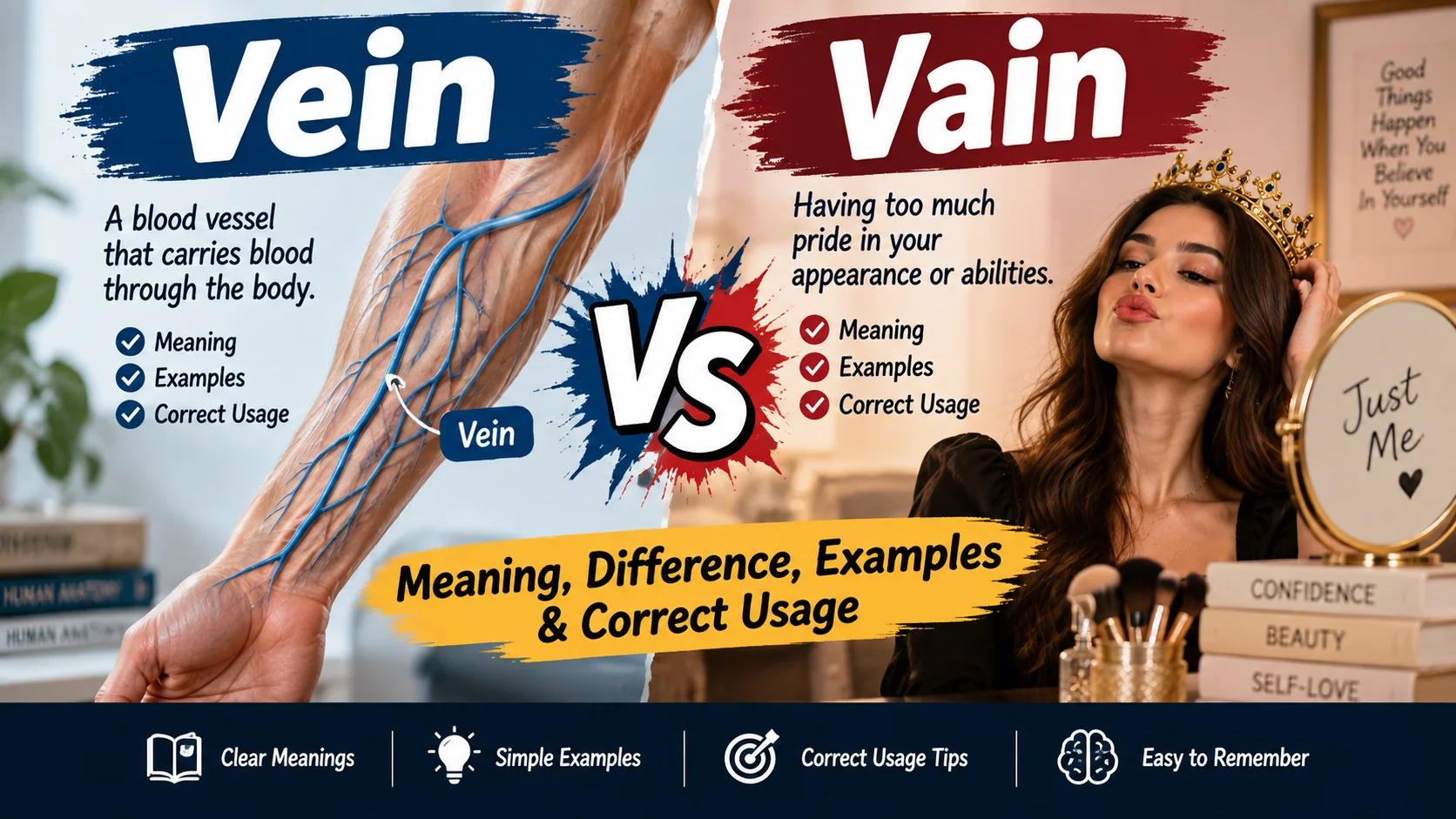
Vein and vain are two English words that sound exactly the same but have completely different meanings. Because they are pronounced alike, they can easily cause confusion in writing. Vein is mainly a noun related to the body, plants, rocks, or patterns, while vain is an adjective that usually describes someone who is overly proud of their appearance or an effort that produces no useful result.
For example, you might talk about a vein in your arm, but you would describe someone who is excessively concerned with their appearance as vain. You can also say that something was done in vain, meaning that the effort was unsuccessful or achieved nothing.
Understanding the difference between vein vs. vain is important because choosing the wrong spelling can completely change the meaning of a sentence.
Vein vs. Vain: Quick Answer
The easiest way to remember the difference is:
- Vein = a blood vessel, plant structure, mineral deposit, or distinctive line or pattern
- Vain = overly proud of appearance or unsuccessful and pointless
- In vain = without success or without achieving the desired result
Examples:
The nurse found a vein in his arm.
He is very vain about his appearance.
They tried in vain to open the locked door.
Although all three sentences contain words that sound alike, their meanings are completely different.
Vein vs. Vain at a Glance
| Word | Part of Speech | Main Meaning | Example |
|---|---|---|---|
| Vein | Noun | A blood vessel that carries blood toward the heart | The doctor examined the vein. |
| Vein | Noun | A thin line or pattern in a plant, leaf, or material | The leaf has visible veins. |
| Vein | Noun | A deposit of minerals or metal in rock | The miners discovered a vein of gold. |
| Vain | Adjective | Too proud of one’s appearance or abilities | He is vain about his looks. |
| Vain | Adjective | Unsuccessful or pointless when used in the phrase in vain | Their efforts were in vain. |
What Does Vein Mean?
Vein is primarily a noun. In anatomy, a vein is a blood vessel that carries blood toward the heart.
Examples:
- The nurse inserted the needle into a vein.
- The doctor examined the veins in her leg.
- His veins were visible beneath his skin.
- The blood sample was taken from a vein in his arm.
This is the most common meaning of vein.
Veins in the Human Body
Arteries and veins both carry blood, but they generally carry it in opposite directions.
- Arteries carry blood away from the heart.
- Veins carry blood toward the heart.
For everyday writing, you usually only need to remember that a vein is a type of blood vessel.
Vein in Plants
The word vein can also describe the structures that carry water and nutrients through a leaf.
Examples:
- The leaf has delicate green veins.
- The main vein runs through the center of the leaf.
- The smaller veins spread outward from the central vein.
Here, vein does not refer to a human blood vessel. It refers to a similar branching structure in a plant.
Vein in Geology
In geology and mining, a vein can refer to a narrow deposit of minerals or valuable material within rock.
Examples:
- The miners discovered a vein of silver.
- A vein of quartz ran through the rock.
- The geologists found a mineral vein beneath the surface.
This meaning is different from the anatomical meaning, but the basic idea of a narrow line or channel remains.
Vein as a Pattern or Line
Vein can also describe a distinctive line, streak, or branching pattern in materials such as marble, wood, or leaves.
Examples:
- The marble has beautiful white veins.
- The wood has dark veins running through it.
- The artist used the natural veins in the stone.
In this sense, vein refers to something that resembles a branching line or streak.
What Does Vain Mean?
Vain is an adjective with two important meanings.
The first describes someone who has an excessively high opinion of their appearance, abilities, or importance.
Examples:
- She is vain about her appearance.
- He is too vain to admit his mistakes.
- The actor was known for being vain.
- She spends hours looking in the mirror because she is vain.
In this sense, vain is usually associated with excessive self-admiration.
Vain Meaning Unsuccessful or Pointless
Vain has another important meaning, especially in the expression in vain.
In vain means that an attempt or effort was unsuccessful or failed to achieve the desired result.
Examples:
- We searched in vain for the missing key.
- She tried in vain to contact him.
- They waited in vain for a response.
- He attempted in vain to repair the machine.
Here, vain has nothing to do with appearance or pride.
What Does In Vain Mean?
The phrase in vain means without success, without achieving the intended result, or unsuccessfully.
For example:
I tried in vain to convince him.
This means:
I tried to convince him, but I was unsuccessful.
Another example:
They searched in vain for the missing dog.
This means they searched but did not find the dog.
Vein vs. Vain: Detailed Difference
| Feature | Vein | Vain |
|---|---|---|
| Pronunciation | Same | Same |
| Part of speech | Usually noun | Adjective |
| Related to | Blood vessels, plants, minerals, patterns | Pride, appearance, unsuccessful efforts |
| Common phrase | Blood vein | In vain |
| Example | A vein carries blood. | She is vain. |
| Other use | Vein of quartz | Their efforts were in vain. |
The biggest difference is meaning. Vein usually refers to a physical structure or line, while vain describes a quality, attitude, or unsuccessful effort.
Vein vs. Vain vs. Vane
There is actually a third word that sounds the same: vane.
These three words are homophones:
- Vein → blood vessel or narrow line/deposit
- Vain → excessively proud or unsuccessful
- Vane → a flat device or blade, such as on a wind turbine or weather vane
Examples:
The doctor examined the vein.
He is vain about his appearance.
The weather vane pointed north.
Knowing all three can help prevent spelling mistakes.
Common Mistakes With Vein and Vain
Mistake 1: Using Vain for a Blood Vessel
Incorrect:
The doctor examined the vain in my arm.
Correct:
The doctor examined the vein in my arm.
A blood vessel is a vein.
Mistake 2: Using Vein for Someone Who Is Conceited
Incorrect:
She is very vein about her appearance.
Correct:
She is very vain about her appearance.
Someone who is excessively proud of their appearance can be described as vain.
Mistake 3: Writing In Vein
Incorrect:
They searched in vein for the missing document.
Correct:
They searched in vain for the missing document.
The expression meaning unsuccessfully is in vain.
Vein: Examples in Sentences
Here are some examples of vein in different contexts:
- The nurse located a vein in his arm.
- The doctor checked the patient’s veins.
- The leaf has several visible veins.
- A large vein runs through the center of the leaf.
- The miners discovered a vein of gold.
- The rock contained a narrow vein of quartz.
- The marble had beautiful gray veins.
- The wood showed several dark veins.
- The surgeon carefully avoided the major vein.
- The mineral vein extended deep underground.
Vain: Examples in Sentences
Here are examples of vain in its different uses:
- She is very vain about her appearance.
- He is too vain to accept criticism.
- The vain actor spent hours checking his reflection.
- She became vain after receiving constant compliments.
- They searched in vain for the missing book.
- I tried in vain to solve the problem.
- He waited in vain for an apology.
- We called several times in vain.
- Their attempt to change the decision was in vain.
- She tried in vain to repair the broken phone.
Vein and Vain in Everyday English
The context usually makes the intended meaning clear.
If the sentence discusses:
- Blood
- Anatomy
- Leaves
- Plants
- Rocks
- Minerals
- Marble
- Wood
you probably need vein.
If the sentence discusses:
- Pride
- Appearance
- Self-importance
- Conceit
- Failed efforts
you probably need vain.
This simple context check can help you choose the correct spelling.
How to Remember Vein vs. Vain
A useful memory trick is to connect vein with the body.
Think:
Vein → Vessels
Both words begin with V, and a vein is a blood vessel.
For vain, think:
Vain → Vanity
The word vanity refers to excessive pride in one’s appearance or achievements.
So remember:
Vein = vessel
Vain = vanity
And:
In vain = unsuccessful
Vein vs. Vain in Medical Writing
When discussing anatomy, the correct spelling is always vein.
Examples:
- The blood was drawn from a vein.
- The patient had a damaged vein.
- The doctor located a superficial vein.
- The procedure involved a major vein.
Using vain in these sentences would be incorrect.
Vein vs. Vain in Descriptive Writing
Writers may use vein to describe visible patterns.
Examples:
- Golden veins ran through the marble.
- Blue veins appeared beneath his skin.
- The leaf’s delicate veins formed a beautiful pattern.
Vain, however, is used to describe a person’s attitude or an unsuccessful attempt.
Example:
- Her vain obsession with appearance became obvious.
- They made a vain attempt to escape.
Words Related to Vein
Depending on the context, related terms include:
- Blood vessel
- Vessel
- Capillary
- Venous vessel
- Leaf vein
- Mineral deposit
- Streak
- Line
- Channel
These are not always exact synonyms, but they can help explain the different meanings of vein.
Words Related to Vain
When vain means overly proud, related words include:
- Conceited
- Self-centered
- Egotistical
- Self-important
- Arrogant
- Proud
- Pretentious
- Self-absorbed
When vain means unsuccessful, related expressions include:
- Fruitless
- Futile
- Unsuccessful
- Pointless
- Ineffective
- Useless
For example:
They made a vain attempt.
can be expressed as:
They made a futile attempt.
Vein vs. Vain: Quick Practice
Choose vein or vain in each sentence.
- The doctor found a suitable ___ for the blood test.
- She is extremely ___ about her appearance.
- They tried in ___ to find the lost wallet.
- The leaf has several visible ___.
- The miners discovered a ___ of copper.
- He is too ___ to admit that he was wrong.
- The nurse inserted the needle into a ___.
- We waited in ___ for a response.
Answers
- Vein
- Vain
- Vain
- Veins
- Vein
- Vain
- Vein
- Vain
People Also Ask
What is the difference between vein and vain?
Vein is usually a noun referring to a blood vessel, plant structure, mineral deposit, or distinctive line. Vain is an adjective describing excessive pride or an unsuccessful effort.
Is vein and vain pronounced the same?
Yes. Vein and vain are homophones because they have the same pronunciation but different spellings and meanings.
What does vein mean?
A vein is a blood vessel that carries blood toward the heart. The word can also describe structures in leaves, mineral deposits in rock, or lines and patterns in materials.
What does vain mean?
Vain can describe someone who is excessively proud of their appearance or abilities. In the phrase in vain, it means unsuccessful or without the desired result.
Is it in vain or in vein?
The correct expression is in vain when you mean without success or unsuccessfully.
What is an easy way to remember vein and vain?
Remember vein = vessel and vain = vanity. If the sentence concerns blood or a physical structure, use vein. If it concerns excessive pride or an unsuccessful effort, use vain.
What is another word for vain?
When vain means excessively proud, alternatives include conceited, egotistical, self-important, arrogant, and self-absorbed. When it means unsuccessful, alternatives include futile, fruitless, and ineffective.
Is vein a noun?
Yes. Vein is primarily used as a noun.
Frequently Asked Questions
Can vein and vain be used interchangeably?
No. They sound the same, but their meanings are completely different.
What is the plural of vein?
The plural is veins.
Example:
The doctor examined the veins in her arm.
What is the noun form of vain?
The related noun is vanity, especially when discussing excessive pride in appearance or abilities.
What does a vein of gold mean?
A vein of gold is a narrow deposit of gold found within rock.
What does a vein in a leaf mean?
A vein in a leaf is one of the structures that carries water and nutrients through the leaf.
Does vain always mean conceited?
No. In the expression in vain, it means that something was attempted without success.
What does a vain attempt mean?
A vain attempt is an unsuccessful attempt that does not achieve its intended result.
Conclusion
The difference between vein vs. vain becomes simple once you connect each word with its meaning. Vein is generally a noun used for a blood vessel, a structure in a leaf, a mineral deposit, or a distinctive line or pattern. Vain is an adjective that can describe someone who is excessively proud of their appearance or abilities.
The phrase in vain has a separate meaning: it describes an action or effort that is unsuccessful.
A quick memory trick can help: vein = vessel, while vain = vanity. If you’re talking about blood, leaves, minerals, or physical patterns, choose vein. If you’re describing excessive pride or an unsuccessful effort, choose vain.
Although the two words sound identical, their meanings are easy to distinguish when you pay attention to context.

Olivia Bennett is a writer and language enthusiast at Vocabsteria. She is passionate about exploring word meanings, name origins, and cultural expressions from around the world.