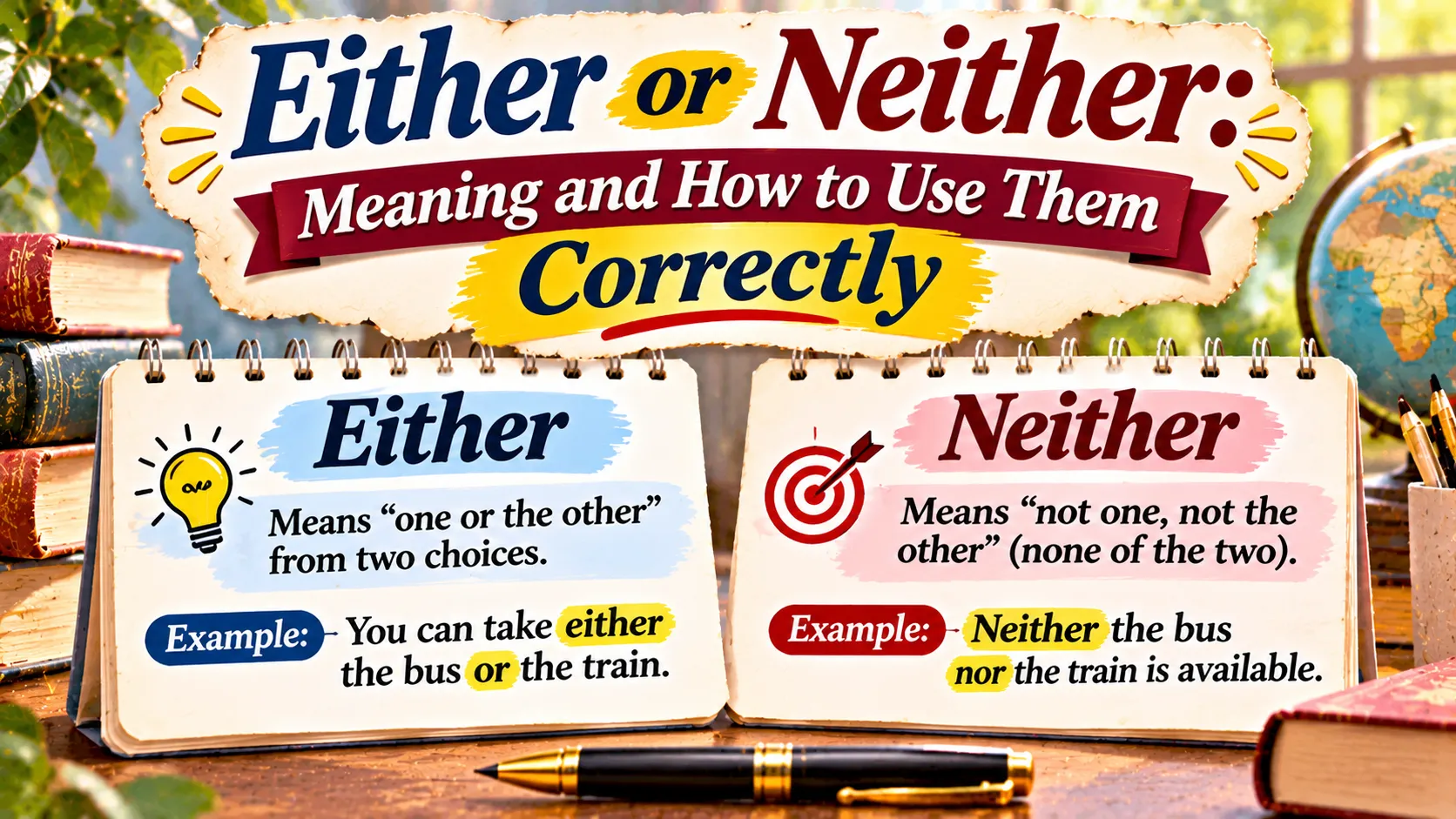
Have you ever wondered whether to use either or neither in a sentence? These two words often confuse English learners because they both relate to two choices or possibilities. However, they express different meanings and follow different grammar rules. Understanding the difference can help you write clearer sentences, avoid common mistakes, and communicate your ideas more confidently.
The easiest way to remember the distinction is that either generally refers to one of two options, while neither means not one and not the other. Both words can function as pronouns, determiners, and conjunctions, depending on how you use them. Let’s explore their meanings, sentence patterns, examples, and common grammar rules.
Either vs. Neither: What’s the Difference? 🤔
The main difference between either and neither comes from the meaning they express. Either presents two possible choices, while neither rejects both choices.
- Either: One or the other of two options. It can also express that both options are acceptable.
- Neither: Not one and not the other. It indicates that both options are unacceptable, incorrect, or unavailable.
Consider these examples:
- You can choose either coffee or tea.
- Neither coffee nor tea contains the answer to my question.
The first sentence offers two choices. The second sentence excludes both choices.
You can also use either in a positive statement and neither in a negative statement.
What Does Either Mean? 📘
Either refers to one of two people, things, choices, or possibilities. It allows someone to select one option without choosing both. In some sentences, either also communicates that both alternatives are equally acceptable.
For example, imagine a restaurant offers two desserts. If someone says, “You can have either dessert,” they mean you may select one of the two options.
Here are more examples:
- You can sit on either side of the table.
- Either answer will work for this question.
- We can visit either museum this weekend.
- Either road leads to the shopping center.
- You may choose either color for your bedroom.
- Either student can represent the class.
- I don’t mind either option.
- You can call me either today or tomorrow.
In these examples, either introduces or refers to two possible alternatives.
What Does Neither Mean? 🚫
Neither means not one and not the other. Use it when you want to reject two choices or explain that neither of two people or things meets a particular condition.
For example, if someone asks whether you prefer coffee or tea and you dislike both, you can respond, “Neither.” This single word communicates that you do not want either option.
Here are additional examples:
- Neither answer is correct.
- Neither student attended the meeting.
- I like neither color.
- Neither restaurant serves breakfast.
- Neither option fits my budget.
- Neither brother lives in New York.
- Neither movie interested me.
- Neither road takes us to the airport.
Neither already carries a negative meaning, so you generally should not add another negative word to the same clause. For example, write “Neither answer is correct,” not “Neither answer isn’t correct.”
How to Use Either in a Sentence ✍️
Either can serve different grammatical purposes. You can use it to offer choices, refer to two possibilities, or agree with a negative statement. The sentence structure determines its exact meaning.
As a determiner: Place either before a singular noun when you refer to one of two options.
- Either candidate can win the election.
- You can take either book.
As a pronoun: Use either independently when the noun is already clear from the conversation.
- Which dress do you prefer? Either is fine.
- There are two available seats. You can take either.
As a conjunction: Use either with or to connect two alternatives.
- You can either walk or take a taxi.
- Either we leave now, or we arrive late.
In negative sentences: Use either at the end of a negative statement to mean that something is also not true for another person or situation.
- I don’t like spicy food, and my brother doesn’t either.
- She isn’t coming, and I won’t either.
How to Use Neither in a Sentence 📖
Neither also has several grammatical uses. It can function as a determiner, pronoun, or conjunction. Each structure helps you express that two options share the same negative result.
As a determiner: Place neither before a singular noun to indicate that both options fail to meet a condition.
- Neither answer is correct.
- Neither child wants to leave.
As a pronoun: Use neither independently when you reject both options.
- Which dress do you want? Neither.
- Do you prefer coffee or tea? Neither.
As a conjunction: Pair neither with nor to connect two negative alternatives.
- Neither Sarah nor Emily attended the party.
- He likes neither football nor basketball.
To agree with a negative statement: Use neither with an auxiliary verb and the subject.
- I don’t eat meat. Neither do I.
- She cannot drive. Neither can her sister.
Either…Or vs. Neither…Nor: Understanding the Difference 🔗
Either…or and neither…nor are paired conjunctions. Both connect two alternatives, but they communicate opposite ideas.
Either…or presents two possible choices. The sentence suggests that one of the alternatives applies or that someone must select between them.
Examples:
- Either John or Mark will lead the meeting.
- You can either order pizza or prepare dinner.
- We will travel either by train or by bus.
- Either the manager or the assistant will call you.
Neither…nor connects two negative alternatives. It explains that neither option applies.
Examples:
- Neither John nor Mark will lead the meeting.
- She likes neither pizza nor pasta.
- Neither the manager nor the assistant answered the phone.
- He speaks neither French nor German.
Remember this simple distinction:
| Structure | Meaning | Example |
|---|---|---|
| Either…or | One option or the other | Either Anna or Lisa will help. |
| Neither…nor | Not one and not the other | Neither Anna nor Lisa will help. |
Either Is vs. Either Are: Which Is Correct? 🔍
The correct choice between either is and either are depends on the sentence structure. When either acts as a determiner before a singular countable noun, it generally takes a singular verb.
Examples:
- Either option is acceptable.
- Either student has the required information.
- Either answer works for me.
However, when either appears in a paired construction with or, the verb generally agrees with the subject closest to it.
- Either the teacher or the students are responsible.
- Either the students or the teacher is responsible.
This proximity rule also applies to neither…nor constructions. When the subjects differ in number, placing the plural subject closer to the verb often makes the sentence easier to read.
Neither Is vs. Neither Are: Which Is Correct? ⚖️
When neither functions as a determiner before a singular noun, use a singular verb in standard formal writing.
Examples:
- Neither answer is correct.
- Neither student has arrived.
- Neither option works for me.
When neither appears in a neither…nor construction, the verb usually agrees with the subject closest to it.
- Neither the coach nor the players are ready.
- Neither the players nor the coach is ready.
Although you may encounter plural agreement with neither in everyday speech, singular agreement remains the traditional choice when neither independently refers to two people or things.
Common Mistakes When Using Either and Neither ⚠️
Writers often confuse these words because they both refer to two alternatives. Understanding their meanings and sentence patterns can help you avoid the following mistakes.
Mistake 1: Using neither when you want to offer a choice
Incorrect: You can choose neither dress.
Correct: You can choose either dress.
Why? Either offers two possible selections. Neither rejects both.
Mistake 2: Using either when both options are rejected
Incorrect: Either answer is correct.
Correct: Neither answer is correct.
Why? If both answers are wrong, neither communicates the intended meaning.
Mistake 3: Mixing neither with or
Incorrect: Neither John or Peter attended.
Correct: Neither John nor Peter attended.
Why? The standard paired structure uses neither…nor.
Mistake 4: Mixing either with nor
Incorrect: Either call me nor send a message.
Correct: Either call me or send a message.
Why? The standard paired structure uses either…or.
Mistake 5: Using double negatives
Incorrect: Neither student didn’t finish the assignment.
Correct: Neither student finished the assignment.
Why? Neither already expresses a negative meaning. Adding didn’t creates an unnecessary double negative in standard English.
Mistake 6: Using an incorrect verb with a singular noun
Incorrect: Neither option are available.
Correct: Neither option is available.
Why? Neither option uses a singular noun, so it generally takes a singular verb.
Either or Neither: Examples in Everyday Conversations 💬
Everyday conversations provide useful opportunities to practice these words. The following examples show how either and neither work in questions, answers, preferences, and daily situations.
Examples with either:
- You can take either route to reach the office.
- Either of my parents can pick me up.
- I can meet you either Monday or Tuesday.
- Either restaurant looks good for dinner.
- You may wear either pair of shoes.
- Either solution could solve the problem.
- I haven’t visited either location yet.
- She doesn’t like coffee, and I don’t either.
Examples with neither:
- Neither of my parents can attend the event.
- Neither restaurant offers outdoor seating.
- I want neither option.
- Neither of us knows the answer.
- Neither candidate impressed the interview panel.
- She likes neither color.
- Neither explanation makes sense.
- I don’t enjoy horror movies, and neither does my sister.
Either and Neither: Easy Ways to Remember the Difference 🧠
A few simple memory tricks can help you choose the correct word without overthinking every sentence.
Remember the meaning: Either means one or the other, while neither means not one and not the other.
Look at the sentence structure: If you see either…or, expect two alternatives. If you see neither…nor, expect two negative alternatives.
Think about your intention: Ask yourself whether you want to offer two choices or reject both. Your intended meaning will usually reveal the correct word.
Practice with a simple example:
- Either cake or ice cream is fine. (One option is acceptable.)
- Neither cake nor ice cream appeals to me. (Both options are unacceptable to me.)
Either or Neither: Practice Quiz With Answers 🎯
Test your understanding by choosing either or neither to complete each sentence. Check the answers after you finish.
- You can choose ______ the red shirt or the blue one.
- ______ answer is correct.
- I don’t like coffee, and my sister doesn’t ______.
- ______ John nor Peter attended the meeting.
- ______ option will work for this project.
- She wants ______ tea nor coffee.
- You can sit on ______ side of the table.
- ______ of the students knew the answer.
- We can travel ______ by car or by train.
- ______ restaurant serves vegetarian food.
Answers:
- Either
- Neither
- Either
- Neither
- Either
- Neither
- Either
- Neither
- Either
- Neither
If you understand why each answer fits, you have a good foundation for using these words correctly.
Frequently Asked Questions About Either or Neither ❓
What is the main difference between either and neither?
Either refers to one of two options, while neither means not one and not the other. Use either to present alternatives and neither to reject both alternatives.
Is either positive or negative?
Either generally expresses a choice or possibility in positive sentences. However, it can also appear in negative sentences, as in “I don’t like it either.”
Is neither always negative?
Yes. Neither carries a negative meaning because it excludes both options. For example, “Neither answer is correct” means both answers are incorrect.
Should I use either or neither with nor?
Use neither…nor to connect two negative alternatives. Use either…or to present two possible choices.
Is it either is or either are?
Use either is when either refers to one of two options before a singular noun, as in “Either choice is fine.” In either…or constructions, the verb generally agrees with the closest subject.
Is it neither is or neither are?
Use neither is when neither refers to two options individually, as in “Neither answer is correct.” In neither…nor constructions, the verb generally agrees with the closest subject.
Can I use either at the end of a sentence?
Yes. You can use either at the end of a negative sentence to express agreement with another negative statement. For example, “I don’t like seafood, and my brother doesn’t either.”
Can I use neither by itself?
Yes. Neither can work as a standalone answer when someone offers two choices. For example, if someone asks, “Do you want coffee or tea?” you can simply answer, “Neither.”
Conclusion 🎓
Understanding either or neither becomes much easier when you focus on what each word communicates. Either presents one of two choices, while neither rejects both options. Remember the paired conjunctions either…or and neither…nor to build grammatically correct sentences.
Practice using these words in everyday conversations, questions, and written examples. Once you understand their meanings and sentence structures, you can choose the correct word confidently and make your English writing clearer.

Olivia Bennett is a writer and language enthusiast at Vocabsteria. She is passionate about exploring word meanings, name origins, and cultural expressions from around the world.