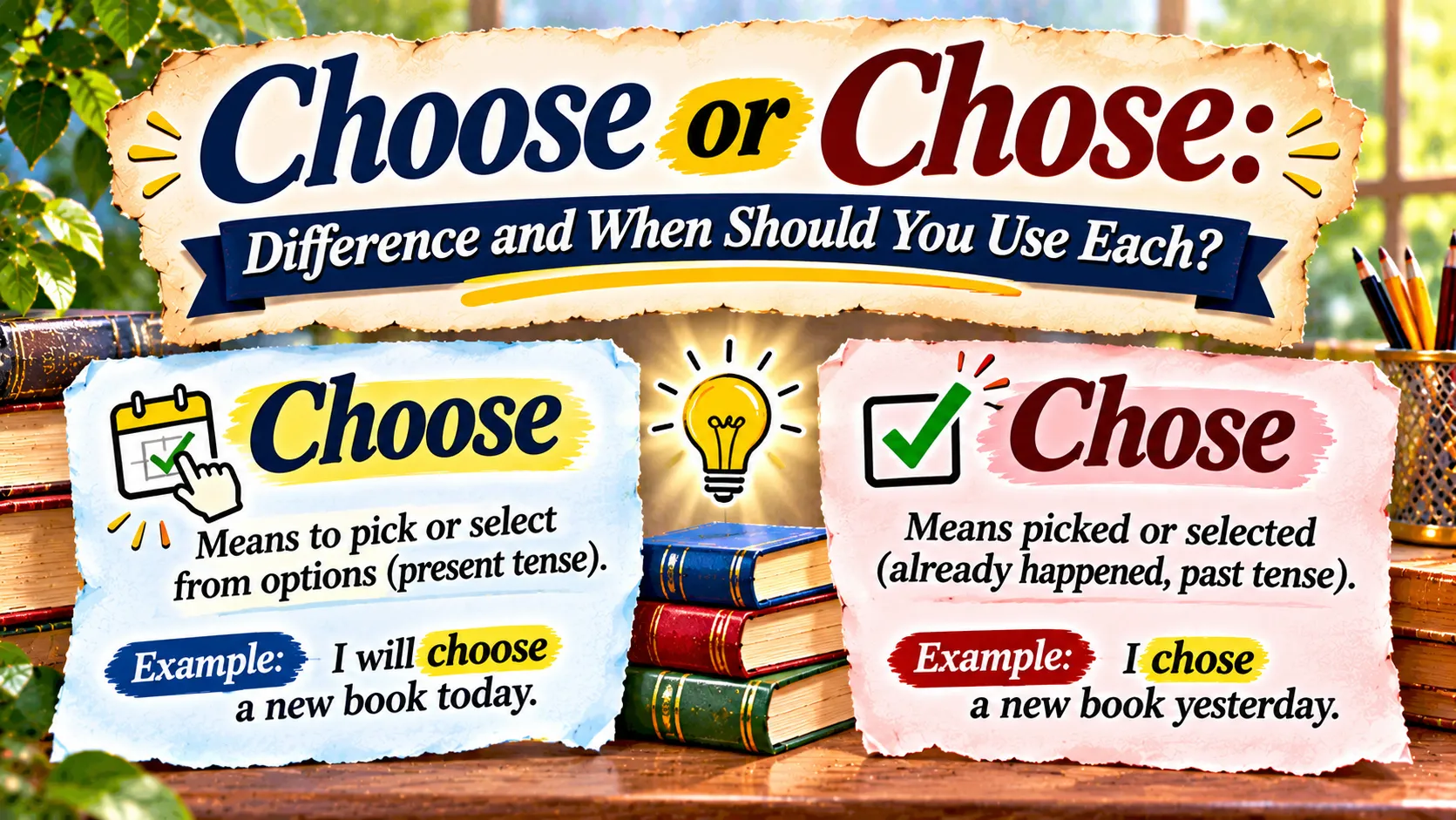
Have you ever paused while writing and wondered whether to use choose or chose? These two words look almost identical and share the same meaning, but they serve different purposes in a sentence. The key difference comes down to time: choose describes a present or future decision, while chose describes a decision someone already made.
Understanding when to use choose vs. chose can improve your grammar, strengthen your writing, and help you avoid common spelling mistakes. Once you learn their verb forms and see how they work in everyday sentences, you can confidently select the correct word.
Choose vs. Chose: What’s the Difference? 🤔
The main difference between choose and chose involves verb tense. Both words describe the act of selecting something from two or more options, but they refer to different times.
- Choose: The present-tense form of the verb. Use it when someone makes a decision now or plans to make one later.
- Chose: The simple past-tense form of the verb. Use it when someone made a decision in the past.
For example:
- I choose the blue dress because it matches my shoes.
- I chose the blue dress for yesterday’s party.
In the first sentence, the speaker makes a current decision. In the second, the speaker describes a choice from the past.
What Does Choose Mean? 📘
Choose means to select, pick, or decide on something from several available options. It describes a present decision, a general preference, or an action that someone plans to take in the future.
People use choose in everyday conversations, professional writing, instructions, and questions about preferences. The word can also describe an important life decision, such as choosing a career, selecting a college, or deciding where to live.
Examples of choose in sentences:
- I always choose fresh fruit over packaged snacks.
- You can choose any seat you like.
- Students choose their favorite subjects each semester.
- We need to choose a restaurant before Friday.
- Please choose the option that best matches your needs.
- She will choose her wedding dress next week.
- I choose honesty over convenience.
- They usually choose the fastest route to work.
Remember, choose works when the decision happens in the present or when someone discusses a future selection.
What Does Chose Mean? ⏳
Chose is the simple past tense of choose. It means someone selected or decided on something at an earlier time. Use it when you describe a completed decision or explain what someone picked in the past.
Unlike choose, chose does not describe a current selection. It connects the decision to an earlier moment, such as yesterday, last year, or a previous experience.
Examples of chose in sentences:
- I chose the red jacket for the winter trip.
- She chose a different career after graduation.
- They chose the smaller apartment because it cost less.
- He chose to study medicine at university.
- We chose a quiet restaurant for dinner.
- My brother chose the blue bicycle last weekend.
- The teacher chose three students for the competition.
- Sarah chose her favorite song for the event.
Use chose whenever you explain a decision that someone already made.
Choose vs. Chose Examples in Everyday Sentences ✍️
Seeing both words in similar sentences makes their difference easier to understand. Pay attention to the time of each action and notice how the verb changes.
| Choose (Present/Future) | Chose (Past) |
|---|---|
| I choose coffee every morning. | I chose coffee yesterday. |
| She chooses the best option. | She chose the best option. |
| We choose our vacation destination today. | We chose our vacation destination last month. |
| He will choose a new phone. | He chose a new phone last week. |
| They choose their team captain every year. | They chose their team captain last year. |
| You can choose your favorite color. | You chose your favorite color. |
| I choose to stay positive. | I chose to stay positive during that difficult time. |
| My parents choose healthy meals. | My parents chose healthy meals for the party. |
The surrounding words often help you identify the correct tense. Expressions such as yesterday, last week, and last year usually indicate a past decision, while today, tomorrow, and every day can point to present or future actions.
When Should You Use Choose? 📝
Use choose when someone selects an option in the present, expresses a regular preference, or plans to make a decision in the future. The word also works in instructions and questions that ask someone to select something.
Here are common situations where choose fits naturally:
For present decisions: Use choose when someone makes a selection now.
- I choose the chocolate cake.
- We choose the best candidate for the position.
For future decisions: Use choose when someone plans to make a selection later. You can also use the helping verb will before choose.
- She will choose her college next month.
- They will choose a new team leader tomorrow.
For regular preferences: Use choose when someone repeatedly selects the same type of thing.
- He always chooses homemade food.
- I choose comfortable shoes for long walks.
For instructions: Use choose when you tell someone to select an option.
- Choose the correct answer.
- Choose a username that represents your personality.
When Should You Use Chose? 📖
Use chose when you describe a decision that happened in the past. The word works in personal stories, historical accounts, conversations, and explanations about earlier choices.
These examples show when chose makes sense:
For completed decisions:
- I chose the green shirt for the interview.
- She chose a new apartment last month.
For past preferences:
- My grandfather chose tea instead of coffee.
- They chose the same vacation spot every summer.
For personal experiences:
- I chose to follow my dreams after college.
- He chose to leave his old job and start a business.
For questions about past decisions:
- Why did you choose that option?
- Which dress did she choose for the wedding?
Notice that questions with did use the base form choose, not chose. For example, write “Why did you choose?” rather than “Why did you chose?”
Choose, Chose, and Chosen: Understanding All Three Forms 🔤
Choose, chose, and chosen belong to the same verb family, but each form has a different grammatical purpose. Learning all three forms helps you use the verb correctly in different sentence structures.
| Verb form | Tense or use | Example |
|---|---|---|
| Choose | Present tense | I choose my own clothes. |
| Chose | Simple past tense | I chose my own clothes yesterday. |
| Chosen | Past participle | I have chosen my own clothes. |
Choose: Use this form for present decisions and after modal verbs such as will, can, should, and must.
- You should choose carefully.
- I can choose another option.
Chose: Use this form for completed past actions.
- She chose the winning design.
- We chose a different location.
Chosen: Use this form with helping verbs such as has, have, and had to create perfect tenses. It also appears in passive constructions.
- I have chosen my favorite book.
- They had chosen a name before the baby arrived.
- The committee has chosen a new president.
Remember this simple pattern:
Choose → Chose → Chosen
Common Mistakes People Make With Choose and Chose ⚠️
Many writers confuse choose and chose because the words share nearly identical spelling and pronunciation. However, a few simple grammar rules can help you avoid these errors.
Mistake 1: Using chose for a present decision
Incorrect: I chose the blue one every time.
Correct: I choose the blue one every time.
Why? The sentence describes a regular preference, so the present-tense form choose fits better.
Mistake 2: Using choose for a completed past action
Incorrect: She choose the red dress yesterday.
Correct: She chose the red dress yesterday.
Why? The word yesterday tells us that the decision happened in the past.
Mistake 3: Using chose after did
Incorrect: Why did you chose this name?
Correct: Why did you choose this name?
Why? The helping verb did already marks the past tense, so the main verb must use its base form, choose.
Mistake 4: Confusing chose with chosen
Incorrect: I have chose the winner.
Correct: I have chosen the winner.
Why? The present perfect tense requires the past participle chosen after have or has.
Mistake 5: Writing choose when you mean a past decision
Incorrect: They choose a new house last year.
Correct: They chose a new house last year.
Why? The phrase last year clearly identifies a completed past action.
Easy Tricks to Remember Choose vs. Chose 🧠
You do not need to memorize complicated grammar rules to distinguish these words. A few simple memory tricks can help you select the right spelling whenever you write.
Remember the vowel difference: Choose contains double O, while chose contains one O. You can connect the double O in choose with an ongoing or current decision.
Connect chose with the past: Chose has a shorter spelling, and you can remember it as the form for a choice someone already made.
Look for time clues: Words such as yesterday, previously, last month, and last year often signal the past tense. These clues can help you decide whether chose fits.
Use the three-form pattern: Memorize choose, chose, chosen. This sequence helps you remember the present, simple past, and past participle forms.
The easiest rule is simple: Choose now, chose before, and chosen with have, has, or had.
Choose or Chose: Practice With These Examples 🎯
Test your understanding with these sentences. Select the correct word in each blank before checking the answers.
- I always ______ the window seat when I travel.
- She ______ a beautiful name for her puppy yesterday.
- You can ______ any book from the shelf.
- They ______ to move to California last year.
- He will ______ his favorite player for the team.
- We ______ the blue curtains for our living room.
- Why did you ______ that particular design?
- My sister has ______ a new dress for the wedding.
- Students should ______ their answers carefully.
- The manager ______ three employees for the project.
Answers:
- Choose
- Chose
- Choose
- Chose
- Choose
- Chose
- Choose
- Chosen
- Choose
- Chose
If you answered most of these correctly, you understand the difference between the three verb forms.
Frequently Asked Questions About Choose or Chose ❓
Is choose present tense or past tense?
Choose is the present-tense form of the verb. Use it when someone makes a decision now, expresses a regular preference, or plans to select something in the future.
Is chose the past tense of choose?
Yes. Chose is the simple past-tense form of choose. Use it when someone already made a decision, such as “I chose the blue dress yesterday.”
What is the past participle of choose?
Chosen is the past participle of choose. Use it with helping verbs such as have, has, and had. For example, “I have chosen my favorite option.”
Should I write choose or chose after did?
Use choose after did because the helping verb already indicates the past tense. For example, write “Did you choose this color?” rather than “Did you chose this color?”
Is it correct to say “I have chose”?
No. The correct phrase is “I have chosen.” The present perfect tense requires the past participle chosen after have or has.
How do you use choose in a sentence?
Use choose when you describe a present or future selection. For example, “I choose the healthier option whenever I can.”
How do you use chose in a sentence?
Use chose when you describe a completed decision. For example, “She chose the red shoes for the party.”
Do choose and chose have the same pronunciation?
No. Choose rhymes with lose, while chose rhymes with rose. Their vowel sounds differ, which can help you recognize them when speaking.
Conclusion 🎓
Understanding choose or chose becomes simple when you focus on verb tense. Choose describes a present or future selection, while chose explains a decision someone made in the past. Remember that chosen serves as the past participle and usually follows have, has, or had.
Keep the three forms in mind: choose, chose, chosen. With regular practice and attention to time-related words, you can use each form confidently and make fewer grammar mistakes in your everyday writing.

Olivia Bennett is a writer and language enthusiast at Vocabsteria. She is passionate about exploring word meanings, name origins, and cultural expressions from around the world.