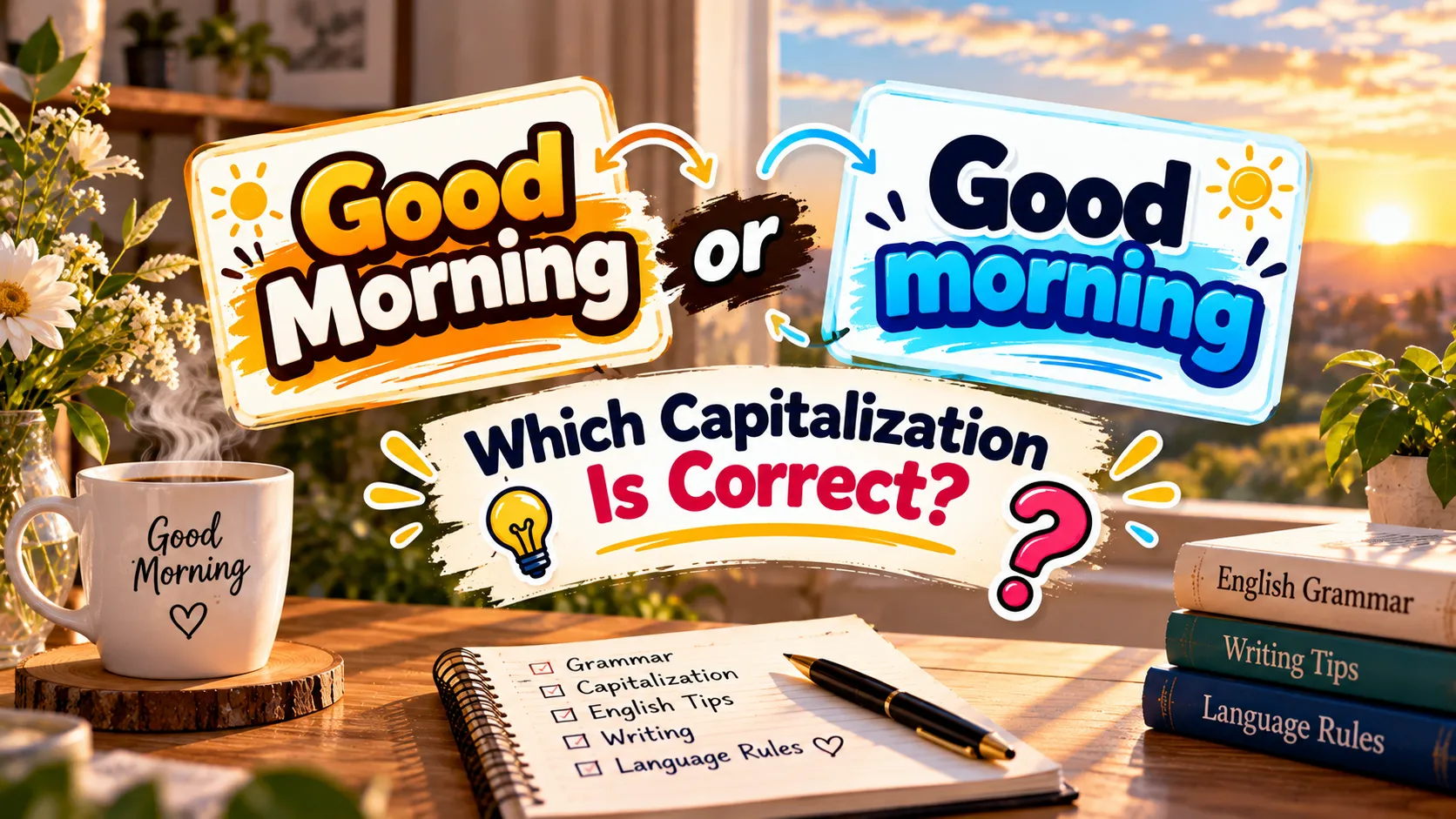
At first glance, good morning or good morning looks like a trick question because the words are exactly the same. The real question is usually not spelling but capitalization and punctuation. Should you write “Good morning” or “good morning”? Does “morning” need a capital letter? And what happens when the phrase begins an email, appears inside a sentence, or is used as a greeting?
In standard American English, Good morning is normally capitalized when it begins a sentence or serves as a greeting at the beginning of a message. The word morning usually remains lowercase because it is a common noun. Understanding this simple rule can help you write emails, texts, messages, letters, and professional greetings correctly.
🌅 Good Morning or Good morning: Which Capitalization Is Correct?
The usual form at the beginning of a sentence or greeting is Good morning, with Good capitalized and morning lowercase.
| Form | Standard Use | Example |
|---|---|---|
| Good morning | ✅ Correct greeting | Good morning, Sarah. |
| good morning | ✅ Correct inside a sentence | She said good morning to everyone. |
| Good Morning | ⚠️ Sometimes used stylistically | Good Morning, team. |
| GOOD MORNING | Stylistic emphasis | GOOD MORNING, everyone! |
| The important distinction is that capitalization depends on where the phrase appears. | ||
| At the beginning: |
Good morning, everyone. ✅
Inside a sentence:
She wished everyone a good morning. ✅
The phrase itself does not require both words to be capitalized.
☀️ Why Is “Good” Capitalized but “Morning” Usually Not?
When Good morning begins a sentence, the first word is capitalized because of the standard capitalization rule for sentences. Morning remains lowercase because it is a common noun.
Correct:
Good morning, everyone.
Not normally:
Good Morning, everyone.
The same pattern applies to other greetings:
- Good afternoon
- Good evening
- Hello, everyone
- Welcome back
Only the first word is normally capitalized when the greeting begins a sentence.
✉️ How to Write “Good Morning” in an Email
In a professional email, Good morning can work as a greeting, especially when followed by the recipient’s name or title.
Examples:
Good morning, Sarah,
I wanted to follow up on the report.
Or:
Good morning, Mr. Johnson,Thank you for your email.
For a group:
Good morning, everyone,I hope you’re all doing well.
The comma after “morning” is commonly used when directly addressing someone:
Good morning, John.
This is known as a vocative comma, which separates the greeting from the person’s name.
💼 Is “Good Morning” Professional?
Yes. Good morning is a perfectly professional greeting in many workplace situations. It is polite, friendly, and appropriate for emails, meetings, phone calls, and face-to-face conversations.
Examples:
- Good morning, team.
- Good morning, everyone.
- Good morning, Ms. Davis.
- Good morning, colleagues.
However, the best greeting can depend on the relationship and workplace culture. A very formal letter may use “Dear,” while a quick internal message may simply begin with “Good morning.”
📱 Good Morning in Text Messages
In text messages, capitalization is more flexible because informal digital communication often ignores traditional capitalization rules. Still, if you want your message to look polished, Good morning is the standard form.
Examples:
Good morning! Hope you have a great day.
Good morning 😊 How are you?
Good morning, Mom!
Lowercase:
good morning 😊
is common in casual texting, but it is a stylistic choice rather than the standard sentence capitalization.
📝 “Good Morning” at the Beginning of a Sentence
When the phrase starts a sentence, capitalize Good.
Examples:
- Good morning, everyone.
- Good morning, class.
- Good morning, Dr. Smith.
- Good morning to you too.
- Good morning! I hope you’re doing well.
The first word is capitalized because it begins the sentence.
“Morning” remains lowercase because there is no general rule requiring it to be capitalized.
🔤 “Good Morning” in the Middle of a Sentence
When the phrase appears in the middle of a sentence and is not being treated as a new sentence, good morning is normally lowercase.
Examples:
- She wished me good morning.
- I said good morning when I entered the office.
- He always says good morning to his coworkers.
- We exchanged a quick good morning before the meeting.
Here, “good” does not begin a sentence, so it does not need capitalization.
🗣️ “Good Morning” as a Greeting
As a greeting, Good morning is an expression used to acknowledge someone during the morning hours. It can be followed by a name, title, group, or additional message.
Examples:
- Good morning, Alex.
- Good morning, everyone.
- Good morning, team.
- Good morning, Professor Lee.
- Good morning! How are you?
The greeting can stand alone:
Good morning!
Or introduce a longer message:
Good morning, everyone. I wanted to share a quick update about today’s meeting.
⏰ When Should You Say “Good Morning”?
The phrase is normally used during the morning, but there is no universal exact clock time at which it suddenly becomes incorrect. In everyday American English, people generally use it from the start of the day through the late morning.
For example:
- 7:00 a.m. → Good morning
- 9:30 a.m. → Good morning
- 11:00 a.m. → Good morning
- 11:45 a.m. → Good morning can still sound natural
As the day moves toward noon and afternoon, Good afternoon becomes the more natural greeting.
🌄 Good Morning vs. Good Afternoon
The two greetings are distinguished primarily by the time of day.
| Greeting | Typical Time | Example |
|---|---|---|
| Good morning | Morning | Good morning, everyone. |
| Good afternoon | Afternoon | Good afternoon, everyone. |
| Good evening | Evening | Good evening, everyone. |
| The exact transition can vary depending on context and personal habit. You do not need to change greetings at precisely 12:00 p.m. |
❤️ “Good Morning” in Friendly Messages
In personal communication, Good morning can sound warm, caring, and cheerful. People often add an encouraging phrase, emoji, or question.
Examples:
- Good morning! Hope your day starts beautifully.
- Good morning! Have a wonderful day.
- Good morning 😊 How did you sleep?
- Good morning! Wishing you a peaceful day.
The capitalization remains the same:
Good morning!
The rest of the message can be as casual or affectionate as the relationship requires.
🏢 “Good Morning” in Workplace Messages
Workplace greetings often benefit from being polite without sounding overly formal. Good morning is a flexible option that works in emails, Slack messages, meetings, and internal communication.
Examples:
Good morning, team. The updated schedule is attached.
Good morning, Sarah. Could you please review the document?
Good morning, everyone. Today’s meeting will begin at 10:00.
If you are sending a very short message, you can also write:
Good morning!
This is perfectly understandable and professional in many contexts.
📧 Good Morning in Formal Emails
For formal emails, the greeting should fit the recipient and purpose. Good morning, [Name] can be polite, although “Dear [Name]” is traditionally more formal.
Compare:
Good morning, Mr. Davis,
I am writing to ask about the status of my application.
and:
Dear Mr. Davis,I am writing to ask about the status of my application.
Both can be appropriate. The second is generally more traditional for formal correspondence.
For ordinary business emails, Good morning is often perfectly natural.
✍️ Good Morning With a Name: Where Does the Comma Go?
When you directly address someone, place a comma between the greeting and the person’s name.
Correct:
Good morning, Sarah.
Good morning, everyone.
Good morning, Dr. Brown.
The comma helps separate the greeting from the person being addressed.
Without the comma:
Good morning Sarah.
the meaning is still understandable, but the punctuation is less polished in standard writing.
❓ Should “Morning” Be Capitalized?
Usually, no. In Good morning, “morning” is normally lowercase.
Correct:
Good morning, everyone.
Not normally:
Good Morning, everyone.
However, you may see Good Morning in titles, headings, branding, advertisements, or stylistic designs where title-style capitalization is being used.
For ordinary sentences and emails, Good morning is the safer standard form.
📚 Good Morning in Titles and Headings
Headings follow different capitalization conventions from ordinary sentences. If you use title case for a heading, you may capitalize more words.
For example:
Good Morning Messages for Friends
In title case, major words are often capitalized according to the chosen style guide.
But in a sentence:
I sent her a good morning message.
Here, “good morning” remains lowercase because it is not a proper noun.
This distinction explains why you may see both capitalization styles online.
🔎 “Good Morning” vs. “Good Mornings”
The expression good morning is normally used as a greeting, while mornings is a plural noun referring to multiple morning periods.
Examples:
Good morning!
I enjoy quiet mornings.
You would not normally use:
Good mornings!
as a standard everyday greeting.
However, “good mornings” can appear in descriptive or poetic contexts:
We shared many good mornings together.
Here, “mornings” is functioning as a regular plural noun.
🌞 Good Morning as a Noun Phrase
Although Good morning is commonly used as a greeting, the phrase can also appear as a noun phrase in a sentence.
Examples:
- Her good morning made everyone smile.
- He gave me a cheerful good morning.
- We exchanged a quick good morning.
In these examples, the phrase is being discussed as an expression rather than directly used to greet someone.
Because it appears inside a sentence, lowercase styling may be appropriate depending on the construction.
⚠️ Common Capitalization and Punctuation Mistakes
Small errors often appear in greetings because people are unsure whether both words should be capitalized.
❌ Good Morning, John.
✅ Good morning, John.
In ordinary sentence-style writing, only “Good” needs capitalization.
❌ Good morning John.
✅ Good morning, John.
Use a comma for direct address.
❌ She said Good morning to me.
✅ She said good morning to me.
The phrase is inside the sentence.
❌ good morning, everyone.
✅ Good morning, everyone.
The greeting begins the sentence, so capitalize “Good.”
❌ Good morning everyone.
✅ Good morning, everyone.
The comma improves standard punctuation when directly addressing the group.
🧠 Easy Memory Trick for Good Morning
Remember:
First word capitalized, second word usually lowercase.
So:
Good morning ✅
Not:
Good Morning ❌ in ordinary sentence-style writing.
Then remember the comma:
Good morning, Sarah.
The formula is:
Good + lowercase morning + comma + name
This simple pattern works for most professional and personal greetings.
🆚 Good Morning or Good morning: Quick Comparison
| Situation | Correct Style | Example |
|---|---|---|
| Beginning of sentence | Good morning | Good morning, everyone. |
| Email greeting | Good morning | Good morning, Sarah. |
| Text message | Good morning | Good morning! |
| Middle of sentence | good morning | She said good morning. |
| Title case heading | Good Morning | Good Morning Messages |
| Direct address | Good morning, | Good morning, John. |
| Casual lowercase texting | good morning | good morning 😊 |
| The important point is that capitalization depends on the grammatical position and writing style. |
❓ Frequently Asked Questions About Good Morning or Good Morning
These questions cover the most common capitalization, punctuation, and usage concerns surrounding this everyday greeting.
Is it “Good morning” or “Good Morning”?
In ordinary sentence-style American English, use Good morning, with only the first word capitalized.
Is “good morning” grammatically correct?
Yes. When it appears inside a sentence or is used casually in lowercase texting, “good morning” can be correct depending on the context.
Should I capitalize “morning” in a greeting?
Normally, no. Write Good morning, not “Good Morning,” in standard sentence-style writing.
Should I put a comma after “Good morning”?
Yes, when directly addressing someone:
Good morning, Sarah.
Is “Good morning, everyone” correct?
Yes. It is a standard and natural greeting.
Is “Good morning John” correct?
It is understandable, but Good morning, John is the standard punctuated form.
Is Good Morning professional?
Yes. “Good morning” is appropriate in many professional emails, meetings, and workplace messages.
Can I write “good morning” in a text?
Yes. Casual texting often uses lowercase, but Good morning is the standard capitalization when starting a sentence.
Is “Good Morning” correct in a title?
It can be correct if the title uses title case:
Good Morning Messages for Friends
When should I say good morning?
Generally, use it during the morning. As the day moves into the afternoon, “Good afternoon” becomes more natural.
Is “Good morning!” a complete sentence?
As a greeting, yes, it can stand alone as an independent expression even though it is not a traditional subject-verb sentence.
What is the correct American English form?
For an ordinary greeting, the standard form is:
Good morning, [Name].
🏁 Final Takeaway
The question good morning or good morning is really about capitalization, punctuation, and context, because the words themselves do not change.
For a normal greeting at the beginning of a sentence, use:
Good morning, Sarah.
Capitalize Good, keep morning lowercase, and use a comma when directly addressing someone. Inside a sentence, lowercase the phrase unless another capitalization rule applies:
She said good morning to everyone.
And if you see Good Morning in a heading, advertisement, or title, it may simply be following a title-style capitalization convention.

Olivia Bennett is a writer and language enthusiast at Vocabsteria. She is passionate about exploring word meanings, name origins, and cultural expressions from around the world.