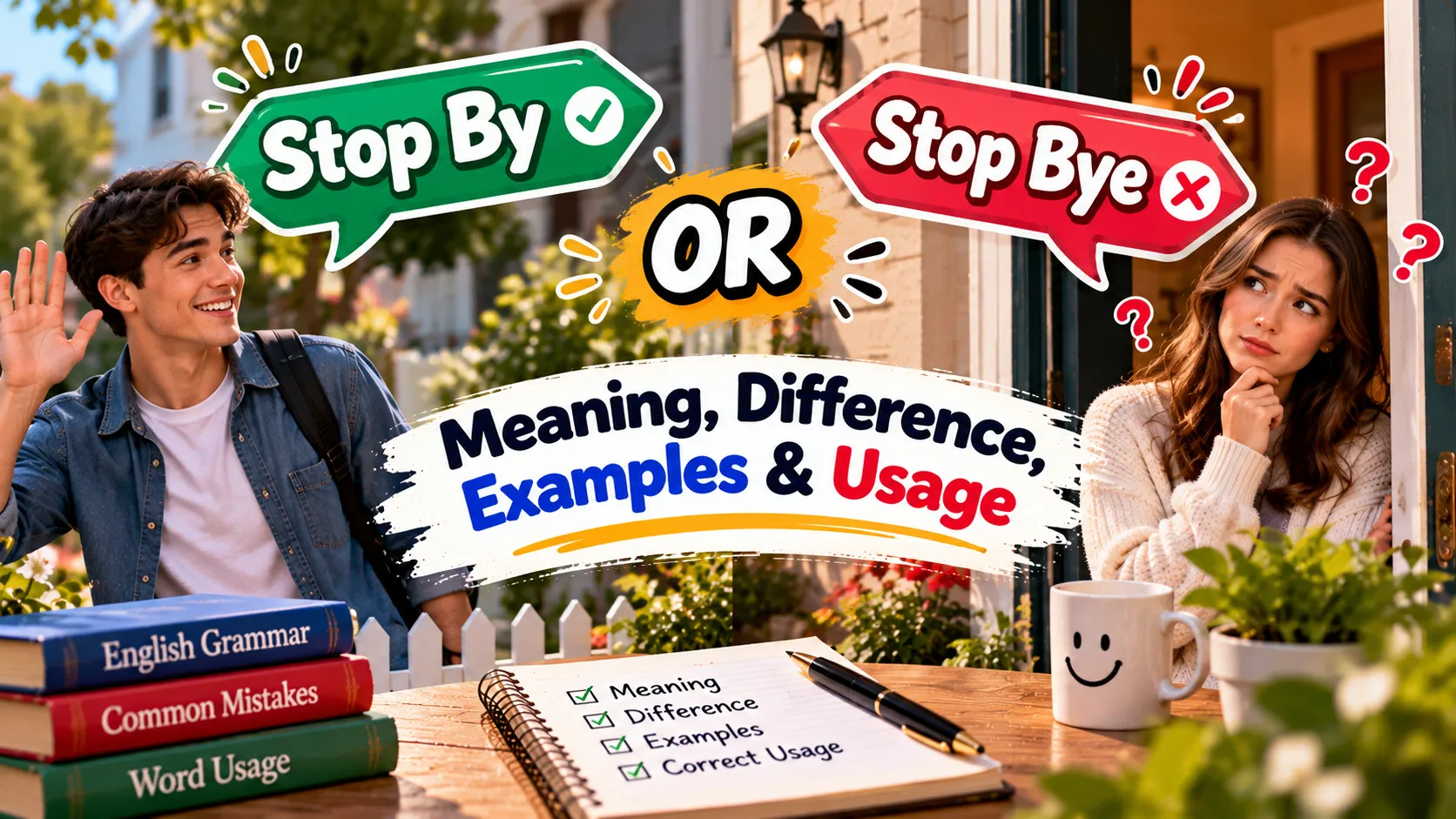
Stop by and stop bye sound similar, but they are not interchangeable. The correct phrase for visiting someone briefly or making a short visit is stop by. The word bye is normally used as an informal way to say goodbye, so stop bye is not the standard spelling of the phrase.
Understanding stop by vs stop bye is especially useful in texts, emails, workplace communication, and everyday American English. Because by and bye are homophones in standard pronunciation, it is easy to type the wrong word.
This guide explains the difference between stop by and stop bye, including meanings, grammar, pronunciation, examples, common mistakes, and easy ways to remember the correct phrase.
🔤 Stop By vs Stop Bye: Quick Difference
The main difference is simple: stop by is a phrasal verb meaning to visit briefly, while bye is an expression associated with leaving or saying goodbye. Therefore, when you mean “visit briefly,” use stop by.
| Phrase | Meaning | Correct? | Example |
|---|---|---|---|
| Stop by | Visit briefly or make a short visit | ✅ Yes | Please stop by my office later. |
| Stop bye | Not the standard spelling for a brief visit | ❌ No | ❌ Please stop bye my office later. |
Easy rule:
Stop by = visit briefly
Bye = goodbye
📖 What Does Stop By Mean?
Stop by is a common phrasal verb meaning to visit a person or place briefly, often without staying for a long time. It is widely used in everyday American English and can be used in casual, professional, and social contexts.
Examples:
- Please stop by my office this afternoon.
- I’ll stop by your house after work.
- Can you stop by the store on your way home?
- She decided to stop by and say hello.
- We should stop by the café before leaving.
- He may stop by later.
The phrase can refer to visiting someone or going somewhere for a short period.
👋 What Does Bye Mean?
Bye is an informal expression used when leaving or ending a conversation. It is short for goodbye and is commonly used in everyday speech.
Examples:
- Bye! See you tomorrow.
- She waved and said bye.
- I have to go now. Bye!
- He said bye before leaving.
- Bye-bye is a more informal or childlike version.
Because bye means goodbye, it does not normally belong in the phrase stop by.
⚖️ Stop By vs Stop Bye Comparison Table
This table highlights the grammatical and semantic difference between the two expressions. The key distinction is that by is the correct word in the phrasal verb, while bye is associated with saying goodbye.
| Feature | Stop By | Stop Bye |
|---|---|---|
| Standard phrase? | Yes | No |
| Meaning | Visit briefly | Not a standard phrase for visiting |
| Grammar | Phrasal verb | Incorrect spelling in this context |
| Main word | By | Bye |
| Context | Visits, errands, short visits | Saying goodbye |
| Example | Stop by later. | ❌ Stop bye later. |
| American English | Common | Incorrect for this meaning |
🗣️ Stop By vs Stop Bye Pronunciation
The words by and bye are pronounced the same in standard English.
| Word | Pronunciation | Meaning |
|---|---|---|
| By | /baɪ/ | Near, through, using, or part of phrases such as “stop by” |
| Bye | /baɪ/ | Goodbye |
Because they are homophones, you cannot always tell which spelling is correct from pronunciation alone. You need to consider the meaning and grammatical context.
🧠 Why Are Stop By and Stop Bye Confused?
The confusion happens because by and bye sound exactly alike. When speaking, there is no audible difference between them for most English speakers.
For example:
I’ll stop by later.
When spoken aloud, by sounds exactly like bye.
However, writing requires the correct spelling. The phrase stop by is the established phrasal verb, so stop bye is considered incorrect when you mean “visit briefly.”
✍️ How to Use Stop By Correctly
Use stop by when someone visits a place or person for a short time.
Common sentence patterns:
- stop by + place
- stop by + person’s location
- stop by to + verb
- stop by and + verb
Examples:
- I’ll stop by the office tomorrow.
- She stopped by my house yesterday.
- Can you stop by to help me?
- He stopped by and said hello.
- We can stop by the store later.
- Please stop by when you have time.
The phrase does not necessarily mean the visit was planned. It can describe either a planned or spontaneous short visit depending on context.
🏠 Stop By Someone’s House
One of the most common uses of stop by is talking about visiting someone’s home briefly.
Examples:
- I might stop by your house tonight.
- She stopped by my house after work.
- Can you stop by before dinner?
- We decided to stop by their house on the way home.
The phrase generally suggests a short or informal visit rather than a long stay.
🏢 Stop By at Work
Stop by is also very common in workplace communication. It can mean visiting someone’s office or desk for a quick conversation.
Examples:
- Please stop by my office when you are free.
- Can you stop by my desk for a minute?
- I’ll stop by your office after lunch.
- She stopped by to discuss the project.
- The manager asked me to stop by later.
This usage is natural in American workplace English.
🛒 Stop By a Store
The phrase can also describe making a short visit to a store or another location, often while traveling somewhere else.
Examples:
- I need to stop by the grocery store.
- Let’s stop by the pharmacy before going home.
- Can you stop by the store and get some milk?
- We stopped by the market on our way back.
- I’ll stop by the bank before work.
Here, stop by can mean making a brief visit for an errand.
🔄 Stop By vs Drop By
Stop by and drop by are closely related phrases. Both can mean visiting someone or somewhere briefly.
| Phrase | Meaning | Example |
|---|---|---|
| Stop by | Visit briefly | I’ll stop by later. |
| Drop by | Visit briefly, often casually or unexpectedly | Feel free to drop by. |
Both are common in everyday English.
For example:
I’ll stop by your office after lunch.
and:
I’ll drop by your office after lunch.
Both can sound natural, although the exact nuance may depend on context.
🆚 Stop By vs Come By
Come by can also mean visiting someone briefly, but it can have slightly different implications depending on the sentence.
- I’ll stop by later.
- I’ll come by later.
Both can mean “I will visit later.”
However, come by can also mean to obtain or acquire something:
Where did you come by that information?
Therefore, context is important.
🚫 Common Mistake: Stop Bye
One of the most common spelling errors is writing stop bye when the intended meaning is “visit briefly.”
Incorrect:
I’ll stop bye your office later.
Correct:
I’ll stop by your office later.
The reason is simple: by is the preposition used in the established phrasal verb stop by.
More examples:
- ❌ Please stop bye tomorrow.
- ✅ Please stop by tomorrow.
- ❌ I’ll stop bye after work.
- ✅ I’ll stop by after work.
- ❌ Can you stop bye my house?
- ✅ Can you stop by my house?
👋 When Should You Use Bye?
Use bye when saying goodbye or ending a conversation.
Examples:
- Bye, see you later.
- Okay, bye!
- She said bye before leaving.
- Bye, have a great day.
- He waved and said bye.
You can also use bye-bye as a more informal expression, especially when speaking to children.
📚 Stop By in Different Tenses
Because stop by is a phrasal verb, the verb stop changes according to tense while by remains unchanged.
| Tense | Example |
|---|---|
| Present | I stop by every Friday. |
| Present continuous | I am stopping by later. |
| Past | I stopped by yesterday. |
| Future | I will stop by tomorrow. |
| Present perfect | I have stopped by several times. |
| Past perfect | I had stopped by before lunch. |
| Modal | I might stop by later. |
Notice that by never changes to bye.
💬 Common Phrases With Stop By
The phrase stop by appears in many everyday expressions. Learning these patterns can make your English sound more natural.
- Stop by later.
- Stop by anytime.
- Stop by tomorrow.
- Stop by my office.
- Stop by my house.
- Stop by the store.
- Stop by the shop.
- Stop by after work.
- Stop by before dinner.
- Stop by for a visit.
- Stop by to say hello.
- Stop by and see me.
- Stop by when you’re free.
- Feel free to stop by.
- I’ll stop by soon.
🇺🇸 Stop By in American English
Stop by is very common in American English and is frequently used in casual conversations, workplace communication, text messages, and emails.
Examples:
“Can you stop by my office?”
“I’ll stop by after work.”
“Feel free to stop by anytime.”
The phrase is natural and widely understood. Stop bye is not the standard spelling when referring to a brief visit.
📝 Stop By in Text Messages and Emails
When writing informal messages, stop by is the correct form.
Text message:
Hey, I’ll stop by around 6 if you’re home.
Workplace message:
I’ll stop by your office after the meeting.
Friendly invitation:
Feel free to stop by anytime this weekend.
Casual request:
Can you stop by the store on your way home?
Even though texting often includes abbreviations and informal spelling, stop by remains the standard spelling.
🧩 Stop By Meaning “Visit Briefly”
The core meaning of stop by is to make a short or casual visit. It does not necessarily mean that you literally “stop” moving in the physical sense.
For example:
I stopped by Sarah’s house.
This means:
I visited Sarah’s house for a short time.
Similarly:
The manager stopped by my desk.
This means:
The manager briefly visited my desk.
The phrase is therefore idiomatic.
🎯 How to Remember Stop By vs Stop Bye
A simple memory trick makes this distinction easy.
Remember:
BY = part of the visit phrase
Stop BY to visit.
BYE = goodbye
Bye! See you later.
You can also remember:
Stop by → stop in for a visit.
Bye → goodbye when leaving.
If you can replace the phrase with “visit briefly,” choose stop by.
If you are saying goodbye, use bye.
📊 Correct Word by Context
Use this table as a quick reference when deciding whether you need by or bye.
| Meaning | Correct Word | Example |
|---|---|---|
| Visit briefly | By | I’ll stop by later. |
| Visit an office | By | Please stop by my office. |
| Visit a house | By | We stopped by their house. |
| Make a quick errand | By | I’ll stop by the store. |
| Say goodbye | Bye | Bye, see you tomorrow. |
| End a conversation | Bye | Okay, bye! |
| Say goodbye informally | Bye | Bye-bye! |
❓ Frequently Asked Questions About Stop By vs Stop Bye
These common questions explain the spelling, meaning, grammar, and everyday use of stop by and stop bye.
Is it stop by or stop bye?
The correct phrase is stop by when you mean “visit briefly.” Stop bye is not the standard spelling for this meaning.
What does stop by mean?
Stop by means to visit a person or place briefly, often for a short or informal visit.
Is stop by one word?
No. Stop by is a two-word phrasal verb.
Is “stop bye” grammatically correct?
Not when you mean “visit briefly.” The standard phrase is stop by.
Is by and bye pronounced the same?
Yes. By and bye are homophones in standard English pronunciation.
What is an example of stop by?
“I’ll stop by your office after lunch.”
Can I say “stop by my house”?
Yes. “Stop by my house” is a natural and common English expression meaning to visit the house briefly.
What is the difference between stop by and drop by?
Both can mean making a short visit. Drop by can sometimes sound more casual or spontaneous, while stop by is also extremely common for brief visits and errands.
What is the difference between stop by and come by?
Both can mean visit briefly in many contexts. Come by can also have meanings related to obtaining or acquiring something, depending on context.
Does stop by mean stay for a long time?
Usually not. Stop by generally suggests a brief or casual visit, although the actual length of the visit depends on the situation.
Is stop by formal or informal?
Stop by is neutral and very common. It works in casual conversation and many workplace situations, although a more formal context may call for wording such as “visit” or “meet.”
How do you remember stop by vs stop bye?
Remember stop by = visit and bye = goodbye. If someone is coming for a short visit, say stop by.
🏁 Conclusion
The difference between stop by vs stop bye is straightforward. Stop by is the correct phrasal verb when you mean to visit someone or somewhere briefly. Bye is an informal way to say goodbye and should not replace by in this phrase.
Remember:
Stop by = visit briefly
Bye = goodbye
So write:
“I’ll stop by later.”
Not:
“I’ll stop bye later.”
Because by and bye sound the same, the best way to avoid the mistake is to remember the meaning and spelling of the phrase rather than relying on pronunciation.

Olivia Bennett is a writer and language enthusiast at Vocabsteria. She is passionate about exploring word meanings, name origins, and cultural expressions from around the world.