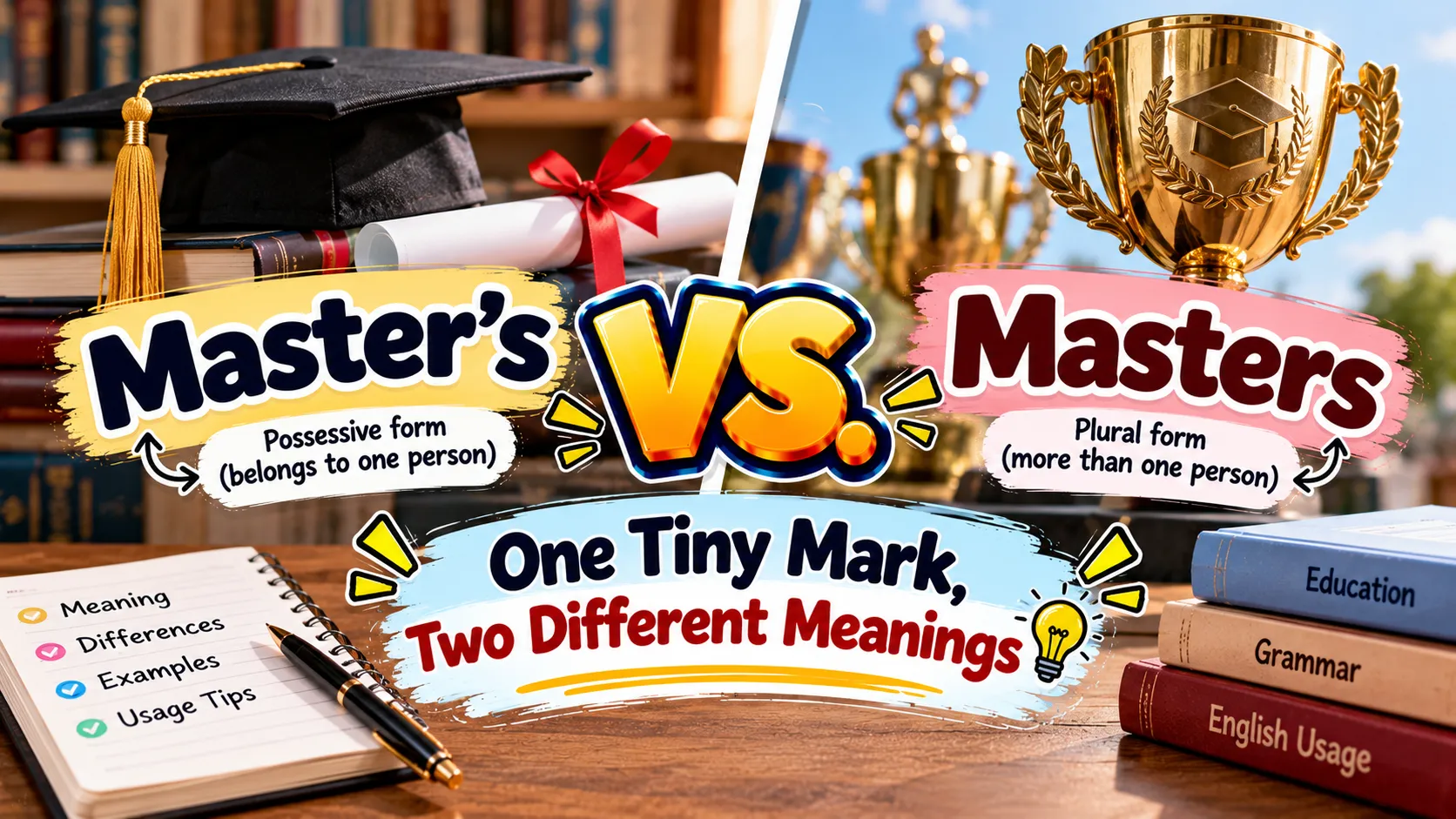
Should you write masters or master’s degree? The answer depends on whether you are talking about an academic degree in general, a specific person’s degree, or the name of a program. The apostrophe in master’s is small, but leaving it out can change the grammatical meaning of the phrase.
In American English, the standard name of the graduate degree is master’s degree, with an apostrophe before the s. Masters without an apostrophe is usually the plural of “master” or part of a different expression. Understanding this distinction is especially useful when writing resumes, applications, LinkedIn profiles, academic documents, and professional biographies.
🎓 Masters or Master’s Degree: Which Is Correct?
When referring to the graduate academic degree, the standard American English form is master’s degree.
| Form | Correct for Academic Degree? | Meaning |
|---|---|---|
| master’s degree | ✅ Yes | A graduate academic degree |
| masters degree | ❌ No in standard edited US English | Common apostrophe omission |
| master degree | ❌ No | Missing possessive form |
| master’s | ✅ Yes | Short form of master’s degree |
| masters | ⚠️ Usually different meaning | Plural noun or other usage |
| Examples: |
- She earned a master’s degree in psychology.
- He is working toward a master’s degree in business.
- I completed my master’s last year.
The apostrophe is important because master’s is traditionally a possessive form referring to a degree associated with a master.
📚 Why Does “Master’s Degree” Have an Apostrophe?
The apostrophe in master’s degree comes from the possessive construction. Historically, the degree can be understood as a master’s degree, meaning a degree associated with a master.
The same pattern appears in:
- bachelor’s degree
- master’s degree
- associate’s degree
For example:
She has a bachelor’s degree in English.
He earned a master’s degree in education.
The apostrophe remains part of the standard spelling even though most speakers do not think about the possessive meaning when using the phrase.
🧑🎓 What Is a Master’s Degree?
A master’s degree is a graduate-level academic degree typically completed after a bachelor’s degree. Depending on the field and institution, it may involve coursework, research, practical training, a thesis, or a combination of these.
Common types include:
- Master of Arts (MA)
- Master of Science (MS)
- Master of Business Administration (MBA)
- Master of Education (MEd)
- Master of Fine Arts (MFA)
- Master of Public Health (MPH)
Examples:
She earned a master’s degree in computer science.
He is pursuing a master’s degree in finance.
Her master’s helped her qualify for the position.
The phrase is common in academic and professional writing.
📝 Master’s Degree vs. Master’s
You do not always need to write the complete phrase master’s degree. Once the context is clear, master’s can be used by itself.
Examples:
I have a master’s degree in marketing.
I have a master’s in marketing.
Both are standard.
The shortened form is especially common in conversation and professional profiles.
However, avoid dropping the apostrophe:
I have a masters in marketing. ❌
Use:
I have a master’s in marketing. ✅
💼 How to Write “Master’s Degree” on a Resume
When listing an academic qualification on a resume, use master’s degree in normal sentence-style text.
Examples:
Master’s Degree in Business Administration
Master’s Degree in Computer Science
Master’s degree in Psychology
If you are listing the formal name of the degree awarded by a university, you may instead use the official degree title:
Master of Science in Computer ScienceMaster of Arts in English
In a sentence:
I earned a master’s degree in computer science in 2025.
The lowercase “degree” is usually appropriate when the phrase appears in ordinary sentence text.
🎯 Master’s vs. Masters: The Basic Grammar Difference
The easiest way to understand master’s vs. masters is to ask what you mean.
Master’s can refer to:
- A master’s degree
- Something belonging to one master
- A shortened form of “master’s degree”
Masters can refer to: - More than one master
- A competition or tournament name
- Certain titles or proper names
Examples:
She earned her master’s last year.
The two masters discussed the project.
Here, “masters” is simply the plural of “master.”
So the apostrophe changes the grammatical function.
🏆 What Does “Masters” Without an Apostrophe Mean?
Masters without an apostrophe is normally the plural of master.
For example:
- The two masters supervised the apprentices.
- Several masters attended the meeting.
It can also appear as part of proper names, such as The Masters, the professional golf tournament.
In that context, “Masters” is not referring to an academic degree.
This is why:
master’s degree = academic qualification
while:
Masters = plural/proper-name usage
The context tells you which meaning is intended.
⛳ “The Masters” Is Different From “Master’s Degree”
One of the most recognizable examples of Masters without an apostrophe is The Masters, the golf tournament.
The spelling is:
The Masters
not:
The Master’s
This has nothing to do with an academic degree.
Compare:
She earned a master’s degree in history.He watched The Masters on television.
The first is an academic qualification. The second is a proper name.
🏫 Master’s Degree vs. Master Degree
A common spelling mistake is removing the apostrophe and the s entirely:
master degree ❌
The standard form is:
master’s degree ✅
You may see “master degree” in nonstandard English, but it is not the usual form in polished American English.
Examples:
I am applying for a master’s degree program.She completed her master’s degree last year.
He plans to pursue a master’s degree in engineering.
🇺🇸 Master’s Degree in American English
For a US English audience, master’s degree is the standard general term. The apostrophe should normally appear before the “s.”
Common American English forms include:
- bachelor’s degree
- master’s degree
- doctoral degree
- associate degree
Notice an important distinction:
master’s degree ✅
bachelor’s degree ✅
associate degree ✅
The exact official terminology can vary by institution and degree type, but “master’s degree” is the standard general expression.
🔤 Master’s Degree Capitalization
Whether you capitalize master’s degree depends on how the phrase is being used.
In ordinary sentences:
She earned a master’s degree in biology.
The phrase is lowercase.
When used as a heading:
Master’s Degree in Biology
you may capitalize it according to the heading or title style.
Formal degree names are capitalized:
Master of Science
Master of Arts
Master of Business Administration
This creates an important distinction between the generic degree description and the official degree title.
📖 Master of Arts vs. Master’s Degree
Master of Arts is the formal name of a specific degree, while master’s degree is the general category.
Examples:
She earned a Master of Arts in English.
She earned a master’s degree in English.
Both can be correct, but the first identifies the formal degree title.
Similarly:
Master of Sciencemaster’s degree in science
The official name should follow the institution’s terminology when you are referring to a specific credential.
🧾 Master’s Degree on Applications and Forms
Academic and employment forms may ask for your highest level of education. In such contexts, master’s degree is the standard description.
Examples:
- Highest education level: Master’s degree
- Degree earned: Master of Science
- Education: Master’s degree in Accounting
If a form uses a dropdown menu, follow the terminology provided by the institution rather than changing it unnecessarily.
💻 Master’s Degree in Professional Profiles
On LinkedIn, resumes, biographies, and professional websites, the apostrophe remains important.
Examples:
Muhammad holds a master’s degree in computer science.
She earned her master’s in business administration.
He is pursuing a master’s degree in data analytics.
A polished professional profile should avoid:
masters degree
unless it is part of a quoted title or an organization’s exact wording.
🧠 Easy Memory Trick for Master’s
A simple way to remember the apostrophe is to connect master’s with the word degree:
master’s degree
bachelor’s degree
Both use an apostrophe.
You can remember:
One master → master’s
More than one master → masters
Compare:
He earned a master’s degree.Two masters attended the conference.
The apostrophe tells you that the word is not simply the plural “masters.”
⚠️ Common Mistakes With Master’s and Masters
Small punctuation errors are especially common when people type degree names quickly.
❌ Masters degree
✅ Master’s degree
❌ Master degree
✅ Master’s degree
❌ I have a masters.
✅ I have a master’s.
❌ I earned my Masters in Biology.
✅ I earned my master’s in biology.
❌ She has a masters degree.
✅ She has a master’s degree.
Remember that the apostrophe is not decorative. It is part of the standard spelling.
🔎 Master’s Degree vs. Masters Degree in Search and Online Writing
You may encounter masters degree frequently online because users often omit apostrophes when searching. Search behavior does not determine standard grammar.
For polished content, use:
master’s degree
rather than:
masters degree
This applies to:
- Blog articles
- Resumes
- University websites
- Application essays
- Professional profiles
- Academic documents
- Business biographies
- Cover letters
Search engines can understand variations, but writers should still use the standard spelling in the actual content.
📝 Examples of Master’s Degree in Sentences
These examples show how the phrase naturally appears in American English.
- She earned a master’s degree in education.
- He is pursuing a master’s degree in engineering.
- I completed my master’s degree last year.
- Her master’s degree helped her advance professionally.
- The university offers several master’s degree programs.
- He listed his master’s degree on his resume.
- She plans to begin a master’s degree program next fall.
- A master’s degree can be required for some positions.
- He holds a master’s degree in finance.
- They discussed the requirements for a master’s degree.
📊 Master’s vs. Masters: Quick Comparison
| Feature | Master’s | Masters |
|---|---|---|
| Apostrophe | Yes | No |
| Academic degree | ✅ Yes | ❌ No |
| Short form of master’s degree | ✅ Yes | ❌ No |
| Plural of “master” | ❌ No | ✅ Yes |
| Golf tournament | ❌ No | ✅ The Masters |
| Example | I earned a master’s. | The masters met. |
| Professional writing | Common | Different meaning |
| Standard degree phrase | Master’s degree | Masters degree is nonstandard |
| The apostrophe is the clearest visual clue. |
🎓 Master’s Degree vs. Bachelor’s Degree
The two degree names follow a similar grammatical pattern.
| Degree | Standard Form |
|---|---|
| Undergraduate degree | bachelor’s degree |
| Graduate degree | master’s degree |
| Advanced research degree | doctoral degree |
| Examples: |
She earned a bachelor’s degree before pursuing a master’s degree.
He has a master’s degree after completing his bachelor’s degree.
Both “bachelor’s” and “master’s” contain apostrophes.
❓ Frequently Asked Questions About Masters or Master’s Degree
These questions cover the most common spelling, punctuation, capitalization, and usage issues.
Is it masters or master’s degree?
The standard form is master’s degree, with an apostrophe.
Is “masters degree” grammatically correct?
In standard edited American English, the preferred form is master’s degree.
Can I say “I have a master’s”?
Yes. When the meaning is clear, master’s can be used as a shortened form of “master’s degree.”
Is “masters” ever correct?
Yes. Masters can be the plural of “master” or part of a proper name such as The Masters golf tournament.
Why does master’s have an apostrophe?
It is traditionally a possessive construction referring to a degree associated with a master.
Should “master’s degree” be capitalized?
In ordinary sentences, it is usually lowercase. Formal degree names such as Master of Science are capitalized.
Is “Master Degree” correct?
No. The standard general term is master’s degree.
Is “Master’s” correct without “degree”?
Yes. For example:
I earned my master’s in psychology.
How do I write a master’s degree on a resume?
You can write:
Master’s degree in Business Administration
or use the formal credential:
Master of Business Administration (MBA)
Is “Masters” correct on a resume?
If you mean the academic degree, use master’s, not “masters.”
What is the difference between master’s and masters?
Master’s can mean the academic degree, while masters is normally a plural noun or part of a proper name.
Is it “master’s degree program”?
Yes:
She enrolled in a master’s degree program.
🏁 Final Takeaway
When writing about the academic degree, choose master’s degree, with an apostrophe.
Master’s degree ✅
Masters degree ❌
Master degree ❌
The word masters without an apostrophe has other meanings, including the plural of “master” and the name of the golf tournament The Masters.
The easiest memory trick is to pair the degree with bachelor’s:
bachelor’s degree → master’s degree
Both academic degree names use the apostrophe. When writing a resume, university application, professional biography, or academic document, that small apostrophe helps make your writing look polished and correct.

Olivia Bennett is a writer and language enthusiast at Vocabsteria. She is passionate about exploring word meanings, name origins, and cultural expressions from around the world.