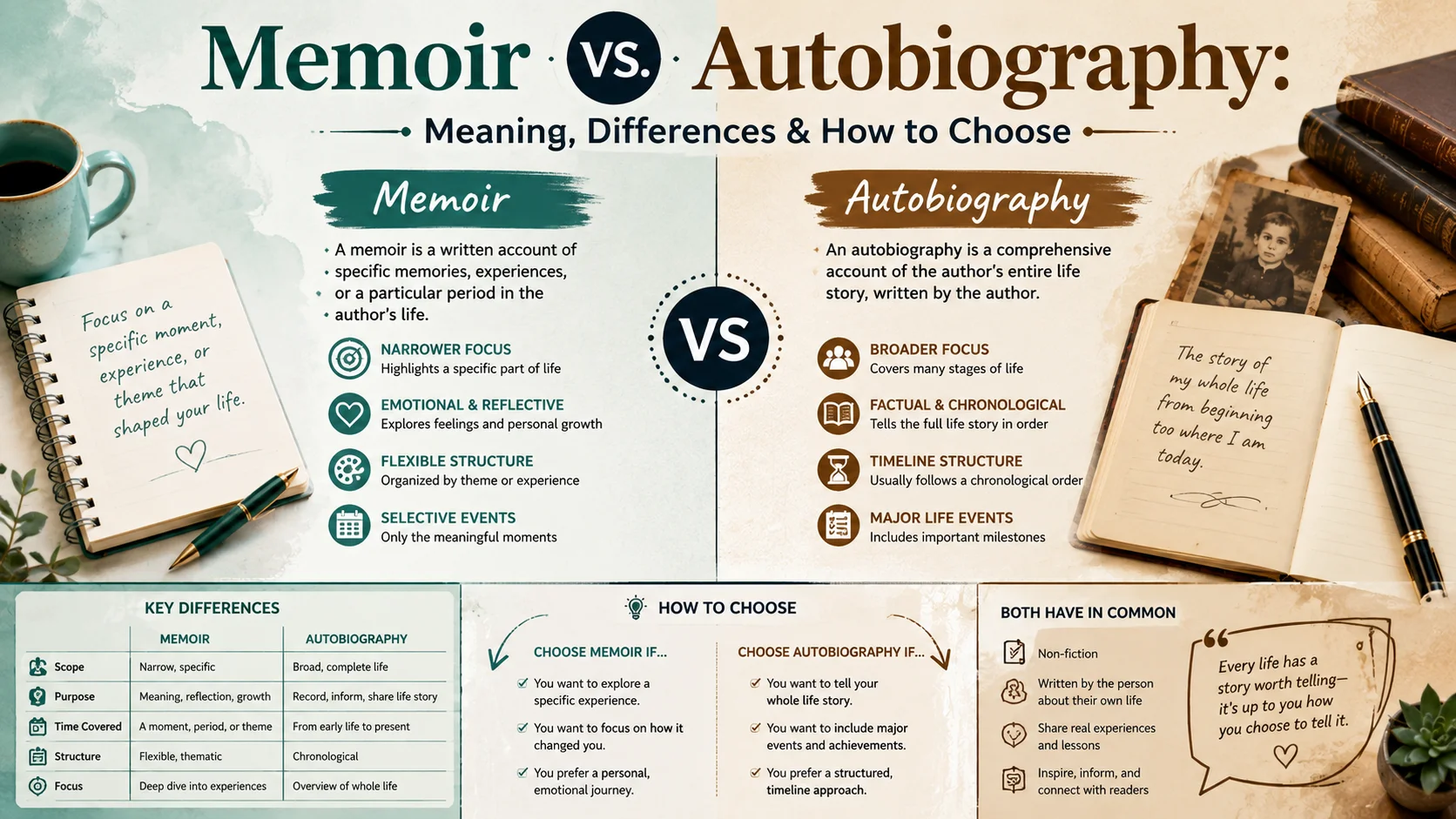
Memoir and autobiography are both forms of nonfiction writing in which an author writes about their own life. Because both genres are based on personal experiences, people often use the terms interchangeably. However, they have an important difference in scope, purpose, focus, and structure.
An autobiography usually tells the story of a person’s life across a broad period, often beginning with childhood and continuing through major stages and achievements. A memoir, on the other hand, typically focuses on a particular period, experience, relationship, theme, or collection of meaningful memories.
For example, a writer might use an autobiography to describe their childhood, education, career, family life, and later achievements. The same writer could create a memoir about one specific experience, such as growing up in a particular place, overcoming a difficult period, or developing an important relationship.
Understanding the difference between memoir vs. autobiography makes it easier to identify these genres and choose the right format when writing about a real-life story.
Quick Answer: What Is the Difference Between a Memoir and an Autobiography?
An autobiography is generally a comprehensive account of the author’s life, while a memoir focuses on selected memories or experiences that carry personal, emotional, or thematic significance.
In simple terms:
Autobiography = the story of your life
Memoir = a meaningful part or theme from your life
This is a useful distinction, although some books can overlap both categories.
What Is a Memoir?
A memoir is a nonfiction work in which an author reflects on personal experiences, memories, and important moments from their life.
Rather than attempting to document every major event, memoir writers usually select experiences connected by a particular theme or period.
A memoir might focus on:
- Childhood memories
- Family relationships
- Friendship
- Love and loss
- Travel experiences
- Career challenges
- Personal growth
- Cultural experiences
- Major life changes
- A difficult or transformative period
The writer usually explores not only what happened, but also how the experience affected them.
Example of a Memoir
Imagine someone writes a book about growing up in a small town.
The book does not need to explain every year of their entire life. Instead, it might focus on childhood friendships, family traditions, school experiences, and the lessons they learned while growing up.
That would fit the memoir format because the story centers on a particular period and theme.
What Is an Autobiography?
An autobiography is a nonfiction account of the author’s own life.
It generally covers a much broader period than a memoir. The writer may describe their childhood, education, family, career, relationships, achievements, challenges, and other important stages of life.
Autobiographies often follow a chronological structure.
A typical structure might look like this:
Childhood → Education → Early career → Major experiences → Achievements → Later life
The author decides which events deserve attention, but the overall goal is usually to provide a broad picture of their life.
Memoir vs. Autobiography: Key Differences
The biggest difference is scope.
| Feature | Memoir | Autobiography |
|---|---|---|
| Main focus | Selected experiences or memories | The author’s broader life |
| Scope | Narrower | Broader |
| Time period | Often one period or theme | Often covers many life stages |
| Structure | Thematic or reflective | Usually chronological |
| Purpose | Explore experiences and their meaning | Document the author’s life |
| Emotional reflection | Usually prominent | May be present but not always central |
| Coverage | Selective | More comprehensive |
| Writing style | Personal and reflective | Biographical and chronological |
| Main question | What did this experience mean to me? | What happened throughout my life? |
| Typical emphasis | Memory, identity, relationships, transformation | Life story, milestones, achievements |
Memoir vs. Autobiography: Scope
Scope is one of the easiest ways to distinguish the two.
A memoir usually has a limited scope.
For example:
A writer discusses five years spent traveling around the world.
An autobiography usually has a broader scope.
For example:
A writer discusses their childhood, education, career, family, and major achievements.
A memoir can cover many years, but it does not have to provide a complete account of those years.
Memoir vs. Autobiography: Focus
Memoirs generally focus on meaning and personal experience.
The author may spend considerable time discussing feelings, relationships, memories, and personal interpretations.
Autobiographies generally focus more on life events and development.
The author may explain what happened at different stages and how those events shaped their life.
However, an autobiography can also be deeply emotional, while a memoir can contain substantial factual information. The categories are not completely rigid.
Memoir vs. Autobiography: Structure
Autobiographies often use a chronological structure.
The author may begin with childhood and move forward through important stages of life.
Memoirs can use a more flexible structure.
A memoir might move between memories, themes, places, or relationships instead of following a strict timeline.
For example, a memoir about grief might move between different years because each memory helps explore the author’s experience of loss.
Memoir vs. Autobiography: Purpose
The purpose also differs.
An autobiography often aims to tell the reader how the author’s life unfolded.
A memoir often aims to explore what particular experiences meant to the author.
Consider these two approaches:
Autobiographical approach
I was born in a small town, attended school there, moved to another city for university, started my career, and eventually founded a company.
Memoir approach
Moving away from home for university changed how I understood independence, family, and responsibility.
The first focuses on the broader life story. The second focuses on the meaning of a particular experience.
Memoir vs. Autobiography: Writing Style
Memoirs often use a highly personal and reflective writing style.
They may include:
- Detailed memories
- Personal observations
- Emotional reflections
- Dialogue
- Sensory descriptions
- Internal thoughts
- Lessons learned
Autobiographies can also contain these elements, but they often place greater emphasis on chronological development and major life events.
Neither genre has to follow one exact writing style.
Memoir vs. Autobiography Examples
Looking at hypothetical examples makes the difference easier to understand.
Memoir Example 1: Childhood
A writer describes growing up with their grandparents and explores how those relationships shaped their values.
Likely genre: Memoir
Memoir Example 2: Travel
A writer describes one year spent living in several countries and reflects on how travel changed their worldview.
Likely genre: Memoir
Autobiography Example 1: Career
A business leader describes their childhood, education, first job, career development, business successes, failures, and later achievements.
Likely genre: Autobiography
Autobiography Example 2: Public Life
A public figure tells the story of their childhood, education, professional career, important relationships, challenges, and accomplishments.
Likely genre: Autobiography
Famous Memoir Examples
Several well-known books are commonly identified as memoirs.
Educated by Tara Westover
This memoir focuses on Westover’s upbringing, education, family relationships, and journey toward developing an independent identity.
The Glass Castle by Jeannette Walls
This memoir explores Walls’s unconventional childhood and family life, focusing on experiences that shaped her identity.
When Breath Becomes Air by Paul Kalanithi
This memoir reflects on medicine, illness, mortality, identity, and the author’s experience as a physician facing a life-changing diagnosis.
These examples demonstrate how memoirs can focus on particular experiences while exploring broader themes.
Famous Autobiography Examples
Autobiographies also have a long literary tradition.
The Autobiography of Benjamin Franklin
Benjamin Franklin presents an account of his life, development, work, ideas, and achievements.
Long Walk to Freedom by Nelson Mandela
Mandela’s autobiography covers his childhood, political development, imprisonment, and major experiences in South Africa’s struggle against apartheid.
The Story of My Life by Helen Keller
Keller’s autobiography describes her childhood, education, development, and experiences as she learned to communicate and engage with the world.
These works provide broad accounts of their authors’ lives rather than focusing exclusively on one isolated experience.
Memoir vs. Autobiography vs. Biography
These three terms are easy to confuse.
The key difference is who writes the story and whose life is being described.
| Genre | Who Writes It? | Whose Life? |
|---|---|---|
| Memoir | Usually the person themselves | Their own selected experiences |
| Autobiography | The person themselves | Their own life |
| Biography | Another writer | Someone else’s life |
For example, if you write about your own childhood, you may be writing a memoir.
If you write a broad account of your entire life, you may be writing an autobiography.
If another person writes a detailed account of your life, that is a biography.
Is a Memoir Always About a Small Part of Life?
Not necessarily.
A memoir can cover a long period. What matters more is its focus.
A writer might cover twenty years of their life but concentrate on one theme, such as immigration, family relationships, career struggles, or personal identity.
Therefore, the distinction is not simply:
Short = memoir
Long = autobiography
Instead, think about the purpose and scope of the story.
Can a Book Be Both a Memoir and an Autobiography?
Yes. The categories can overlap.
Some life-writing books contain characteristics of both genres. A work may provide substantial information about the author’s life while concentrating heavily on specific experiences and personal reflections.
That is why literary classification is not always perfectly clear.
The terms describe common approaches rather than strict rules that every book must follow.
How to Decide Between a Memoir and an Autobiography
If you are planning to write about your own life, ask yourself a few questions.
Are you telling your whole life story?
If yes, an autobiography may be the better format.
Are you focusing on one important period?
A memoir may be more appropriate.
Are you exploring a particular theme?
A memoir can work especially well.
Do you want to document major milestones?
An autobiography may be the stronger choice.
Do you want to explore how experiences changed you?
A memoir may give you more freedom to reflect.
Memoir or Autobiography: Which Is More Personal?
Both can be highly personal because both are written about the author’s own life.
However, memoirs often place greater emphasis on reflection, memory, emotion, and personal meaning.
Autobiographies can also be personal, but their broader chronological approach may give more attention to life events and milestones.
Memoir or Autobiography: Which Is More Chronological?
An autobiography is generally more chronological.
It often moves from early life toward later experiences.
A memoir can be chronological, but it does not have to be. It may organize events around a theme, relationship, place, or emotional journey.
Memoir or Autobiography: Which Should You Read?
The choice depends on what you enjoy.
Choose a memoir if you prefer:
- Personal stories
- Emotional experiences
- Specific life periods
- Family stories
- Personal transformation
- Reflection and self-discovery
Choose an autobiography if you prefer:
- Complete life stories
- Historical context
- Career journeys
- Major achievements
- Chronological storytelling
- Detailed personal history
A Simple Way to Remember the Difference
Use this memory trick:
Memoir = meaningful memories
Autobiography = author’s life story
A memoir selects important experiences and explores their significance.
An autobiography generally attempts to provide a broader account of the author’s life.
Common Mistakes About Memoirs and Autobiographies
Mistake 1: Thinking a memoir must cover only a few months
A memoir can cover years or even decades. Its defining feature is its focused approach rather than a specific length.
Mistake 2: Assuming every autobiography covers every single event
Autobiographies are selective too. Authors choose which events to include.
Mistake 3: Believing memoirs are fictional
Memoirs are nonfiction. They are based on the author’s memories and experiences, although memory and personal perspective naturally influence how events are presented.
Mistake 4: Thinking autobiographies cannot be emotional
Autobiographies can be deeply personal and emotional. The main distinction is usually their broader life-story focus.
Memoir vs. Autobiography: Quick Comparison
| Question | Memoir | Autobiography |
|---|---|---|
| Is it nonfiction? | Yes | Yes |
| Is it written by the subject? | Usually | Yes |
| Does it focus on the author’s life? | Yes, selectively | Yes, broadly |
| Does it cover the entire life? | Usually not | Often broadly |
| Can it focus on one theme? | Yes | Sometimes |
| Is reflection important? | Usually | Sometimes |
| Is chronology common? | Sometimes | Usually |
| Can the genres overlap? | Yes | Yes |
People Also Ask
What is the main difference between memoir and autobiography?
A memoir usually focuses on selected experiences, memories, or themes from an author’s life, while an autobiography generally provides a broader account of the author’s life.
Is a memoir the same as an autobiography?
No. They are related forms of nonfiction, but a memoir is usually more selective and reflective, while an autobiography tends to cover a broader portion of the author’s life.
Which is more personal, memoir or autobiography?
Both can be personal, but memoirs often place more emphasis on personal reflection, emotions, memories, and the meaning of specific experiences.
Is a memoir fiction or nonfiction?
A memoir is generally considered nonfiction because it is based on the author’s real-life experiences and memories.
Does an autobiography cover your whole life?
An autobiography generally attempts to provide a broad account of the author’s life, but it does not necessarily describe every event.
Can a memoir cover your entire life?
It can cover a long period of life, but memoirs usually have a particular focus or theme rather than attempting to document everything.
What is the difference between a memoir and a biography?
A memoir is usually written by the person about their own experiences. A biography is written by someone else about another person’s life.
Is a memoir always emotional?
No, but reflection and personal meaning are often important features of memoir writing.
Frequently Asked Questions
What does memoir mean?
Memoir refers to a nonfiction account of selected personal experiences and memories, usually written with a strong focus on reflection and meaning.
What does autobiography mean?
Autobiography is a nonfiction account of a person’s own life written by that person, usually covering a broad range of life experiences.
Which is longer, memoir or autobiography?
There is no fixed length for either genre. An autobiography may be broader in scope, while a memoir may focus on a smaller period or theme.
Can you write a memoir about one event?
Yes. A memoir can focus heavily on one important event if that event provides enough material for reflection and exploration.
Can an autobiography focus on one period?
It can, although a strong focus on one period or theme may make the work closer to a memoir.
Are memoirs always written in chronological order?
No. Memoirs can use chronological, thematic, reflective, or other structures.
Are autobiographies always chronological?
Not necessarily, but chronological organization is common because autobiographies generally trace the development of a person’s life.
Conclusion
The difference between memoir vs. autobiography mainly comes down to scope and focus. An autobiography generally tells a broad story of the author’s life, often moving through childhood, education, career, relationships, challenges, and achievements. A memoir usually selects meaningful experiences, memories, or periods and explores what those experiences meant to the writer.
Both genres are forms of nonfiction, and both can contain emotional storytelling, reflection, historical details, and personal insights. They can also overlap, which means some books may share characteristics of both.
If you want to document the broader journey of your life, an autobiography may be the better choice. If you want to explore a particular experience, period, relationship, or theme, a memoir may give you greater freedom and focus.
The simplest distinction to remember is this: an autobiography tells the broader story of a life, while a memoir explores meaningful parts of that life.

Olivia Bennett is a writer and language enthusiast at Vocabsteria. She is passionate about exploring word meanings, name origins, and cultural expressions from around the world.