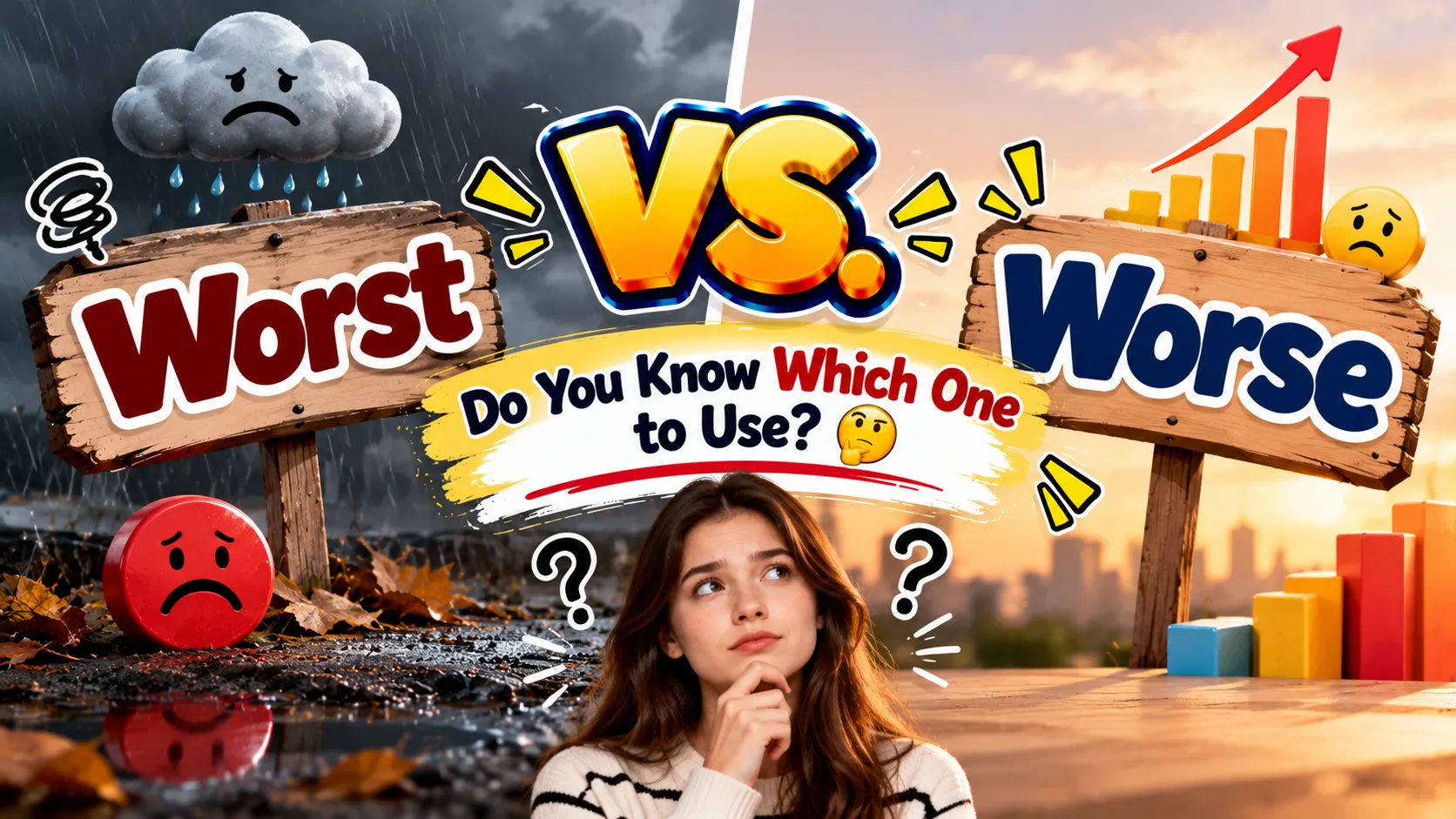
Is it worst or worse? These two words are closely related, but they do not serve the same grammatical purpose. Both describe something negative, unpleasant, or inferior, yet choosing the wrong form can completely change the meaning of a sentence.
The easiest distinction is this: worse is usually used when comparing two things, people, situations, or experiences, while worst is used when comparing three or more things or identifying the lowest level in a group. Once you understand this comparison rule, the difference between worst and worse becomes much easier to remember.
🔤 Worst or Worse: What Is the Difference?
The difference between worst and worse is mainly based on the degree of comparison. Worse is the comparative form of “bad,” while worst is the superlative form.
| Word | Form | Basic Meaning | Example |
|---|---|---|---|
| bad | Positive | Negative quality | This is bad. |
| worse | Comparative | More bad than another | This is worse than that. |
| worst | Superlative | Most bad in a group | This is the worst option. |
| A quick memory rule is: |
Bad → worse → worst
Think of the forms as levels:
bad → worse → worst
The choice depends on how many things you are comparing and what you want to say about them.
📊 When Should You Use “Worse”?
Use worse when comparing one thing with another. It indicates that one person, object, situation, or experience has a lower quality or condition than another.
Examples:
- This weather is worse than yesterday’s.
- My headache is worse today.
- The second option is worse than the first.
- This problem is worse than I expected.
- His condition became worse overnight.
Notice that “worse” often appears with than, although “than” is not always necessary.
For example:
The traffic is getting worse.
Here, the comparison may be understood from the context.
🏆 When Should You Use “Worst”?
Use worst when describing the lowest, most unpleasant, or most negative option among three or more possibilities—or when something represents the lowest possible level.
Examples:
- This is the worst day of my life.
- That was the worst movie I have ever seen.
- Monday was the worst day of the week.
- This is the worst mistake I have made.
- She had the worst experience of everyone in the group.
The word worst often appears with phrases such as: - the worst
- my worst
- his worst
- her worst
- the worst ever
- the worst possible
Unlike “worse,” worst identifies the lowest point or most negative choice.
🧠 The Easiest Rule for Worse vs. Worst
If you are trying to remember worse or worst, use this simple rule:
Worse = comparing two.
Worst = comparing three or more.
For example:
This book is worse than that book.
Two books are being compared.
This is the worst book in the series.
Now the book is being compared with the entire series.
Another way to remember it:
-er = comparative
-est = superlative
Just as:
- faster → fastest
- smaller → smallest
- better → best
- worse → worst
This pattern helps connect “worse” and “worst” to the broader system of English comparison.
⚖️ Worse vs. Worst With “Than”
The word worse commonly appears with than when making a direct comparison.
Examples:
- This is worse than I expected.
- The traffic is worse than yesterday.
- Her second attempt was worse than her first.
- This problem is worse than the original one.
- The new version is worse than the old version.
Using “worst” with “than” is usually incorrect when you are making a simple two-way comparison.
Incorrect:
This is worst than yesterday. ❌
Correct:
This is worse than yesterday. ✅
The word “than” is a useful clue that worse may be needed.
🌧️ “Worse” Can Describe a Change
Worse does not always require two clearly named things. It can describe a movement from one condition to a less favorable condition.
Examples:
- The weather is getting worse.
- My cold is getting worse.
- Things became worse after the delay.
- The situation seems to be getting worse.
- His pain became worse during the night.
In these sentences, the comparison is between an earlier condition and a later condition.
For example:
The weather is getting worse.
The meaning is essentially that the weather is becoming less pleasant than it was before.
🚨 “Worst” Can Describe an Extreme
Worst can describe something at the lowest or most negative extreme.
Examples:
- That was the worst mistake.
- This is the worst traffic I’ve seen.
- She had the worst luck.
- It was the worst possible outcome.
- He prepared for the worst.
The word can also appear without an explicit list of alternatives because the superlative meaning is understood.
For example:
I was expecting the worst.
This means the speaker expected the most negative possible result.
📚 Worse and Worst as Forms of “Bad”
The words worse and worst are irregular comparison forms. They do not follow the usual pattern of adding “-er” and “-est” to “bad.”
Instead:
| Degree | Word |
|---|---|
| Positive | bad |
| Comparative | worse |
| Superlative | worst |
| Do not write: |
- badder ❌
- baddest ❌
Use: - worse ✅
- worst ✅
For example:
This is bad.
This is worse.
This is the worst.
These three forms represent increasing degrees of negativity.
🆚 Worse or Worst in Everyday Sentences
Seeing the words side by side makes the distinction easier to understand.
| Sentence | Correct Word | Reason |
|---|---|---|
| This is ___ than before. | worse | Comparison |
| This is the ___ day ever. | worst | Extreme |
| My headache is getting ___. | worse | Change in condition |
| That was the ___ meal I’ve had. | worst | Lowest among experiences |
| The traffic is ___ today. | worse | Compared with another time |
| This is the ___ option available. | worst | Lowest option |
| Things could get ___. | worse | Future deterioration |
| Prepare for the ___. | worst | Most negative outcome |
| The surrounding words often give you a strong clue. |
💬 “Things Could Get Worse” or “Things Could Get Worst”?
The correct expression is:
Things could get worse. ✅
Not:
Things could get worst. ❌
Why? The sentence describes a possible change to a more negative condition. It does not identify the absolute lowest condition.
Similarly:
- It could get worse.
- The situation is getting worse.
- Things became worse.
Use worst when referring to the extreme:
We should prepare for the worst.
Here, “the worst” means the most negative possible outcome.
😟 “Hope for the Best, Prepare for the Worst”
This familiar expression provides an excellent example of worst used correctly.
Hope for the best, prepare for the worst.
The phrase contrasts:
- best = most positive outcome
- worst = most negative outcome
It does not use “worse” because the sentence is not comparing two conditions. Instead, it refers to the extreme ends of possible outcomes.
🗣️ “Could Be Worse” vs. “Could Be the Worst”
These phrases may look similar but communicate different ideas.
Could be worse
Things could be worse.
This means the current situation is bad, but an even less favorable situation is possible.
Could be the worst
This could be the worst outcome.
This means the situation may represent the most negative outcome among the possibilities.
Compare:
My day was bad, but it could have been worse.This was the worst day of the entire trip.
The first describes a possible deterioration. The second identifies the lowest point.
🏢 Worse or Worst in Professional Writing
Choosing the correct comparative form is important in reports, emails, reviews, articles, and business communication.
Examples:
- Sales performance was worse than projected.
- Customer satisfaction was worse in the second quarter.
- This was the worst result of the year.
- The revised process produced worse results than the previous system.
- The report identified the worst performing region.
Notice how worse is useful for direct comparisons, while worst identifies the lowest-performing option or result.
📝 Worse or Worst in Academic Writing
Academic writing often requires precise comparisons, making the distinction particularly important.
Examples:
Group B performed worse than Group A.
Group C recorded the worst result among all three groups.
The second method produced worse results.
The final method produced the worst results overall.
If you are comparing two groups, worse is generally appropriate. If you are identifying the lowest result among a larger set, worst is usually the correct choice.
🔄 Can “Worse” Be Used Without “Than”?
Yes. Worse does not always need “than.”
Examples:
- My cold is getting worse.
- The situation is worse now.
- Things have become worse.
- The traffic is getting worse.
In these sentences, the comparison is implied.
For example:
The situation is worse now.
The implied comparison is between the current situation and the earlier situation.
Therefore, do not assume that “worse” is incorrect simply because there is no “than.”
🔝 Can “Worst” Be Used Without “The”?
Yes. Although worst frequently appears with “the,” it can occur without it in certain constructions.
Examples:
- If worst comes to worst, we’ll leave.
- At worst, we may lose a few hours.
- Prepare for worst-case scenarios.
However, in many ordinary sentences, the worst is the natural construction:
We expected the worst.
This was the worst result.
The article depends on the grammatical structure.
🧩 Worse or Worst With “Ever”
The phrase the worst ever is common when describing an extreme experience.
Examples:
- This is the worst ever.
- That was the worst experience ever.
- It was the worst storm ever recorded in the area.
By contrast, worse than ever means something has become more negative compared with previous conditions.
Examples: - The traffic is worse than ever.
- His symptoms are worse than ever.
- The situation is worse than ever.
This creates another useful contrast:
worse than ever = more negative than before
the worst ever = the most negative on record or in the speaker’s experience
⚠️ Common Mistakes With Worse and Worst
These words are frequently confused because they both describe negative conditions. The following mistakes are especially common.
❌ This is worst than yesterday.
✅ This is worse than yesterday.
Use worse for the comparison.
❌ Things could get worst.
✅ Things could get worse.
The sentence describes possible deterioration.
❌ This is the worse day of my life.
✅ This is the worst day of my life.
Use worst for the extreme.
❌ This is the worst of the two options.
✅ This is the worse of the two options.
When specifically comparing two options, worse is generally the appropriate comparative form.
❌ This is the badest result.
✅ This is the worst result.
“Bad” has the irregular forms worse and worst.
🔎 “The Worse of Two” vs. “The Worst of Three”
The number of options being compared can provide a useful grammatical clue.
For two:
Of the two choices, this is the worse option.
For three or more:
Of the three choices, this is the worst option.
Compare:
| Number of Choices | Correct Form | Example |
|—|—|—|
| Two | worse | The worse of the two options |
| Three or more | worst | The worst of the three options |
This is one of the clearest ways to understand comparative and superlative adjectives.
🧠 Easy Memory Trick for Worse vs. Worst
Try remembering the number of letters:
worse = 5 letters
worst = 5 letters
So letter count does not help—but the endings do.
Think:
Worse → compare
Worst → extreme
Or remember:
-er = comparative
-est = superlative
Therefore:
worse → comparative
worst → superlative
A simple sentence pair can reinforce the rule:
This is worse than that.This is the worst of all.
🆚 Worse vs. Worst: Quick Comparison
| Feature | Worse | Worst |
|---|---|---|
| Degree | Comparative | Superlative |
| Meaning | More bad | Most bad |
| Typical use | Two things/conditions | Three or more or an extreme |
| Common word | than | the |
| Example | Worse than yesterday | The worst day |
| Change in condition | Yes | Not usually |
| Example | Getting worse | The worst outcome |
| Opposite | Better | Best |
| The simplest distinction remains: | ||
| worse = comparative | ||
| worst = superlative |
❓ Frequently Asked Questions About Worst or Worse
These questions cover some of the most common situations where writers hesitate between the two forms.
Is it worse or worst?
Both are correct words, but they are used differently. Worse is comparative, while worst is superlative.
Is “worse than” correct?
Yes. “Worse than” is the standard construction for comparing one thing with another.
Is “worst than” correct?
No. Use worse than for a normal comparison.
Is “could get worse” correct?
Yes. “Could get worse” means the situation may become more negative.
Is “could get worst” correct?
No. The standard expression is could get worse.
Is it “the worst” or “the worse”?
Use the worst when identifying the most negative option or extreme. Use the worse in certain comparisons, especially when distinguishing between two things.
Which is correct: “worse of the two” or “worst of the two”?
When comparing exactly two options, the worse of the two is the standard comparative construction.
Which is correct: “worst of the three” or “worse of the three”?
Use the worst of the three because you are identifying the lowest option among three.
Can “worse” be used without “than”?
Yes. For example: “The weather is getting worse.”
Can “worst” describe one thing?
Yes. “Worst” can describe something as the most negative or extreme even when the other alternatives are not explicitly listed.
What are the forms of bad?
The standard forms are:
bad → worse → worst
What is the opposite of worse?
The comparative opposite is better.
What is the opposite of worst?
The superlative opposite is best.
🏁 Final Takeaway
The difference between worst and worse becomes simple once you understand comparison.
Use worse when one thing is more negative than another:
This situation is worse than yesterday.
Use worst when something represents the most negative option, experience, or outcome:
This is the worst day of the year.
Remember the progression:
bad → worse → worst
And keep this shortcut in mind:
Worse = comparative.
Worst = superlative.
When you identify whether you are comparing two things or describing the extreme within a group, choosing the correct word becomes much easier.

Olivia Bennett is a writer and language enthusiast at Vocabsteria. She is passionate about exploring word meanings, name origins, and cultural expressions from around the world.