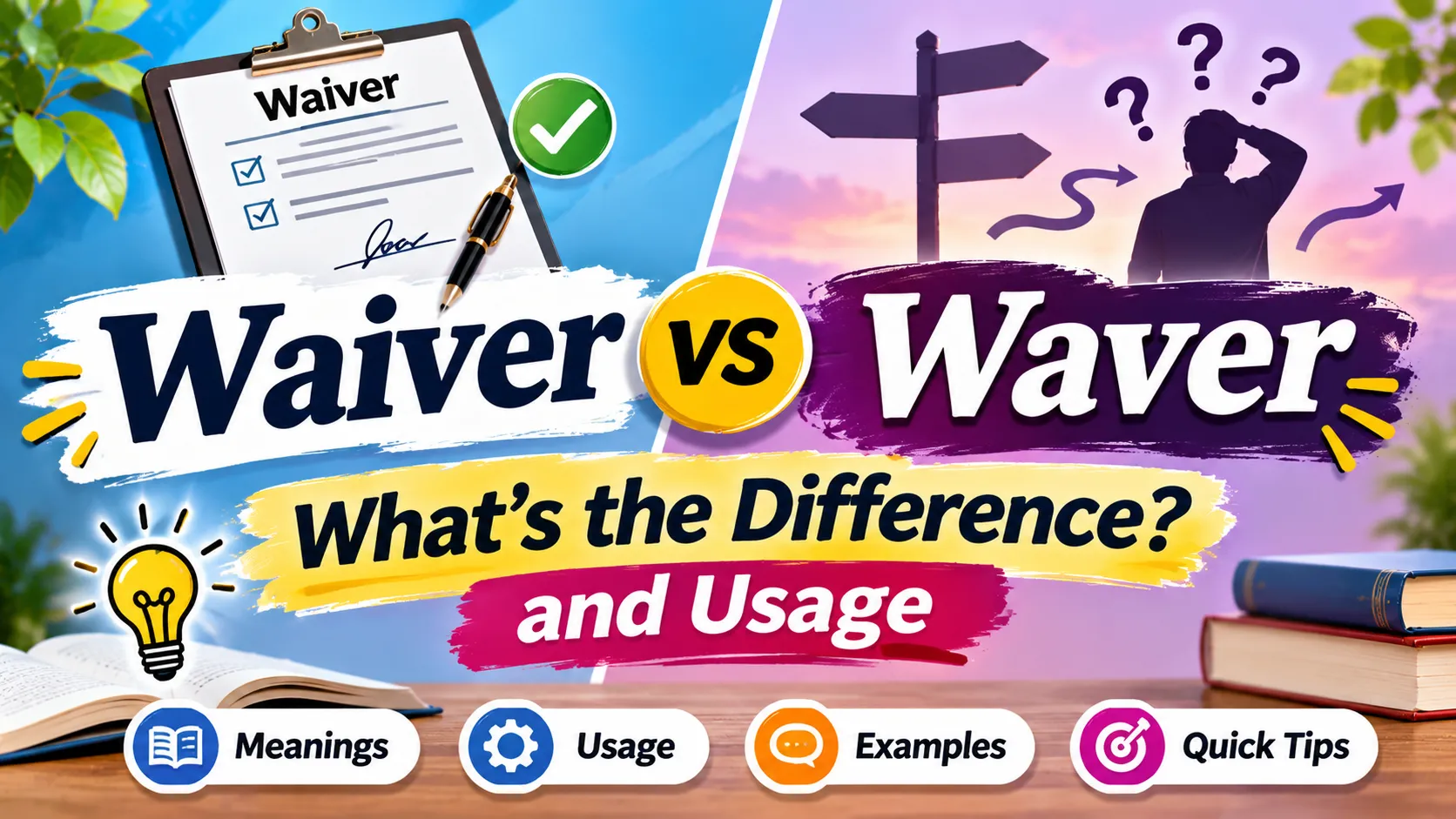
Waiver vs. waver is a common English spelling confusion because both words sound exactly alike but have completely different meanings. A single letter changes the meaning, grammatical role, and usage of each word. If you’ve ever wondered whether to write “sign a waiver” or “sign a waver,” understanding this distinction will help you avoid an embarrassing spelling mistake.
The word waiver is a noun that refers to giving up a right, claim, requirement, or legal protection voluntarily. For example, a person may sign a liability waiver before participating in a sporting activity. On the other hand, waver is primarily a verb that means to hesitate, become uncertain, or move unsteadily from side to side. You might waver when making a difficult decision or notice that a candle flame begins to waver in the wind.
Although these words share the same pronunciation, you cannot use them interchangeably. In this guide, you’ll learn their definitions, grammatical differences, pronunciation, sentence examples, common expressions, and practical tips for remembering which spelling to choose.
⚡ Quick Answer: Waiver vs. Waver
Waiver is a noun meaning the voluntary surrender of a right, claim, or requirement. Waver is a verb meaning to hesitate, become uncertain, or move unsteadily.
| Word | Part of Speech | Meaning | Example |
|---|---|---|---|
| Waiver | Noun | Giving up a right or requirement | I signed a liability waiver. |
| Waver | Verb | To hesitate or become uncertain | She began to waver during the decision. |
| Waver | Verb | To move unsteadily | The candle flame started to waver. |
Easy way to remember:
- Waiver contains “waive,” which means to give something up.
- Waver contains “wave,” which can help you remember its meaning of moving unsteadily.
📖 What Does Waiver Mean?
Waiver is a noun that refers to the voluntary decision to give up, surrender, or refrain from enforcing a particular right, claim, privilege, or requirement. It commonly appears in legal documents, contracts, insurance agreements, sports activities, and official applications.
When someone signs a waiver, they generally acknowledge that they are giving up a particular right or agreeing to certain conditions. For example, a gym may ask new members to sign a liability waiver before using its equipment. Similarly, a sports organization may require participants to complete a waiver before joining an event.
Waivers can also apply to requirements that an organization agrees not to enforce. For instance, a school may grant an application fee waiver to a student who qualifies for financial assistance.
Examples of waiver in sentences:
- Every participant must sign a liability waiver before entering the competition.
- The university granted her an application fee waiver.
- He requested a waiver of the late payment fee.
- The insurance company explained the terms of the waiver.
- Parents must complete a permission form and liability waiver.
- The organization approved his request for a requirement waiver.
- She received a tuition waiver because of her financial circumstances.
- The agreement included a waiver of certain contractual rights.
In each example, waiver refers to a formal or voluntary decision involving a right, fee, requirement, or claim.
📝 What Does Waver Mean?
Waver is primarily a verb that means to hesitate, become uncertain, lose confidence, or struggle to make a decision. It can also describe something that moves unsteadily, fluctuates, or becomes less stable.
When a person wavers, they may feel unsure about what to do. For example, someone might waver before accepting a job offer because they are uncertain about moving to another city. Similarly, a person’s confidence may waver when they face unexpected challenges.
The word can also describe physical movement. A candle flame may waver when the wind blows, or someone’s voice may waver because of nervousness or emotion.
Examples of waver in sentences:
- She began to waver when the interviewer asked a difficult question.
- His confidence did not waver despite the unexpected challenges.
- I started to waver about accepting the job offer.
- The candle flame continued to waver in the gentle breeze.
- Her voice began to waver as she delivered the emotional speech.
- The team’s determination never wavered during the competition.
- He refused to waver from his original decision.
- The signal seemed to waver during the storm.
Unlike waiver, waver describes an action, condition, or change in confidence or stability.
🔍 Waiver vs. Waver: Key Differences
The main difference between waiver and waver is their meaning and grammatical function. Although both words have identical pronunciation, they belong to different parts of speech and appear in different sentence structures.
| Feature | Waiver | Waver |
|---|---|---|
| Part of speech | Noun | Verb |
| Meaning | Giving up a right or requirement | Hesitating or becoming unsteady |
| Pronunciation | /ˈweɪ.vər/ | /ˈweɪ.vər/ |
| Related word | Waive | Wave |
| Common usage | Legal forms and agreements | Decisions and uncertain behavior |
| Example | Sign a waiver. | Do not waver. |
| Word forms | Waivers | Wavers, wavered, wavering |
Remember: If you’re talking about a document, permission, fee, or surrendered right, use waiver. If you’re describing hesitation, uncertainty, or unsteady movement, use waver.
⚖️ When Should You Use Waiver?
Use waiver when discussing the voluntary surrender of a right, claim, fee, privilege, or requirement. It is especially common in legal, financial, educational, medical, and sports-related situations.
Here are some common situations in which waiver is the correct choice.
Legal Agreements and Liability Forms
A liability waiver is a document that generally records a person’s acknowledgment of certain risks and may involve giving up specific legal claims. Its actual legal effect depends on the wording and applicable law.
Examples:
- All visitors must sign a liability waiver before participating.
- The company included a waiver in the service agreement.
- She reviewed the waiver before signing the document.
- The attorney explained the conditions outlined in the waiver.
Education and School Applications
Schools, colleges, and universities sometimes offer waivers for application fees, tuition charges, or other requirements.
Examples:
- The college approved his application fee waiver.
- She qualified for a tuition waiver.
- Students can request a waiver if they meet the eligibility requirements.
- The university offers an examination fee waiver to eligible applicants.
Sports and Recreational Activities
Sports clubs, gyms, adventure parks, and recreational organizations may ask participants to sign waivers before taking part in certain activities.
Examples:
- The gym requires every new member to complete a waiver.
- Participants signed a waiver before the climbing session.
- The tournament organizer collected waivers from all players.
- Parents must submit a waiver for their children.
Fees and Financial Requirements
A waiver can also refer to an exemption from a payment or financial obligation.
Examples:
- The bank granted a waiver of the annual fee.
- She requested a late payment waiver.
- The organization approved his fee waiver.
- Eligible customers may receive a service charge waiver.
🌊 When Should You Use Waver?
Use waver when describing hesitation, uncertainty, fluctuating confidence, or unsteady physical movement. It can refer to people, emotions, voices, lights, flames, and other things that move or change.
Here are the most common situations in which waver is appropriate.
Hesitating Before Making a Decision
Waver often describes someone who feels uncertain about a choice or struggles to commit to a decision.
Examples:
- She began to waver before accepting the offer.
- I never wavered in my decision to pursue my goals.
- He tends to waver whenever he faces a difficult choice.
- They started to waver about purchasing the expensive property.
Losing Confidence or Determination
Waver can describe a person’s confidence, belief, commitment, or determination becoming weaker.
Examples:
- Her confidence never wavered during the presentation.
- His determination began to waver after several failures.
- The team’s belief in victory did not waver.
- She refused to waver in her commitment to helping others.
Moving Unsteadily
Waver can also describe physical movement that appears unstable, irregular, or gently shifting.
Examples:
- The candle flame began to waver in the wind.
- The light seemed to waver across the dark wall.
- The reflection started to waver on the surface of the water.
- The small flame continued to waver in the cold air.
A Voice Becoming Unsteady
A person’s voice may waver because of nervousness, sadness, fear, or strong emotion.
Examples:
- His voice began to waver during the emotional conversation.
- She tried to speak confidently, but her voice continued to waver.
- The speaker’s voice wavered as she remembered the difficult experience.
- His voice did not waver when he answered the question.
📊 Waiver vs. Waver: Examples in Different Sentences
Seeing both words in similar contexts makes their difference easier to understand. The following examples demonstrate how each spelling works in everyday English.
| Waiver Example | Waver Example |
|---|---|
| I signed the waiver before the event. | I began to waver before the event. |
| The school granted a fee waiver. | Her confidence started to waver. |
| He requested a liability waiver. | He refused to waver from his decision. |
| The agreement included a waiver clause. | The candle flame began to waver. |
| She received a tuition waiver. | Her voice began to waver. |
| Participants must submit a waiver. | His determination never wavered. |
| The company approved the waiver request. | The light seemed to waver in the distance. |
| They discussed the waiver conditions. | She did not waver under pressure. |
🔄 Waive vs. Waiver vs. Waver
Another common source of confusion is the relationship between waive, waiver, and waver. These three words look and sound similar, but they have different grammatical roles.
| Word | Part of Speech | Meaning | Example |
|---|---|---|---|
| Waive | Verb | To voluntarily give up a right or requirement | The school may waive the application fee. |
| Waiver | Noun | The act or document involving the surrender of a right | She signed the waiver. |
| Waver | Verb | To hesitate or become unsteady | He refused to waver. |
What Does Waive Mean?
Waive is a verb meaning to voluntarily give up a right, claim, privilege, or requirement. It is the base verb from which the noun waiver is formed.
Examples:
- The university agreed to waive the application fee.
- The company decided to waive the late payment charge.
- She chose to waive her right to appeal.
- The organization may waive certain eligibility requirements.
How Is Waiver Related to Waive?
Waiver is the noun form associated with the act of waiving something. It can describe the act itself or a document that records the surrender of a particular right or requirement.
Examples:
- The fee waiver saved her money.
- He signed a waiver before entering the facility.
- The company approved the waiver request.
How Is Waver Different?
Waver has a completely different meaning. It does not mean giving up a right or requirement. Instead, it describes hesitation, uncertainty, or unsteady movement.
Examples:
- She began to waver about her decision.
- His confidence never wavered.
- The candle flame started to waver.
Easy memory trick: Waive means to give up, waiver is the noun, and waver means to hesitate or move unsteadily.
🧠 How to Remember the Difference Between Waiver and Waver
If you frequently confuse these spellings, a simple memory technique can help you choose the correct word.
Remember the letter I in waiver:
- Waiver contains the letter combination found in waive.
- Waive means to give up a right or requirement.
- A waiver is the noun connected to that action.
Remember the letter E in waver:
- Waver looks similar to wave.
- A wave moves from side to side.
- Waver can describe something moving unsteadily or a person hesitating.
Try these examples:
- Sign a waiver before joining the activity.
- Don’t waver when making an important decision.
- The company agreed to waive the additional fee.
Once you connect each spelling to its related word, the distinction becomes much easier to remember.
❌ Common Mistakes When Using Waiver and Waver
Even experienced writers sometimes confuse waiver and waver because they sound identical. Understanding these common errors will help you use both words correctly.
1. Writing Waver When You Mean a Legal Document
Incorrect: All participants must sign a waver before the event.
Correct: All participants must sign a waiver before the event.
A document that involves surrendering certain rights or acknowledging conditions is a waiver.
2. Writing Waiver When You Mean Hesitation
Incorrect: She began to waiver before making her decision.
Correct: She began to waver before making her decision.
The sentence describes uncertainty, so waver is the appropriate verb.
3. Confusing Waiver With Waive
Incorrect: The university issued a waive for the application fee.
Correct: The university issued a waiver for the application fee.
Waive is a verb, while waiver is a noun.
4. Using Waiver as a Verb
Incorrect: He decided to waiver his right to appeal.
Correct: He decided to waive his right to appeal.
Use waive when describing the action of voluntarily giving something up.
5. Assuming Waver Only Describes People
Waver can describe both human behavior and physical movement.
Examples:
- Her confidence began to waver.
- The candle flame started to waver.
Both uses are correct.
6. Forgetting the Different Word Forms
Waver changes according to tense, while waiver normally forms its plural by adding -s.
| Base Word | Other Forms |
|---|---|
| Waiver | Waivers |
| Waver | Wavers, wavered, wavering |
| Waive | Waives, waived, waiving |
✍️ More Examples of Waiver and Waver in Everyday English
These additional examples show how both words appear in common situations.
Waiver:
- The sports center requires a signed waiver from every visitor.
- He submitted a waiver to avoid paying the additional charge.
- The insurance policy includes a waiver of certain fees.
- The school provided a waiver for eligible students.
- She read every section of the waiver before signing it.
- The organization rejected his request for a waiver.
- A signed waiver is necessary before the activity begins.
- The company offered a waiver to qualifying customers.
- The contract contains a waiver of specific claims.
- They discussed the waiver during the meeting.
Waver:
- She refused to waver despite the criticism.
- His confidence began to waver after the unexpected news.
- The flame continued to waver in the breeze.
- I started to waver when I considered the risks.
- Her determination never wavered.
- The light appeared to waver in the distance.
- His voice started to waver during the interview.
- They did not waver from their original plan.
- The team began to waver under pressure.
- My decision did not waver after the discussion.
🧩 Synonyms for Waiver and Waver
Learning synonyms can help you understand the different meanings of these words and expand your vocabulary.
Synonyms for Waiver
When waiver means giving up or surrendering a right, useful related words and expressions include:
- Surrender
- Relinquishment
- Renunciation
- Forfeiture
- Exemption
- Dispensation
- Release
- Abandonment
- Forgoing
- Disclaimer
- Rejection of a right
- Voluntary surrender
Example: The university approved an exemption from the application fee.
Note: These alternatives are related but not identical. An exemption removes a requirement, while a waiver may involve voluntarily giving up a right or the decision not to enforce a requirement.
Synonyms for Waver
When waver means to hesitate or become uncertain, useful alternatives include:
- Hesitate
- Falter
- Vacillate
- Fluctuate
- Wobble
- Sway
- Doubt
- Dither
- Tremble
- Quiver
- Shift
- Become uncertain
- Lose confidence
- Be indecisive
- Change one’s mind
Example: She began to hesitate before accepting the invitation.
🧠 Practice Quiz: Waiver or Waver?
Test your understanding by choosing the correct word in each sentence.
1. All visitors must sign a liability ______ before entering the facility.
- A. Waiver
- B. Waver
2. She began to ______ when she heard the unexpected news.
- A. Waiver
- B. Waver
3. The university approved his application fee ______.
- A. Waiver
- B. Waver
4. His confidence did not ______ during the difficult interview.
- A. Waiver
- B. Waver
5. The candle flame started to ______ in the breeze.
- A. Waiver
- B. Waver
6. The company agreed to grant a late payment ______.
- A. Waiver
- B. Waver
7. She refused to ______ from her original decision.
- A. Waiver
- B. Waver
8. The sports club requires every participant to complete a ______.
- A. Waiver
- B. Waver
9. His voice began to ______ as he delivered the emotional speech.
- A. Waiver
- B. Waver
10. The school may ______ the application fee for eligible students.
- A. Waive
- B. Waiver
- C. Waver
✅ Quiz Answer Key
| Question | Correct Answer | Explanation |
|---|---|---|
| 1 | A. Waiver | A liability waiver is a document. |
| 2 | B. Waver | Waver describes hesitation. |
| 3 | A. Waiver | A fee waiver is an exemption or surrender of a charge. |
| 4 | B. Waver | Waver describes confidence becoming unsteady. |
| 5 | B. Waver | Waver can describe a moving flame. |
| 6 | A. Waiver | A payment waiver concerns a fee or charge. |
| 7 | B. Waver | Waver means to hesitate or become uncertain. |
| 8 | A. Waiver | Participants complete a waiver form. |
| 9 | B. Waver | Waver describes an unsteady voice. |
| 10 | A. Waive | Waive is the verb meaning to give up a fee. |
❓ Frequently Asked Questions About Waiver vs. Waver
1. What is the difference between waiver and waver?
Waiver is a noun that refers to giving up a right, claim, fee, or requirement. Waver is a verb that means to hesitate, become uncertain, or move unsteadily. Both words sound alike but have different meanings.
2. Is it sign a waiver or sign a waver?
The correct expression is sign a waiver. A waiver is a document that may record the surrender of certain rights or acknowledgment of specific conditions. Waver is a verb and does not refer to a legal document.
3. What does waiver mean in simple words?
A waiver means voluntarily giving up a particular right, claim, privilege, or requirement. It can also refer to a document that records this decision.
4. What does waver mean in simple words?
Waver means to hesitate, become unsure, or lose confidence. It can also describe something moving gently or unsteadily from side to side.
5. Are waiver and waver pronounced the same?
Yes. Both words are pronounced /ˈweɪ.vər/. They are homophones, meaning they sound alike but have different spellings and meanings.
6. What is the difference between waive and waiver?
Waive is a verb that means to voluntarily give up a right, fee, or requirement. Waiver is a noun that describes the act or document associated with giving something up.
Examples:
- The college may waive the application fee.
- The student received an application fee waiver.
7. Can waver be used as a noun?
Waver is primarily used as a verb. It can also appear as a noun in less common contexts to describe someone or something that wavers, but this usage is uncommon. Waiver is the standard noun when discussing the surrender of a right or requirement.
8. What is the plural of waiver?
The plural form of waiver is waivers.
Example: All participants must submit their signed waivers before the competition.
9. What is the past tense of waver?
The past tense of waver is wavered.
Example: She wavered before accepting the offer.
10. What is the opposite of waver?
Depending on the context, antonyms of waver include remain firm, stand firm, persist, stay committed, and remain steadfast.
11. What is another word for waiver?
Related alternatives include exemption, relinquishment, surrender, renunciation, and dispensation. However, these words have slightly different meanings and are not interchangeable in every legal or financial context.
12. What is another word for waver?
Depending on the sentence, alternatives include hesitate, falter, vacillate, wobble, sway, fluctuate, and become uncertain.
13. Can a person’s confidence waver?
Yes. Waver can describe a person’s confidence, determination, belief, or commitment becoming weaker.
Example: Her confidence began to waver after receiving negative feedback.
14. Is a liability waiver the same as a release form?
The terms are sometimes used similarly, but they are not necessarily identical. A liability waiver generally concerns giving up or limiting certain legal claims, while a release form may document the release of particular rights or claims. Their legal effects depend on the wording and applicable law.
15. How can I remember waiver vs. waver?
Remember that waiver comes from waive, meaning to give something up. Waver is related in appearance to wave and describes hesitation or unsteady movement. If you’re signing a document, use waiver. If you’re describing uncertainty, use waver.
🎯 Conclusion
The difference between waiver vs. waver becomes easy once you remember their meanings and grammatical roles. Waiver is a noun that refers to giving up a right, claim, fee, or requirement. Waver is a verb that means to hesitate, become uncertain, or move unsteadily.
Use waiver when discussing legal documents, liability forms, fee exemptions, or surrendered rights. Choose waver when describing someone’s hesitation, changing confidence, or an unsteady movement. Also remember the related verb waive, which means to voluntarily give something up. Keeping these three words separate will help you write more accurately and avoid common spelling mistakes.

Olivia Bennett is a writer and language enthusiast at Vocabsteria. She is passionate about exploring word meanings, name origins, and cultural expressions from around the world.