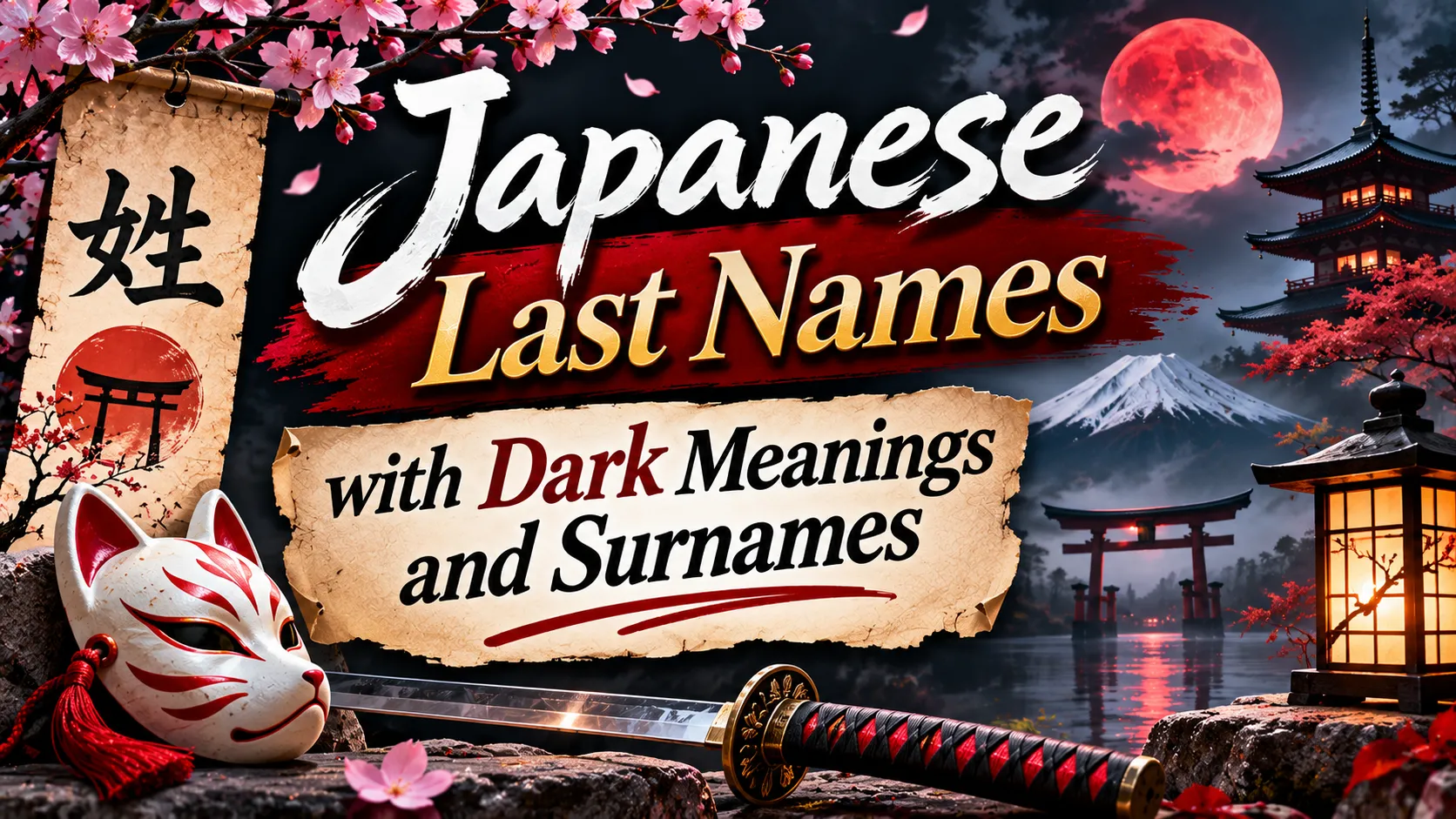
Japanese last names with dark meanings have a fascinating connection to nature, history, mythology, and traditional Japanese language. Some surnames contain kanji associated with darkness, shadows, death, ghosts, mountains, storms, or other mysterious elements. These names can sound elegant and poetic while carrying meanings that feel mysterious, powerful, or even unsettling.
Japanese surnames often combine two or more kanji characters, and their meanings can change depending on the characters used and their pronunciation. For example, Kuro (黒) means black, while Yami (闇) means darkness. Other characters, such as Kage (影), meaning shadow, and Shi (死), meaning death, can create a darker atmosphere. However, not every surname containing these characters has a frightening meaning or association.
If you are searching for a mysterious surname for a fictional character, fantasy story, gaming identity, or creative project, this collection offers plenty of inspiration. You will discover Japanese surnames associated with darkness, shadows, death, ghosts, dangerous landscapes, and supernatural imagery, along with their kanji, meanings, and cultural context.
🖤 Japanese Last Names Associated with Darkness
Japanese surnames connected to darkness often use characters associated with blackness, night, shadows, and mysterious surroundings. These names can create an atmospheric impression, making them interesting choices for gothic fiction, fantasy characters, and mysterious personalities.
Here are some surnames and surname-style combinations with dark associations.
- Kuroda (黒田) – Black rice field.
- Kuroki (黒木) – Black tree.
- Kuromori (黒森) – Black forest.
- Kuroiwa (黒岩) – Black rock.
- Kurokawa (黒川) – Black river.
- Kuroyama (黒山) – Black mountain.
- Kuroishi (黒石) – Black stone.
- Kurose (黒瀬) – Black rapids.
- Kurobane (黒羽) – Black feather.
- Kurozawa (黒沢) – Black marsh or swamp.
- Kurohama (黒浜) – Black beach.
- Kurohashi (黒橋) – Black bridge.
- Kurotani (黒谷) – Black valley.
- Kurotsuki (黒月) – Black moon.
- Kurohoshi (黒星) – Black star.
Note: Some combinations above are creative or uncommon surname-style forms rather than verified common Japanese family names. The meanings are based on the displayed kanji.
🌑 Japanese Last Names Meaning Shadow
Shadows have a strong connection to mystery, secrecy, and hidden identities. Japanese writing uses the kanji 影 (kage) for shadow, which appears in some names and can inspire darker fictional surnames.
These options work particularly well for mysterious characters, secretive families, and supernatural stories.
- Kageyama (影山) – Shadow mountain.
- Kageishi (影石) – Shadow stone.
- Kagekawa (影川) – Shadow river.
- Kagetani (影谷) – Shadow valley.
- Kagemori (影森) – Shadow forest.
- Kagezawa (影沢) – Shadow marsh.
- Kagehara (影原) – Shadow field.
- Kageuchi (影内) – Within the shadow.
- Kagehira (影平) – Shadow plain.
- Kagefumi (影文) – Shadow writing or shadow text.
Some of these are creative kanji combinations rather than established surnames. For authentic family-name research, verify the exact spelling and reading before using one.
☠️ Japanese Last Names with Death-Related Meanings
Death-related Japanese names can create an especially dark atmosphere. The kanji 死 (shi) means death, while characters such as 墓 (haka, grave) and 骸 (mukuro, remains) carry associations with burial and mortality.
However, these characters are not common ingredients in ordinary Japanese family names. The following entries are primarily creative surname-style combinations for fictional characters, not a list of widely established Japanese surnames.
- Shizuka (静) – Quiet or still; a subtle, somber association rather than death itself.
- Hakaba (墓場) – Graveyard; a dark Japanese word, not a typical surname.
- Shikotsu (死骨) – Death bones; a fictional kanji construction.
- Shibone (死骨) – Death remains; a fictional construction.
- Shikage (死影) – Death shadow; a fictional construction.
- Shizumi (沈み) – Sinking or descending; a dark atmospheric expression.
- Hakaishi (墓石) – Tombstone; a descriptive word, not a typical surname.
- Mukuro (骸) – Corpse or remains; an ominous word sometimes used as a fictional name.
- Shigure (時雨) – Late-autumn or early-winter rain; poetic and melancholy, not a death-related surname by definition.
- Kurotsume (黒爪) – Black claw; a fictional dark-themed construction.
Important: A Japanese word with a dark meaning does not automatically qualify as a traditional Japanese surname. These options are best treated as creative inspiration unless their real-world family-name usage is independently verified.
👻 Japanese Last Names Inspired by Ghosts and Spirits
Japanese folklore contains many supernatural beings, including yūrei (幽霊), which means ghost or spirit. Traditional stories also feature mysterious forests, haunted places, and spirits connected to particular landscapes.
The following names combine supernatural imagery with Japanese-style kanji. Some are established surname forms, while others are fictional combinations.
- Yurei (幽霊) – Ghost or spirit; a supernatural word, not a typical surname.
- Onimura (鬼村) – Demon village; a creative combination.
- Onizuka (鬼塚) – Demon mound; an established Japanese surname.
- Onishi (大西) – Great west; an established surname, not literally demon-related.
- Onikawa (鬼川) – Demon river; a creative combination.
- Onigawa (鬼川) – Demon river; a fictional surname-style form.
- Obake (お化け) – Ghost or monster; a common supernatural word, not a traditional surname.
- Ayakashi (妖) – Mysterious or supernatural being; a creative name inspiration.
- Kimon (鬼門) – Demon gate; a traditional concept associated with an unlucky direction.
- Reikon (霊魂) – Spirit or soul; a supernatural term rather than a typical surname.
For authentic character naming, Onizuka is a more recognizable family-name option, while the other combinations work better as fantasy names.
🌲 Japanese Last Names Inspired by Dark Forests and Mountains
Forests and mountains appear frequently in Japanese surnames because they reflect the country’s natural landscapes. When combined with words associated with blackness, isolation, or shadows, they can create a mysterious atmosphere.
These surnames and creative combinations are especially suitable for characters who live in remote villages, mysterious mountain regions, or gothic fantasy settings.
- Kuromori (黒森) – Black forest.
- Kuroyama (黒山) – Black mountain.
- Kageyama (影山) – Shadow mountain.
- Kurotani (黒谷) – Black valley.
- Kagegawa (影川) – Shadow river.
- Yamaguro (山黒) – Mountain black; creative construction.
- Kurohayashi (黒林) – Black woodland.
- Kuromine (黒峰) – Black peak.
- Kagezawa (影沢) – Shadow marsh.
- Kurohara (黒原) – Black field.
- Kurobuchi (黒淵) – Black abyss or deep pool; creative construction.
- Kurofuchi (黒淵) – Black abyss; creative construction.
- Kurotake (黒竹) – Black bamboo; creative construction.
- Kagegiri (影霧) – Shadow mist; creative construction.
- Kuronuma (黒沼) – Black swamp.
These names can work well in dark fantasy stories, particularly when a character’s family has a connection to an isolated landscape.
🌧️ Japanese Last Names Inspired by Storms and Dark Weather
Storms, heavy rain, thunder, and strong winds can create powerful imagery in Japanese-inspired fiction. Weather-related kanji can suggest danger, loneliness, and dramatic natural forces.
The following options include real surname forms and creative combinations.
- Arashi (嵐) – Storm; also a word used in Japanese names.
- Kurokaze (黒風) – Black wind; creative combination.
- Amagiri (雨霧) – Rain mist; creative combination.
- Kuroame (黒雨) – Black rain; creative combination.
- Kazanami (風波) – Wind and waves; name-style combination.
- Raikawa (雷川) – Thunder river; creative combination.
- Kaminari (雷) – Thunder; a Japanese word and name inspiration.
- Fuyuki (冬木) – Winter tree; an established name element.
- Yukimura (雪村) – Snow village; an established surname.
- Amemiya (雨宮) – Rain shrine or rain palace; an established surname.
- Kiriyama (霧山) – Mist mountain; an established surname.
- Kiriishi (霧石) – Mist stone; creative combination.
- Shigure (時雨) – Seasonal rain; a poetic name.
- Kazehaya (風早) – Fast wind; a Japanese surname and name form.
- Arakawa (荒川) – Rough or wild river; an established surname.
Not every weather-related surname has a dark meaning. Their atmospheric quality comes from the imagery they evoke.
🕯️ Japanese Last Names with Mysterious and Gothic Meanings
Gothic names often suggest old family histories, abandoned places, hidden secrets, and mysterious traditions. Japanese surnames associated with mountains, rivers, temples, forests, and unusual landscapes can create this atmosphere without requiring explicitly frightening meanings.
Here are some options for gothic-inspired characters.
- Tsukiyama (月山) – Moon mountain.
- Tsukikage (月影) – Moon shadow; also a poetic name-style combination.
- Kuroda (黒田) – Black field.
- Kiriyama (霧山) – Mist mountain.
- Shirogane (白銀) – Silver; an established surname and name element.
- Yashiro (八代) – Eight generations; an established surname.
- Kuronuma (黒沼) – Black swamp.
- Amemiya (雨宮) – Rain shrine or rain palace.
- Kageyama (影山) – Shadow mountain.
- Takamori (高森) – Tall forest.
- Fuyusawa (冬沢) – Winter marsh; surname-style combination.
- Kurokawa (黒川) – Black river.
- Tsukimori (月森) – Moon forest; creative combination.
- Kirisawa (霧沢) – Mist marsh; creative combination.
- Yomiyama (黄泉山) – Underworld mountain; fictional construction inspired by Yomi, the Japanese underworld.
These names are particularly useful when you want a character’s surname to feel atmospheric rather than openly evil.
🐍 Japanese Last Names Inspired by Demons and Dark Folklore
Japanese folklore includes supernatural creatures known as yōkai and powerful beings such as oni. Oni are commonly described as demons or ogre-like creatures in Japanese mythology.
Names inspired by these figures can create a strong supernatural identity for fictional villains, fantasy warriors, and mysterious families.
- Onizuka (鬼塚) – Demon mound; an established Japanese surname.
- Onishi (大西) – Great west; an established surname, not literally demon-related.
- Onoda (小野田) – Small field rice paddy; an established surname, not demon-related.
- Onikubo (鬼久保) – Demon hollow; an established surname form.
- Onigashima (鬼ヶ島) – Demon island; famous in Japanese folklore as the island associated with the tale of Momotarō.
- Oniyama (鬼山) – Demon mountain; creative surname-style combination.
- Onikawa (鬼川) – Demon river; creative combination.
- Kimon (鬼門) – Demon gate; a folklore-related concept.
- Akuma (悪魔) – Devil or demon; a common word, not a typical Japanese surname.
- Yasha (夜叉) – Yaksha or supernatural being; a mythological name inspiration.
For a realistic Japanese character, consider established surnames such as Onizuka. For a fantasy setting, combinations such as Oniyama or Onikawa may offer more dramatic possibilities.
🌙 Japanese Last Names Inspired by the Moon and Night
The moon and nighttime have a strong presence in Japanese poetry, literature, and traditional aesthetics. These themes can suggest loneliness, mystery, romance, or hidden identities.
Some options below are established surnames, while others are creative combinations.
- Tsukiyama (月山) – Moon mountain.
- Tsukikage (月影) – Moon shadow.
- Tsukimori (月森) – Moon forest.
- Yoruoka (夜岡) – Night hill; creative combination.
- Yoruishi (夜石) – Night stone; creative combination.
- Kurotsuki (黒月) – Black moon; creative combination.
- Yozora (夜空) – Night sky; a Japanese word and name inspiration.
- Tsukishiro (月城) – Moon castle.
- Hoshikage (星影) – Star shadow; creative combination.
- Yamagetsu (山月) – Mountain moon; creative combination.
- Fuyutsuki (冬月) – Winter moon.
- Mikazuki (三日月) – Crescent moon; also a surname and given-name element.
- Tsukino (月野) – Moon field; an established surname.
- Yoru (夜) – Night; a Japanese word rather than a common family name.
- Kageboshi (影星) – Shadow star; creative combination.
🏚️ Japanese Last Names Inspired by Abandoned and Haunted Places
Abandoned houses, old temples, forgotten villages, and empty roads are common settings in Japanese horror and supernatural fiction. Surnames associated with these locations can help establish a mysterious family background.
The following suggestions combine Japanese place-related words with darker imagery.
- Kuroyashiki (黒屋敷) – Black mansion; creative construction.
- Onizuka (鬼塚) – Demon mound; established surname.
- Kurotani (黒谷) – Black valley.
- Kurohara (黒原) – Black field.
- Kageyama (影山) – Shadow mountain.
- Yomiyama (黄泉山) – Underworld mountain; fictional construction.
- Kurofuchi (黒淵) – Black abyss; creative combination.
- Kuroishi (黒石) – Black stone.
- Kirisawa (霧沢) – Mist marsh; creative combination.
- Kurozawa (黒沢) – Black marsh.
- Hakaba (墓場) – Graveyard; descriptive word rather than a typical surname.
- Kagegawa (影川) – Shadow river; creative combination.
- Yashiro (八代) – Eight generations; established surname.
- Kurokawa (黒川) – Black river.
- Kurobuchi (黒淵) – Black abyss; creative combination.
These names can help create a memorable setting for a mystery novel, horror game, or supernatural family history.
🎭 Japanese Dark Last Names for Fictional Characters
A good fictional surname should match the character’s personality, background, and role in the story. A quiet antagonist might need a subtle surname, while a supernatural villain could have a more dramatic name.
Here are some character-oriented suggestions.
| Character type | Suggested surname | Meaning or inspiration |
|---|---|---|
| Mysterious villain | Kuroda (黒田) | Black field |
| Shadow warrior | Kageyama (影山) | Shadow mountain |
| Gothic aristocrat | Tsukiyama (月山) | Moon mountain |
| Demon character | Onizuka (鬼塚) | Demon mound |
| Lonely wanderer | Kiriyama (霧山) | Mist mountain |
| Dark fantasy hero | Kurokawa (黒川) | Black river |
| Haunted village resident | Kurotani (黒谷) | Black valley |
| Mysterious female character | Tsukino (月野) | Moon field |
| Supernatural antagonist | Yomiyama (黄泉山) | Fictional underworld mountain |
| Gothic storyteller | Shigure (時雨) | Seasonal rain |
For realistic Japanese characters, use established surnames and treat the dark atmosphere as a creative interpretation. For fantasy characters, you can use invented kanji combinations as long as you clearly distinguish them from authentic family names.
🇯🇵 Real Japanese Surnames with Mysterious Associations
If you want a surname that feels authentic rather than invented, it is better to choose an established Japanese family name and build the darker meaning through the character’s story.
The following surnames are established or recognizable Japanese family names. Their meanings are based on the kanji shown, although readings and written forms can vary between families.
- Kuroda (黒田) – Black field.
- Kuroki (黒木) – Black tree.
- Kurokawa (黒川) – Black river.
- Kuroiwa (黒岩) – Black rock.
- Kurose (黒瀬) – Black rapids.
- Kurozawa (黒沢) – Black marsh.
- Kuroishi (黒石) – Black stone.
- Kageyama (影山) – Shadow mountain.
- Kiriyama (霧山) – Mist mountain.
- Onizuka (鬼塚) – Demon mound.
- Onikubo (鬼久保) – Demon hollow.
- Amemiya (雨宮) – Rain shrine or rain palace.
- Arakawa (荒川) – Rough or wild river.
- Tsukino (月野) – Moon field.
- Tsukiyama (月山) – Moon mountain.
- Yukimura (雪村) – Snow village.
- Fuyuki (冬木) – Winter tree.
- Shirogane (白銀) – Silver.
- Mikazuki (三日月) – Crescent moon.
- Yashiro (八代) – Eight generations.
These surnames do not necessarily indicate that a family has a dark history. Their meanings are linguistic and often geographical. The mysterious atmosphere comes from how writers use them in fictional settings.
🧠 How to Choose a Japanese Last Name with a Dark Meaning
Choosing a Japanese surname for a character or creative project requires more than selecting a word that sounds mysterious. Japanese names depend on kanji, pronunciation, historical usage, and cultural context.
Keep these points in mind:
- Check the kanji: The same pronunciation can have different written forms and meanings.
- Verify authenticity: A dramatic combination of Japanese characters is not automatically an established surname.
- Match the character: Choose a name that reflects the character’s personality or background.
- Consider pronunciation: A name should be easy for your intended readers to recognize and pronounce.
- Understand cultural meaning: Words associated with death, demons, and ghosts may carry specific cultural or religious associations.
- Avoid false translations: Do not assume every surname containing 黒 means the family has an evil history.
- Use creative names carefully: If you invent a surname, identify it as fictional rather than presenting it as a common Japanese family name.
A well-chosen surname can make a fictional character more memorable without relying on an exaggerated or inaccurate translation.
❓ Frequently Asked Questions
What Japanese last name means darkness?
Japanese surnames do not commonly translate directly to darkness. The character 闇 means darkness, but it is not a common element in ordinary Japanese family names. Kuroda (黒田), Kuroki (黒木), and Kurokawa (黒川) contain 黒, meaning black, and can create a dark atmosphere.
What Japanese surname means shadow?
Kageyama (影山) is a recognizable Japanese surname whose kanji can be interpreted as shadow mountain. The character 影 means shadow. Other combinations containing this character may work as fictional surname ideas.
What Japanese last name means demon?
Onizuka (鬼塚) is an established Japanese surname. Its kanji combine 鬼, meaning demon or ogre, with 塚, meaning mound. It is a recognizable option for someone seeking a surname with a dark association.
What Japanese surname means black?
Kuroda (黒田), Kuroki (黒木), Kurokawa (黒川), and Kuroiwa (黒岩) are Japanese surnames containing 黒, meaning black. Their complete meanings relate to fields, trees, rivers, and rocks.
What Japanese name means death?
The kanji 死 means death in Japanese, and the word 死神 (shinigami) refers to a death spirit or death god. However, these are not ordinary Japanese family names. They are better suited to supernatural or fantasy naming inspiration.
What Japanese last name means ghost?
Yūrei (幽霊) means ghost or spirit, but it is a supernatural term rather than a typical Japanese surname. You can use it as inspiration for a fictional character, but it should not be presented as a common family name.
What is a good Japanese last name for a dark villain?
Onizuka, Kuroda, Kurokawa, and Kageyama can work well for dark fictional characters. They are more grounded choices than invented surnames with explicitly supernatural meanings.
Are Japanese surnames based on nature?
Yes. Many Japanese surnames contain characters associated with natural features such as mountains, rivers, forests, fields, trees, and landscapes. This is why names such as Kurokawa, Kuroki, and Tsukiyama can have geographical meanings.
Can I use these surnames for an anime character?
Yes. Established surnames can work for realistic anime characters, while invented combinations can suit fantasy settings. Check the kanji and pronunciation carefully if you want the name to feel culturally authentic.
Are all dark Japanese surnames associated with evil?
No. Words such as black, shadow, mist, and winter do not automatically suggest evil in Japanese culture. Their meaning depends on the context, kanji, and the way a writer presents the character.
✅ Conclusion
Japanese last names with dark meanings offer plenty of creative inspiration for mysterious characters, gothic stories, supernatural settings, and fantasy worlds. Surnames such as Kuroda, Kuroki, Kurokawa, Kageyama, and Onizuka contain kanji that can evoke blackness, shadows, or supernatural imagery.
However, it is important to distinguish authentic Japanese family names from invented combinations. A word such as Yurei means ghost, but it is not a typical Japanese surname. Similarly, a fictional combination such as Kurotsuki may suggest a black moon without being an established family name.
For a realistic Japanese character, choose a verified surname and develop its mysterious atmosphere through the character’s personality and background. For fantasy writing, creative kanji combinations can offer more freedom. The best name is one that sounds appropriate, carries the intended meaning, and respects the language and culture behind it.

Olivia Bennett is a writer and language enthusiast at Vocabsteria. She is passionate about exploring word meanings, name origins, and cultural expressions from around the world.