Understanding colon vs dash is important if you want your writing to look clear, professional, and grammatically correct. Both punctuation marks can introduce additional information, explanations, examples, or lists, but they create different effects in a sentence.
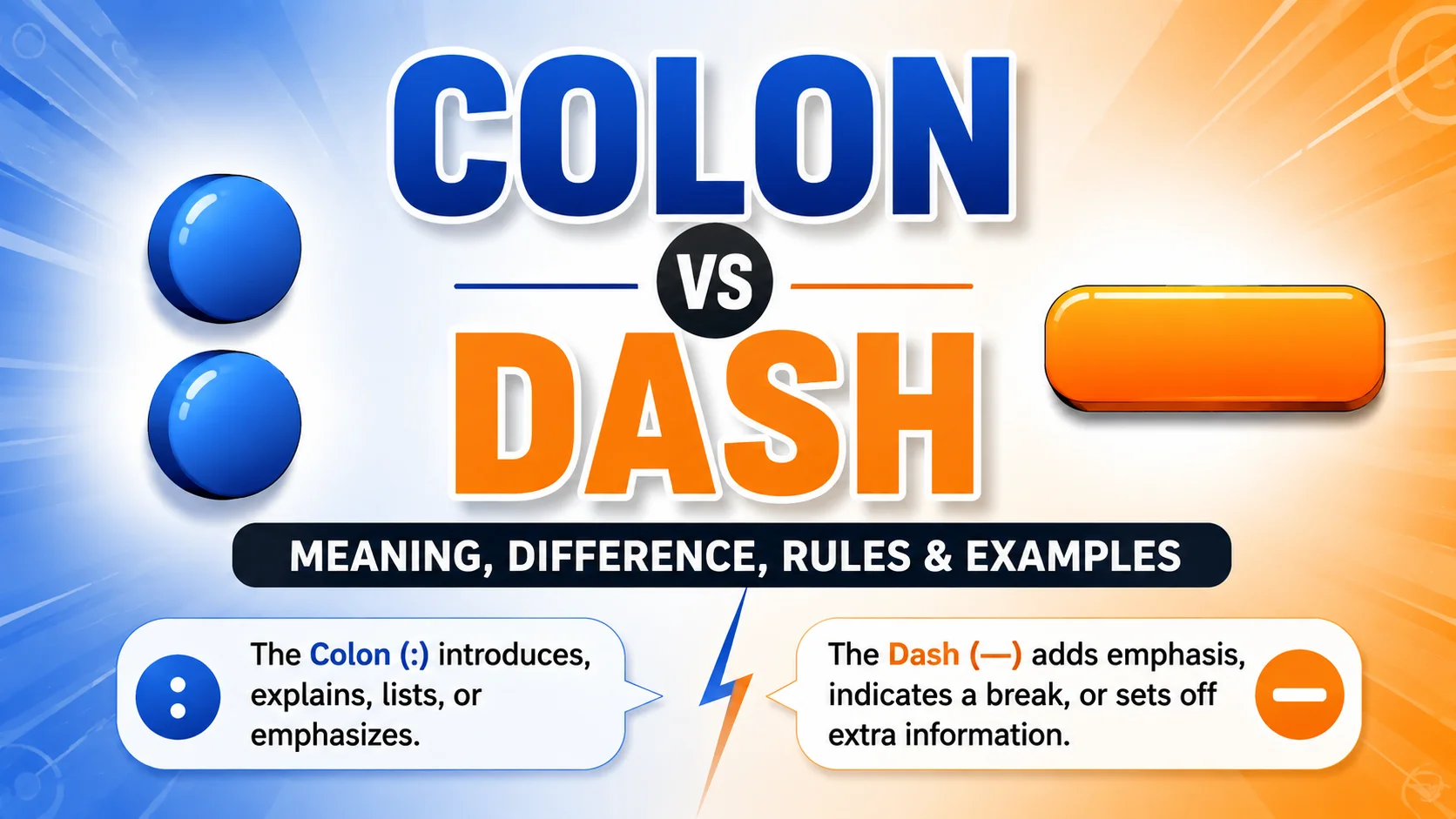
A colon (:) usually tells the reader that more information is coming. It is commonly used before lists, explanations, examples, and important details.
A dash (—) creates a stronger break. It can add emphasis, introduce an unexpected detail, show an interruption, or separate extra information from the main sentence.
Although a colon and dash can sometimes be used in similar sentences, they are not always interchangeable. Understanding their individual purposes will help you choose the right punctuation mark for formal writing, essays, blog posts, emails, creative writing, and everyday communication.
Colon vs Dash at a Glance
| Feature | Colon (:) | Dash (—) |
|---|---|---|
| Main purpose | Introduces related information | Adds emphasis or creates a break |
| Tone | Structured and formal | Expressive and flexible |
| Introduces a list | Yes | Yes |
| Introduces an explanation | Yes | Yes |
| Adds emphasis | Sometimes | Strongly |
| Shows interruption | No | Yes |
| Shows an abrupt change | No | Yes |
| Sets off extra information | Limited | Yes |
| Common in formal writing | Very common | Used selectively |
| Common in creative writing | Useful | Very useful |
What Is a Colon?
A colon (:) is a punctuation mark that tells the reader that additional information is about to follow. That information can be a list, explanation, example, clarification, or important detail.
Examples of Colons
| Use | Example |
|---|---|
| List | I bought three things: bread, milk, and eggs. |
| Explanation | There was one problem: nobody had the key. |
| Example | Some fruits are rich in vitamin C: oranges are one example. |
| Clarification | She had one goal: to finish the race. |
| Important detail | He learned an important lesson: patience matters. |
A colon creates a logical connection between the first part of the sentence and the information that follows.
What Is a Dash?
A dash, particularly an em dash (—), creates a noticeable break in a sentence. It can introduce extra information, emphasize an idea, show an interruption, or create a dramatic pause.
Examples of Dashes
| Purpose | Example |
|---|---|
| Emphasis | She had one goal—to win. |
| Extra information | My brother—who lives in Texas—is visiting us. |
| Interruption | I was about to call you—but never mind. |
| Dramatic effect | He opened the door—and froze. |
| Unexpected detail | There was only one problem—the car wouldn’t start. |
The Main Difference Between Colon and Dash
The easiest way to understand the difference is to remember the purpose of each mark.
Colon = introduces information
Dash = emphasizes or interrupts information
A colon generally feels more organized and predictable. A dash creates a stronger pause and gives the following words more attention.
| Colon | Dash |
|---|---|
| Formal | More expressive |
| Logical | Emphatic |
| Structured | Flexible |
| Common before lists | Common for interruptions |
| Common before explanations | Common for dramatic additions |
| Creates a controlled pause | Creates a stronger pause |
When to Use a Colon
Use a Colon Before a List
A colon is one of the most common punctuation marks used to introduce a list.
| Sentence | Correct? |
|---|---|
| She bought three fruits: apples, oranges, and bananas. | Yes |
| We need four items: paper, pens, folders, and envelopes. | Yes |
| The box contained several things: books, toys, and clothes. | Yes |
A useful rule is to use a colon when the words before it form a complete thought.
Use a Colon to Introduce an Explanation
A colon can connect a statement with an explanation.
| Sentence | What Comes After the Colon? |
|---|---|
| There was one problem: the door was locked. | Explanation |
| She knew the truth: he had lied. | Explanation |
| He had one reason for leaving: he was exhausted. | Explanation |
| We learned an important lesson: preparation matters. | Explanation |
Use a Colon Before an Example
A colon can introduce an example that supports the statement before it.
| Statement | Example |
|---|---|
| Some hobbies are inexpensive: | Reading costs very little. |
| Several foods contain protein: | Eggs are one example. |
| Many activities improve fitness: | Walking is a simple choice. |
When to Use a Dash
Use a Dash for Emphasis
A dash can make the information following it stand out.
| Sentence | Effect |
|---|---|
| She had one goal—to win. | Strong emphasis |
| He wanted only one thing—a second chance. | Emotional emphasis |
| There was one answer—the truth. | Strong emphasis |
| I finally understood the problem—the timing was wrong. | Emphasis |
Use a Dash Around Extra Information
Two dashes can separate information that interrupts the main sentence.
| Sentence | Extra Information |
|---|---|
| Sarah—our team leader—organized the meeting. | our team leader |
| My brother—who lives nearby—visited yesterday. | who lives nearby |
| The restaurant—which recently opened—was crowded. | which recently opened |
The sentence can usually still make sense if the extra information is removed.
Use a Dash for an Interruption
An em dash can show that a sentence suddenly stops or changes direction.
| Example | Effect |
|---|---|
| I wanted to explain—but it was too late. | Sudden break |
| If you touch that button— | Interrupted thought |
| I thought everything was fine—and then the lights went out. | Abrupt change |
Colon vs Dash Before a List
Both punctuation marks can sometimes introduce a list, but they create different styles.
| Colon Example | Dash Example |
|---|---|
| Bring these items: water, snacks, and sunscreen. | Bring these items—water, snacks, and sunscreen. |
| We visited three cities: Paris, Rome, and Madrid. | We visited three cities—Paris, Rome, and Madrid. |
| She packed four things: clothes, shoes, books, and toiletries. | She packed four things—clothes, shoes, books, and toiletries. |
The colon is generally the more conventional choice for formal lists.
The dash can work when the writer wants a more conversational or emphatic tone.
Colon vs Dash for Explanations
| Colon | Dash |
|---|---|
| There was one problem: the door was locked. | There was one problem—the door was locked. |
| He had one goal: to finish first. | He had one goal—to finish first. |
| She discovered the truth: the report was wrong. | She discovered the truth—the report was wrong. |
| I learned one lesson: preparation matters. | I learned one lesson—preparation matters. |
Both can be acceptable depending on context, but the colon feels more formal, while the dash feels more forceful.
Colon vs Dash in Formal Writing
For academic and professional writing, a colon is often the safer choice when introducing a list or explanation.
| Writing Situation | Recommended |
|---|---|
| Academic essay | Colon |
| Research paper | Colon |
| Business report | Colon |
| Formal email | Colon |
| Professional document | Colon |
| Blog article | Either |
| Personal writing | Either |
| Creative writing | Dash |
| Dialogue | Dash |
| Dramatic writing | Dash |
This does not mean that dashes are incorrect in formal writing. They simply have a more expressive quality and should be used intentionally.
Colon vs Dash in Creative Writing
Creative writers often use dashes because they create rhythm and emphasis.
| Writing Goal | Better Choice |
|---|---|
| Introduce a clear explanation | Colon |
| Introduce a formal list | Colon |
| Create suspense | Dash |
| Show interruption | Dash |
| Add dramatic emphasis | Dash |
| Create a sudden shift | Dash |
| Make writing conversational | Dash |
Example
A colon can make a sentence feel controlled:
She had one choice: leave.
A dash can make the same idea feel more dramatic:
She had one choice—leave.
The meaning is similar, but the emotional effect is different.
Colon Rules
Rule 1: Use a Colon After a Complete Thought
Correct:
She had three options: stay, leave, or wait.
The words before the colon form a complete thought.
Rule 2: Do Not Put a Colon After an Incomplete Phrase
Incorrect:
Her favorite foods are: pizza, pasta, and tacos.
Better:
Her favorite foods are pizza, pasta, and tacos.
Or:
She has three favorite foods: pizza, pasta, and tacos.
Rule 3: Do Not Use a Colon Automatically Before Every List
A list does not always need a colon.
| Sentence | Correct? |
|---|---|
| I bought apples, oranges, and bananas. | Yes |
| I bought: apples, oranges, and bananas. | No |
| I bought three fruits: apples, oranges, and bananas. | Yes |
Dash Rules
Rule 1: Use an Em Dash for a Strong Break
The em dash can create a noticeable pause.
Example:
The answer was obvious—the plan had failed.
Rule 2: Use Two Dashes Around an Interruption
Example:
The new employee—who joined last month—is already managing the project.
Rule 3: Avoid Overusing Dashes
Dashes are visually powerful. Using too many can make writing difficult to follow.
| Too Many Dashes | Cleaner Version |
|---|---|
| She arrived late—because of traffic—and missed the meeting—which had already started. | She arrived late because of traffic and missed the meeting. |
| He wanted to go—but he couldn’t—and he tried again—but failed. | He wanted to go, but he couldn’t. He tried again but failed. |
Colon vs Dash vs Semicolon
These punctuation marks have different jobs.
| Punctuation | Main Purpose | Example |
|---|---|---|
| Colon | Introduces information | Remember this: practice matters. |
| Em dash | Adds emphasis or interruption | Remember this—practice matters. |
| Semicolon | Connects related independent clauses | Practice matters; consistency helps. |
| Comma | Separates parts of a sentence | Practice regularly, and you will improve. |
Colon vs Dash vs Hyphen
A dash is also different from a hyphen.
| Mark | Name | Main Use | Example |
|---|---|---|---|
| – | Hyphen | Connects words | well-known |
| – | En dash | Shows ranges or relationships | 2025–2026 |
| — | Em dash | Creates a strong break | She left—without warning. |
| : | Colon | Introduces information | Remember this: practice helps. |
Confusing a hyphen with an em dash is a common punctuation mistake.
Common Mistakes With Colons
Mistake: Colon After an Incomplete Sentence
Incorrect:
The things I need are: a notebook and a pen.
Better:
The things I need are a notebook and a pen.
Or:
I need two things: a notebook and a pen.
Mistake: Using a Colon When a Comma Is Enough
Incorrect:
My favorite colors are: blue and black.
Better:
My favorite colors are blue and black.
Mistake: Using Colons Everywhere
A colon should have a clear grammatical purpose. Adding one simply because additional information follows can make writing look awkward.
Common Mistakes With Dashes
Mistake: Using a Hyphen Instead of an Em Dash
Incorrect:
She left – without saying goodbye.
Better:
She left—without saying goodbye.
Mistake: Overusing Dashes
Too many dashes can make a sentence visually confusing.
Better writing often combines commas, parentheses, colons, and dashes according to their specific purposes.
Mistake: Using Dashes Without Understanding the Break
A dash should create a meaningful interruption, emphasis, or separation. It should not be added randomly.
Colon vs Dash Examples
| Situation | Colon Version | Dash Version |
|---|---|---|
| Goal | Her goal was simple: win. | Her goal was simple—win. |
| Problem | There was one problem: time. | There was one problem—time. |
| Explanation | He knew the reason: she was busy. | He knew the reason—she was busy. |
| List | Bring three things: food, water, and a map. | Bring three things—food, water, and a map. |
| Important detail | She learned one lesson: patience matters. | She learned one lesson—patience matters. |
How to Choose Between a Colon and Dash
Ask yourself what you want the punctuation to do.
| Question | Best Choice |
|---|---|
| Am I introducing a list? | Colon |
| Am I giving an explanation? | Colon |
| Am I giving an example? | Colon |
| Am I adding strong emphasis? | Dash |
| Am I showing an interruption? | Dash |
| Am I creating a dramatic pause? | Dash |
| Am I setting off an aside? | Dash |
| Am I writing formally? | Usually colon |
Easy Memory Trick
Remember these two simple rules:
| Punctuation | Memory Trick |
|---|---|
| Colon (:) | Introduces |
| Dash (—) | Emphasizes |
If the second part is there to explain or list, a colon is often the natural choice.
If the second part is there to stand out or create a strong pause, a dash may be better.
Practice: Choose Colon or Dash
| Sentence | Correct Punctuation |
|---|---|
| I need three things ___ food, water, and shelter. | Colon |
| She had one goal ___ to win. | Colon or Dash |
| There was one problem ___ nobody had the key. | Colon or Dash |
| He opened the door ___ and froze. | Dash |
| My sister ___ who lives nearby ___ is visiting. | Dashes |
| Remember this ___ practice makes progress. | Colon or Dash |
| Bring these items ___ a notebook and pen. | Colon or Dash |
| I was going to tell you ___ never mind. | Dash |
Frequently Asked Questions
What is the difference between a colon and a dash?
A colon generally introduces information such as a list, explanation, example, or clarification. A dash creates a stronger break and can add emphasis, show an interruption, or introduce additional information.
Can a dash replace a colon?
Sometimes. For example, both of these can work:
She had one goal: to win.
She had one goal—to win.
The colon sounds more structured, while the dash adds stronger emphasis.
Is a colon more formal than a dash?
Generally, yes. Colons are especially common in academic, professional, and formal writing. Dashes are more expressive, although they can still be appropriate in formal writing.
Can a colon introduce a list?
Yes. This is one of the most common uses of a colon.
Can a dash introduce a list?
Yes. A dash can introduce a list, particularly in informal or expressive writing.
Can a dash show an interruption?
Yes. An em dash is commonly used to show an interruption or abrupt change.
Can a colon show an interruption?
No. A colon is not normally used to show an interrupted thought.
Which is better before a list?
A colon is generally the standard choice when the preceding words form a complete sentence.
What is an em dash?
An em dash (—) is a long punctuation mark used to create a strong break, add emphasis, show an interruption, or set off additional information.
What is the easiest way to remember colon vs dash?
Remember:
Colon = introduce
Dash = emphasize
Final Colon vs Dash Comparison
| Feature | Colon | Dash |
|---|---|---|
| Symbol | : | — |
| Main purpose | Introduce information | Emphasize or interrupt |
| Lists | Excellent | Possible |
| Explanations | Excellent | Possible |
| Examples | Excellent | Possible |
| Formal writing | Excellent | Selective |
| Creative writing | Useful | Excellent |
| Dramatic pause | Limited | Excellent |
| Interruption | No | Yes |
| Extra information | Limited | Excellent |
| Tone | Structured | Expressive |
| Easy meaning | Introduces | Emphasizes |
Conclusion
The difference between colon vs dash becomes much easier when you focus on the purpose of each punctuation mark.
A colon (:) is mainly used to introduce information. It works especially well before lists, explanations, examples, and important details. Because it creates a logical connection between two parts of a sentence, it is especially useful in formal and academic writing.
A dash (—) is more flexible and expressive. It can emphasize an important idea, create a dramatic pause, show an interruption, or separate additional information from the main sentence.
In simple terms:
Colon = introduce
Dash = emphasize
For example, a colon gives a structured feel:
She had one goal: to win.
A dash gives the same idea more emphasis:
She had one goal—to win.
Learning when to use each punctuation mark will make your writing clearer, smoother, and more natural.

Olivia Bennett is a writer and language enthusiast at Vocabsteria. She is passionate about exploring word meanings, name origins, and cultural expressions from around the world.