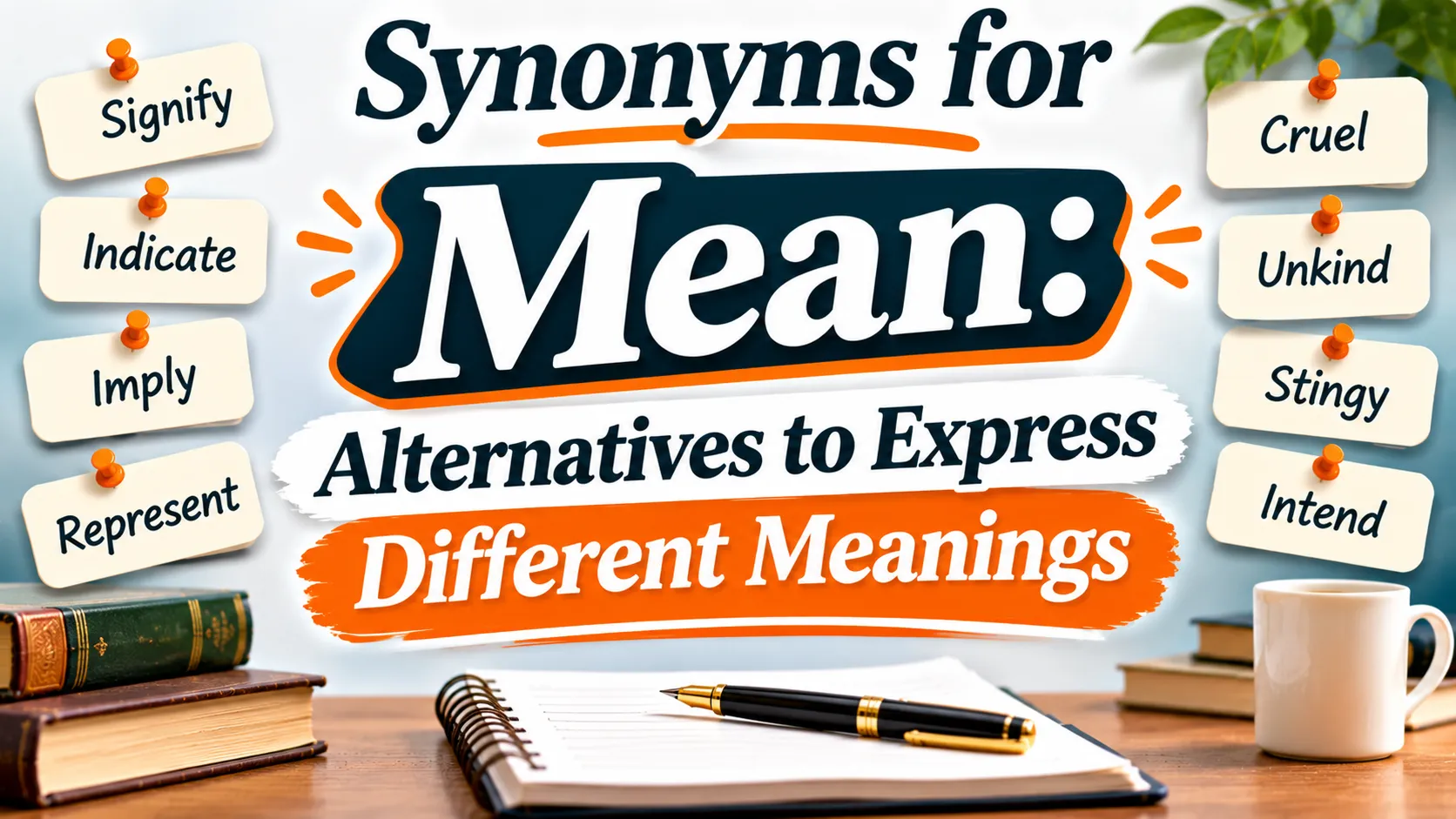
The word mean has several meanings in English, so choosing the right synonym depends on how you use it. You might use mean to describe someone who behaves unkindly, explain what a word or sentence communicates, or discuss the average value in mathematics. Each situation calls for a different alternative.
For example, you can replace mean with cruel, unkind, or rude when you describe unpleasant behavior. When you explain an idea, words such as signify, indicate, and represent work better. In mathematics, average often serves as the closest alternative.
This guide explores more than 40 synonyms for mean, explains their differences, and provides examples to help you choose the most accurate word in everyday conversations, academic writing, and professional communication.
What Does Mean Actually Mean?
The word mean works as a verb, adjective, and noun. Its meaning changes according to the sentence, which makes context especially important when selecting a synonym.
Here are its main uses:
| Meaning | Explanation | Example |
|---|---|---|
| Unkind behavior | Treating someone in an unpleasant or hurtful way | He made a mean comment. |
| Definition or message | Expressing what something communicates | What does this word mean? |
| Intention | Referring to what someone wants to say or do | I mean no harm. |
| Average value | Describing the average of a group of numbers | Find the mean of these values. |
| Stingy behavior | Being unwilling to spend or share money | She is mean with money. |
Understanding these meanings will help you avoid choosing a synonym that changes your intended message.
1. Synonyms for Mean When Describing an Unkind Person
When mean describes someone’s behavior, it usually refers to an unpleasant, hurtful, or inconsiderate attitude. The following words offer more precise ways to describe that behavior.
| Synonym | Meaning | Example |
|---|---|---|
| Unkind | Not showing kindness | It was unkind of him to ignore her. |
| Cruel | Causing pain without concern | The cruel remark upset everyone. |
| Rude | Showing poor manners | His rude response surprised me. |
| Nasty | Extremely unpleasant or hurtful | She received a nasty message. |
| Harsh | Unnecessarily severe or critical | The teacher gave harsh feedback. |
| Hurtful | Causing emotional pain | His hurtful words stayed with her. |
| Malicious | Intending to cause harm | Someone spread a malicious rumor. |
| Spiteful | Acting to hurt or upset another person | He made a spiteful comment. |
| Hostile | Showing anger or opposition | The conversation became hostile. |
| Insensitive | Ignoring other people’s feelings | That joke sounded insensitive. |
Best choice: Use unkind for general unpleasant behavior, cruel for serious emotional or physical harm, and rude for disrespectful language or manners.
2. Stronger Words for Someone Who Behaves Meanly
Sometimes, ordinary alternatives do not fully describe someone’s behavior. These stronger words communicate a more intense attitude.
- Vindictive: Seeking revenge or wanting to punish someone.
- Vicious: Showing extreme cruelty or aggression.
- Heartless: Showing little sympathy or compassion.
- Callous: Showing no concern for another person’s suffering.
- Ruthless: Willing to hurt others to achieve a goal.
- Sadistic: Taking pleasure in another person’s suffering.
- Abusive: Using harmful words or actions to control or hurt someone.
- Contemptuous: Showing that you consider someone inferior or unworthy.
- Belligerent: Acting aggressively and looking for conflict.
- Scornful: Expressing strong disrespect or disdain.
Examples in sentences:
- His heartless response made the situation worse.
- The manager used a ruthless approach to get results.
- Her contemptuous attitude created tension in the room.
- He sent a vindictive message after the argument.
These words carry stronger emotional meanings than mean, so use them when the situation genuinely supports that level of intensity.
3. Synonyms for Mean When You Want to Say Something Is Unpleasant
The word mean can also describe an action, comment, joke, or remark that hurts someone’s feelings. These alternatives help you explain exactly why something felt unpleasant.
| Alternative | Best Used For | Example |
|---|---|---|
| Offensive | Something that causes anger or resentment | The comment was offensive. |
| Insulting | Words that disrespect someone | His insulting remark crossed a line. |
| Disrespectful | Behavior that shows a lack of respect | That response was disrespectful. |
| Derogatory | Language that belittles someone | She objected to the derogatory label. |
| Demeaning | Something that reduces a person’s dignity | The joke sounded demeaning. |
| Disparaging | Language that expresses a low opinion | He made a disparaging comment. |
| Belittling | Making someone feel unimportant | Stop belittling your teammates. |
| Hurtful | Something that causes emotional pain | Her words were hurtful. |
For professional writing, disrespectful, offensive, and demeaning often communicate the problem more clearly than the general word mean.
4. Synonyms for Mean When Explaining a Word or Idea
When you ask what something means, you are asking about its definition, significance, or message. In this context, words such as cruel and unkind do not fit. Choose alternatives that describe communication or interpretation instead.
| Synonym | Meaning | Example |
|---|---|---|
| Signify | To represent or indicate something | What does this symbol signify? |
| Indicate | To point toward an idea or fact | The results indicate improvement. |
| Denote | To stand for a particular meaning | This symbol denotes equality. |
| Represent | To stand for something | The color represents hope. |
| Imply | To suggest something indirectly | His words imply disagreement. |
| Suggest | To communicate an idea indirectly | Her expression suggests concern. |
| Convey | To communicate a message or feeling | The poem conveys sadness. |
| Express | To communicate thoughts or emotions | His words express gratitude. |
| Refer to | To mention or identify something | This term refers to a specific process. |
| Define | To explain the meaning of something | The dictionary defines the word clearly. |
| Interpret | To explain the meaning of information | Readers interpret the passage differently. |
| Denote | To indicate a particular thing or concept | In this context, the term denotes a legal status. |
Writing tip: Use signify or denote when explaining symbols and terminology. Choose convey when discussing emotions or messages, and imply when someone communicates an idea without stating it directly.
5. Alternatives to Mean When Talking About Intention
Sometimes, I mean introduces an explanation, clarifies a statement, or describes someone’s intention. The following expressions can make your writing sound more natural and precise.
- Intend: To have a particular purpose or plan.
- Aim: To work toward a specific result.
- Plan: To decide what you want to do.
- Want: To desire a particular outcome.
- Refer to: To point toward a particular person, thing, or idea.
- Have in mind: To think about something specific.
- Wish: To want something to happen.
- Purpose: To have a particular reason for doing something.
Examples:
- I intend to finish the project today.
- What do you refer to when you mention that problem?
- I have in mind a different approach.
- We aim to improve the customer experience.
- I want to make my point clear.
These alternatives do not always replace mean word for word. Instead, they express the intended purpose more directly.
6. Synonyms for Mean When Describing Someone Who Is Stingy
In some situations, mean describes someone who dislikes spending money or sharing possessions. This meaning differs from being cruel or disrespectful.
Here are useful alternatives:
| Synonym | Meaning | Example |
|---|---|---|
| Stingy | Unwilling to spend or share | He is stingy with his money. |
| Miserly | Extremely unwilling to spend money | Her miserly habits surprised her friends. |
| Cheap | Unwilling to spend money, often negatively | He is too cheap to replace his shoes. |
| Greedy | Wanting more than one’s fair share | The greedy businessman wanted more profit. |
| Tightfisted | Reluctant to spend money | My uncle is tightfisted about unnecessary expenses. |
| Parsimonious | Extremely careful or unwilling to spend | The company adopted a parsimonious budget. |
| Ungenerous | Unwilling to give or share | His offer seemed ungenerous. |
| Selfish | Caring mainly about personal interests | It was selfish to keep everything for himself. |
Be careful with these alternatives. Stingy and miserly focus on money, while selfish describes a broader attitude toward other people’s needs.
7. Synonyms for Mean in Mathematics
In mathematics and statistics, mean refers to an average value calculated from a set of numbers. Its alternatives depend on the type of average or statistical measure you discuss.
| Term | Explanation |
|---|---|
| Average | A general term for a central value |
| Arithmetic mean | The sum of values divided by their number |
| Statistical average | A central value used in statistical analysis |
| Expected value | A probability-weighted average outcome |
| Central tendency | A statistical concept describing the center of a dataset |
Example:
Consider these five numbers:
4, 6, 8, 10, 12
Add them together:
4 + 6 + 8 + 10 + 12 = 40
Divide the total by five:
40 ÷ 5 = 8
Therefore, the arithmetic mean is 8.
Remember that mean, median, and mode are different statistical measures. Although people sometimes use average as a general term, these concepts do not always produce the same result.
8. Formal and Professional Alternatives to Mean
The word mean can sound vague or informal in professional communication. More specific alternatives help you describe behavior, intentions, or messages with greater accuracy.
| Word or Phrase | Best Context | Example |
|---|---|---|
| Inconsiderate | Professional feedback about behavior | The response was inconsiderate. |
| Inappropriate | Workplace conduct | His remark was inappropriate. |
| Disrespectful | Communication and workplace manners | The employee used disrespectful language. |
| Unprofessional | Workplace behavior | That reaction seemed unprofessional. |
| Uncharitable | An unfair or ungenerous judgment | Her interpretation was uncharitable. |
| Adverse | Negative effects or outcomes | The decision had adverse consequences. |
| Signify | Formal explanations | The results signify a major change. |
| Indicate | Reports and research | The figures indicate steady growth. |
| Demonstrate | Evidence-based writing | The findings demonstrate progress. |
| Intend | Plans and objectives | We intend to revise the policy. |
For business emails and reports, replace vague expressions with precise descriptions. For example, instead of writing “That was a mean decision,” you could write “That decision was inconsiderate and may negatively affect the team.”
9. Common Expressions That Use the Word Mean
You do not always need a single-word synonym. Sometimes, a short phrase communicates the intended meaning more naturally.
| Expression | Meaning | Example |
|---|---|---|
| Mean well | Have good intentions | She means well, even when she makes mistakes. |
| Mean business | Be serious about an intention | The company means business this year. |
| Mean no harm | Have no intention of hurting anyone | I meant no harm by my comment. |
| Mean a lot | Be very important | Your support means a lot to me. |
| Mean the world | Be extremely valuable | My family means the world to me. |
| What do you mean? | Ask someone to clarify | What do you mean by that statement? |
| I mean | Clarify or emphasize a point | I mean, we should consider another option. |
| Mean to do something | Intend to do something | I meant to call you yesterday. |
These expressions show why context matters when you select an alternative for mean.
10. Mean Synonyms in Everyday Sentences
The easiest way to understand synonyms is to see how they work in real sentences. Compare the examples below to learn how different words change the tone and meaning.
| Original Sentence | Alternative Sentence |
|---|---|
| She was mean to her friend. | She was unkind to her friend. |
| That was a mean joke. | That was an offensive joke. |
| He made a mean comment. | He made a hurtful comment. |
| What does this word mean? | What does this word signify? |
| I mean to help you. | I intend to help you. |
| He is mean with money. | He is stingy with money. |
| Her response was mean. | Her response was disrespectful. |
| What do you mean by this? | What are you implying by this? |
| The numbers have a mean of 15. | The numbers have an average of 15. |
| I didn’t mean to upset you. | I didn’t intend to upset you. |
A good synonym should preserve the original message. Before replacing mean, consider whether the sentence describes behavior, a definition, an intention, or a mathematical value.
11. How to Choose the Right Synonym for Mean
A synonym may look correct in a dictionary but sound unnatural in a particular sentence. Use these guidelines to make a better choice.
When describing an unkind person: Choose unkind, cruel, rude, or insensitive. Consider the severity of the behavior before selecting a stronger word.
When describing hurtful language: Choose offensive, insulting, demeaning, or disparaging. These words explain the effect of someone’s remarks.
When explaining a definition: Choose signify, denote, represent, or define. These alternatives work well in educational and academic writing.
When discussing intention: Choose intend, aim, plan, or have in mind. These expressions clarify what someone wants to accomplish.
When describing unwillingness to share: Choose stingy, miserly, tightfisted, or ungenerous. These words focus on generosity and spending habits.
When discussing mathematics: Use average or arithmetic mean when the context supports that meaning. Avoid treating every statistical measure as interchangeable.
Frequently Asked Questions About Synonyms for Mean
What is the best synonym for mean?
The best synonym depends on the context. Unkind works well when describing unpleasant behavior, signify fits explanations of meaning, intend describes purpose, and average applies to mathematics.
What is another word for mean in a negative way?
Common alternatives include cruel, rude, nasty, spiteful, malicious, insensitive, heartless, and hurtful. Each word describes a different level or type of negative behavior.
What is a more polite word for mean?
You can use unkind, inconsiderate, or thoughtless when you want to describe unpleasant behavior without sounding overly harsh.
What is a formal synonym for mean?
Formal alternatives include inconsiderate, disrespectful, inappropriate, and uncharitable when discussing behavior. For definitions, use signify, denote, or indicate.
What is another word for mean when someone is stingy?
Useful alternatives include miserly, tightfisted, parsimonious, ungenerous, and stingy. These words describe someone who dislikes spending or sharing money.
What does mean mean in mathematics?
In mathematics, the mean is the arithmetic average of a group of numbers. You calculate it by adding all the values and dividing the total by the number of values.
What is the difference between mean and cruel?
Mean is a broad word that describes unkind or unpleasant behavior. Cruel is stronger and usually suggests deliberate or serious harm. For example, an insensitive comment may sound mean, while deliberately causing suffering may be cruel.
Can I use signify instead of mean?
Yes, when mean refers to the meaning or significance of something. For example, “What does this symbol mean?” can become “What does this symbol signify?” However, signify does not replace mean when you describe an unkind person.
Conclusion
The best synonyms for mean depend on the message you want to communicate. Words such as unkind, cruel, and rude describe unpleasant behavior, while signify, denote, and represent explain the meaning of an idea or symbol. If you discuss someone’s intentions, intend and aim offer clearer alternatives. In mathematics, average provides the most familiar equivalent.
Instead of choosing a synonym simply because it appears in a dictionary, consider the context, tone, and purpose of your sentence. The right word makes your writing clearer, more accurate, and more expressive.

Olivia Bennett is a writer and language enthusiast at Vocabsteria. She is passionate about exploring word meanings, name origins, and cultural expressions from around the world.