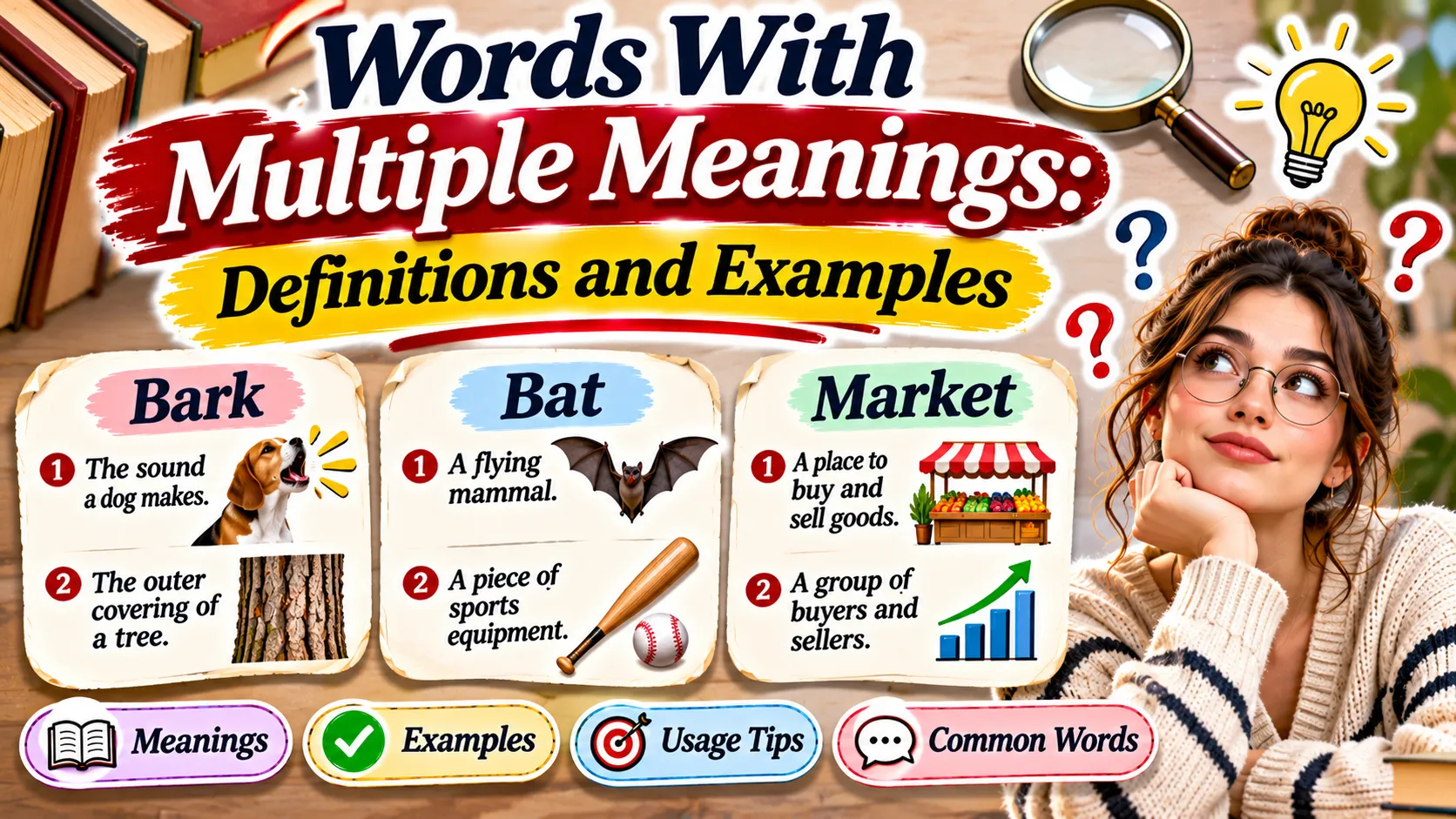
Words with multiple meanings make the English language interesting, expressive, and sometimes confusing. A single word can describe completely different things depending on how someone uses it in a sentence. For example, the word bark can refer to the sound a dog makes or the outer covering of a tree. Similarly, light can describe brightness, something that is not heavy, or the act of setting something on fire.
These words appear in everyday conversations, books, news articles, academic writing, and professional communication. Understanding their different meanings helps you interpret sentences correctly, improve your vocabulary, and become a more confident reader and writer.
In this guide, you will discover more than 200 English words with multiple meanings, along with clear definitions and practical sentence examples. From familiar words such as bank, bat, and right to less obvious examples such as current, draft, and novel, each section explores how context changes a word’s meaning.
📚 What Are Words With Multiple Meanings?
Words with multiple meanings are words that have more than one definition. Their meaning can change depending on the sentence, subject, situation, or context in which they appear.
For example, consider the word match. It can refer to a small stick used to create fire, a sports competition, or two things that go well together.
- Fire: She used a match to light the candle.
- Competition: Our team won the football match.
- Combination: Those shoes are a perfect match for your outfit.
Although the spelling and pronunciation remain the same, the meaning changes with the context.
Linguists use terms such as polysemy and homonymy to describe different types of multiple-meaning words. Some words develop related meanings over time, while others share the same spelling or pronunciation but have different origins.
🔤 Common Words With Multiple Meanings
Many English words have several definitions that people use in everyday communication. Recognizing these meanings can help you understand conversations more easily and avoid misunderstandings.
Here are 30 common examples.
| Word | Meaning 1 | Meaning 2 |
|---|---|---|
| Bank | Financial institution | Land beside a river |
| Bat | Flying mammal | Sports equipment |
| Bark | Sound made by a dog | Outer covering of a tree |
| Bright | Full of light | Intelligent |
| Book | Printed or digital publication | To reserve something |
| Can | Container | To be able to do something |
| Date | Calendar day | Romantic meeting |
| Fair | Just and reasonable | Public entertainment event |
| Fly | To travel through the air | A small flying insect |
| Jam | Fruit preserve | Traffic congestion |
| Kind | Caring or helpful | Type or category |
| Light | Brightness | Not heavy |
| Match | Fire-starting stick | Competition |
| Nail | Part of a finger | Metal fastener |
| Park | Public green space | To leave a vehicle |
| Point | Sharp end | Main idea |
| Right | Correct | Opposite of left |
| Rock | Stone | A music genre |
| Ring | Circular object | Sound of a bell |
| Rose | Flower | Past tense of rise |
| Saw | Cutting tool | Past tense of see |
| Seal | Marine animal | Official stamp or closure |
| Spring | Season | Coil or source of water |
| Star | Celestial object | Famous performer |
| Train | Railway vehicle | To teach or practice a skill |
| Wave | Movement of water | Hand gesture |
| Well | Healthy | Water source |
| Watch | Timepiece | To observe |
| Yard | Outdoor area | Unit of measurement |
| Date | Fruit | Calendar day or meeting |
These examples show why context matters. A sentence usually provides enough information to identify the intended definition.
🏦 Words With Two Different Meanings
Some English words have two widely recognized meanings that are easy to confuse when they appear without context. Learning these pairs of definitions can strengthen your vocabulary.
1. Bank
- Meaning 1: A financial institution where people deposit and withdraw money.
- Meaning 2: The land alongside a river or stream.
Examples:
- I deposited my paycheck at the bank.
- We sat on the river bank and watched the water.
2. Bat
- Meaning 1: A flying mammal that is active mainly at night.
- Meaning 2: A piece of equipment used in sports such as baseball or cricket.
Examples:
- A bat flew out of the cave.
- He bought a new baseball bat.
3. Bark
- Meaning 1: The sharp sound made by a dog.
- Meaning 2: The protective outer layer of a tree.
Examples:
- The dog began to bark at strangers.
- The tree has thick, rough bark.
4. Book
- Meaning 1: A written or printed work.
- Meaning 2: To reserve a seat, room, or appointment.
Examples:
- She is reading an interesting book.
- We need to book a hotel before Friday.
5. Can
- Meaning 1: A metal container used to store food or drinks.
- Meaning 2: To have the ability or permission to do something.
Examples:
- He opened a can of soup.
- I can speak three languages.
6. Date
- Meaning 1: A particular day on the calendar.
- Meaning 2: A romantic meeting.
- Meaning 3: A sweet fruit from a date palm.
Examples:
- What is today’s date?
- They went on their first date.
- She added chopped dates to the dessert.
7. Fair
- Meaning 1: Just, honest, or reasonable.
- Meaning 2: An event featuring entertainment, rides, or exhibitions.
- Meaning 3: Moderately good or acceptable.
Examples:
- The teacher made a fair decision.
- We visited the county fair.
- Her performance was fair.
8. Fly
- Meaning 1: To move through the air.
- Meaning 2: A small insect with wings.
- Meaning 3: A fastening or opening on clothing.
Examples:
- Birds fly across the sky.
- A fly landed on the window.
- His pants have a broken fly.
9. Jam
- Meaning 1: A sweet spread made from fruit and sugar.
- Meaning 2: A situation in which movement becomes difficult or blocked.
- Meaning 3: An informal music session.
Examples:
- I spread strawberry jam on my toast.
- We were stuck in a traffic jam.
- The musicians joined a jazz jam.
10. Kind
- Meaning 1: Friendly, caring, or considerate.
- Meaning 2: A type or category of something.
Examples:
- She is always kind to animals.
- What kind of music do you enjoy?
💡 English Words With Multiple Meanings and Examples
Some words have several meanings that appear in different situations. These examples demonstrate how one spelling can communicate different ideas.
11. Light
- Brightness: The room needs more light.
- Not heavy: This suitcase is surprisingly light.
- To ignite: Please light the candle.
12. Match
- Fire-starting stick: He struck a match.
- Competition: The basketball match starts at six.
- Suitable combination: Your jacket is a perfect match for your shoes.
13. Nail
- Body part: She painted her nails red.
- Metal fastener: He hammered a nail into the wood.
- To do something successfully: The student managed to nail the presentation.
14. Park
- Public outdoor area: Children played in the park.
- To leave a vehicle: You can park your car here.
- A collection of vehicles or equipment: The company manages a fleet of trucks in its vehicle park.
15. Point
- Sharp tip: Be careful with the point of that needle.
- Main idea: I understand your point.
- Score: Our team earned another point.
- Direction: The compass needle points north.
16. Rock
- Stone: He picked up a smooth rock.
- Music genre: My brother enjoys rock music.
- To move gently: She rocked the baby to sleep.
17. Ring
- Jewelry: She wears a gold ring.
- Sound: I heard the phone ring.
- Circular shape: The children stood in a ring.
18. Spring
- Season: Flowers bloom in spring.
- Coiled metal: The mattress contains a broken spring.
- Water source: We drank fresh water from a natural spring.
- To jump: The cat sprang onto the table.
19. Star
- Celestial object: A bright star appeared in the sky.
- Famous person: The movie star attended the event.
- Main performer: She will star in the new television series.
20. Train
- Railway vehicle: We caught the morning train.
- To develop a skill: Athletes train every day.
- A long sequence: The bride’s dress had a beautiful train.
21. Wave
- Movement of water: A large wave reached the shore.
- Hand gesture: She gave me a friendly wave.
- To move back and forth: The flag began to wave in the wind.
22. Watch
- Timekeeping device: He bought a new watch.
- To observe: Watch the children carefully.
- To monitor: Doctors will watch his condition closely.
23. Well
- Healthy: I hope you feel well soon.
- Water source: They collected water from the well.
- An expression: Well, that was unexpected.
- Successfully: The project went well.
24. Yard
- Outdoor area: The children played in the yard.
- Measurement: The fabric was two yards long.
- Storage area: Workers moved the equipment into the lumber yard.
25. Current
- Happening now: What is the current price?
- Flow of water or electricity: The river current was strong.
- Movement of air or water: The boat drifted with the current.
🎯 Words With Multiple Meanings in Everyday Conversations
Many words change meaning depending on the situation. They can describe objects, actions, emotions, measurements, and abstract ideas.
Here are 25 additional examples.
| Word | Meaning 1 | Meaning 2 |
|---|---|---|
| Address | Location of a place | To speak to an audience |
| Air | The atmosphere | To broadcast something |
| Arm | Part of the body | A weapon or branch of an organization |
| Bill | Statement of money owed | Proposed law |
| Change | To make something different | Coins or small money |
| Check | To examine | A restaurant bill |
| Close | Near | To shut |
| Club | Social organization | Heavy striking tool |
| Coach | Sports instructor | Passenger vehicle |
| Court | Legal institution | Sports playing area |
| Draft | Preliminary version | Current of air |
| Draw | To create a picture | To pull or attract |
| Drop | A small amount of liquid | To let something fall |
| File | Collection of documents | Tool for smoothing surfaces |
| Fine | Good or acceptable | Money paid as a penalty |
| Grade | School score | Level or category |
| Ground | Surface of the earth | Past tense of grind |
| Head | Part of the body | Person in charge |
| Key | Object used to unlock | Important or essential |
| Left | Opposite of right | Past tense of leave |
| Letter | Written character | Personal message |
| Mean | To intend | Unkind or unpleasant |
| Mine | Belonging to me | Underground excavation |
| Note | Written message | Musical sound |
| Plane | Aircraft | Flat surface |
📖 More English Words With Multiple Meanings
The following words demonstrate how English vocabulary can express several related or unrelated ideas. Understanding their different uses will make your reading and writing more precise.
26. Address
- Location: Please write your home address.
- To speak to someone: The principal will address the students.
- To deal with an issue: We need to address this problem.
27. Air
- Atmosphere: Fresh air makes the room comfortable.
- To broadcast: The television station will air the interview tonight.
- Appearance or manner: She has an air of confidence.
28. Arm
- Body part: He injured his left arm.
- Weapon: The soldiers carried an arm for protection.
- Branch: The research arm of the organization published a report.
29. Bill
- Invoice: I paid the electricity bill.
- Proposed law: The Senate discussed a new bill.
- Bird’s beak: The duck dipped its bill into the water.
30. Change
- To make different: We need to change our plans.
- Money: Do you have any spare change?
- New development: The weather change surprised everyone.
31. Check
- To examine: Please check your answers.
- Payment document: He wrote a check for the payment.
- Pattern: She wore a red check shirt.
- To stop or restrain: The guard tried to check the crowd’s movement.
32. Close
- Near: The supermarket is close to my house.
- To shut: Please close the door.
- Personal relationship: They are close friends.
- Ending: The store will close at nine.
33. Club
- Organization: She joined a reading club.
- Sports equipment: The golfer selected a different club.
- Heavy striking object: The character carried a wooden club.
34. Coach
- Instructor: The coach trained the football team.
- Passenger vehicle: We traveled by coach.
- To teach: She coached him through the interview.
35. Court
- Legal institution: The case went to court.
- Sports area: The players entered the tennis court.
- To seek someone’s attention: He tried to court public support.
36. Draft
- Early version: I finished the first draft of my essay.
- Air current: A cold draft came through the window.
- Military recruitment: The country introduced a military draft.
- Beer served from a tap: They ordered draft beer.
37. Draw
- To create a picture: The child likes to draw animals.
- To pull something: Draw the curtains.
- A tie: The game ended in a draw.
- To attract: The exhibition will draw many visitors.
38. Drop
- Small amount of liquid: A drop of water fell on the table.
- To let something fall: Do not drop your phone.
- Decrease: The company reported a drop in sales.
- To leave something: I need to drop this subject.
39. File
- Collection of documents: Save the report in a separate file.
- Tool: Use a metal file to smooth the edge.
- To submit officially: Please file your application today.
- Line of people: A file of students entered the classroom.
40. Fine
- Good quality: The restaurant serves fine food.
- Penalty: He received a parking fine.
- Thin or delicate: The artist used a fine brush.
- Acceptable: Everything is fine.
41. Grade
- School mark: She received a good grade.
- Level: This product is available in several grades.
- Slope: The road has a steep grade.
- To evaluate: Teachers grade the assignments.
42. Ground
- Earth or surface: The children sat on the ground.
- Past tense of grind: She ground the coffee beans.
- Reason: He explained the grounds for his decision.
- Electrical connection: The technician checked the ground wire.
43. Head
- Body part: My head hurts.
- Leader: She is the head of the department.
- To move toward: We are heading home.
- Top or front: Write your name in the heading.
44. Key
- Lock opener: I lost my house key.
- Essential: Communication is key to teamwork.
- Musical scale: The song is written in the key of C.
- Computer button: Press the Enter key.
45. Left
- Direction: Turn left at the corner.
- Past tense of leave: She left the office early.
- Remaining: There are three cookies left.
46. Letter
- Alphabet character: The word begins with the letter A.
- Written message: I received a letter from my friend.
- Literature: She enjoys reading letters and historical documents.
47. Mean
- To intend: What do you mean by that?
- Unkind: That was a mean thing to say.
- Mathematical average: Calculate the mean of these numbers.
- To signify: This symbol can mean different things.
48. Mine
- Belonging to me: That blue bag is mine.
- Underground excavation: The workers entered the coal mine.
- Explosive device: The ship avoided a sea mine.
49. Note
- Written message: She left a note on the table.
- Musical sound: The pianist played a high note.
- To notice: Please note the important details.
- Banknote: He paid with a twenty-dollar note.
50. Plane
- Aircraft: The plane landed safely.
- Flat surface: The carpenter smoothed the wooden plane.
- Geometric surface: A plane extends in two dimensions.
- Tool: He used a plane to smooth the board.
🔍 Words With Multiple Meanings That Are Often Confused
Some words are especially interesting because their meanings can be quite different. These examples are useful for vocabulary development and English language learning.
| Word | Meaning 1 | Meaning 2 |
|---|---|---|
| Capital | Main city of a region | Money used for investment |
| Charge | Request payment | Accuse someone formally |
| Crane | Large lifting machine | Tall bird |
| Current | Present or existing | Flow of water or electricity |
| Fall | To drop downward | Autumn season |
| Fine | Acceptable or excellent | Financial penalty |
| Grave | Burial place | Serious or important |
| Host | Person receiving guests | Computer hosting service |
| Interest | Curiosity | Money earned or charged |
| Novel | Fiction book | New or unusual |
| Object | Physical thing | To disagree |
| Patient | Person receiving medical care | Able to tolerate delays |
| Pound | Unit of weight | To strike repeatedly |
| Present | Gift | Existing or happening now |
| Record | Stored information | To capture audio or video |
| Season | Part of the year | To add flavor |
| Subject | Topic | Person under authority |
| Tender | Gentle | Formal offer or bid |
| Volume | Amount of space | Sound level |
| Well | Healthy | Water source |
🧠 Why Do English Words Have Multiple Meanings?
English words develop additional meanings through changes in culture, technology, communication, and everyday usage. A word that originally described one object or action may gradually become useful in a completely different situation.
Several linguistic processes explain this phenomenon.
1. Polysemy
Polysemy occurs when one word develops multiple related meanings. For example, head can describe a body part, the leader of an organization, or the top of something. These meanings share a historical or conceptual connection.
2. Homonymy
Homonymy occurs when words have the same spelling or pronunciation but different meanings and often different origins. For example, bat can mean a flying mammal or a piece of sports equipment.
3. Metaphorical Meaning
People often extend a word’s original meaning through comparisons. For example, branch describes part of a tree and a division of an organization.
4. Changes in Technology
Technology introduces new meanings to familiar words. The word mouse, for example, describes both a small animal and a computer input device.
5. Everyday Language Development
Common expressions can give words additional meanings over time. The word cloud originally refers to a mass of water droplets in the atmosphere, but it also describes online data storage.
✍️ How to Understand Words With Multiple Meanings
Understanding a word’s meaning requires more than memorizing a dictionary definition. You should examine the surrounding words and the overall situation to determine what the writer or speaker intends.
Here are some practical ways to identify the correct meaning.
- Read the complete sentence: Avoid deciding what a word means before reading the surrounding information.
- Identify the subject: Determine whether the sentence discusses money, nature, sports, technology, or another topic.
- Look at nearby words: Words surrounding an unfamiliar term often provide useful clues.
- Check its grammatical role: Notice whether the word functions as a noun, verb, adjective, or another part of speech.
- Consider the situation: Think about what would make sense in the conversation.
- Use a dictionary: Compare the available definitions when the intended meaning remains unclear.
For example, the sentence “The bank was flooded” probably refers to land beside a river, while “The bank approved my loan” refers to a financial institution. The surrounding information makes the intended meaning clear.
🧪 Practice Quiz: Words With Multiple Meanings
Test your understanding with these questions. Choose the correct meaning of the bold word according to the sentence.
1. She deposited her money at the bank.
- A. Riverbank
- B. Financial institution
- C. Garden
2. The dog began to bark loudly.
- A. Outer covering of a tree
- B. Sound made by a dog
- C. Type of leaf
3. He used a bat to hit the ball.
- A. Flying animal
- B. Sports equipment
- C. Insect
4. Please book a table for two.
- A. Read a novel
- B. Reserve a table
- C. Write a story
5. The room was filled with bright light.
- A. Something not heavy
- B. Brightness
- C. A small object
6. We were stuck in a traffic jam.
- A. Fruit spread
- B. Music session
- C. Traffic congestion
7. She wore a gold ring.
- A. Circular jewelry
- B. Sound of a bell
- C. Group of people
8. The students will train every morning.
- A. Railway vehicle
- B. Practice or develop skills
- C. Travel by bus
9. Please watch the children.
- A. Timepiece
- B. Observe carefully
- C. Purchase something
10. He received a parking fine.
- A. Excellent quality
- B. Financial penalty
- C. Thin material
Quiz Answers
- B. Financial institution
- B. Sound made by a dog
- B. Sports equipment
- B. Reserve a table
- B. Brightness
- C. Traffic congestion
- A. Circular jewelry
- B. Practice or develop skills
- B. Observe carefully
- B. Financial penalty
❓ Frequently Asked Questions About Words With Multiple Meanings
1. What are words with multiple meanings called?
Words with multiple meanings are often discussed as examples of polysemy or homonymy. Polysemous words have related meanings, while homonyms share spelling or pronunciation but have different meanings.
2. What is an example of a word with multiple meanings?
The word bank is a common example. It can refer to a financial institution or the land beside a river.
3. What English word has the most meanings?
There is no universally agreed answer because dictionaries count definitions, phrases, and related senses differently. Words such as set, run, go, and take have exceptionally large numbers of recorded meanings.
4. What is the difference between polysemy and homonymy?
Polysemy refers to one word with several related meanings. Homonymy describes words that share spelling or pronunciation but have different meanings and often separate historical origins.
5. Why do some English words have different meanings?
Words develop additional meanings through cultural changes, metaphor, technology, historical language development, and everyday communication.
6. What is an example of a word with three meanings?
The word date can refer to a calendar day, a romantic meeting, or a sweet fruit. Its meaning depends on the sentence.
7. Are multiple-meaning words the same as homophones?
No. Homophones are words that sound alike but have different meanings and usually different spellings, such as sea and see. Multiple-meaning words may have the same spelling and pronunciation.
8. Can a word have more than five meanings?
Yes. Many English words have far more than five dictionary meanings. Words such as run, set, and take have numerous definitions and uses.
9. How can students learn words with multiple meanings?
Students can learn them through sentence examples, reading exercises, vocabulary lists, quizzes, and context-based activities. Comparing different meanings helps them understand how words function in everyday English.
10. What are some easy words with multiple meanings?
Easy examples include bat, bank, light, book, date, watch, ring, spring, right, and park. These words appear frequently in everyday conversations.
✅ Conclusion
Words with multiple meanings demonstrate how flexible and expressive the English language can be. A single word may describe an object, an action, a place, an emotion, or an entirely different concept depending on the context. Words such as bank, bat, light, match, and spring are excellent examples of how meaning changes within everyday communication.
Learning these words can improve your vocabulary, reading comprehension, writing skills, and confidence in English. Instead of memorizing only one definition, pay attention to how each word appears in different sentences. With regular reading and practice, you will become better at recognizing multiple meanings and using them accurately.

Olivia Bennett is a writer and language enthusiast at Vocabsteria. She is passionate about exploring word meanings, name origins, and cultural expressions from around the world.