Is it awhile or a while? At first glance, the difference seems tiny—just one space—but that space changes how the phrase works in a sentence. Both forms are correct in American English, yet they are not always interchangeable. The key is understanding whether you need an adverb or a noun phrase.
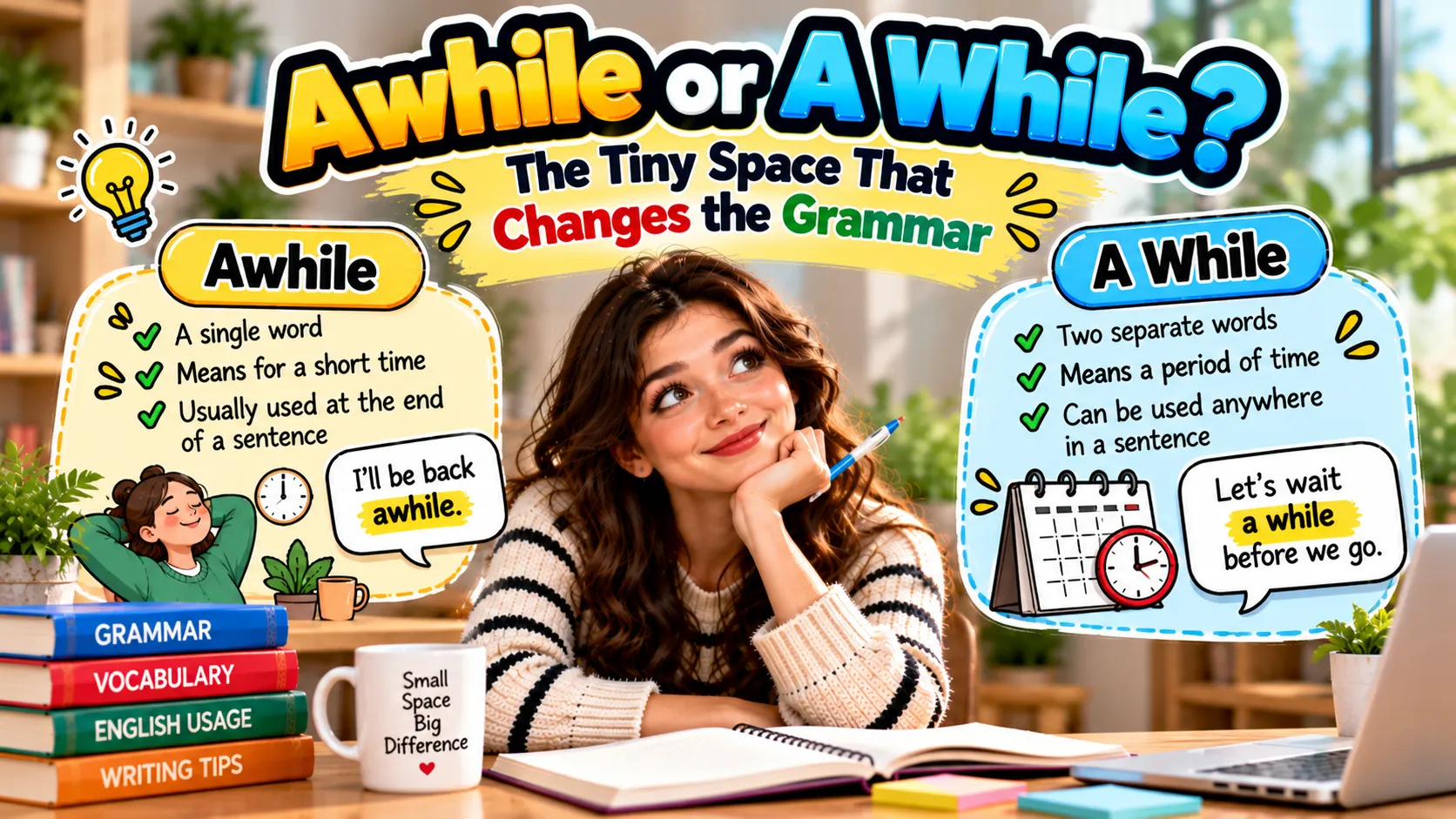
Awhile means “for a short time” and usually functions as an adverb. A while contains the article a and the noun while, so it commonly appears after prepositions such as “for,” “in,” or “after.” Once you understand this grammatical difference, choosing between awhile and a while becomes much easier.
🔤 Awhile or A While: What Is the Difference?
The main difference between awhile or a while is grammatical. Awhile is an adverb meaning “for a short time,” while a while is a noun phrase referring to a period of time.
| Form | Part of Speech | Basic Meaning | Example |
|---|---|---|---|
| awhile | Adverb | For a short time | Stay awhile. |
| a while | Noun phrase | A period of time | Stay for a while. |
| A useful shortcut is: |
Stay awhile. ✅
Stay for a while. ✅
Both sentences mean essentially the same thing, but the grammar is different.
The easiest rule is that awhile can often stand alone after a verb, while a while frequently follows a preposition.
⏳ What Does “Awhile” Mean?
Awhile is an adverb that means “for a short time” or “for some time.” It describes the duration of an action and commonly follows a verb.
Examples:
- Sit awhile.
- Wait awhile.
- Stay awhile.
- Rest awhile.
- Come in and relax awhile.
In these examples, “awhile” tells us how long the action should continue.
You can think of awhile as answering the question:
How long?
For example:
Please wait awhile.
How long should you wait? Awhile.
🕐 What Does “A While” Mean?
A while is a noun phrase made up of the article a and the noun while. It refers to a period of time.
Examples:
- I haven’t seen her for a while.
- We talked for a while.
- He stayed there for a while.
- It took a while to finish.
Here, while is functioning as a noun, and “a” is its article.
This is why the phrase works naturally after prepositions: - for a while
- in a while
- after a while
- once in a while
- every once in a while
The space between “a” and “while” matters because the two words are performing separate grammatical jobs.
🧠 The Easiest Rule for Awhile vs. A While
If you are trying to remember awhile or a while, use this simple test:
If “for” comes directly before it, use “a while.”
Stay for a while. ✅
Stay for awhile. ❌ in standard edited usage
If there is no preposition and you are describing how long an action happens, awhile may be appropriate:
Stay awhile. ✅
Wait awhile. ✅
This is not the only possible construction, but it is one of the easiest practical rules for everyday writing.
📚 Awhile or A While After a Verb
Many mistakes happen because both forms can follow a verb in certain sentences. The important question is how the phrase functions.
Compare:
We talked awhile.
Here, “awhile” acts as an adverb modifying “talked.”
Now compare:
We talked for a while.
Here, “a while” is the object of the preposition “for.”
Both sentences are grammatical and have almost the same meaning.
Another pair:
She waited awhile.
She waited for a while.
The meaning is nearly identical, but the construction is different.
🚫 Why “For Awhile” Is Usually Avoided
One of the most common questions about awhile or a while is whether you can write “for awhile.”
In standard edited American English, the preferred form is:
for a while ✅
rather than:
for awhile ⚠️
The reason is grammatical: awhile is already an adverb, while “for” normally takes a noun phrase such as a while.
Compare:
- Wait awhile.
- Wait for a while.
Both work because the grammar changes.
A simple memory trick is:
Awhile = no “for.”
A while = often after “for.”
📝 Awhile or A While in Common Sentences
The difference becomes clearer when you see the two forms used naturally. Here are several everyday examples.
| Sentence | Correct Form | Why |
|---|---|---|
| Please wait ___ | awhile | Adverb |
| Please wait for ___ | a while | Noun phrase |
| I haven’t seen him in ___ | a while | Follows “in” |
| Sit ___ | awhile | Adverb |
| We talked for ___ | a while | Follows “for” |
| Come back in ___ | a while | Follows “in” |
| Stay ___ | awhile | Adverb |
| She rested for ___ | a while | Follows “for” |
| Let’s wait ___ | awhile | Adverb |
| It took ___ | a while | Noun phrase |
| This pattern can help you identify the correct spelling quickly. |
💬 “Wait Awhile” vs. “Wait for a While”
Both wait awhile and wait for a while are correct, although the second version explicitly uses a prepositional phrase.
Wait awhile
Please wait awhile.
This is concise and natural.
Wait for a while
Please wait for a while.
This is also natural and may sound slightly more explicit.
The important point is not that one sentence is always better. Instead, understand why each form is written differently.
The same pattern appears with other verbs:
- Stay awhile / stay for a while
- Rest awhile / rest for a while
- Sit awhile / sit for a while
- Talk awhile / talk for a while
🔎 Awhile vs. A While With “In”
The phrase in a while is one of the clearest examples of why the space matters.
Correct:
I’ll call you in a while.
Here, “in” is a preposition, so a while is the natural noun phrase.
The phrase can mean “after some time.”
Examples:
- I’ll be back in a while.
- She’ll arrive in a while.
- We can discuss it in a while.
- I’ll check again in a while.
Do not normally replace this with:
I’ll call you in awhile.
For standard edited writing, in a while is the preferred form.
🔄 Awhile vs. A While With “After”
The phrase after a while also requires the two-word form.
Examples:
- After a while, everyone became comfortable.
- She stopped talking after a while.
- After a while, the rain finally stopped.
- He eventually understood after a while.
Here, “after” introduces a prepositional phrase, and a while functions as the noun phrase.
This gives you another useful memory clue:
after a while ✅
in a while ✅
for a while ✅
When a preposition comes immediately before the phrase, the two-word form is usually the right choice.
🌙 What Does “Once in a While” Mean?
The common expression is once in a while, not “once in awhile.”
It means “occasionally” or “sometimes.”
Examples:
- I eat dessert once in a while.
- We go hiking once in a while.
- She visits us once in a while.
- It’s okay to take a break once in a while.
The expression contains the noun phrase a while, which follows the preposition “in.”
A related expression is:
every once in a while
Examples:
- I still think about that trip every once in a while.
- We meet for coffee every once in a while.
✍️ Awhile or A While in Professional Writing
Professional writing benefits from precise grammar, especially when small differences can affect sentence structure. Knowing when to use awhile and a while can make emails, reports, articles, and business communication more polished.
Examples:
Please wait awhile before submitting the form.
Please wait for a while before submitting the form.
I haven’t received an update in a while.
We discussed the issue for a while.
After a while, the team reached an agreement.
These forms are all appropriate when used according to their grammatical roles.
🇺🇸 Awhile or A While in American English
In American English, both awhile and a while are established forms. The difference is grammatical rather than a simple matter of American versus British spelling.
For US English writing:
- awhile = adverb
- a while = noun phrase
Examples:
Stay awhile.
Stay for a while.
I’ll see you in a while.
We waited a while.
The same distinction is useful in formal writing, casual conversation, websites, and academic work.
⚠️ Common Mistakes With Awhile and A While
The most frequent errors happen when writers treat the two forms as completely interchangeable. They are closely related, but their grammatical functions differ.
❌ For awhile
Preferred:
for a while
❌ In awhile
Preferred:
in a while
❌ After awhile
Preferred in standard edited writing:
after a while
❌ Once in awhile
Preferred:
once in a while
✅ Sit awhile
Here, “awhile” works as an adverb.
✅ Sit for a while
Here, “a while” follows “for.”
Learning these patterns will eliminate most common mistakes.
🧩 Awhile vs. A While: A Simple Substitution Test
One useful way to determine the correct form is to replace the phrase with for a short time.
If the sentence still works naturally, awhile may be appropriate because it already functions adverbially.
For example:
Stay awhile.
Stay for a short time.
The meaning works.
Now look at:
Stay for a while.Stay for a short time.
Again, the meaning works, but the grammar is different.
Another helpful test is to look for a preposition:
- for
- in
- after
- during
- once in
If the phrase follows one of these constructions, a while is usually the appropriate choice.
📖 Examples of Awhile Used Correctly
Here are natural examples showing how awhile functions as an adverb.
- Sit awhile and enjoy the view.
- Please wait awhile.
- Stay awhile if you have time.
- She rested awhile before continuing.
- He listened awhile before responding.
- Come inside and warm up awhile.
- We talked awhile after dinner.
- The children played awhile.
- I decided to stay awhile.
- She watched the show awhile before leaving.
In each sentence, “awhile” describes the duration of an action without needing a separate preposition.
🕰️ Examples of A While Used Correctly
The two-word form appears frequently when “while” functions as a noun.
- I haven’t seen you in a while.
- We waited for a while.
- It took a while to finish.
- After a while, everyone relaxed.
- I’ll return in a while.
- She stayed for a while.
- We talked for a while.
- Every once in a while, he calls.
- It has been a while since we spoke.
- After a while, the noise stopped.
These examples show why the two-word form is so common in everyday English.
🆚 Awhile or A While: Quick Comparison
| Feature | Awhile | A While |
|---|---|---|
| Spelling | One word | Two words |
| Part of speech | Adverb | Noun phrase |
| Meaning | For a short time | A period of time |
| “For” before it | Usually no | Yes |
| “In” before it | Usually no | Yes |
| “After” before it | Usually no | Yes |
| Example | Stay awhile. | Stay for a while. |
| Example | Wait awhile. | Wait for a while. |
| Common phrase | Sit awhile. | In a while. |
| Common mistake | — | — |
| The distinction becomes much easier once you focus on grammar instead of simply memorizing spelling. |
🧠 How to Remember Awhile or A While
Use this short memory formula:
Awhile = action + duration.
A while = a period of time.
And remember these three expressions:
for a while
in a while
after a while
All three use the two-word form.
For the one-word form, think:
Wait awhile.
Stay awhile.
Rest awhile.
If you remember these patterns, you can handle most situations without hesitation.
❓ Frequently Asked Questions About Awhile or A While
The difference between these forms is small but useful. These answers cover the most common questions about spelling, grammar, and everyday usage.
Is it awhile or a while?
Both are correct, but they serve different grammatical functions. Awhile is an adverb, while a while is a noun phrase.
Is “for awhile” correct?
In standard edited American English, use for a while rather than “for awhile.”
Is “in awhile” correct?
The standard form is in a while.
Is “after awhile” correct?
The preferred standard form is after a while.
Is “wait awhile” correct?
Yes. “Wait awhile” is grammatically correct because awhile functions as an adverb.
Is “wait for a while” correct?
Yes. This is also correct and means essentially the same thing.
What does awhile mean?
Awhile means “for a short time” or “for some time.”
What does a while mean?
A while refers to a period of time.
Is “once in a while” correct?
Yes. Once in a while means occasionally or sometimes.
Is “every once in a while” correct?
Yes. It means occasionally or from time to time.
Which is more common: awhile or a while?
A while appears very frequently because it is used after prepositions in expressions such as “for a while,” “in a while,” and “after a while.”
Does the space really matter?
Yes. The space indicates that a and while are separate words functioning together as a noun phrase.
🏁 Final Takeaway
When choosing between awhile or a while, do not focus only on the spelling. Focus on the grammar.
Use awhile when it functions as an adverb meaning “for a short time”:
Please stay awhile.
Use a while when you are referring to a period of time, especially after a preposition:
Please stay for a while.
The most useful expressions to remember are for a while, in a while, after a while, and once in a while. Once you recognize these patterns, the tiny space between “a” and “while” becomes much easier to manage.

Olivia Bennett is a writer and language enthusiast at Vocabsteria. She is passionate about exploring word meanings, name origins, and cultural expressions from around the world.