Mood ring meanings have fascinated people for decades because these colorful accessories appear to change shades depending on how you feel. From deep blue and bright green to mysterious purple and black, every mood ring color has a traditional meaning associated with different emotions, feelings, and personality traits.
Whether your mood ring turns blue when you feel relaxed, green when you feel balanced, or black when you are experiencing stress, understanding its color chart makes wearing one even more interesting.
Mood rings are more than fashionable jewelry. They are popular conversation starters, nostalgic accessories, and fun ways to explore the connection between colors and emotions. Many people enjoy checking their rings throughout the day to see how their colors change with different situations.
However, there is something interesting to know: mood rings do not actually read your thoughts or detect emotions. They contain temperature-sensitive materials that respond to changes in your skin temperature. Their traditional color meanings are based on popular interpretations rather than scientifically proven emotional readings.
In this guide, you will discover mood ring color meanings, what each shade traditionally represents, how mood rings work, and how to understand their changing colors.
💍 What Is a Mood Ring?
A mood ring is a type of jewelry designed to change color in response to temperature variations. It typically contains thermochromic liquid crystals or temperature-sensitive materials that react to changes in the wearer’s skin temperature.
These rings became especially popular during the 1970s and have remained recognizable fashion accessories ever since. Their changing colors make them entertaining to wear, particularly for people who enjoy colorful jewelry and symbolic meanings.
Traditional mood ring charts connect different colors with emotional states such as happiness, excitement, calmness, nervousness, and sadness.
For example, blue is commonly associated with relaxation, green with balance, and purple with excitement or romance.
Although these interpretations are fun, the actual color change is influenced by physical temperature rather than a direct measurement of your emotional state.
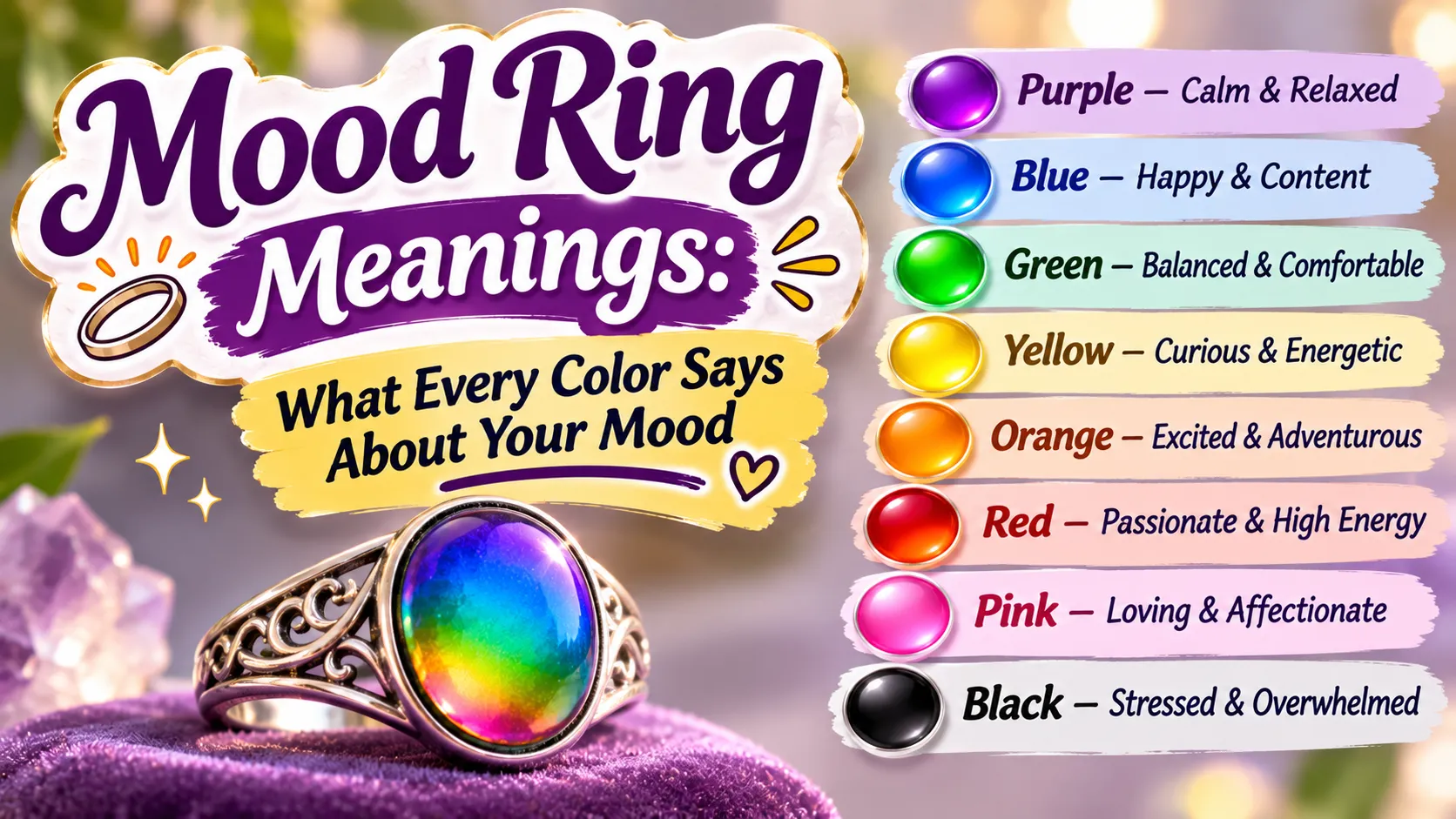
🌈 Mood Ring Color Meanings: Complete Quick Reference Chart
Before exploring individual colors, take a look at this quick mood ring color chart. It includes common traditional interpretations of the shades found in many mood rings.
| Mood ring color | Traditional mood meaning |
|---|---|
| Black | Stress, tension, or emotional discomfort |
| Gray | Nervousness, uncertainty, or anxiety |
| Brown | Restlessness or emotional uneasiness |
| Amber | Mixed feelings or nervous excitement |
| Yellow | Alertness, creativity, or excitement |
| Green | Balance, calmness, and normal mood |
| Turquoise | Relaxation, friendliness, and contentment |
| Blue-green | Peacefulness and emotional stability |
| Light blue | Calmness and happiness |
| Blue | Relaxation and tranquility |
| Dark blue | Deep relaxation and contentment |
| Purple | Romance, passion, or excitement |
| Violet | Imagination, sensitivity, and affection |
| Pink | Love, tenderness, and happiness |
| Red | Energy, passion, or strong emotions |
| Orange | Enthusiasm, adventure, and excitement |
| White | Confusion, reflection, or uncertainty |
Note: This is a traditional mood ring interpretation chart. Exact colors and meanings vary by manufacturer, temperature range, and product design.
⚫ Black Mood Ring Meaning: Stress and Emotional Tension
A black mood ring is traditionally associated with stress, tension, discomfort, or emotional uneasiness. It is often considered one of the more negative-looking shades on a traditional mood ring chart.
When your ring appears black, popular interpretations suggest that you may be feeling overwhelmed, worried, exhausted, or uncomfortable.
Common black mood ring interpretations include:
- Stress and pressure
- Emotional tension
- Nervousness
- Mental exhaustion
- Frustration
- Discomfort
- Low energy
However, a black mood ring does not necessarily mean you are upset. The ring may simply be cold because of the surrounding temperature, your skin temperature, or limited contact with your finger.
🩶 Gray Mood Ring Meaning: Nervousness and Uncertainty
Gray is traditionally associated with nervousness, uncertainty, and emotional hesitation. It represents a middle ground between darker and lighter shades, making it a popular symbol of mixed feelings.
A gray mood ring is sometimes interpreted as a sign of worry, confusion, or feeling unsettled about something.
Common gray mood ring meanings include:
- Nervousness
- Uncertainty
- Mild anxiety
- Emotional confusion
- Hesitation
- Restlessness
- Lack of confidence
In traditional mood ring interpretations, gray can suggest that your mind is occupied with something that requires attention.
🤎 Brown Mood Ring Meaning: Restlessness and Uneasiness
Brown mood rings are traditionally associated with restlessness, emotional discomfort, and frustration. The earthy shade is sometimes interpreted as representing an unsettled or uneasy emotional state.
People who follow traditional mood ring charts may connect brown with feeling distracted, impatient, or overwhelmed.
Common brown mood ring meanings include:
- Restlessness
- Uneasiness
- Frustration
- Impatience
- Worry
- Emotional discomfort
- Irritability
Brown is not a standard color on every mood ring. Some manufacturers use different shades or skip this color entirely.
🟡 Yellow Mood Ring Meaning: Excitement and Uncertainty
Yellow is traditionally connected with excitement, curiosity, nervous energy, and mixed emotions. It is a bright shade that often represents an active mind and changing feelings.
When your mood ring turns yellow, traditional interpretations suggest that you may be experiencing a little nervousness or anticipation.
Common yellow mood ring meanings include:
- Curiosity
- Excitement
- Mixed emotions
- Mental alertness
- Uncertainty
- Anticipation
- Creative thinking
Yellow can also represent a transitional color between green and amber on certain mood ring charts. Its exact interpretation depends on the temperature range used in the ring.
🟠 Amber Mood Ring Meaning: Nervousness and Mixed Feelings
Amber is a warm golden-orange shade traditionally associated with nervousness, anxiety, and emotional uncertainty. It often appears between green and yellow on traditional mood ring charts.
An amber mood ring may be interpreted as a sign of anticipation, mild stress, or a combination of different emotions.
Common amber mood ring meanings include:
- Mild nervousness
- Anxiety
- Mixed feelings
- Anticipation
- Emotional uncertainty
- Restlessness
- Excitement with hesitation
Amber is one of the shades that can easily be confused with yellow or orange. Some manufacturers use all three colors, while others include only one or two of them.
💚 Green Mood Ring Meaning: Balance and Calmness
Green is commonly considered the neutral or average color on a traditional mood ring chart. It represents emotional balance, normal feelings, and a comfortable state.
When your mood ring turns green, popular interpretations suggest that you are feeling relatively balanced rather than experiencing particularly strong emotions.
Common green mood ring meanings include:
- Emotional balance
- Calmness
- Stability
- Normal feelings
- Contentment
- Peacefulness
- Mental relaxation
Green is often considered the baseline shade because many traditional mood rings are calibrated to display it around a typical resting skin temperature.
However, green does not prove that you are emotionally neutral. It simply indicates that the temperature-sensitive material is responding to a particular temperature range.
🩵 Turquoise Mood Ring Meaning: Comfort and Friendliness
Turquoise is a refreshing blue-green shade traditionally associated with comfort, friendliness, happiness, and relaxation.
It often appears between green and blue on mood ring color charts, representing a warmer temperature range than the neutral green shade.
Common turquoise mood ring meanings include:
- Emotional comfort
- Friendliness
- Relaxation
- Happiness
- Positive energy
- Contentment
- Openness
Turquoise is a popular shade because it combines the traditional symbolism of blue and green. It can represent a peaceful state of mind and a positive emotional atmosphere.
🩵 Blue-Green Mood Ring Meaning: Peacefulness and Stability
Blue-green is traditionally associated with a relaxed emotional state and a sense of inner stability. It represents a transition between the balanced green shade and the more relaxed blue shades.
When your ring displays blue-green, popular interpretations suggest that you may be comfortable, peaceful, and emotionally settled.
Common blue-green mood ring meanings include:
- Peacefulness
- Emotional stability
- Relaxation
- Comfort
- Contentment
- Positive feelings
- Inner balance
This shade is particularly interesting because even a small temperature change can make a mood ring shift between green, blue-green, and blue.
💙 Light Blue Mood Ring Meaning: Happiness and Relaxation
Light blue is one of the most popular mood ring colors. It is traditionally connected with happiness, relaxation, affection, and emotional comfort.
A light blue mood ring is often interpreted as a sign that you are feeling comfortable and enjoying a peaceful moment.
Common light blue mood ring meanings include:
- Happiness
- Calmness
- Relaxation
- Affection
- Emotional comfort
- Positive energy
- Peace of mind
Light blue is often considered a pleasant shade on traditional mood ring charts. It can also represent a gentle, easygoing emotional state.
💙 Blue Mood Ring Meaning: Calmness and Contentment
Blue is traditionally associated with calmness, relaxation, and contentment. It is one of the most recognizable shades in mood ring color charts and is often considered a positive color.
When your ring turns blue, popular interpretations suggest that you are feeling peaceful, comfortable, and emotionally settled.
Common blue mood ring meanings include:
- Calmness
- Happiness
- Relaxation
- Contentment
- Affection
- Emotional comfort
- Confidence
Blue is also associated with trust and tranquility in general color symbolism. That is why it is frequently used in fashion, interior design, and decorative jewelry.
🔵 Dark Blue Mood Ring Meaning: Deep Relaxation and Passion
Dark blue is traditionally associated with happiness, affection, romance, and deep relaxation. On many traditional mood ring charts, it represents a warmer temperature range than ordinary blue.
This shade is often interpreted as a sign of positive feelings, emotional comfort, and romantic excitement.
Common dark blue mood ring meanings include:
- Deep relaxation
- Romantic feelings
- Happiness
- Passion
- Affection
- Emotional satisfaction
- Confidence
Dark blue is often considered one of the most desirable colors on a traditional mood ring chart because of its positive emotional associations.
💜 Purple Mood Ring Meaning: Romance and Excitement
Purple is traditionally associated with romance, passion, excitement, imagination, and intense happiness. It is often found toward the warmer end of a traditional mood ring color spectrum.
When your ring changes to purple, popular interpretations suggest that you may be experiencing affection, enthusiasm, or strong positive emotions.
Common purple mood ring meanings include:
- Romance
- Passion
- Excitement
- Imagination
- Happiness
- Affection
- Emotional intensity
Purple is also associated with mystery, creativity, and individuality. This makes it one of the most attractive and recognizable mood ring shades.
💜 Violet Mood Ring Meaning: Passion and Intense Happiness
Violet is often considered one of the warmest shades on traditional mood ring charts. It is commonly associated with intense happiness, romantic feelings, excitement, and passion.
Some traditional interpretations describe violet as a color representing a particularly positive or affectionate emotional state.
Common violet mood ring meanings include:
- Intense happiness
- Romantic excitement
- Passion
- Affection
- Creativity
- Emotional warmth
- Enthusiasm
Violet and purple are sometimes used interchangeably in mood ring charts. However, some manufacturers list them as separate shades with slightly different interpretations.
🩷 Pink Mood Ring Meaning: Love and Affection
Pink is traditionally associated with tenderness, love, affection, sweetness, and emotional warmth. It is a popular shade in modern mood jewelry and is often connected with romantic or caring feelings.
When your mood ring turns pink, popular interpretations suggest that you may be experiencing affection, happiness, or emotional excitement.
Common pink mood ring meanings include:
- Love
- Affection
- Tenderness
- Happiness
- Romantic feelings
- Emotional warmth
- Compassion
Pink is also widely associated with kindness, friendship, and caring relationships. Its meaning can vary depending on the specific mood ring chart.
❤️ Red Mood Ring Meaning: Energy and Strong Emotions
Red is traditionally associated with passion, energy, excitement, and strong feelings. Some mood ring charts include red or reddish shades, although they are not present in every design.
A red mood ring may be interpreted as representing enthusiasm, intense emotions, or heightened energy.
Common red mood ring meanings include:
- Passion
- Energy
- Excitement
- Strong emotions
- Confidence
- Romantic intensity
- Enthusiasm
Red is also a powerful color in general symbolism. It is commonly associated with love, determination, courage, and excitement.
However, red is not a standard shade on many classic mood ring charts, so its interpretation depends heavily on the manufacturer.
🧡 Orange Mood Ring Meaning: Adventure and Enthusiasm
Orange is traditionally connected with enthusiasm, creativity, adventure, and energetic feelings. It is a lively shade that can represent excitement and a desire to explore new experiences.
Some mood ring charts associate orange with restlessness or nervous energy, while others interpret it as a positive and adventurous mood.
Common orange mood ring meanings include:
- Enthusiasm
- Creativity
- Adventure
- Excitement
- Energy
- Curiosity
- Restlessness
Orange is often positioned between yellow and warmer shades on color-changing jewelry charts. Its appearance can indicate a temperature shift rather than a particular emotional state.
🤍 White Mood Ring Meaning: Confusion and Uncertainty
White is sometimes associated with confusion, uncertainty, reflection, and emotional hesitation in mood ring interpretations.
However, white is not a standard color on every mood ring chart. In some rings, a white or cloudy appearance can indicate a product-specific effect, fading, or damage rather than an emotional interpretation.
Possible white mood ring meanings include:
- Uncertainty
- Confusion
- Reflection
- Hesitation
- Emotional sensitivity
- A transitional state
If your mood ring suddenly becomes permanently white or cloudy and no longer changes color, check whether the stone has been damaged.
⚫ Why Does a Mood Ring Turn Black?
A mood ring often turns black when it becomes colder than its normal operating temperature. This commonly happens when you remove it from your finger because the stone is no longer receiving warmth from your skin.
Traditional mood ring charts associate black with stress, tension, and emotional discomfort. However, a black appearance is not proof that you are experiencing negative emotions.
Other possible reasons include:
- Cold weather.
- Low finger temperature.
- Reduced warmth from skin contact.
- A ring that has been left unused.
- Damage to the temperature-sensitive material.
- Moisture entering the ring’s protective covering.
If the ring remains black even after warming naturally on your finger, its temperature-sensitive material may be damaged.
🔬 How Do Mood Rings Work?
Mood rings work through a temperature-sensitive material known as thermochromic liquid crystals. These crystals respond to changes in temperature by altering their molecular arrangement, which changes the wavelengths of light they reflect.
When you wear a mood ring, heat from your finger transfers to the stone. As its temperature changes, the liquid crystals shift and produce different colors.
Here is how the process works:
- Skin contact: Your finger transfers heat to the mood ring.
- Temperature changes: The temperature-sensitive crystals respond to the heat.
- Crystal movement: Their molecular arrangement changes as the temperature shifts.
- Light reflection: The crystals reflect different wavelengths of light.
- Color transformation: Your mood ring displays a different shade.
This process explains why a mood ring can change colors several times throughout the day. It is essentially a small temperature-sensitive accessory rather than an electronic emotion detector. scienceline.ucsb.edu+2
🌡️ Why Do Mood Rings Change Colors?
Mood rings change colors because the temperature of your finger is not constant. It can fluctuate throughout the day due to weather, physical activity, circulation, and other environmental factors.
Even small temperature differences can cause the liquid crystals to reflect a different color.
For example, your ring might appear green while you are sitting comfortably indoors, turn blue when your finger becomes warmer, and become darker when you step outside in cold weather.
Common factors that influence mood ring colors include:
- Weather: Cold surroundings can cool your fingers and produce darker shades.
- Physical activity: Exercise can change blood circulation and skin temperature.
- Stress: Nervousness can sometimes affect blood flow to the fingers.
- Relaxation: Changes in circulation may influence finger temperature.
- Room temperature: Warm or cold indoor environments can affect the ring.
- Hand movement: Contact with different surfaces can change local temperature.
- Skin circulation: Natural changes in blood flow influence finger warmth.
These factors explain why the same person can see different colors throughout the day without experiencing a major emotional change.
🧪 Are Mood Ring Meanings Scientifically Accurate?
Mood ring meanings are entertaining, but they are not scientifically proven methods of identifying emotions.
A mood ring measures temperature changes in the material inside its stone. It does not measure happiness, sadness, love, anger, anxiety, or other psychological states.
There is a small connection between emotions and physical temperature. For example, stress can sometimes influence blood circulation, which may change the temperature of your fingers. However, this relationship is not reliable enough to determine exactly how someone feels.
Consider these examples:
- Your ring may turn black because your hands are cold, even when you feel happy.
- It may turn blue because your fingers are warm, even when you feel worried.
- It may display green while you are experiencing several different emotions.
- It may change colors because of the room temperature rather than your feelings.
Therefore, treat mood ring color meanings as traditional interpretations and entertainment rather than scientific emotional measurements. ThoughtCo+2
💞 What Does It Mean When Your Mood Ring Changes Colors Quickly?
When a mood ring changes colors quickly, it usually means the temperature around its stone is fluctuating.
For example, moving between a warm room and a cold outdoor environment can cause noticeable color changes. Holding a cold drink, washing your hands, or touching a cool surface may also influence the ring.
Some people interpret frequent color changes as emotional sensitivity or changing feelings. However, there is no scientific evidence that rapid color changes reveal an unstable mood.
Common reasons for quick color changes include:
- Sudden temperature differences.
- Changes in finger circulation.
- Moving between indoor and outdoor environments.
- Holding warm or cold objects.
- Changes in skin contact.
- Different levels of exposure to surrounding air.
A quick color transition is generally a normal feature of temperature-sensitive jewelry.
💍 Why Does My Mood Ring Stay One Color?
If your mood ring stays the same color for a long time, it does not necessarily mean your mood is unchanged. It may simply be experiencing a relatively stable temperature.
For example, a ring that stays green throughout the day may be operating within its green temperature range.
However, a mood ring that never changes color may have a problem.
Possible explanations include:
- Your finger temperature remains relatively stable.
- The surrounding environment is consistently warm or cool.
- The ring is not making proper contact with your skin.
- Its temperature-sensitive material has deteriorated.
- Moisture has entered the stone.
- The protective coating has become damaged.
Try wearing the ring comfortably for a while in a stable indoor environment. If it still does not respond to normal temperature changes, the color-changing component may no longer be working.
🕰️ When Were Mood Rings Invented?
Mood rings became popular in the United States during the 1970s. They were introduced by Josh Reynolds and Maris Ambats in 1975 and quickly became a fashionable novelty jewelry trend.
Their popularity came from an appealing idea: a ring that appeared to reveal the wearer’s emotional state through changing colors.
People were fascinated by the combination of science, fashion, and personal expression. Mood rings became particularly popular among teenagers and young adults, and they were sold in different designs, shapes, and materials.
The rings also became part of the wider 1970s fashion culture, when colorful accessories and experimental styles were especially popular.
Although their original popularity eventually faded, mood rings never completely disappeared. They continue to attract people who enjoy nostalgic jewelry, unusual accessories, and color-changing designs. HISTORY+1
✨ How to Read a Mood Ring Correctly
Reading a mood ring is simple once you understand its traditional color chart and temperature-sensitive design.
Instead of assuming that every color represents a definite emotion, use the chart as a fun reference for interpreting its changing shades.
Follow these simple steps:
- Wear the ring properly: Place it comfortably on your finger so that its stone receives warmth from your skin.
- Allow it to adjust: Give the ring a little time to respond to your finger temperature.
- Identify the displayed shade: Look closely to determine whether the stone is blue, green, purple, yellow, or another color.
- Check the color chart: Compare the shade with the traditional meanings supplied by the manufacturer.
- Consider the surroundings: Think about whether the weather, room temperature, or physical activity could have influenced the color.
- Enjoy the interpretation: Treat the result as a playful reflection rather than a definite description of your emotional state.
Different manufacturers use different temperature ranges, so the chart that comes with your particular ring is usually the best reference.
🧼 How to Take Care of Your Mood Ring
Mood rings require some care because their color-changing materials can be sensitive to moisture, excessive heat, and physical damage.
Proper maintenance can help preserve the appearance and performance of your jewelry.
Here are some practical care tips:
- Remove your mood ring before swimming.
- Avoid wearing it while washing dishes.
- Keep it away from harsh cleaning chemicals.
- Avoid exposing it to excessive heat.
- Store it in a dry jewelry box.
- Protect the stone from scratches and impact.
- Avoid pulling or pressing the temperature-sensitive setting.
- Clean the surrounding metal gently with a soft, dry cloth.
Moisture is particularly important because water entering the sealed stone can damage its temperature-sensitive material. If the color-changing component is damaged, it may not be possible to restore its original function.
🎁 Why Are Mood Rings Still Popular?
Mood rings remain popular because they combine nostalgia, personal style, and interactive design. Unlike ordinary rings, they offer something unexpected: their appearance can change throughout the day.
They are also affordable accessories that appeal to children, teenagers, and adults who enjoy unusual jewelry.
Some people wear mood rings as fashion statements, while others enjoy comparing their colors with traditional mood interpretations.
Here are some reasons people enjoy mood rings:
- They feature eye-catching color changes.
- They make interesting conversation starters.
- They are available in different designs.
- They can make thoughtful gifts.
- They bring back nostalgic memories.
- They combine science with fashion.
- They offer a fun way to explore color symbolism.
Whether you believe in their traditional meanings or simply enjoy their appearance, mood rings remain a unique addition to any jewelry collection.
🌟 Different Types of Mood Rings
Mood rings are available in several styles, allowing people to choose accessories that match their personal preferences.
Although their basic temperature-sensitive function is similar, their designs, shapes, and materials can vary.
Popular mood ring styles include:
- Classic mood rings: Traditional rings with an oval color-changing stone.
- Heart-shaped mood rings: Decorative designs often associated with love and affection.
- Adjustable mood rings: Flexible rings that can fit different finger sizes.
- Vintage mood rings: Retro-inspired designs influenced by 1970s jewelry.
- Silver mood rings: Rings featuring silver-colored metal settings.
- Gold-tone mood rings: Decorative designs with gold-colored finishes.
- Mood ring bands: Simple bands featuring smaller color-changing sections.
- Children’s mood rings: Colorful and playful designs made for younger jewelry lovers.
Choosing a mood ring is mostly a matter of personal style. The important thing is to select a design with a properly protected temperature-sensitive component.
❓ Frequently Asked Questions About Mood Ring Meanings
Here are answers to common questions about mood ring colors, their traditional meanings, and how these fascinating accessories work.
1. What is the most common mood ring color?
Green is commonly considered the neutral or average color on traditional mood ring charts. It is often associated with balance, calmness, and normal feelings.
2. What is the happiest color on a mood ring?
Blue and dark blue are traditionally associated with happiness, relaxation, and contentment. Violet is also connected with intense happiness and excitement.
3. What does purple mean on a mood ring?
Purple traditionally represents romance, passion, excitement, affection, and imagination. It is often considered one of the warmer shades on a mood ring chart.
4. What does blue mean on a mood ring?
Blue generally represents calmness, relaxation, happiness, and emotional comfort. Dark blue is sometimes associated with deeper relaxation and romantic feelings.
5. What does green mean on a mood ring?
Green is traditionally associated with emotional balance, stability, and a normal mood. It is often considered the neutral shade on classic mood rings.
6. What does black mean on a mood ring?
Black is traditionally associated with stress, tension, and emotional discomfort. However, it can also appear simply because the ring is cold or damaged.
7. What does yellow mean on a mood ring?
Yellow is commonly associated with excitement, curiosity, nervousness, and mixed emotions. Its interpretation varies between manufacturers.
8. What does pink mean on a mood ring?
Pink traditionally represents love, affection, tenderness, happiness, and emotional warmth. It is also associated with caring relationships.
9. Can mood rings really detect your emotions?
No. Mood rings cannot directly detect emotions. They use temperature-sensitive liquid crystals that respond to changes in finger temperature.
10. Why does my mood ring turn black when I take it off?
When you remove your ring, it loses the warmth provided by your finger. As its temperature decreases, the color-changing material may turn black or dark gray.
11. Why does my mood ring turn blue when I am happy?
Blue is traditionally associated with happiness and relaxation. However, the actual reason is that the temperature-sensitive crystals are responding to your finger’s temperature.
12. Can mood rings change color in cold weather?
Yes. Cold weather can lower your finger temperature, causing the ring to display darker shades such as gray or black.
13. What does a rainbow-colored mood ring mean?
A rainbow or multicolored appearance can indicate that different areas of the stone are experiencing slightly different temperatures or that the ring is transitioning between shades. It does not have one universally accepted emotional meaning.
14. Are mood rings suitable for everyday wear?
Yes, many mood rings can be worn regularly, provided they are protected from moisture, excessive heat, scratches, and physical damage.
15. Do all mood rings have the same color meanings?
No. Different manufacturers use different liquid crystal mixtures and temperature ranges. Their color charts may therefore have slightly different meanings.
💖 Conclusion: Discover the Colorful World of Mood Ring Meanings
Understanding mood ring meanings makes these fascinating accessories even more enjoyable. Every shade has a traditional interpretation, from black representing stress and tension to blue symbolizing relaxation and purple representing passion and romance.
Green is commonly associated with balance, yellow with excitement, pink with affection, and orange with enthusiasm. These colorful interpretations make mood rings interesting accessories for anyone who enjoys exploring color symbolism.
Remember that mood rings respond to temperature rather than directly measuring emotions. Their traditional meanings are best enjoyed as fun interpretations, not scientific readings of your feelings.
Whether you wear one for fashion, nostalgia, or curiosity, a mood ring adds a little mystery and color to everyday life.

Olivia Bennett is a writer and language enthusiast at Vocabsteria. She is passionate about exploring word meanings, name origins, and cultural expressions from around the world.