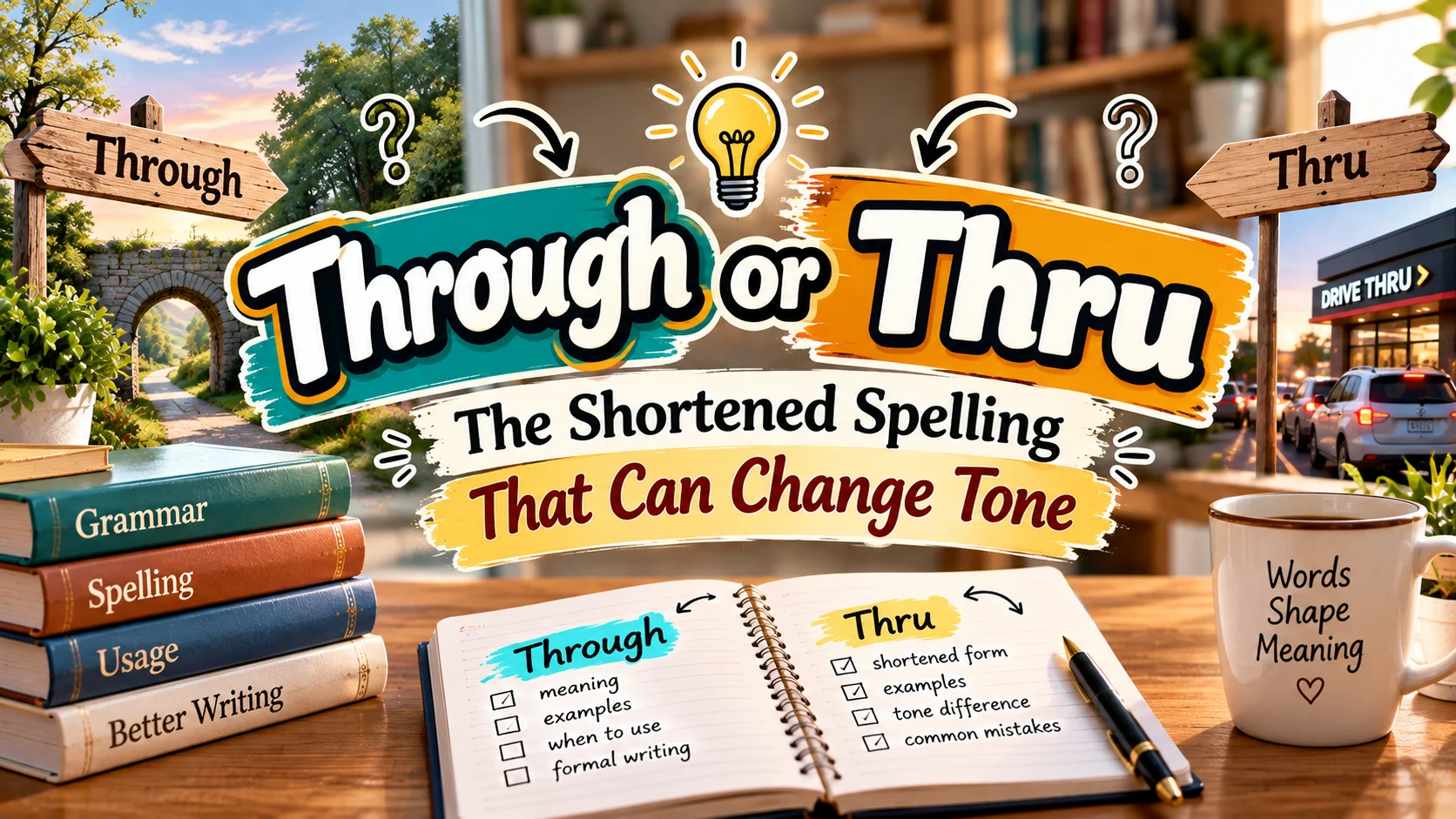
“Through” and “thru” look almost identical, sound the same, and are often used in similar situations. So why does one appear in formal writing while the other shows up on signs, menus, texts, and advertisements? The answer is mostly about standard spelling, context, and style rather than pronunciation or meaning.
If you have ever wondered whether thru is a real word, whether you should write through or thru, or why Americans commonly see drive-thru instead of drive-through, you are not alone. The two spellings can both appear in everyday American English, but they do not have the same level of formality.
In this guide, we will explain the difference between through or thru, when each spelling is appropriate, how “thru” is used in American English, and why choosing the right version can make your writing look more polished.
📖 Through or Thru: What Is the Difference?
The main difference between through or thru is that through is the standard spelling, while thru is an informal or abbreviated spelling used in certain contexts. Both are pronounced the same, but their written forms carry different stylistic expectations.
When writing an essay, email, report, application, or professional document, through is normally the better choice. “Thru” is more common in casual communication, signs, shortened expressions, and certain established compounds.
| Word | Status | Typical Use |
|---|---|---|
| through | Standard spelling | Formal and everyday writing |
| thru | Informal/abbreviated spelling | Signs, texting, casual writing |
| drive-thru | Established US usage | Restaurants and businesses |
| throughout | Standard word | Formal and everyday writing |
For most ordinary sentences, choose through.
✍️ Is “Through” the Correct Spelling?
Yes. Through is the standard spelling used in American English and other varieties of standard English. It is the form you should normally use when writing complete, polished sentences.
For example, you would write:
- We walked through the park.
- She looked through the documents.
- I stayed awake through the night.
- He worked through the weekend.
- We drove through the tunnel.
The spelling “through” is appropriate for school assignments, professional correspondence, articles, reports, formal messages, and most published content.
If you are unsure which spelling to use, through is the safest choice.
🚗 Is “Thru” a Real Word?
Yes, thru is a recognized informal spelling, particularly in American English. It is not simply a random spelling mistake, although it should not replace “through” in every situation.
You will commonly see “thru” in places where brevity, visibility, or a compact design matters:
- Drive-thru
- Thru traffic
- Thruway in certain US contexts
- Informal notes
- Text messages
- Short advertisements
- Signs and displays
- Space-limited instructions
For example:
Please use the drive-thru.
Here, drive-thru is a familiar American English compound. However, in a sentence such as “We walked thru the park,” the informal spelling may look out of place in polished writing.
🗣️ How Do You Pronounce Through and Thru?
Through and thru have the same pronunciation in normal English speech. Both are pronounced approximately like “throo.”
The phonetic pronunciation of through is commonly represented as /θruː/. The initial sound is the voiceless “th” sound, followed by the long “oo” sound.
Examples include:
- through → “throo”
- thru → “throo”
The difference is therefore primarily written, not spoken. When someone says “through,” you cannot normally tell from the pronunciation whether they would write “through” or “thru.”
🧭 What Does “Through” Mean?
The word through has several meanings depending on the sentence. It can describe movement from one side or point to another, movement during a period, a method or means, or completion of an activity.
Here are some common meanings:
| Meaning | Example |
|---|---|
| From one side to another | We walked through the door. |
| During a period | She worked through the night. |
| By means of | We heard about it through a friend. |
| From beginning to end | He read through the entire report. |
| Completed | I’m through with the assignment. |
Because “through” has several grammatical functions and meanings, it appears frequently in everyday English.
🔤 When Should You Use “Through”?
Use through whenever you are writing standard English and do not have a specific reason to use the abbreviated form.
It is especially appropriate in:
- Academic papers
- School assignments
- Business emails
- Reports
- Resumes
- Cover letters
- Legal documents
- Professional websites
- Formal letters
- Articles and blog posts
- Official communication
For example:
Correct for formal writing:
The information was collected through several reliable sources.
Less appropriate for formal writing:
The information was collected thru several reliable sources.
The second sentence can be understood, but the first one follows standard written conventions.
📱 When Is “Thru” Acceptable?
“Thru” can be acceptable when the context is deliberately informal, abbreviated, or space-conscious. It frequently appears in casual communication and commercial language.
You may encounter it in:
- Text messages
- Casual notes
- Social media posts
- Informal advertisements
- Signs
- Menus
- Digital displays
- Business names
- Established expressions
For example:
I’ll send it thru email later.
This is understandable in casual messaging, but through would be preferable in polished writing:
I’ll send it through email later.
The choice depends heavily on the audience and purpose.
🚦 Why Do Signs Use “Thru”?
Signs often use abbreviated spellings because they need to communicate information quickly while using limited physical or visual space.
A sign needs to be:
- Easy to read
- Short
- Visible from a distance
- Simple to understand
- Efficient in limited space
That is one reason you may see:
- Drive-Thru
- Thru Traffic
- Thru Lane
- Thru Entrance
In these contexts, the shortened spelling is practical and familiar. It does not mean that “thru” has replaced “through” throughout the English language.
🍔 Why Is It “Drive-Thru”?
Drive-thru is a well-established American English expression referring to a service that allows customers to remain in their vehicles while ordering or receiving something.
Examples include:
- Drive-thru restaurant
- Drive-thru window
- Drive-thru pharmacy
- Drive-thru pickup
- Drive-thru service
You may also see drive-through, especially when a writer prefers the full spelling. Both forms can occur, but drive-thru is extremely familiar in American commercial usage.
For example:
We stopped at the drive-thru for dinner.
This is a natural use of “thru.”
📝 Through vs. Thru in Formal Writing
Formal writing generally favors through because it follows standard spelling conventions. Academic and professional writing typically avoids abbreviations that can make the tone look overly casual.
Compare these examples:
| Formal/standard | Informal/abbreviated |
|---|---|
| I walked through the building. | I walked thru the building. |
| She looked through the file. | She looked thru the file. |
| We worked through the problem. | We worked thru the problem. |
| He drove through the city. | He drove thru the city. |
| We communicated through email. | We communicated thru email. |
The meaning remains clear in both versions, but the tone and style differ.
🎓 Should You Use “Thru” in Academic Writing?
Generally, no. Academic writing should normally use through unless “thru” appears as part of a proper name, quotation, established term, or other context where preserving the original wording is necessary.
Academic writing values:
- Standard spelling
- Consistency
- Precision
- Professional tone
- Formal language
Instead of:
Students can learn thru repeated practice.
Write:
Students can learn through repeated practice.
This small spelling choice helps maintain an appropriate academic tone.
💼 Through or Thru in Professional Emails
For professional emails, through is normally the better option. Business communication should generally use standard spelling unless the company or context specifically uses “thru” as part of a name or service.
For example:
Professional:
We received the documents through the online portal.
Casual:
I got the documents thru the portal.
The second sentence is understandable, but the first is more polished and appropriate for formal workplace communication.
💬 Through or Thru in Text Messages
Texting is one of the situations where thru can appear naturally. People often shorten words when communicating casually, especially when speed and convenience matter.
For example:
- “I’m coming thru in 10.”
- “Can you send it thru?”
- “We drove thru the city.”
- “I’ll get thru it tonight.”
These messages are easy to understand because the conversation is informal. Still, using “through” is never wrong simply because you are texting.
The key difference is style, not pronunciation.
🌐 Through or Thru on Social Media
Social media allows much more flexibility than academic or professional writing. A creator may choose “thru” because it is shorter, visually compact, or fits a particular casual style.
For example:
Made it thru Monday! 😅
This can work perfectly well as an informal caption. However, if the same sentence appears in a formal article, professional announcement, or educational resource, through would usually be preferable.
Social media writing often prioritizes personality and brevity, so informal spellings are more common.
🏢 Through or Thru in Business Names
Sometimes a company, restaurant, organization, or product may intentionally use thru in its official name or branding.
If “Thru” appears as part of a proper name, do not automatically change it to “Through.”
For example, if a fictional business were officially named:
Quick Thru Services
you would preserve the company’s chosen spelling when referring to the business.
Proper names follow their own spelling conventions. The standard rule about formal writing does not require you to alter someone’s official brand name.
🚘 Through, Thru, and Drive-Through
One of the most common questions is whether drive-thru or drive-through is correct.
Both spellings are used, but drive-thru is a highly familiar American English form, especially in restaurant and commercial contexts.
Examples:
- We ordered from the drive-thru.
- The restaurant has a drive-through window.
- The drive-thru closes at midnight.
- Please use the drive-through lane.
The choice can depend on house style, branding, and context.
🛣️ What About “Thruway”?
Thruway is another form you may encounter in American English. It can refer to a highway or expressway, and it is also used in proper names.
For example:
We took the Thruway to reach the next city.
This does not mean that “thru” should replace “through” in ordinary sentences. Thruway has developed as a distinct lexical form in certain American contexts.
When referring to an official name, follow the name’s established spelling.
❌ Common Mistakes With Through and Thru
The most common mistake is treating thru as though it were always interchangeable with through in every type of writing.
Here are some examples:
- ❌ We walked thru the museum.
✅ We walked through the museum. - ❌ Please read thru the report carefully.
✅ Please read through the report carefully. - ❌ She worked thru the night.
✅ She worked through the night. - ❌ The students moved thru the lesson.
✅ The students moved through the lesson. - ❌ We drove thru the tunnel.
✅ We drove through the tunnel.
The informal version may be understandable, but standard writing usually calls for through.
🧠 Easy Memory Trick for Through or Thru
If you are unsure whether to use through or thru, remember this simple rule:
Formal = through.
Informal or abbreviated = thru.
You can also remember that through is the full spelling, while thru is the shortened version.
Ask yourself:
“Am I writing something that needs standard spelling?”
If the answer is yes, choose through.
If you are writing a casual text, sign, label, or established compound such as drive-thru, “thru” may be appropriate.
🔍 Through or Thru: Quick Comparison
The following table makes the difference easy to remember:
| Feature | Through | Thru |
|---|---|---|
| Standard spelling | Yes | No, generally informal |
| Pronunciation | /θruː/ | /θruː/ |
| Formal writing | Preferred | Usually avoided |
| Academic writing | Preferred | Usually avoided |
| Business writing | Preferred | Usually avoided |
| Texting | Common | Common as abbreviation |
| Signs | Common | Very common |
| Drive-thru | Not usually in this compound | Common |
| Social media | Common | Informal option |
| Meaning | Same basic meaning | Same basic meaning |
The biggest difference is register and context, not meaning.
🧾 Through in Everyday Sentences
Because “through” is the standard form, it appears in countless everyday expressions.
Here are some natural examples:
- We walked through the garden.
- She drove through downtown.
- He looked through the window.
- I read through the instructions.
- They worked through the problem.
- We stayed awake through the night.
- She went through the entire process.
- He made it through the difficult period.
- I searched through my files.
- We talked through the issue.
These sentences all use the standard spelling.
🗨️ Through or Thru in Casual Conversation
In spoken conversation, the distinction disappears because both spellings are pronounced the same. Nobody hears the spelling when you say the word aloud.
For example:
“I walked through the store.”
When spoken, there is no difference between this and the informal written form “thru.”
That is why the confusion mostly appears when you are writing, editing, proofreading, or choosing wording for a published piece of content.
🖥️ Through or Thru in Website Content
For website articles, blog posts, educational pages, product descriptions, and informational content, through is generally the stronger standard spelling.
For example:
Learn how to work through common grammar mistakes.
Using “thru” throughout an informational article can make the content look unnecessarily informal. If the site is aimed at a professional or educational audience, the full spelling is especially appropriate.
However, if “thru” is part of a product name, restaurant name, quote, or established phrase, preserve the intended spelling.
📚 Through or Thru in Essays and Reports
Essays and reports should normally use through.
Consider:
The researcher collected information through interviews.
This is standard and polished.
Using:
The researcher collected information thru interviews.
does not make the sentence impossible to understand, but it introduces an informal abbreviation into a formal context.
The same principle applies to school assignments, research papers, workplace reports, and official documents.
✏️ Correct vs. Informal Examples
Here are several examples that show how context affects the choice:
| Context | Recommended Form | Example |
|---|---|---|
| School essay | Through | We learned through experience. |
| Business email | Through | Please send the file through the portal. |
| Text message | Thru can work | I’ll send it thru later. |
| Restaurant sign | Thru can work | Drive-thru open. |
| Blog article | Through | We walked through the process. |
| Social caption | Either, depending on style | Made it thru the day! |
| Official report | Through | The data was obtained through surveys. |
| Brand name | Follow official spelling | Use the company’s chosen name. |
The important question is not simply “Which one is correct?” but “Which spelling fits this context?”
🚫 When “Thru” Looks Out of Place
Although “thru” has legitimate uses, it can look unprofessional when used repeatedly in formal content.
Avoid it in:
- Academic essays
- Job applications
- Resumes
- Formal reports
- Legal documents
- Professional proposals
- Formal business correspondence
- Government forms
- Educational articles
For example:
❌ Please review the information thru the attached document.
A more polished version is:
✅ Please review the information through the attached document.
Standard spelling makes the sentence fit the professional setting better.
🌟 Why “Thru” Exists
English spelling has a long history of abbreviations and shortened forms. In modern American English, thru has become especially visible because signs, advertising, texting, and commercial language often favor compact wording.
Shorter spellings can:
- Save space
- Improve visual impact
- Fit signs more easily
- Speed up casual communication
- Create a conversational tone
- Match established branding
This explains why “thru” continues to appear even though through remains the standard spelling for most writing.
🔤 Through or Thru: Does the Meaning Change?
Usually, no. The basic meaning is generally the same when “thru” is used as an abbreviation of “through.”
For example:
We drove through the tunnel.
and
We drove thru the tunnel.
communicate the same basic idea.
The difference is primarily the style of the written form.
This is why it is better to think of the pair as a difference in standard versus abbreviated spelling, rather than two completely different words.
📌 Common Phrases With “Through”
Learning common phrases can make it easier to recognize when through is the natural choice.
Some frequently used expressions include:
- Go through
- Get through
- Walk through
- Drive through
- Look through
- Read through
- Work through
- Think through
- Talk through
- Follow through
- Come through
- Break through
- See through
- Pull through
- Live through
- Make it through
- All through
- Through the night
- Through the process
- Through the years
These expressions almost always appear with the standard spelling in polished writing.
🧩 Through vs. Thru: Sentence Practice
Test yourself with these examples:
- We walked ___ the forest.
- I need to read ___ the contract.
- The restaurant has a drive-___ window.
- She stayed awake ___ the night.
- Please work ___ the instructions carefully.
- I’ll send the file ___ email.
- We made it ___ the difficult period.
- The sign says “Drive-___.”
- He looked ___ the documents.
- The message was sent ___ the company’s portal.
Answers
- through
- through
- thru
- through
- through
- through
- through
- thru
- through
- through
The pattern is simple: use the standard spelling in normal sentences, while “thru” appears mainly where abbreviation or established usage makes it suitable.
❓ Is “Thru” Wrong?
Not necessarily. Saying that “thru” is always wrong would be too broad.
Thru is an accepted informal or abbreviated spelling and is especially common in American signs, commercial language, texting, and expressions such as drive-thru.
However, if you are writing a formal sentence and have no special reason to abbreviate the word, through is the better choice.
So the practical rule is:
Use through by default; use thru when the context specifically calls for the abbreviated form.
❓ Is “Thru” Acceptable in American English?
Yes. “Thru” appears regularly in American English, particularly in signs, business language, informal communication, and certain established compounds.
It should not, however, be treated as the normal replacement for “through” in formal writing.
❓ Should I Write “Drive-Thru” or “Drive-Through”?
Both forms are used. Drive-thru is especially common in American commercial usage, while drive-through preserves the full spelling.
Follow the spelling used by the business or the style guide you are following.
❓ Is “Thru” Appropriate in a School Essay?
Usually, no. A school essay should normally use through, because standard spelling is expected in formal academic writing.
Unless “thru” is part of a quoted name or source, the full spelling is the safer choice.
❓ Can I Use “Thru” in a Text Message?
Yes. Text messages are informal, so “thru” can be used as a shortened spelling.
For example:
“I’ll come thru after work.”
In a casual conversation, this is easy to understand.
❓ Do Through and Thru Sound the Same?
Yes. They are normally pronounced the same way: approximately “throo.”
The distinction is in spelling and written style.
❓ Which Is Better for Professional Writing: Through or Thru?
Through is generally better for professional writing. It is the standard spelling and works naturally in emails, reports, proposals, articles, resumes, and other polished documents.
❓ Why Do Restaurants Use “Drive-Thru”?
“Drive-thru” is a familiar American English compound that describes a service where customers can order or receive products without leaving their vehicles.
The shortened spelling is widely recognized and works well in commercial signs and branding.
🏁 Final Takeaway: Through or Thru?
The difference between through or thru is easier once you stop thinking of them as completely separate words. Through is the standard spelling used in formal, professional, academic, and ordinary polished writing. Thru is a shortened, informal spelling that appears in texting, signs, advertising, space-limited displays, and established expressions such as drive-thru.
If you are writing an essay, article, email, report, application, or other formal content, choose through. If you are dealing with a sign, casual message, brand name, or familiar compound such as drive-thru, “thru” may be appropriate.
The simplest rule to remember is:
Through = standard spelling.
Thru = informal or abbreviated spelling.
When in doubt, write through.

Olivia Bennett is a writer and language enthusiast at Vocabsteria. She is passionate about exploring word meanings, name origins, and cultural expressions from around the world.