“Which” and “that” are two of the most common words in English, but choosing between them can become surprisingly confusing. Both can introduce information about a noun, and in many everyday sentences, speakers use them almost interchangeably. The real difference becomes clearer when you look at restrictive and nonrestrictive clauses, punctuation, and the type of information you are adding.
If you have ever wondered when to use which or that, whether a comma belongs before “which,” or whether “that” is always the correct choice for essential information, this guide will make the distinction much easier.
The traditional grammar rule is useful, but modern American English has some flexibility. Understanding the role of the clause is more important than memorizing a single shortcut.
📚 Which or That: What Is the Main Difference?
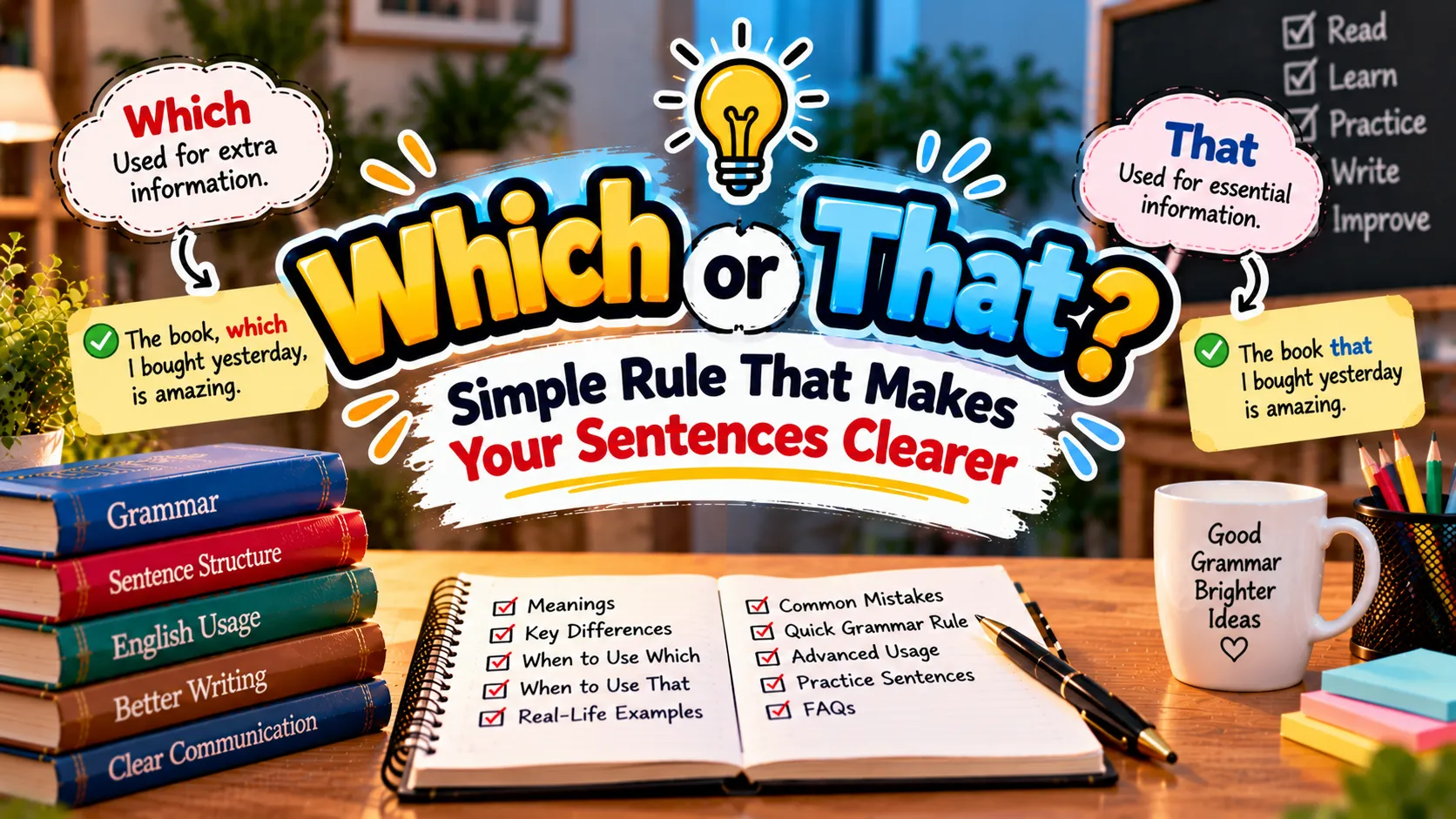
The most useful distinction between which or that is whether the information is essential to identifying the noun. That commonly introduces a restrictive clause, while which commonly introduces a nonrestrictive clause set off by commas.
A restrictive clause gives information that helps identify exactly which person, thing, or group you mean. A nonrestrictive clause adds extra information that could be removed without changing the basic identity of the noun.
| Word | Common Function | Commas? | Example |
|---|---|---|---|
| that | Restrictive clause | Usually no | The book that I bought is new. |
| which | Nonrestrictive clause | Usually yes | The book, which I bought yesterday, is new. |
| which | Restrictive use in some styles | No | The book which I bought is new. |
| that | Nonrestrictive clause | Not standard | The book, that I bought yesterday, is new. |
For polished American English, the simplest rule is that for essential information and which for extra information.
🧩 What Is a Restrictive Clause?
A restrictive clause contains information that is necessary to identify the noun being discussed. Without the clause, the meaning may become unclear or change significantly.
For example:
The shoes that are under the bed are mine.
The phrase “that are under the bed” tells us which shoes are being discussed. It restricts the meaning of “shoes.”
Another example:
Employees that arrive early can use the front entrance.
The clause identifies a particular group of employees—the ones who arrive early.
Because the information is essential, we normally do not put commas around it.
✨ What Is a Nonrestrictive Clause?
A nonrestrictive clause adds extra information about a noun that has already been identified. The sentence can usually remain clear if the clause is removed.
For example:
My laptop, which I bought last year, still works perfectly.
The phrase “which I bought last year” provides additional information. The reader already knows which laptop is being discussed.
Remove the extra clause:
My laptop still works perfectly.
The basic meaning remains intact, so commas are appropriate.
🎯 When Should You Use “That”?
Use that when the information following it is essential to identifying the noun. This is especially common in American English.
Examples:
- The car that has a broken window belongs to John.
- The movie that we watched last night was hilarious.
- The dress that she ordered online finally arrived.
- The restaurant that opened downtown is already popular.
- The computer that I use for work is several years old.
In each sentence, “that” introduces information that helps narrow down the noun.
🔎 When Should You Use “Which”?
Use which when you are adding extra, nonessential information about a noun. In this use, which is normally surrounded by commas.
Examples:
- My car, which is ten years old, still runs well.
- The restaurant, which opened last month, is already crowded.
- Her laptop, which was expensive, needs a new battery.
- The movie, which won several awards, is available online.
- The house, which sits near the lake, has a beautiful view.
The noun is already identifiable, and the “which” clause simply gives the reader more information.
📝 Why Does the Comma Matter?
The comma can change the relationship between the noun and the information that follows it. It can tell readers whether the information is essential or additional.
Compare:
The books that are on the table belong to Sarah.
This means Sarah owns the books that are on the table—not necessarily every book.
Now compare:
The books, which are on the table, belong to Sarah.
This suggests that the books have already been identified, and being on the table is simply additional information.
The comma therefore does more than create a pause. It can affect the sentence’s meaning.
🇺🇸 Which or That in American English
Traditional American English style strongly favors that for restrictive clauses and which for nonrestrictive clauses.
For example:
The report that contains the financial data is on my desk.
But:
The report, which contains the financial data, is on my desk.
This distinction is particularly useful in professional, academic, and edited writing.
Modern usage can be more flexible, especially when “which” is used without a comma in restrictive clauses. However, following the traditional distinction can make your writing clearer and easier to interpret.
🇬🇧 Is British English Different?
British English can be more flexible about restrictive which. You may encounter sentences such as:
The car which I bought last year is already having problems.
This construction is understandable and accepted in many varieties of English.
American style guides often prefer:
The car that I bought last year is already having problems.
This does not mean British English is incorrect. It reflects a difference in grammatical style and convention.
🔄 Which vs. That in Restrictive Clauses
A restrictive clause narrows down the noun. In American English, that is often the preferred relative pronoun when the clause is essential.
For example:
The phone that has the cracked screen is mine.
The clause identifies which phone you mean.
You can sometimes see:
The phone which has the cracked screen is mine.
This is understandable and used in English, but many American style guides recommend that for this restrictive construction.
If you want a simple American English rule, use that when the clause is essential.
💡 Which vs. That in Nonrestrictive Clauses
For nonrestrictive clauses, which is the standard choice.
For example:
My phone, which has a cracked screen, still works.
You would not normally write:
My phone, that has a cracked screen, still works.
In standard edited English, that is generally not used to introduce a nonrestrictive relative clause.
A helpful pattern is:
Essential information → that
Extra information → which
🏠 Compare “The House That” and “The House Which”
Consider these two sentences:
The house that has a red door belongs to my uncle.
The clause identifies the house.
Now:
The house, which has a red door, belongs to my uncle.
The house is already identified, and the red door is additional information.
The difference is subtle but important. The first sentence answers which house? The second simply tells us something about a known house.
👥 Which or That With People
When referring to people, who is usually preferred over which or that when the relative pronoun functions as the subject or object referring to a person.
For example:
The woman who lives next door is a doctor.
Instead of:
The woman which lives next door is a doctor.
However, that can sometimes refer to people in restrictive clauses:
The person that called earlier left a message.
Even so, who is often the more natural and polished choice for people.
🐶 Which or That With Animals
When referring to animals, both that and which can appear depending on whether the clause is restrictive or nonrestrictive.
Examples:
The dog that barked all night belongs to our neighbor.
Our dog, which loves playing outside, sleeps near the window.
If the animal is being treated as an individual with a personal relationship, who may also be used in some contexts:
Our dog, who loves everyone, follows us everywhere.
The choice depends on style and context.
📖 Which or That With Things
When referring to objects and things, that and which are especially common.
Compare:
The computer that I bought is fast.
My computer, which I bought last month, is fast.
The first identifies the computer. The second gives additional information about a computer already identified.
This is one of the most useful patterns to learn.
🚫 Can “That” Follow a Comma?
In standard edited English, that should generally not introduce a nonrestrictive clause after a comma.
For example:
❌ My car, that I bought last year, is blue.
A better version is:
✅ My car, which I bought last year, is blue.
Or, if the information is essential:
✅ The car that I bought last year is blue.
The problem is not simply the comma. The problem is the combination of a nonrestrictive clause with “that.”
✍️ Can “Which” Be Used Without a Comma?
Yes, and this is where English grammar becomes more nuanced. Which can introduce a restrictive clause in some varieties of English and in some established styles.
For example:
The book which I ordered arrived today.
This construction is widely understandable and accepted, especially in British English.
However, in traditional American usage, many editors would prefer:
The book that I ordered arrived today.
If your goal is clear, conventional American English, that is usually the easiest choice for restrictive clauses.
🧠 An Easy Memory Trick
Here is a simple way to remember the basic distinction:
That = tells you which one.
Which = tells you more about it.
For example:
The shirt that is on the chair is mine.
Which shirt? The one on the chair.
My shirt, which is on the chair, is mine.
You already know which shirt I mean; I am simply giving you additional information.
Another memory trick is:
No commas → that
Commas → which
This is not an absolute rule for every grammatical construction, but it is a useful shortcut for standard American English relative clauses.
📊 Which or That: Quick Comparison
| Feature | That | Which |
|---|---|---|
| Restrictive clause | Commonly preferred | Possible in some styles |
| Nonrestrictive clause | Generally avoided | Preferred |
| Commas | Usually none | Usually required for nonrestrictive use |
| Essential information | Yes | Not usually in traditional US style |
| Extra information | No | Yes |
| Formal American English | Common | Common |
| Refers to things | Yes | Yes |
| Refers to people | Sometimes | Generally not preferred |
The key is to identify whether the clause is essential or additional.
⚠️ Common Mistakes With Which and That
Writers often choose the wrong relative pronoun because they focus on the noun rather than the information that follows it.
Here are common mistakes:
- ❌ My car, that is parked outside, is new.
- ✅ My car, which is parked outside, is new.
- ❌ The car, that has a flat tire, is mine.
- ✅ The car that has a flat tire is mine.
- ❌ The book which I need for class, is on the desk.
- ✅ The book that I need for class is on the desk.
- ❌ The laptop, that I bought yesterday, is already broken.
- ✅ The laptop, which I bought yesterday, is already broken.
The best correction often comes from asking whether the information is necessary.
🔍 How to Decide Between Which and That
When you are unsure, follow these steps:
- Step 1: Find the noun being described.
- Step 2: Look at the clause that follows it.
- Step 3: Ask whether that clause identifies the noun.
- Step 4: If it identifies the noun, use that in conventional American English.
- Step 5: If it only adds extra information, use which with commas.
For example:
The phone ___ has a cracked screen belongs to me.
Which phone? The one with the cracked screen.
So:
The phone that has a cracked screen belongs to me.
🧪 Which or That Practice Quiz
Choose which or that in each sentence.
- The shoes ___ I bought yesterday are uncomfortable.
- My shoes, ___ are black, are by the door.
- The restaurant ___ serves sushi is nearby.
- Our restaurant, ___ opened in June, is very popular.
- The computer ___ has the new software is mine.
- My computer, ___ I bought last year, still works.
- The movie ___ we watched was funny.
- The movie, ___ won an award, was excellent.
- The house ___ has the white fence is for sale.
- Our house, ___ has a large backyard, is near the park.
Answers
- that
- which
- that
- which
- that
- which
- that
- which
- that
- which
The pattern becomes easier when you focus on whether the clause identifies the noun or simply describes it.
🎯 When “That” Is the Better Choice
In American English, that is especially useful when the relative clause is necessary to identify the noun.
Consider:
Employees that work remotely must complete the form.
The clause identifies the employees being discussed.
Another example:
The documents that contain confidential information must be secured.
Not all documents are necessarily confidential. The clause narrows down the group.
This is why “that” is so common in restrictive constructions.
🌟 When “Which” Is the Better Choice
Use which when the noun is already clear and the clause simply provides additional information.
Examples:
- My car, which is parked outside, needs washing.
- The book, which was published in 2024, became a bestseller.
- Her laptop, which has a broken hinge, still works.
- The office, which is on the second floor, closes at five.
- The dog, which belongs to my neighbor, is very friendly.
In each case, the main noun can stand on its own.
🗣️ Which or That in Everyday Speech
Spoken English is generally more flexible than formal written English. Native speakers may use which in restrictive clauses without thinking about the traditional distinction.
For example:
That’s the book which I told you about.
This sounds natural to many speakers.
In everyday conversation, people also omit the relative pronoun completely:
That’s the book I told you about.
This is perfectly natural because “that” is functioning as the object of the relative clause and can be omitted.
📝 When You Can Omit “That”
In some sentences, that can be left out when it functions as the object of the relative clause.
For example:
The movie that I watched was excellent.
can become:
The movie I watched was excellent.
However, you cannot simply omit “that” when it is the subject of the relative clause.
For example:
The movie that won the award was excellent.
You cannot normally reduce this to:
❌ The movie won the award was excellent.
Understanding the difference between subject and object helps explain why some relative clauses can be shortened.
🔗 Which or That After a Preposition
Prepositions create another interesting situation.
For example:
The company that I work for is growing.
You can also write:
The company for which I work is growing.
The first version is more conversational. The second is more formal.
Notice that which can work naturally after a preposition:
The organization for which she works is expanding.
This construction is grammatically different from the simple restrictive pattern, so the basic “that = no comma, which = comma” shortcut does not cover every possible use.
🏛️ Formal Style and “For Which”
In formal writing, you may see which following a preposition.
For example:
The project on which we are working is nearly complete.
In everyday English, people are more likely to say:
The project that we are working on is nearly complete.
Both are grammatical. The first has a more formal structure, while the second sounds more conversational.
🌎 Which or That Across English Varieties
English varies across regions, and grammar preferences are not identical everywhere.
American English traditionally emphasizes:
restrictive = that
and:
nonrestrictive = which
British English often permits which in restrictive clauses more freely.
This means you may encounter perfectly understandable sentences that do not follow the traditional American distinction. Context and style guide expectations matter.
📰 Which or That in Professional Writing
If you write articles, reports, business documents, or professional web content, consistency is important.
For a US audience, a practical approach is:
- Use that for restrictive clauses.
- Use which for nonrestrictive clauses.
- Use commas around nonrestrictive “which” clauses.
- Avoid “that” after a comma when introducing a nonrestrictive clause.
- Review long sentences for clarity.
This approach aligns with traditional American editing conventions and makes the relationship between ideas easier for readers to follow.
📋 Which or That: Before-and-After Examples
Here are some examples that show the difference clearly:
| Less Clear/Incorrect | Improved Version |
|---|---|
| My car, that is blue, is outside. | My car, which is blue, is outside. |
| The car which is outside is mine. | The car that is outside is mine. |
| The book, that I bought yesterday, is good. | The book, which I bought yesterday, is good. |
| The book that I bought yesterday is good. | The book that I bought yesterday is good. |
| The house, that has a garage, is expensive. | The house, which has a garage, is expensive. |
The goal is not to memorize dozens of isolated rules. Instead, determine whether the clause identifies the noun or simply adds extra information. Once you understand that distinction, choosing between which and that becomes much easier.
🧾 More Examples of Which or That
These additional examples show how punctuation and the choice of relative pronoun can affect meaning in everyday and professional writing.
| Sentence | Correct Choice | Reason |
|---|---|---|
| The email that contains the attachment is important. | That | The clause identifies which email is important. |
| The email, which contains the attachment, is important. | Which | The clause adds extra information about an already identified email. |
| The shoes that are on sale are comfortable. | That | The clause identifies a particular group of shoes. |
| My shoes, which are on sale, are comfortable. | Which | The clause provides additional information about the shoes. |
| The website that I use for research is helpful. | That | The clause identifies which website is being discussed. |
| This website, which I use for research, is helpful. | Which | The clause adds information about a known website. |
| The building that has a glass entrance is the library. | That | The clause identifies the building. |
| The library, which has a glass entrance, closes at six. | Which | The building is already identified. |
| The report that includes the final results is ready. | That | The clause specifies which report is ready. |
| The report, which includes the final results, is ready. | Which | The clause provides additional information about the report. |
Remember that the intended meaning matters. A sentence can be grammatically correct with either word in different contexts, but the clause structure and punctuation help readers understand the relationship between ideas.
❓ Frequently Asked Questions About Which or That
What is the main difference between which and that?
In traditional American English grammar, that usually introduces a restrictive clause, which provides essential information about a noun. Which commonly introduces a nonrestrictive clause, which adds extra information and is separated by commas.
Example:
- The book that has a red cover is mine.
- My book, which has a red cover, is on the desk.
The first sentence identifies a particular book, while the second adds information about an already identified book.
Should I use which or that in American English?
For conventional American English, use that when the relative clause identifies the noun and which when the clause adds nonessential information. Put commas around a nonrestrictive which clause.
This is a reliable approach for professional articles, academic assignments, and business writing.
Do you put a comma before which?
Usually, yes, when which introduces a nonrestrictive clause that adds extra information.
Correct: My laptop, which I bought last year, still works well.
However, which can also introduce restrictive clauses without commas in some varieties of English and established writing styles. Therefore, a comma is not automatically required every time you use which.
Can you use that after a comma?
In standard edited English, that generally does not introduce a nonrestrictive relative clause.
Incorrect in standard edited usage: My car, that is parked outside, is new.
Correct: My car, which is parked outside, is new.
If the information is essential, you can remove the commas and use that:
The car that is parked outside is new.
Can which be used without a comma?
Yes. In some styles, particularly British English, which can introduce a restrictive clause without commas.
Example: The book which I ordered arrived today.
In traditional American English, many editors prefer:
The book that I ordered arrived today.
Both forms are understandable, but the second follows the conventional American style preference.
Is which used for people or things?
Which is generally used for things and animals, rather than people.
For a person, who is usually the most natural choice:
The woman who teaches English is my neighbor.
For an object, which is appropriate when adding extra information:
My laptop, which is new, works quickly.
In restrictive clauses, that can sometimes refer to people, although who is often preferred in polished writing.
Is that always used for essential information?
No. That is commonly preferred for restrictive clauses in traditional American English, but it is not the only possible construction. Which can also introduce restrictive clauses in some varieties and styles of English.
The key distinction is the role of the clause, not simply the word used to introduce it.
Can you omit that from a sentence?
Yes, when that functions as the object of the relative clause.
With that:
The movie that I watched was excellent.
Without that:
The movie I watched was excellent.
However, when that is the subject of the relative clause, it generally cannot be omitted.
Correct: The movie that won the award was excellent.
Incorrect: The movie won the award was excellent.
Which is more formal: which or that?
Neither word is inherently more formal. Both are appropriate in professional writing. The choice depends on whether the relative clause is restrictive or nonrestrictive and on the style conventions you are following.
For example, the report that contains the data identifies a particular report, while the report, which contains the data, adds information about a report already identified.
What is the easiest way to remember which or that?
Use this simple reminder for traditional American English:
- That = identifies which one.
- Which = adds information about an identified one.
For example, “The bag that is on the chair” identifies a particular bag. “My bag, which is on the chair, is heavy” adds information about a bag that is already known.
This shortcut is helpful, although it does not cover every possible grammatical construction.
Is it wrong to say “the book which I bought”?
No. This construction is accepted in many varieties of English, including British English. However, traditional American style often prefers “the book that I bought” when the clause is essential to identifying the book.
The best choice depends on your audience and the style guide you follow.
✅ Conclusion
Understanding the difference between which and that is easier when you focus on the information a clause provides. In traditional American English, use that for essential information and which for additional information, placing commas around nonrestrictive which clauses.
For example, “The car that has a broken window belongs to John” identifies a particular car. By contrast, “John’s car, which has a broken window, is parked outside” adds information about a car that is already identified.
Although some English varieties allow more flexibility, following the traditional distinction is a practical choice for clear, polished American writing. When in doubt, ask yourself whether the clause identifies the noun or simply provides extra information. That simple check will help you choose the appropriate word and punctuation in most everyday writing situations.

Olivia Bennett is a writer and language enthusiast at Vocabsteria. She is passionate about exploring word meanings, name origins, and cultural expressions from around the world.