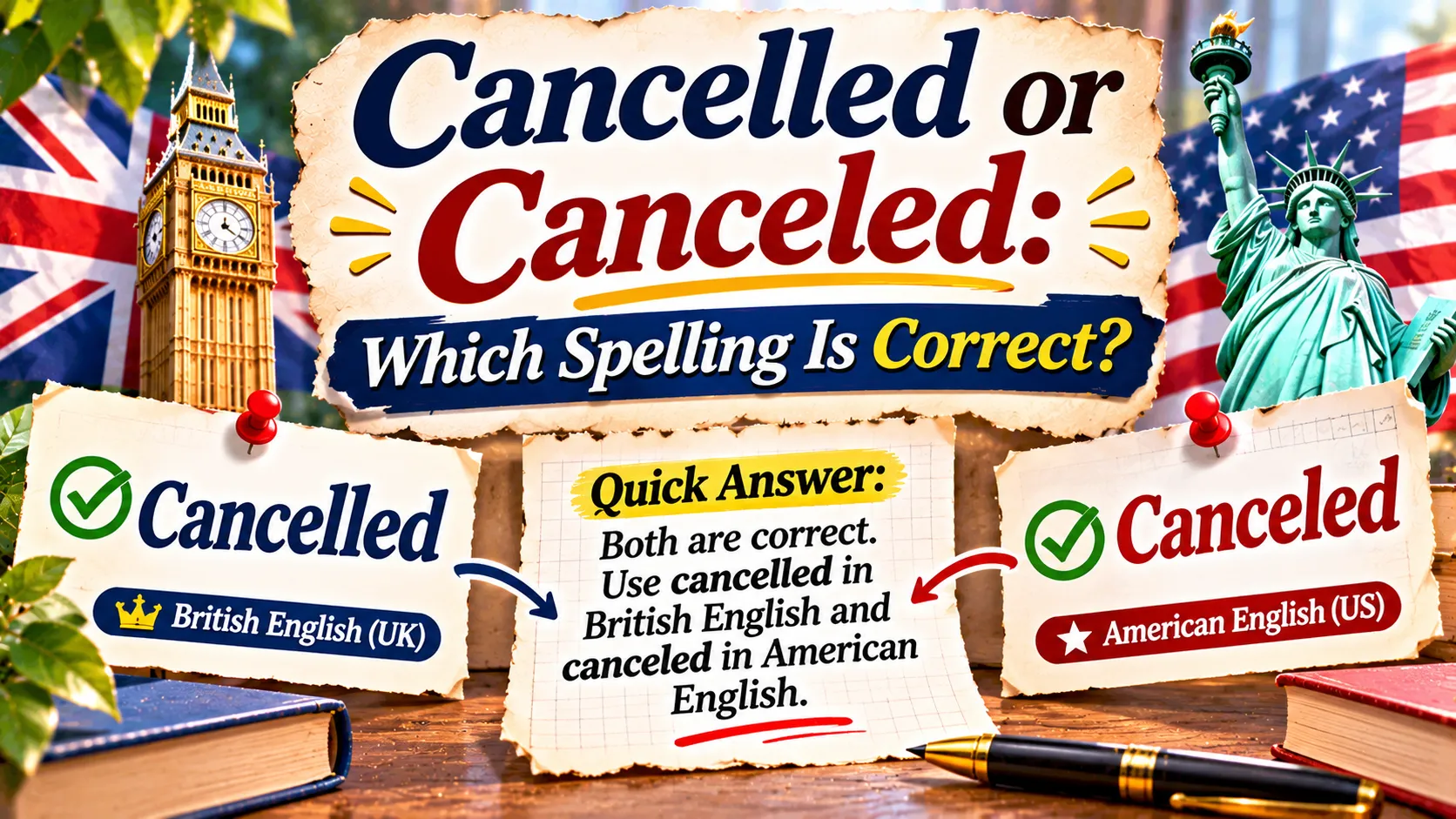
Have you ever wondered whether to write cancelled or canceled? Both spellings are correct, but your choice depends on the type of English you use. American English prefers canceled with one L, while British English generally uses cancelled with two Ls.
The difference often confuses writers because both versions share the same meaning and pronunciation. Whether you write emails, blog posts, business documents, or social media updates, understanding this spelling difference will help you choose the correct form. Let’s explore the meanings, grammar rules, examples, and other related words.
Cancelled vs. Canceled: The Main Difference 🔍
The main difference between cancelled and canceled comes from regional spelling conventions. American English usually drops the extra L, while British English keeps it when forming the past tense and past participle of cancel.
- Canceled: Preferred American English spelling.
- Cancelled: Preferred British English spelling.
Both words describe an action that stopped a planned event, service, arrangement, or activity.
American English: The airline canceled our flight.
British English: The airline cancelled our flight.
Neither spelling is wrong. Choose the version that matches your audience and maintain consistency throughout your writing.
What Does Canceled Mean? 🇺🇸
Canceled is the American English spelling of the past tense and past participle of the verb cancel. People use it when someone stops an event, appointment, reservation, order, or planned activity.
American dictionaries and style guides generally prefer one L in canceled. This spelling also follows the American convention for several related forms, including canceling.
Examples:
- The school canceled classes because of heavy snow.
- We canceled our hotel reservation yesterday.
- She canceled the meeting at the last minute.
- The company canceled its annual event.
- I canceled my subscription last week.
What Does Cancelled Mean? 🇬🇧
Cancelled is the British English spelling of the past tense and past participle of cancel. Writers in the United Kingdom and many other English-speaking regions commonly use this double-L form.
British English generally keeps the second L when adding endings to cancel. Therefore, writers commonly use cancelled and cancelling in British publications and documents.
Examples:
- The concert was cancelled because of the weather.
- They cancelled their dinner reservation.
- The manager cancelled the appointment.
- The school cancelled the outdoor event.
- We cancelled our travel plans.
Why Does American English Use Canceled and British English Use Cancelled? 📚
American and British English follow different spelling conventions for certain words. One major difference involves verbs that end in a single vowel followed by a consonant.
British English often doubles the final consonant when adding endings such as -ed and -ing. American English does not always follow that pattern, especially with words such as cancel.
For example:
| American English | British English |
|---|---|
| Canceled | Cancelled |
| Canceling | Cancelling |
| Traveled | Travelled |
| Traveling | Travelling |
| Labeled | Labelled |
| Labeling | Labelling |
| Modeled | Modelled |
| Modeling | Modelling |
These differences reflect established regional spelling preferences. Neither convention makes the other incorrect.
Canceling or Cancelling: Which Spelling Is Correct? ✍️
The same regional spelling difference applies to canceling and cancelling.
Canceling is the preferred American English spelling. Cancelling is the preferred British English spelling. Both forms describe the act of stopping or ending a planned arrangement.
American English examples:
- I am canceling my gym membership.
- The company is canceling several appointments.
- She considered canceling her trip.
British English examples:
- I am cancelling my gym membership.
- The company is cancelling several appointments.
- She considered cancelling her trip.
Remember this simple rule: American English usually uses one L, while British English usually uses two.
Cancel vs. Canceled vs. Cancelling: Understanding the Grammar 📝
The verb cancel changes its form depending on the tense and grammatical structure of a sentence. Understanding these forms helps you avoid spelling and grammar mistakes.
| Word | Grammar | Example |
|---|---|---|
| Cancel | Base verb | I need to cancel the appointment. |
| Cancels | Present tense | She cancels unnecessary meetings. |
| Canceled | American past tense | He canceled the order. |
| Cancelled | British past tense | He cancelled the order. |
| Canceling | American -ing form | We are canceling the event. |
| Cancelling | British -ing form | We are cancelling the event. |
The word canceled or cancelled can also function as a past participle with helping verbs.
Examples:
- They have canceled the reservation.
- She had cancelled the meeting.
- The airline has canceled several flights.
When Should You Use Canceled or Cancelled? 🎯
Your audience should determine which spelling you choose. If you write for American readers, use canceled. If you write for British readers, use cancelled.
Choose canceled when:
- You write American English blog posts.
- Your audience primarily lives in the United States.
- You prepare American business documents.
- You follow American editorial style guides.
- You want consistency with American spellings such as traveled and labeled.
Choose cancelled when:
- You write for readers in the United Kingdom.
- You follow British English conventions.
- Your publication uses British spelling.
- You write for audiences that prefer double-L spellings.
For international websites, choose one spelling convention and apply it consistently. Mixing both forms in the same article can make your writing look inconsistent.
Common Mistakes to Avoid ⚠️
Writers sometimes confuse regional spelling differences with grammar errors. Keep these points in mind when using canceled and cancelled.
Mistake 1: Treating one spelling as incorrect
Both canceled and cancelled are correct. They simply follow different regional conventions.
Mistake 2: Mixing American and British spelling
Avoid using canceled in one paragraph and cancelled in another unless you discuss the spelling difference itself.
Mistake 3: Forgetting the related -ing form
American English prefers canceling, while British English prefers cancelling.
Mistake 4: Confusing spelling with pronunciation
Both words have the same pronunciation. The extra L in the British spelling does not create a different sound.
Frequently Asked Questions About Cancelled or Canceled ❓
Is canceled or cancelled correct?
Both spellings are correct. American English prefers canceled, while British English generally prefers cancelled.
Is canceled American or British English?
Canceled is the standard American English spelling. It uses one L before the -ed ending.
Is cancelled British or American English?
Cancelled is the preferred British English spelling. It uses two Ls before the -ed ending.
Why does canceled have one L in American English?
American English spelling conventions generally avoid doubling the final L in words such as cancel when adding -ed or -ing. Therefore, Americans write canceled and canceling.
Is canceling or cancelling correct?
Both are correct. American English uses canceling, while British English generally uses cancelling.
Does canceled have one L or two?
Canceled has one L after the A and before the E in its spelling. Cancelled has two consecutive Ls.
How do you spell canceled in the USA?
In the United States, write canceled with one L. For example: “The airline canceled my flight.”
How do you spell cancelled in the UK?
In the United Kingdom, write cancelled with two Ls. For example: “The airline cancelled my flight.”
Do canceled and cancelled sound different?
No. Both spellings have the same pronunciation and meaning. Only the written form changes.
Which spelling should I use for a US audience?
Use canceled when writing for a US audience. Also choose American forms such as canceling, traveled, and labeled to maintain consistency.
Conclusion 🌟
The choice between cancelled or canceled depends on your preferred English spelling convention. American English uses canceled with one L, while British English generally uses cancelled with two Ls. Both spellings communicate the same meaning and pronunciation.
If you write for an American audience, choose canceled and canceling. If you target British readers, use cancelled and cancelling. Once you select a spelling style, maintain it throughout your writing to keep your content clear and consistent.

Olivia Bennett is a writer and language enthusiast at Vocabsteria. She is passionate about exploring word meanings, name origins, and cultural expressions from around the world.