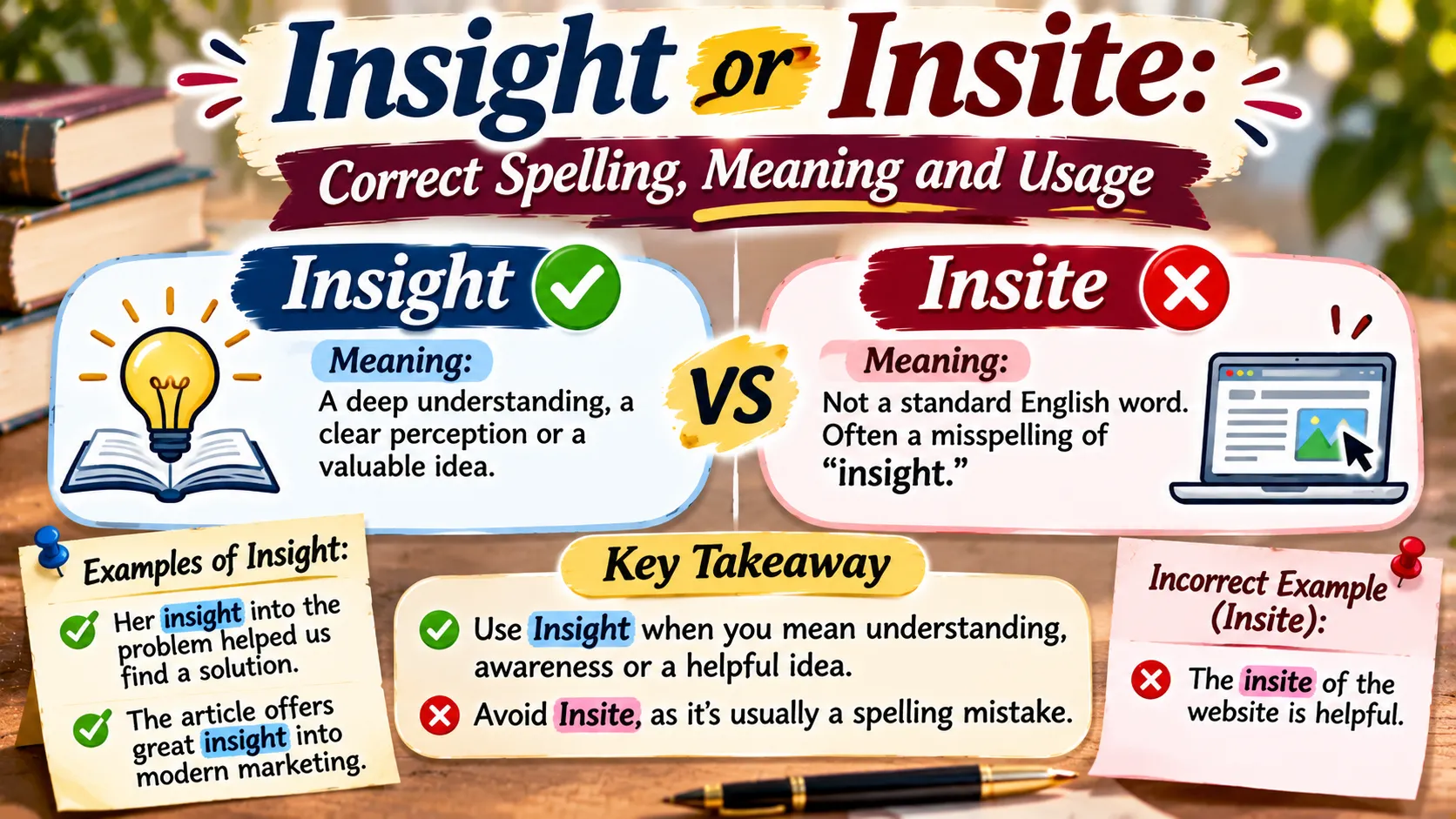
Insight or insite is a common spelling confusion because both words sound almost identical when spoken. However, they do not have the same usage. If you want to describe a person’s understanding, awareness, or ability to recognize something clearly, the correct word is insight. The spelling insite is generally incorrect when used with this meaning.
English has many confusing word pairs that sound similar but have different spellings and purposes. Sometimes, a small spelling mistake can change the clarity of an entire sentence. That is why learning the difference between insight and insite can help you improve your writing, communication, and vocabulary.
In this guide, you will discover the meaning of insight, whether insite is a real word, how to use both spellings correctly, and which examples can help you remember the difference. We will also explore synonyms, common spelling mistakes, and practical tips for choosing the right word in everyday English.
🔍 Insight or Insite: Which Spelling Is Correct?
Insight is the correct spelling when you want to describe deep understanding, awareness, or the ability to recognize the true nature of something. Insite is generally a spelling mistake when someone intends to use the noun insight.
Although both spellings sound similar, only insight is the standard English word for a clear or deeper understanding.
- Insight: Correct spelling for understanding or awareness.
- Insite: Usually an incorrect spelling of insight.
- Insights: Correct plural form of insight.
- Insightful: An adjective describing someone or something that shows deep understanding.
Examples:
- Correct: Her experience gave her valuable insight into the industry.
- Incorrect: Her experience gave her valuable insite into the industry.
- Correct: The report provides useful insights into customer behavior.
- Incorrect: The report provides useful insites into customer behavior.
Remember to use insight whenever you discuss knowledge, understanding, or perception.
📖 What Does Insight Mean?
Insight is a noun that refers to a deep understanding of a person, situation, subject, or problem. It describes the ability to recognize something that may not be immediately obvious.
A person gains insight through experience, observation, learning, research, or careful thinking. It can also describe useful information that helps someone understand a complicated topic.
For example, a teacher may provide insight into a difficult lesson, while a business report may offer insight into customer preferences.
Examples of insight in sentences:
- Her experience gave her insight into the challenges of running a business.
- The documentary offers valuable insight into wildlife conservation.
- His comments provided a fresh insight into the problem.
- Reading different books can improve your insight into human behavior.
- The meeting gave us a better insight into the company’s goals.
- My conversation with the manager offered useful insight into the decision.
Insight does not simply mean having information. It often involves understanding what that information means and how it connects to a larger situation.
❌ What Does Insite Mean?
Insite is generally not the correct spelling when you want to describe understanding or awareness. Most people who write insite actually intend to use the word insight.
For example, writing “I gained valuable insite from the meeting” is incorrect in standard English. The correct sentence is “I gained valuable insight from the meeting.”
However, Insite may appear as a company name, brand name, product name, or other proper noun. Such uses do not make it an alternative spelling of the standard English word insight.
Incorrect examples:
- The article provides useful insite into education.
- I need more insite before making a decision.
- Her presentation gave us a new insite into the topic.
Correct versions:
- The article provides useful insight into education.
- I need more insight before making a decision.
- Her presentation gave us new insight into the topic.
⚖️ Insight vs. Insite: Key Differences
The main difference between insight and insite is their spelling and standard usage. Insight is an established English noun, while insite is generally an incorrect spelling when referring to understanding.
| Feature | Insight | Insite |
|---|---|---|
| Standard English word | Yes | Not for this meaning |
| Part of speech | Noun | Usually a proper name when used |
| Meaning | Deep understanding or awareness | No standard meaning as a synonym of insight |
| Correct spelling | Yes | No, when meaning understanding |
| Plural form | Insights | Depends on proper-name usage |
| Example | She shared valuable insight. | Incorrect: She shared valuable insite. |
Easy rule: Whenever you mean understanding, awareness, perception, or knowledge gained through experience, write insight.
✍️ How to Use Insight in a Sentence
Insight works naturally in conversations, academic writing, business communication, professional reports, and everyday discussions. You can use it when explaining what someone understands or what information helps reveal about a subject.
Here are several examples showing how to use insight correctly.
- The teacher gave us valuable insight into the subject.
- Her research provides insight into climate change.
- I gained new insight after reading the book.
- The interview offered an interesting insight into his career.
- His experience gives him insight into customer needs.
- The article provides insight into modern technology.
- We need more insight before making a final decision.
- Her observations revealed an important insight.
- The discussion helped me develop a deeper insight into the issue.
- This study offers useful insights into human behavior.
Notice that insight often appears with words such as valuable, useful, fresh, deep, important, and new.
🧠 What Is the Difference Between Insight and Understanding?
Insight and understanding are closely related, but they do not always mean exactly the same thing.
Understanding generally refers to knowing what something means or how it works. Insight often goes further by describing the ability to recognize deeper connections, hidden reasons, or important details.
For example, you may understand how a business operates without having insight into why its customers prefer one product over another.
| Word | Meaning | Example |
|---|---|---|
| Insight | Deep understanding or perception | Her research gave us insight into the problem. |
| Understanding | Knowledge of a subject or situation | He has a good understanding of mathematics. |
| Awareness | Knowledge that something exists | Public awareness of the issue is growing. |
| Perception | The way someone understands something | Her perception of the situation changed. |
Both words are useful, but insight often emphasizes a deeper level of recognition or discovery.
🔤 Synonyms of Insight
Several English words have meanings similar to insight. You can use these alternatives to make your writing more natural, avoid repetition, and express different levels of understanding.
Here are common synonyms of insight:
- Understanding
- Awareness
- Perception
- Comprehension
- Realization
- Knowledge
- Wisdom
- Discernment
- Recognition
- Intuition
- Clarity
- Interpretation
- Observation
- Intelligence
- Acumen
- Judgment
- Perspective
- Consciousness
- Expertise
- Appreciation
Example sentences using synonyms:
- Her awareness of the situation helped the team.
- The professor has a deep understanding of the subject.
- His perception of the problem was different from ours.
- The research led to an important realization.
- Experience often develops wisdom and good judgment.
Choose a synonym according to the meaning you want to express. For example, perception emphasizes how someone interprets something, while wisdom often suggests knowledge gained through experience.
📚 Common Phrases That Use Insight
Insight appears in many everyday and professional expressions. Learning these phrases can help you use the word more naturally.
| Phrase | Meaning | Example |
|---|---|---|
| Valuable insight | Useful understanding | The report provides valuable insight. |
| Deep insight | Thorough understanding | She has deep insight into the topic. |
| Fresh insight | A new perspective | The discussion offered fresh insight. |
| Gain insight | Develop understanding | We gained insight from the research. |
| Provide insight | Offer useful understanding | The expert provided insight into the issue. |
| Insight into | Understanding of something | He has insight into human behavior. |
| Business insight | Understanding of business matters | The analysis offers business insight. |
| Customer insight | Understanding customer needs | The company studies customer insight. |
| Personal insight | Understanding of oneself | The experience gave her personal insight. |
| Valuable insights | Multiple useful observations | The interviews revealed valuable insights. |
These expressions are particularly useful in articles, presentations, reports, and professional conversations.
🚫 Common Mistakes When Using Insight or Insite
Spelling confusion often happens because people focus on pronunciation rather than the correct written form. Since insight and insite sound similar, writers may accidentally replace the correct spelling with the incorrect one.
Avoid these common mistakes:
- Writing insite instead of insight when discussing understanding.
- Using insites as the plural of insight instead of insights.
- Confusing insight with information, even though the words have slightly different meanings.
- Assuming that insight and understanding are interchangeable in every sentence.
- Forgetting that insightful is the adjective form of insight.
- Using insight when you actually mean an opinion or personal preference.
Incorrect: The presentation gave me valuable insite.
Correct: The presentation gave me valuable insight.
Incorrect: We discovered several interesting insites.
Correct: We discovered several interesting insights.
Incorrect: She is an insight person.
Correct: She is an insightful person.
Paying attention to these differences will make your writing clearer and more professional.
💡 How to Remember the Correct Spelling of Insight
A simple memory trick can help you avoid confusing insight with insite.
The word insight contains the word sight, which relates to seeing. Think of insight as the ability to see or understand something more clearly.
You can remember the spelling with these tips:
- Think of sight: Insight contains the complete word sight.
- Connect it with understanding: Insight means seeing beyond the obvious.
- Remember the gh: The correct spelling includes the letters g and h.
- Learn related words: Practice insight, insights, and insightful together.
- Read examples: Seeing the correct spelling in sentences helps build familiarity.
For example, remember this sentence: “Her insight helped me see the problem clearly.”
This connection between sight and understanding makes the correct spelling easier to remember.
❓ Frequently Asked Questions About Insight or Insite
Is insight or insite correct?
Insight is the correct standard English spelling when referring to deep understanding, awareness, or perception. Insite is generally a misspelling of insight in this context.
Is insite a real English word?
Insite may appear as a proper name, brand, or specialized term. However, it is not the standard English word for understanding or awareness.
What is the meaning of insight?
Insight means the ability to understand something deeply or recognize important details that may not be immediately obvious.
What is the plural of insight?
The plural form of insight is insights. For example, “The report provides several useful insights into customer behavior.”
Is insight a noun or an adjective?
Insight is a noun. The related adjective is insightful, which describes someone or something that demonstrates deep understanding.
What is another word for insight?
Common synonyms include understanding, awareness, perception, comprehension, realization, wisdom, and discernment.
How do you use insight in a sentence?
You can write, “Her experience gave her valuable insight into the business.” This sentence shows how insight describes deeper understanding gained through experience.
Is insight the same as knowledge?
Not exactly. Knowledge refers to information or facts someone has learned, while insight involves understanding the deeper meaning or connections behind that information.
Why do people confuse insight and insite?
People often confuse these spellings because they sound similar when spoken. However, only insight is the standard spelling for the noun meaning understanding or awareness.
What is the difference between insight and insightful?
Insight is a noun that means deep understanding, while insightful is an adjective that describes someone or something showing deep understanding. For example, “She shared valuable insight” and “She gave an insightful explanation.”
🎯 Conclusion: Choose Insight, Not Insite
When comparing insight or insite, remember that insight is the correct spelling for deep understanding, awareness, or perception. It describes the ability to recognize important information and understand something beyond its surface meaning.
Insite is generally incorrect when used with this meaning, although it may appear in brand names or other specialized contexts. You can avoid this spelling mistake by remembering that insight contains the word sight.
Use insight in your everyday writing, professional communication, academic work, and conversations whenever you want to describe deeper understanding. Its related forms, insights and insightful, will also help you express your ideas more clearly.

Olivia Bennett is a writer and language enthusiast at Vocabsteria. She is passionate about exploring word meanings, name origins, and cultural expressions from around the world.