Have you ever looked at your mood ring and wondered what its changing colors mean? Mood ring color meanings have fascinated people for decades because these colorful accessories appear to reflect emotions through beautiful shades of blue, green, purple, yellow, and black. Each color is traditionally associated with a different emotional state, such as happiness, relaxation, excitement, nervousness, or stress. Whether your ring turns deep blue during a peaceful afternoon or changes to purple while you’re enjoying an exciting moment, its colors can make you curious about what is happening inside your body.
Mood rings became popular during the 1970s and remain an interesting fashion accessory today. They contain temperature-sensitive materials that change color when the temperature of your finger changes. Although people traditionally connect these colors with specific feelings, mood rings do not directly detect emotions. Instead, they respond to physical temperature changes that may sometimes accompany emotional reactions. This means their color chart should be treated as an entertaining guide rather than a scientific emotional assessment.
In this complete guide, you’ll discover the meanings of every common mood ring color, including blue, green, purple, pink, yellow, orange, brown, gray, and black. You’ll also learn how mood rings work, why their colors change, what different shades traditionally represent, and whether you can trust their readings.
⚡ Quick Answer: What Do Mood Ring Colors Mean?
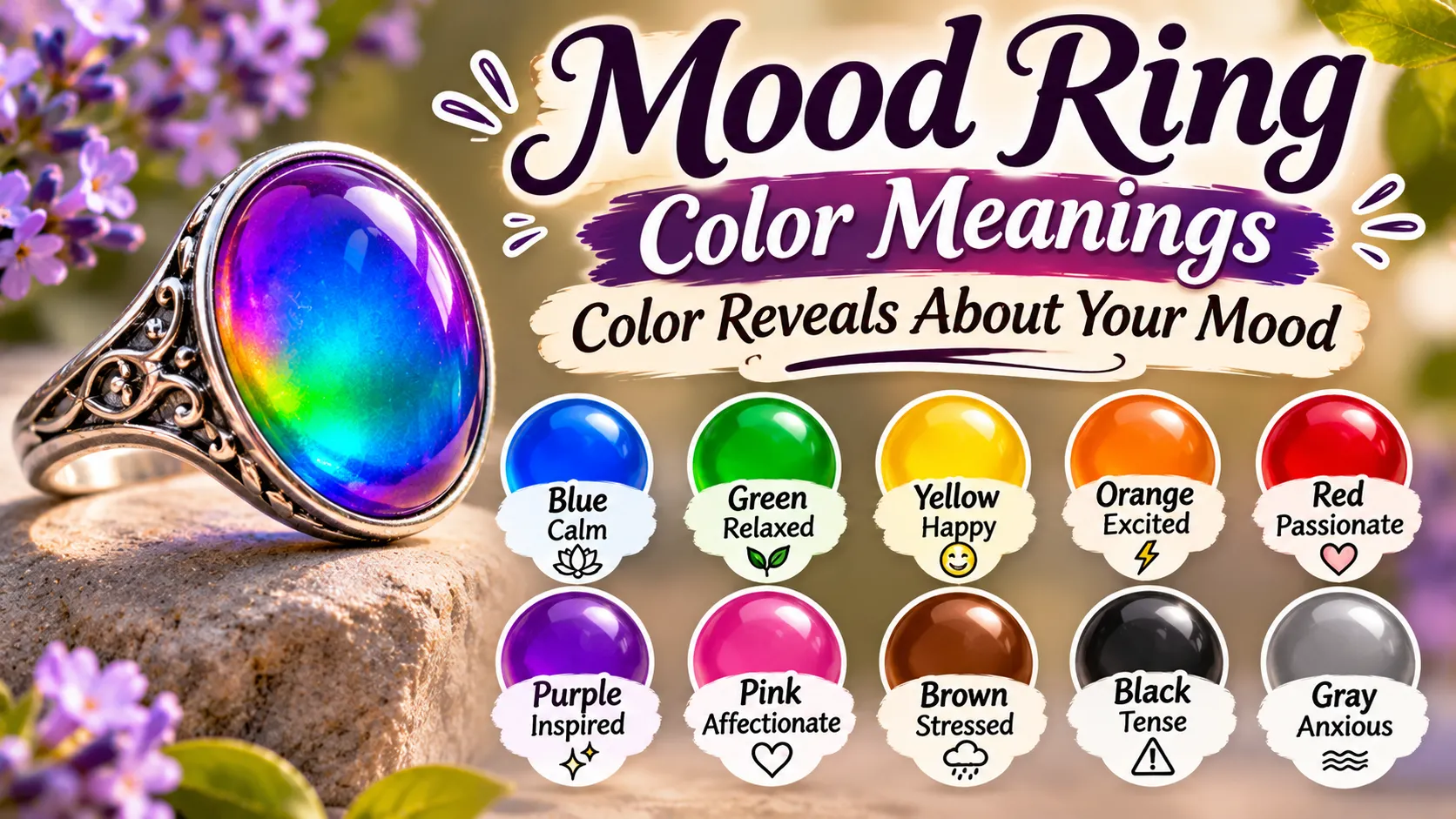
Mood ring colors are traditionally associated with different emotions and feelings. Blue commonly represents calmness and relaxation, green suggests balance or a neutral mood, purple symbolizes passion or excitement, and yellow is often associated with nervousness or alertness. Darker shades, such as brown, gray, and black, are traditionally connected with tension, uneasiness, or cooler skin temperatures.
However, these interpretations are not universal. Different manufacturers may use different temperature ranges and color charts.
| Mood Ring Color | Traditional Mood Meaning | General Interpretation |
|---|---|---|
| Black ⚫ | Stress, tension, or discomfort | Cold or inactive ring |
| Gray 🩶 | Nervousness or uncertainty | Uneasy or cool state |
| Brown 🟤 | Restlessness or anxiety | Unsettled feelings |
| Yellow 🟡 | Nervousness or curiosity | Alert or changing state |
| Orange 🟠 | Excitement or emotional energy | Restlessness or stimulation |
| Green 🟢 | Balance or normal feelings | Neutral or comfortable state |
| Blue-Green 🩵 | Relaxation and comfort | Increasing calmness |
| Blue 🔵 | Happiness and relaxation | Calm and content |
| Dark Blue 💙 | Deep relaxation or affection | Warm and comfortable |
| Purple 🟣 | Passion, excitement, or romance | Strong emotional energy |
| Pink 🩷 | Affection or playfulness | Warm or affectionate feelings |
| Red 🔴 | Excitement or intense emotions | Energetic or stimulated state |
🌈 Complete Mood Ring Color Meanings Chart
A mood ring color chart helps you understand the traditional emotional interpretations associated with different shades. Although the exact meanings may vary by manufacturer, many traditional charts follow a similar pattern, connecting cooler colors with certain emotional states and warmer colors with others.
The chart below covers the most commonly discussed colors and their symbolic interpretations. Remember that your ring responds to temperature, so its color does not confirm how you actually feel.
| Color | Traditional Meaning | Common Emotional Association |
|---|---|---|
| Black | Stressed or tense | Discomfort, pressure |
| Gray | Nervous or uncertain | Anxiety, hesitation |
| Brown | Uneasy or restless | Worry, mixed feelings |
| Amber | Nervous or unsettled | Tension, alertness |
| Yellow | Curious or anxious | Mental activity, uncertainty |
| Orange | Excited or restless | Energy, enthusiasm |
| Green | Normal or balanced | Calmness, stability |
| Blue-Green | Relaxed | Comfort, peace |
| Blue | Happy or calm | Contentment, relaxation |
| Dark Blue | Very relaxed | Affection, peacefulness |
| Purple | Passionate or excited | Romance, inspiration |
| Pink | Affectionate or playful | Warmth, excitement |
| Red | Energetic or intense | Stimulation, excitement |
| White | Varies by product | May indicate damage or a temperature outside the ring’s normal range |
🔵 What Does Blue Mean on a Mood Ring?
Blue is one of the most popular mood ring colors and traditionally represents happiness, calmness, relaxation, and emotional comfort. When your mood ring turns blue, it traditionally suggests that you feel peaceful, content, or comfortable.
People often associate blue with positive emotions because they connect this color with clear skies, peaceful surroundings, and calm water. Traditional mood ring charts also link blue shades to comfortable finger temperatures.
Traditional blue mood ring meanings include:
- Happiness
- Relaxation
- Calmness
- Contentment
- Emotional comfort
- Peacefulness
- Confidence
- Positive feelings
- Satisfaction
- Inner balance
Example: If your mood ring changes to blue while you’re relaxing at home, its traditional chart may interpret the color as a sign of calmness and comfort.
Keep in mind that blue does not prove you’re happy. A warmer finger temperature can produce this color even when your emotional state has not changed.
💙 What Does Dark Blue Mean on a Mood Ring?
Dark blue is traditionally associated with deep relaxation, affection, romantic feelings, and emotional comfort. It is often considered a warmer shade than ordinary blue on traditional mood ring charts.
People commonly connect dark blue with peacefulness and a strong sense of contentment. It may appear when your finger becomes warmer, although the exact temperature depends on the ring’s design.
Traditional dark blue meanings include:
- Deep relaxation
- Affection
- Romantic feelings
- Happiness
- Emotional security
- Peacefulness
- Contentment
- Warmth
- Comfort
- Satisfaction
Dark blue is sometimes described as a sign of being deeply relaxed or emotionally comfortable. However, it is not a reliable measurement of love, happiness, or romantic attraction.
🟢 What Does Green Mean on a Mood Ring?
Green is commonly considered the neutral or balanced color on traditional mood ring charts. It is often associated with normal feelings, emotional stability, calmness, and a comfortable state.
Many traditional mood rings are designed to display green around their middle temperature range. This is why green is frequently described as the baseline color of a mood ring.
Traditional green mood ring meanings include:
- Balance
- Normal emotions
- Calmness
- Stability
- Comfort
- Contentment
- Emotional neutrality
- Relaxation
- Steadiness
- Peace of mind
For example, if your ring turns green while you’re reading, working, or enjoying a quiet afternoon, the traditional interpretation may suggest a balanced or relaxed state.
Green does not necessarily mean that nothing is happening emotionally. It simply represents a particular temperature range that traditional charts associate with neutral feelings.
🩵 What Does Blue-Green Mean on a Mood Ring?
Blue-green, also known as turquoise or teal, traditionally represents relaxation, emotional comfort, and peace of mind. Many mood ring color charts place this shade between blue and green.
This color often suggests growing calmness or contentment. Your mood ring may display blue-green when your finger temperature rises toward a warmer range.This color often suggests growing calmness or contentment. Your mood ring may display blue-green when your finger temperature rises toward a warmer range.This shade is often interpreted as a sign of increasing calmness or contentment. It may appear when the temperature of your finger moves toward a warmer range.
Traditional blue-green meanings include:
- Relaxation
- Comfort
- Peacefulness
- Emotional balance
- Contentment
- Calm energy
- Satisfaction
- Ease
- Positive feelings
Blue-green can be a beautiful transitional shade, especially when your ring gradually changes from green to blue.
🟣 What Does Purple Mean on a Mood Ring?
Purple is traditionally connected with passion, excitement, romance, creativity, and strong emotional energy. It is often considered one of the warmer colors on traditional mood ring charts.
Many people associate purple with imagination, mystery, luxury, and intense feelings. When a mood ring displays purple, its traditional interpretation may suggest excitement or romantic emotions.
Traditional purple mood ring meanings include:
- Passion
- Romance
- Excitement
- Creativity
- Inspiration
- Affection
- Imagination
- Emotional intensity
- Enthusiasm
- Happiness
For example, if your ring turns purple while you’re enjoying a special occasion, a traditional chart might describe the shade as passionate or excited.
However, purple does not automatically mean you’re in love or experiencing intense emotions. It simply reflects a temperature-related color change.
🩷 What Does Pink Mean on a Mood Ring?
Pink is often associated with affection, happiness, tenderness, excitement, and playful feelings. It is a softer color that traditionally represents warmth and positive emotional energy.
Some modern mood rings include pink in their color range, while older or simpler designs may not display it at all. Its meaning and position on the temperature scale can vary between products.
Traditional pink mood ring meanings include:
- Affection
- Happiness
- Romance
- Playfulness
- Warmth
- Excitement
- Emotional openness
- Tenderness
- Joy
- Positive energy
Pink is sometimes interpreted as a sign of affection or a cheerful emotional state. If your ring displays this shade, you can enjoy its traditional meaning without treating it as a definite reading of your feelings.
🟡 What Does Yellow Mean on a Mood Ring?
Yellow is commonly associated with nervousness, curiosity, alertness, uncertainty, and mental activity. It may represent a state in which someone feels restless or emotionally stimulated according to traditional interpretations.
Yellow is also associated with sunshine, energy, creativity, and attention. Depending on the ring’s chart, it may have a slightly different emotional meaning.
Traditional yellow mood ring meanings include:
- Nervousness
- Curiosity
- Alertness
- Uncertainty
- Mental activity
- Restlessness
- Excitement
- Mixed feelings
- Caution
- Emotional stimulation
For example, a traditional mood ring chart might associate yellow with feeling nervous before an important presentation.
Remember that yellow does not confirm anxiety. Changes in room temperature, finger temperature, and the ring’s material can also produce this shade.
🟠 What Does Orange Mean on a Mood Ring?
Orange is traditionally associated with excitement, restlessness, enthusiasm, and heightened energy. It is often interpreted as a sign of emotional stimulation or an active state of mind.
Because orange sits between yellow and red on the visible color spectrum, people sometimes associate it with a combination of curiosity, energy, and excitement.
Traditional orange mood ring meanings include:
- Excitement
- Enthusiasm
- Restlessness
- Energy
- Creativity
- Nervous excitement
- Emotional stimulation
- Curiosity
- Activity
- Anticipation
Some charts describe orange as a sign of nervousness, while others associate it with excitement. This difference shows why you should check the chart supplied with your particular ring.
🟤 What Does Brown Mean on a Mood Ring?
Brown is commonly connected with nervousness, discomfort, restlessness, and unsettled feelings. Traditional charts often place it among the cooler or transitional shades.
A brown mood ring may appear when the temperature of your finger moves toward the cooler end of the ring’s range. This can happen because of environmental conditions or changes in blood flow to your hands.
Traditional brown mood ring meanings include:
- Nervousness
- Uneasiness
- Restlessness
- Worry
- Uncertainty
- Discomfort
- Mixed emotions
- Emotional tension
- Insecurity
- Stress
Brown should not automatically be interpreted as a sign of sadness or anxiety. The ring cannot distinguish between different emotions based on temperature alone.
🩶 What Does Gray Mean on a Mood Ring?
Gray is traditionally associated with nervousness, uncertainty, anxiety, and emotional discomfort. It is often considered a cooler shade that appears before a ring turns darker.
Some traditional mood ring charts connect gray with feeling unsettled or overwhelmed. However, the same shade may simply indicate that your finger is cooler.
Traditional gray mood ring meanings include:
- Nervousness
- Anxiety
- Uncertainty
- Uneasiness
- Stress
- Confusion
- Emotional tension
- Hesitation
- Discomfort
- Restlessness
For example, if your mood ring changes to gray while you’re preparing for an important event, its traditional chart may interpret the color as nervousness.
Still, a cool room or cold hands could produce the same result even if you feel perfectly comfortable.
⚫ What Does Black Mean on a Mood Ring?
Black is traditionally associated with tension, stress, discomfort, and nervousness. It is also one of the colors that may appear when a mood ring is not being worn because the ring has cooled down.
A black mood ring does not necessarily mean that someone is angry, sad, or upset. It often indicates that the temperature-sensitive material has reached the cooler end of its range.
Traditional black mood ring meanings include:
- Stress
- Tension
- Nervousness
- Discomfort
- Uneasiness
- Emotional pressure
- Frustration
- Cold hands
- Low temperature
- Inactive ring
If your ring remains black after you remove it, this may simply be because the material is no longer receiving warmth from your finger.
If it stays black even when worn, check whether it is damaged or whether the surrounding temperature is affecting it.
🔴 What Does Red Mean on a Mood Ring?
Red is sometimes associated with excitement, energy, passion, stimulation, and intense emotions. However, not every mood ring includes red in its standard color range.
Some products may display red or reddish shades, while others use orange, pink, or purple for similar temperature ranges. This makes red one of the less standardized mood ring colors.
Traditional red mood ring meanings may include:
- Excitement
- Passion
- Energy
- Romance
- Enthusiasm
- Emotional intensity
- Stimulation
- Confidence
- Strong feelings
- Alertness
If your mood ring displays red, check the manufacturer’s color chart before interpreting its meaning. The shade may have a different position on the temperature scale depending on the product.
⚪ What Does White Mean on a Mood Ring?
White is not a standard emotional color on every mood ring. Some products may display a pale or white shade, while others may use white to represent a temperature outside the material’s usual color range.
In certain cases, a faded, cloudy, or permanently white appearance may indicate damage or deterioration. The meaning depends on the ring’s construction and the manufacturer’s instructions.
Possible traditional or product-specific interpretations include:
- A very cool temperature
- A very warm temperature
- A color outside the normal range
- A pale transitional shade
- A damaged or faded mood stone
Do not assume white has one universal emotional meaning. Check the instructions that came with your ring.
🔬 How Do Mood Rings Work?
Mood rings work through temperature-sensitive materials called thermochromic liquid crystals. These materials change the way they reflect light when their temperature changes, causing the ring to display different colors.
When you wear a mood ring, the material inside its decorative stone responds to the temperature of your finger. As your skin becomes warmer or cooler, the liquid crystals change their structure and produce a different visible color.
This process explains why the ring can change colors even when you do not experience an obvious emotional shift.
Here is how the process works:
- Finger temperature changes: Your skin temperature naturally rises and falls throughout the day.
- The ring responds to heat: Temperature-sensitive liquid crystals react to the warmth of your finger.
- The crystals change their structure: Their molecular arrangement changes as the temperature changes.
- Light reflection changes: The altered structure reflects different wavelengths of light.
- A new color appears: The ring displays a different shade based on its temperature range.
Mood rings became popular in the 1970s because people enjoyed the idea of wearing jewelry that appeared to reveal their emotions. Today, they remain popular as novelty accessories, gifts, and conversation starters.
❤️ Do Mood Rings Really Detect Your Emotions?
No. Mood rings do not directly detect emotions or measure psychological states. They respond to changes in skin temperature, which can sometimes accompany emotional reactions.
For example, nervousness may affect blood flow to the fingers, potentially making them cooler. Relaxation may be associated with warmer hands in some situations. However, many other factors can influence finger temperature.
These include:
- Room temperature
- Weather conditions
- Blood circulation
- Physical activity
- Hand movement
- Stress responses
- Holding warm or cold objects
- Individual body temperature differences
This means a person can feel happy while wearing a black mood ring or feel nervous while wearing a blue one.
A mood ring is best treated as entertaining jewelry rather than a scientific instrument for understanding emotions.
🌡️ Why Does Your Mood Ring Keep Changing Colors?
Mood rings can change colors throughout the day because your finger temperature is constantly affected by internal and external conditions. Even small temperature differences can change the appearance of temperature-sensitive crystals.
For example, your ring may display blue while you’re sitting in a warm room and turn gray when you step outside into cold weather. This does not necessarily mean your emotional state has changed.
Common reasons your mood ring changes colors include:
- Weather changes: Cold outdoor temperatures can cool your fingers and produce darker shades.
- Body temperature: Your finger temperature naturally changes during the day.
- Physical activity: Exercise can affect blood flow and skin temperature.
- Emotional reactions: Some emotional responses can influence circulation and temperature.
- Room conditions: Air conditioning, heating, and sunlight may affect the ring.
- Hand movement: Contact with different surfaces can change the ring’s temperature.
- Ring placement: Different fingers may have slightly different skin temperatures.
These factors explain why mood ring colors can change even when your feelings remain the same.
📊 Mood Ring Colors From Coldest to Warmest
Many traditional mood rings follow a temperature-based color sequence. Although the exact order and calibration differ between products, the general pattern often moves from darker shades toward brighter colors as the material becomes warmer.
| Temperature Position | Common Color | Traditional Interpretation |
|---|---|---|
| Coldest range | Black | Stress or tension |
| Very cool | Gray | Nervousness |
| Cool | Brown | Uneasiness |
| Cool to moderate | Amber or yellow | Alertness or uncertainty |
| Moderate | Green | Neutral or balanced |
| Moderately warm | Blue-Green | Relaxation |
| Warm | Blue | Calmness and happiness |
| Warmer | Dark Blue | Deep relaxation |
| Warmest range | Purple or violet | Passion or excitement |
This sequence is a general illustration, not a universal temperature scale. Some rings use different pigments and may display colors in another order.
💍 What Does It Mean When a Mood Ring Shows Multiple Colors?
A mood ring may sometimes display two or more colors at once. This can happen because different parts of the ring are experiencing slightly different temperatures or because the color-sensitive material is transitioning between shades.
For example, one side of the stone may appear blue while another section looks green. This does not necessarily mean you’re experiencing multiple emotions simultaneously.
Possible reasons for multiple colors include:
- Uneven temperature across the ring.
- Different parts of the stone receiving different amounts of heat.
- A gradual transition between color ranges.
- Variations in the liquid crystal material.
- The design or construction of the mood ring.
Some modern mood jewelry is specifically designed to create multicolor effects. These patterns can be visually attractive, but they should not be interpreted as a precise emotional reading.
🛠️ Why Is Your Mood Ring Always Black?
A mood ring that remains black does not automatically indicate stress or negative emotions. Black commonly appears when the ring is cold, but it may also remain dark if its temperature-sensitive material is damaged.
Here are some possible reasons:
- Cold surroundings: Low temperatures may keep the ring in its darkest color range.
- Cold fingers: Your hands may be cooler than the ring’s normal operating range.
- Inactive crystals: The temperature-sensitive material may have deteriorated.
- Water damage: Moisture can damage some mood ring constructions.
- Old jewelry: Older mood rings may lose their color-changing ability over time.
- Manufacturing differences: Some rings use different color ranges and may display dark shades more frequently.
If the ring never changes color, compare it with the manufacturer’s instructions. Avoid exposing it to water or extreme heat unless the manufacturer specifically says it is safe.
🧪 Are Mood Ring Color Meanings Scientifically Accurate?
Mood ring color meanings are not scientifically established measurements of specific emotions. The technology behind a mood ring is real: temperature-sensitive crystals change their appearance as their temperature changes. However, interpreting those colors as exact emotional states is a different matter.
Skin temperature can be influenced by several factors unrelated to feelings. A cold room, warm drink, physical activity, or changes in circulation can affect the ring’s color.
For this reason, a mood ring cannot reliably determine whether someone is happy, angry, nervous, romantic, or sad.
What mood rings can do:
- Respond to temperature changes.
- Display different colors.
- Provide an interesting visual effect.
- Encourage conversations about emotions.
- Offer a fun accessory for personal style.
What mood rings cannot reliably do:
- Read your thoughts.
- Identify exact emotions.
- Diagnose stress or anxiety.
- Measure happiness or sadness.
- Predict romantic feelings.
- Replace a professional emotional or psychological assessment.
Enjoy the colors as symbolic interpretations rather than scientific facts.
✨ How to Read Your Mood Ring Correctly
If you want to understand your mood ring’s color changes, start by checking the chart provided by its manufacturer. This is important because different rings may use different temperature-sensitive materials and color ranges.
Follow these simple steps:
- Find the original color chart: Check the packaging or instruction booklet.
- Wear the ring comfortably: Place it on a finger where it fits properly.
- Allow it to adjust: Give the ring some time to respond to your finger temperature.
- Observe the color: Notice whether the stone displays one shade or several.
- Compare the chart: Match the color with the manufacturer’s interpretation.
- Consider the surroundings: Think about whether cold weather, heating, or physical activity may affect the result.
- Avoid overinterpreting: Remember that the ring measures temperature rather than emotions.
You can also treat the color as a fun reminder to check in with yourself. Instead of assuming the ring knows how you feel, ask yourself whether you’re relaxed, excited, tired, or stressed.
❓ Frequently Asked Questions About Mood Ring Color Meanings
1. What do the colors on a mood ring mean?
Mood ring colors traditionally represent different emotions. Blue often symbolizes calmness, green suggests balance, and purple represents passion. Yellow commonly indicates nervousness, while black often signals tension or cold temperatures. However, each manufacturer may assign slightly different meanings to these colors.
2. What is the happiest color on a mood ring
Blue is commonly associated with happiness, calmness, and contentment. Dark blue may represent deeper relaxation or affection on traditional charts. However, the ring responds to temperature rather than directly detecting happiness.
3. What does purple mean on a mood ring?
Purple is traditionally associate with passion, romance, excitement, creativity, and strong emotional energy. Some charts interpret it as a sign of intense positive feelings.
4. What does green mean on a mood ring?
Green commonly represents a balanced, neutral, or comfortable emotional state. It is often considere the baseline color on traditional mood ring charts.
5. What does blue mean on a mood ring?
Blue is traditionally associate with relaxation, happiness, calmness, and emotional comfort. It often appears when the temperature-sensitive material reaches a warmer range.
6. What does black mean on a mood ring?
Black is traditionally associate with stress, tension, nervousness, or discomfort. However, it may simply mean that the ring is cold, inactive, or damaged.
7. What does yellow mean on a mood ring?
Yellow is commonly associate with curiosity, nervousness, alertness, and uncertainty. Its exact interpretation depends on the color chart supplied with the ring.
8. What does orange mean on a mood ring?
Orange is often connect with excitement, enthusiasm, restlessness, and emotional stimulation. Some manufacturers may assign it a slightly different meaning.
9. What does brown mean on a mood ring?
Brown is traditionally associate with uneasiness, nervousness, restlessness, and mixed feelings. It can also appear when the ring is in a cooler temperature range.
10. What does gray mean on a mood ring?
Gray is commonly interpreted as a sign of anxiety, uncertainty, nervousness, or discomfort. However, it may simply reflect a cooler finger temperature.
11. What does pink mean on a mood ring?
Pink is often associated with affection, happiness, romance, playfulness, and emotional warmth. Not every mood ring includes pink in its color scale.
12. Can a mood ring show multiple colors at once?
Yes. A mood ring can display multiple colors when different parts of its surface experience different temperatures or when the material is transitioning between shades. This does not mean the ring is detecting several emotions.
13. Why does my mood ring turn black when I take it off?
When you remove a mood ring, it no longer receives warmth from your finger. As it cools down, its temperature-sensitive material may change to black or another dark shade.
14. Do mood rings actually work?
Mood rings work as temperature-sensitive accessories because their materials change color in response to heat. However, they cannot accurately identify specific emotions or determine someone’s psychological state.
15. Can two mood rings show different colors at the same time?
Yes. Different rings may use different liquid crystals, pigments, and temperature ranges. Two people wearing different mood rings may therefore see different colors even under similar conditions.
16. What finger should you wear a mood ring on?
You can wear a mood ring on any finger that feels comfortable. There is no scientifically establishe finger that makes a mood ring more accurate.
17. Do mood rings change color because of body temperature?
Yes. Mood rings respond to changes in the temperature of the finger underneath the stone. This temperature response causes their thermochromic materials to display different colors.
18. Can a mood ring tell if someone is in love?
No. A mood ring cannot identify love or romantic attraction. Purple and dark blue are sometimes associate with romance and affection in traditional charts, but these are symbolic interpretations.
🎯 Conclusion
Understanding mood ring color meanings makes these fascinating accessories even more interesting. Blue traditionally represents happiness and relaxation, while green suggests balance and purple reflects passion or excitement. Yellow often symbolizes nervous energy, and black commonly indicates cooler temperatures or tension. Other shades, such as pink, orange, brown, and gray, also carry traditional interpretations.
However, mood rings do not measure emotions directly. Their temperature-sensitive materials react to changes in your finger temperature, not your actual feelings. Different manufacturers may also provide different color charts. So, enjoy these symbolic interpretations as a fun way to explore mood rings, but don’t treat them as scientifically proven emotional readings. Always check your ring’s original color chart to understand its specific meanings.

Olivia Bennett is a writer and language enthusiast at Vocabsteria. She is passionate about exploring word meanings, name origins, and cultural expressions from around the world.