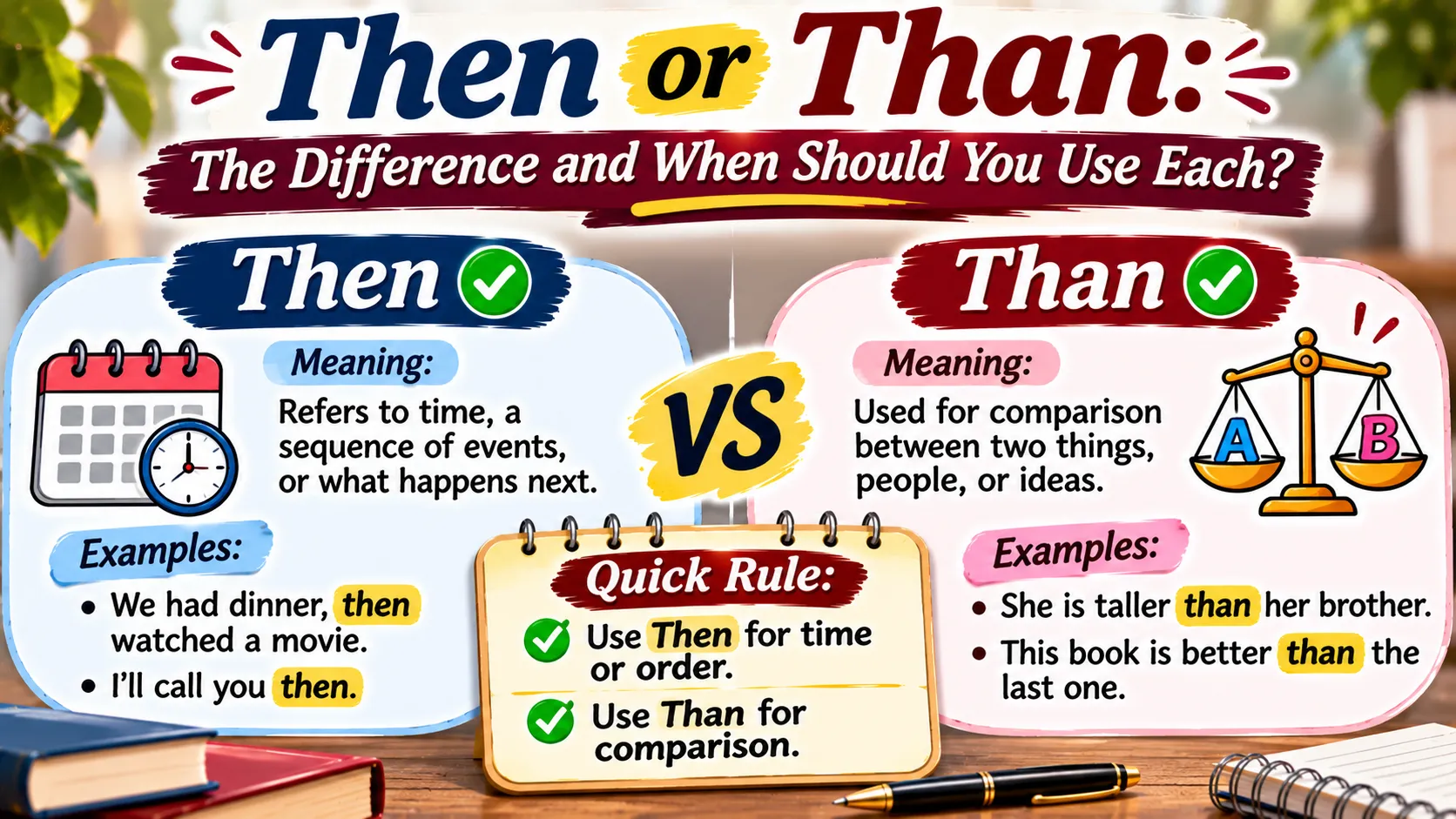
Then or than is a common English grammar confusion because both words look and sound similar. However, they have different meanings and serve different purposes in a sentence. The word then usually refers to time, sequence, or what happens next, while than helps compare two or more people, things, or situations.
Choosing the wrong word can change the meaning of your sentence and make your writing less clear. For example, “I am taller then my brother” is incorrect because the sentence compares two people. The correct version is “I am taller than my brother.”
Understanding when to use then and than can improve your everyday communication, academic writing, emails, and professional content. In this guide, you will learn their definitions, grammatical differences, sentence examples, common mistakes, and easy tricks to remember the correct spelling. You will also find practical exercises to test your understanding.
🔍 Then or Than: Which One Is Correct?
Both then and than are correct English words, but you cannot use them interchangeably. The right choice depends on what you want to communicate.
Use then when you talk about time, order, or the next step in a sequence. Use than when you compare two different things or people.
- Then: Refers to a time, sequence, or consequence.
- Than: Introduces a comparison between people, objects, or situations.
Examples:
- I finished my homework, then I watched television.
- My sister is younger than me.
- We went shopping and then visited a restaurant.
- This book is more interesting than the previous one.
The easiest way to remember the difference is to connect then with time and than with comparison.
📖 What Does Then Mean?
Then is an adverb that usually describes when something happens or the order in which events occur. It can refer to the past, present, or future, depending on the sentence.
You can also use then to describe a result or introduce the next step in a process.
Examples of then in sentences:
- I was living in Chicago then.
- Finish your breakfast, then get ready for school.
- We can discuss the details then.
- She worked as a teacher and then became a writer.
- If you are ready, then we can begin.
- I will call you tomorrow, and then we can make a plan.
- First, open the document. Then, read the instructions.
In each example, then connects an event with a particular time, order, or result.
📚 What Does Than Mean?
Than is a conjunction or preposition used to introduce the second part of a comparison. It helps explain how one person, object, or situation differs from another.
You commonly see than after comparative adjectives and expressions such as better, taller, faster, smaller, more, and less.
Examples of than in sentences:
- My car is faster than yours.
- She is taller than her brother.
- This assignment is easier than the last one.
- I would rather read than watch television.
- Summer is warmer than winter in many places.
- He earns more money than his friend.
- This restaurant is less expensive than the one downtown.
Remember that than usually appears when a sentence compares two things or presents two alternatives.
⚖️ Then vs. Than: Key Differences
The main difference between then and than is their grammatical purpose. Then focuses on time, sequence, or results, while than introduces comparisons.
| Feature | Then | Than |
|---|---|---|
| Part of speech | Adverb | Conjunction or preposition |
| Main purpose | Shows time or sequence | Shows comparison |
| Meaning | At that time, next, or afterward | In comparison with |
| Common usage | Events and instructions | Comparative sentences |
| Example | Eat first, then leave. | She is older than me. |
| Memory trick | Think of time | Think of comparison |
Quick rule: If your sentence answers when or what happens next, use then. If it compares two things, use than.
⏰ When Should You Use Then?
Use then when you want to explain the order of events, refer to a particular time, or show what happens as a result of something else.
Here are the most common situations in which then is appropriate.
To describe the order of events
- I took a shower, then got dressed.
- First, prepare the ingredients, then start cooking.
- She completed her homework and then went outside.
- We visited the museum and then had lunch.
To refer to a particular time
- I was much younger then.
- Things were different back then.
- I lived in New York then.
- We did not know each other back then.
To describe a result
- If you finish your work, then you can relax.
- If it rains, then we will stay indoors.
- If you need help, then contact the support team.
- If everyone agrees, then we can move forward.
To introduce the next step
- Read the question, then choose your answer.
- Save the file, then close the program.
- Turn on the computer, then open your browser.
- Mix the ingredients, then place the mixture in the oven.
📊 When Should You Use Than?
Use than whenever you want to compare two or more people, places, objects, ideas, or situations. It commonly follows comparative words and phrases.
After comparative adjectives
- My house is bigger than yours.
- This road is shorter than the other one.
- Her explanation was clearer than mine.
- The blue dress is prettier than the red one.
After more and less
- This movie is more exciting than the last one.
- He is more experienced than his colleague.
- The second option is less expensive than the first.
- Online shopping is more convenient than visiting several stores.
After better, worse, and other comparisons
- Your idea is better than mine.
- Today’s weather is worse than yesterday’s.
- This restaurant serves better food than that one.
- The new phone works faster than my old device.
When expressing preferences
- I would rather walk than drive.
- She prefers reading than watching television.
- He would rather stay home than go out.
- I would choose honesty than popularity.
✍️ Then or Than Examples in Everyday Sentences
The best way to understand these words is to see how they work in everyday communication. The following examples show the difference in conversations, schoolwork, work situations, and casual writing.
| Sentence | Correct word | Why? |
|---|---|---|
| I will call you ___ . | Then | Refers to a future time. |
| She is smarter ___ her brother. | Than | Compares two people. |
| Finish your lunch, ___ leave. | Then | Shows the order of events. |
| This bag is cheaper ___ that one. | Than | Compares prices. |
| We lived there back ___ . | Then | Refers to the past. |
| He runs faster ___ I do. | Than | Compares speed. |
| First study, ___ take the test. | Then | Shows sequence. |
| This year is better ___ last year. | Than | Compares two periods. |
| I was happier ___ . | Then | Refers to a past time. |
| She is more confident ___ before. | Than | Shows comparison. |
🚫 Common Mistakes When Using Then and Than
Even experienced English writers sometimes confuse then and than. Their similar pronunciation makes it easy to type the wrong word, especially when writing quickly.
Avoid these common mistakes to keep your sentences grammatically correct.
Mistake: Using then for comparisons
Incorrect: My phone is newer then yours.
Correct: My phone is newer than yours.
Mistake: Using than for sequence
Incorrect: We ate dinner than watched a movie.
Correct: We ate dinner, then watched a movie.
Mistake: Using then after comparative words
Incorrect: This question is harder then the previous one.
Correct: This question is harder than the previous one.
Mistake: Using than to describe time
Incorrect: I was living in California than.
Correct: I was living in California then.
Mistake: Confusing preference structures
Incorrect: I would rather sleep than studying.
Correct: I would rather sleep than study.
A useful habit is to reread your sentence and identify whether you are describing time or making a comparison.
🧠 Easy Tricks to Remember Then vs. Than
You do not need to memorize complicated grammar rules to use these words correctly. A few simple memory tricks can help you choose the right spelling every time.
- Then = Time: Both words contain the letter sequence associated with the beginning of time-related thinking. Remember that then often tells you when something happens.
- Than = Comparison: Think of comparison words such as greater than, better than, and more than.
- Check the sentence: Ask yourself whether you are comparing two things or describing an event.
- Look for comparative words: If you see taller, faster, older, better, or more, you will usually need than.
- Look for sequence words: If your sentence includes first, next, afterward, or finally, then may fit naturally.
Remember this simple example:
- I am taller than my brother.
- I finished my work, then I went outside.
🔤 Related Words and Expressions
Learning related expressions can help you understand how then and than fit into everyday English.
| Expression | Meaning | Example |
|---|---|---|
| Back then | At a time in the past | Life was different back then. |
| Since then | From a past time until now | I have improved since then. |
| Every now and then | Occasionally | We visit them every now and then. |
| Better than | More desirable or effective | This option is better than the other. |
| More than | A greater amount or degree | She has more experience than I do. |
| Less than | A smaller amount or degree | The repair cost less than expected. |
| Rather than | Instead of | I would walk rather than drive. |
| Other than | Except for or apart from | No one other than Sarah knew. |
These expressions are useful in both spoken and written English. Pay attention to the meaning of each phrase rather than choosing a word based only on how it sounds.
📝 Then or Than: Practice Quiz
Test your understanding with these simple questions. Choose the correct word for each sentence before checking the answers.
Choose Then or Than:
- My brother is taller ___ me.
- We went to the store and ___ returned home.
- This test is easier ___ the previous one.
- I was much younger back ___.
- She is more creative ___ her classmates.
- Finish your dinner, ___ wash the dishes.
- Today is colder ___ yesterday.
- If you need anything, ___ let me know.
- I would rather read ___ watch television.
- He runs faster ___ his friend.
Answer Key:
- Than
- Then
- Than
- Then
- Than
- Then
- Than
- Then
- Than
- Than
If you answered all ten correctly, you understand the basic difference between then and than. If you missed a few, review the comparison and sequence examples above.
❓ Frequently Asked Questions About Then or Than
Is it then or than?
Both words are correct, but they have different meanings. Use then for time, sequence, or results, and use than when comparing two people or things.
What is the difference between then and than?
Then refers to a time or the order of events. Than introduces a comparison, as in “She is taller than her sister.”
Is it better then or better than?
The correct expression is better than when comparing two things. For example, “This book is better than the previous one.”
Is it more then or more than?
The correct phrase is more than when describing a greater amount or degree. For example, “She has more experience than I do.”
Is it first then or first than?
Use first, then when describing steps or events in order. For example, “First, wash the vegetables, then cut them.”
Is it other then or other than?
The standard expression is other than when you mean except for or apart from something. For example, “I have no plans other than studying.”
Is it rather then or rather than?
Use rather than when expressing a preference or alternative. For example, “I would rather walk than take a taxi.”
Can then and than sound the same?
Yes. In many English accents, then and than sound very similar, which explains why people often confuse their spellings. Their grammatical roles remain different.
What is the opposite of then?
Then does not have one direct opposite. Depending on the context, words such as now, before, or earlier may express a contrasting time.
Can I start a sentence with then?
Yes. You can start a sentence with then when you want to show the next event or refer to a particular time. For example, “Then we decided to take a different route.”
🎯 Conclusion: Remember When to Use Then or Than
Understanding then or than becomes simple when you remember their main purposes. Use then to describe time, sequence, or results, and use than to compare people, objects, or situations.
For example, “I finished my homework, then watched television” describes the order of two events. On the other hand, “My homework was easier than yesterday’s assignment” makes a comparison.
Whenever you feel confused, check the meaning of your sentence. If you are talking about what happened next or when something occurred, choose then. If you are comparing two things, choose than. Practicing these simple rules will help you avoid common spelling mistakes and write clearer English.

Olivia Bennett is a writer and language enthusiast at Vocabsteria. She is passionate about exploring word meanings, name origins, and cultural expressions from around the world.