Have you ever wondered what ancient Celtic knots, spirals, and mysterious symbols really represent? These fascinating designs carry centuries of cultural history, artistic expression, and spiritual tradition. From the famous Trinity Knot to the powerful Triskelion, Celtic symbols continue to capture people’s attention through their intricate patterns and meaningful associations.
Celtic symbols and their meanings reveal fascinating details about ancient Celtic art, Irish heritage, mythology, and religious traditions. Some symbols represent love, strength, protection, and eternal connection, while others reflect nature, creativity, faith, and personal growth. Their stories make them popular choices for tattoos, jewelry, decorations, and meaningful gifts.
In this guide, you’ll explore more than 25 popular Celtic symbols, discover what each design represents, and learn about its historical background. You’ll also understand which meanings come from documented traditions and which interpretations modern culture has developed over time.
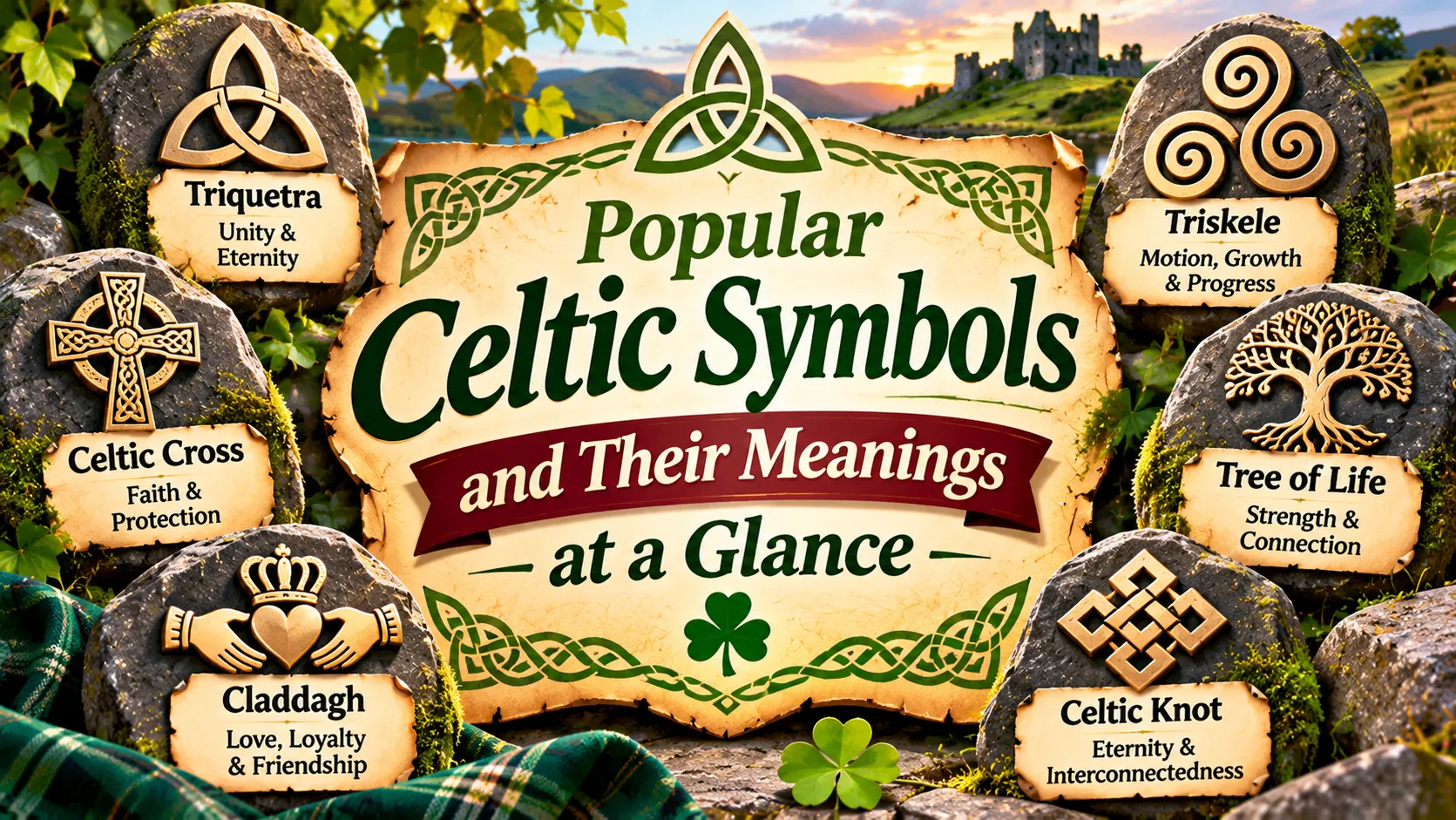
Popular Celtic Symbols and Their Meanings at a Glance 🍀
Celtic artwork features beautiful patterns that appear in ancient monuments, medieval manuscripts, jewelry, and religious objects. Each design has a different background, and its modern interpretation may differ from its original historical purpose.
| Celtic symbol | Commonly associated meaning |
|---|---|
| Triquetra | Threefold unity and eternity |
| Triskelion | Movement, cycles, and progress |
| Celtic Knot | Interconnection and continuity |
| Celtic Cross | Christianity and Celtic heritage |
| Tree of Life | Nature, growth, and connection |
| Claddagh | Love, loyalty, and friendship |
| Shamrock | Ireland and the Holy Trinity |
| Dara Knot | Strength and resilience |
| Celtic Spiral | Movement and transformation |
| Awen | Inspiration and creativity |
| Brigid’s Cross | Protection and Irish tradition |
| Celtic Shield Knot | Protection and strength |
| Five-Fold Symbol | Unity and interconnectedness |
| Celtic Love Knot | Everlasting love |
| Solomon’s Knot | Interconnection and continuity |
| Celtic Sun Symbol | Light and renewal |
| Celtic Moon Symbol | Cycles and transformation |
| Celtic Dragon | Power and mythology |
| Green Man | Nature and renewal |
| Celtic Harp | Irish identity and cultural heritage |
| Celtic Bird | Freedom and spiritual symbolism |
| Celtic Horse | Strength and movement |
| Celtic Boar | Courage and ferocity |
| Celtic Stag | Nature and nobility |
| Celtic Wheel | Cycles and movement |
Triquetra: The Symbol of Threefold Unity 🔺
The Triquetra, often called the Trinity Knot, features three interconnected arcs that form a continuous-looking pattern. Early medieval Christian artists used this design in manuscripts and religious artwork across Ireland and Britain.
Today, many people associate the Triquetra with eternity, unity, and the connection between three elements. Christian traditions often use its three points to represent the Father, Son, and Holy Spirit. Modern spiritual interpretations also connect its design with mind, body, and spirit.
Common meanings:
- Threefold unity
- Eternity and continuity
- Spiritual connection
- The Christian Holy Trinity
- Interconnected relationships
Although people frequently call it a Celtic symbol, the Triquetra does not belong exclusively to ancient Celtic pagan traditions. Its meaning developed across different artistic and religious contexts.
Triskelion: The Symbol of Movement and Progress 🌀
The Triskelion, also known as the Triskele, features three curved arms or spirals that extend from a central point. Ancient artists carved spiral designs into prehistoric monuments, including Ireland’s famous Newgrange passage tomb.
Its original meaning remains uncertain, but its flowing design inspires modern interpretations of movement, progress, transformation, and recurring life cycles. The number three also holds an important place in many later Celtic and Irish traditions.
Common meanings:
- Movement and progress
- Life’s changing cycles
- Personal growth
- Unity and interconnectedness
- Transformation and renewal
The Isle of Man also features a three-legged design called the Three Legs of Mann on its national flag. This related motif makes the three-part design especially recognizable in modern Celtic and Manx heritage.
Celtic Knot: The Symbol of Eternity and Connection ♾️
Celtic knots feature intricate lines that weave over and under one another to create elaborate patterns. Many designs create the appearance of a continuous path without a visible beginning or ending.
Early medieval Irish and British artists used knotwork to decorate illuminated manuscripts, stone crosses, metalwork, and religious objects. The Book of Kells remains one of the most famous examples of this artistic tradition.
Modern audiences often connect Celtic knots with eternity, lasting relationships, unity, and the interconnected nature of life. However, medieval artists did not leave a written explanation for every knot pattern, so we cannot assign one proven meaning to all of them.
Common meanings:
- Eternal connection
- Unity and togetherness
- Interconnectedness
- Continuity and infinity
- Lasting relationships
Today, people choose Celtic knot designs for wedding rings, necklaces, tattoos, and family keepsakes.
Celtic Cross: The Symbol of Faith and Heritage ✝️
The Celtic Cross features a cross with a circular ring around the intersection of its arms. Medieval Christian communities in Ireland and Britain used this distinctive design in stone monuments and religious artwork.
Artists decorated many historic stone crosses with biblical scenes, interlacing patterns, and ornamental details. These monuments now represent an important part of Ireland’s Christian and artistic heritage.
Modern interpretations often connect the circle with eternity, divine love, and spiritual continuity. However, the historical Celtic Cross primarily represents Christian faith and the artistic traditions of medieval Ireland and Britain.
Common meanings:
- Christian faith
- Irish and Celtic heritage
- Spiritual devotion
- Religious tradition
- Eternity and continuity
People continue to choose the Celtic Cross for jewelry, memorials, religious decorations, and heritage-inspired artwork.
Celtic Tree of Life: The Symbol of Growth and Connection 🌳
The Tree of Life features a tree with spreading branches and deep roots, often surrounded by a circular frame. Its design represents the relationship between nature, growth, and the world around us.
Trees played important roles in many historical Celtic communities. People relied on them for food, shelter, building materials, and other natural resources. Irish traditions also gave certain trees special cultural and symbolic importance.
Modern Celtic-inspired artwork often connects the Tree of Life with family, personal development, strength, and the natural world. However, the familiar circular Tree of Life design does not represent one universally documented ancient Celtic symbol.
Common meanings:
- Growth and renewal
- Family connections
- Strength and stability
- Connection with nature
- Balance between different parts of life
People frequently choose the Tree of Life for family jewelry, home decorations, tattoos, and meaningful gifts.
Claddagh: The Symbol of Love, Loyalty, and Friendship ❤️
The Claddagh features two hands holding a heart beneath a crown. This famous Irish design represents three important values: friendship, love, and loyalty.
The symbol takes its name from Claddagh, a fishing village near Galway, Ireland. Irish craftspeople developed Claddagh rings into meaningful pieces of jewelry that people exchange with romantic partners, friends, and family members.
Each part of the design carries a recognizable association. The hands represent friendship, the heart represents love, and the crown represents loyalty.
Common meanings:
- Love and affection
- Friendship and trust
- Loyalty and commitment
- Romantic relationships
- Irish cultural identity
The Claddagh stands out because its history as an Irish jewelry tradition offers a clearer historical background than many modern Celtic-inspired symbols.
Shamrock: The Symbol of Ireland and the Holy Trinity ☘️
The shamrock is a small three-leaf plant that represents Ireland around the world. It appears in Irish cultural celebrations, national imagery, jewelry, and St. Patrick’s Day decorations.
Christian tradition tells the story of St. Patrick using the shamrock’s three leaves to explain the Holy Trinity. This story became an important part of Irish religious and cultural heritage.
People also associate the shamrock with good fortune, national pride, and Irish identity. However, the shamrock differs from the four-leaf clover, which carries its own popular association with luck.
Common meanings:
- Irish heritage
- The Holy Trinity
- Faith and spirituality
- Good fortune
- National pride
Today, the shamrock remains one of the most recognizable symbols of Ireland.
Dara Knot: The Symbol of Inner Strength and Resilience 🌿
The Dara Knot takes inspiration from the oak tree and modern Celtic interlacing designs. Its name comes from the Irish word doire, which means oak grove.
Oak trees have long represented strength and endurance in European cultural traditions. Their deep roots and sturdy trunks inspire modern interpretations of stability, resilience, and personal strength.
However, historians have not established one ancient Dara Knot design with a universally documented meaning. Modern artists and jewelry makers developed its familiar symbolism from oak imagery and traditional knotwork.
Common meanings:
- Inner strength
- Resilience and endurance
- Stability and grounding
- Wisdom and maturity
- Connection with nature
People often choose the Dara Knot for tattoos and jewelry that represent personal strength or the ability to overcome challenges.
Celtic Spiral: The Symbol of Growth and Transformation 🌀
Spiral designs appear among the oldest decorative motifs in prehistoric European art. Ancient artists carved them into stone monuments, including the remarkable prehistoric artwork at Newgrange in Ireland.
Their flowing shapes naturally suggest movement, recurring cycles, and transformation. A spiral can expand outward or turn inward, which inspires modern interpretations of personal development and renewal.
Common meanings:
- Personal growth
- Transformation and change
- Life’s recurring cycles
- Movement and energy
- Renewal and development
Although modern Celtic-inspired spiritual traditions assign specific meanings to different spirals, historians cannot confirm one original meaning for every prehistoric design.
Awen: The Symbol of Inspiration and Creativity ☀️
Awen is a Welsh word that commonly means inspiration, especially poetic or artistic inspiration. Its familiar modern symbol features three rays that extend upward, often with three dots or points above them.
Welsh poetic and bardic traditions give the concept an important place in creative expression and spiritual insight. Modern Welsh cultural movements and Druid-inspired traditions also use the Awen symbol.
Common meanings:
- Creative inspiration
- Artistic expression
- Wisdom and insight
- Spiritual awareness
- Harmony and balance
Writers, musicians, artists, and creative people often appreciate Awen because it represents the power of imagination and inspiration.
Brigid’s Cross: The Symbol of Protection and Irish Tradition 🧶
Brigid’s Cross is a traditional Irish craft that people make by weaving rushes or straw into a cross with four arms around a small central square.
Irish tradition connects this design with St. Brigid of Kildare and the seasonal festival of Imbolc, which takes place around the beginning of February. Families traditionally display the cross in their homes as a symbol of blessing and protection.
The design brings together Irish seasonal customs and Christian traditions, making it an important part of Irish cultural heritage.
Common meanings:
- Protection of the home
- Blessings and good fortune
- Faith and devotion
- Irish cultural heritage
- Seasonal renewal
Many Irish families still make Brigid’s Crosses as part of traditional celebrations.
Celtic Shield Knot: The Symbol of Protection and Strength 🛡️
The Celtic Shield Knot describes square or circular interlacing designs that resemble protective emblems. Artists create these patterns by weaving continuous lines into compact, symmetrical shapes.
Modern interpretations connect their shield-like appearance with defense, courage, and resilience. However, the appearance of an ancient knot does not prove that its original creator intended it to serve as a protective charm.
Common meanings:
- Protection and security
- Strength and courage
- Resilience during hardship
- Stability and determination
- Defense against negativity
Today, people use shield-inspired knotwork in tattoos, pendants, decorative artwork, and symbolic gifts.
Five-Fold Symbol: The Symbol of Unity and Balance 🔵
The Five-Fold Symbol usually features four outer circles arranged around a central circle. Together, these shapes create a balanced and symmetrical design.
Modern Celtic-inspired interpretations connect the five parts with unity, harmony, and the relationship between different aspects of existence. Some people associate the outer circles with four elements and the center with spirit or a fifth element.
However, historians have not established this interpretation as a universal explanation from ancient Celtic sources.
Common meanings:
- Unity and interconnectedness
- Balance and harmony
- Spiritual connection
- Relationships between different elements
- Wholeness and completeness
Its symmetrical appearance makes the Five-Fold Symbol popular in decorative artwork and modern spiritual designs.
Celtic Love Knot: The Symbol of Everlasting Love 💕
The Celtic Love Knot describes modern interwoven designs that express romantic connection and lasting affection. These patterns often combine two continuous lines or shapes that create the appearance of an endless bond.
The design draws inspiration from historical Celtic knotwork, but modern jewelry makers and artists developed many of its specific romantic interpretations.
Common meanings:
- Everlasting love
- Romantic commitment
- Loyalty and devotion
- Emotional connection
- Togetherness and unity
People often choose Celtic Love Knots for wedding rings, anniversary gifts, necklaces, and matching couple tattoos.
Solomon’s Knot: The Symbol of Interconnection and Continuity 🔗
Solomon’s Knot features two interlaced loops that form a symmetrical decorative pattern. Artists used similar designs in different cultural traditions, including Roman mosaics and medieval artwork.
Although modern Celtic symbol collections often include Solomon’s Knot, the pattern does not belong exclusively to Celtic art. Its appearance across different regions shows how artistic motifs can travel between cultures and historical periods.
Common meanings:
- Interconnection
- Continuity and eternity
- Unity between different elements
- Strength through connection
- Enduring relationships
Its balanced appearance makes Solomon’s Knot a popular decorative pattern in jewelry, architecture, and artwork.
Celtic Sun Symbol: The Symbol of Light and Renewal ☀️
Ancient European artists created circular motifs, radiating patterns, and wheel-like designs that modern audiences sometimes interpret as solar symbols. These patterns also appear in Celtic-influenced decorative traditions.
The sun naturally represents warmth, daylight, and the changing seasons. Modern Celtic-inspired artwork often connects solar imagery with energy, renewal, growth, and life.
Common meanings:
- Light and warmth
- Renewal and new beginnings
- Vitality and energy
- Growth and abundance
- Hope and positivity
No single design represents every Celtic sun symbol, so its meaning depends on the specific artwork and historical context.
Celtic Moon Symbol: The Symbol of Cycles and Transformation 🌙
Moon imagery appears in modern Celtic-inspired artwork through crescent shapes and other lunar designs. Artists use these patterns to express the relationship between the night sky, natural cycles, and personal transformation.
Modern interpretations commonly associate the moon with intuition, reflection, renewal, and feminine symbolism. However, these associations do not form one fixed system of ancient Celtic belief.
Common meanings:
- Natural cycles
- Change and transformation
- Reflection and intuition
- Renewal and new beginnings
- Connection with the night sky
Moon-inspired Celtic designs remain popular in jewelry, tattoos, and spiritual artwork.
Celtic Dragon: The Symbol of Power and Protection 🐉
Dragons and serpent-like creatures appear in medieval Celtic-influenced artwork, mythology, and decorative traditions. Artists often weave their elaborate bodies into interlacing patterns and animal designs.
Modern Celtic-inspired interpretations connect dragons with strength, protection, wisdom, and authority. Their symbolic roles also vary across different stories and artistic traditions.
Common meanings:
- Power and strength
- Protection and courage
- Wisdom and mystery
- Authority and leadership
- Mythological heritage
People who enjoy mythology, fantasy art, and bold tattoo designs often choose Celtic dragons.
Green Man: The Symbol of Nature and Renewal 🌱
The Green Man features a face surrounded by or formed from leaves, vines, and other plant imagery. Medieval European builders included similar foliage-covered faces in architectural decorations, including buildings in regions with Celtic cultural influences.
Modern interpretations connect the Green Man with nature, seasonal renewal, and the relationship between human life and the natural world. However, historians should not automatically identify every Green Man carving as an ancient Celtic god or pagan deity.
Common meanings:
- Nature and the environment
- Renewal and rebirth
- Seasonal cycles
- Growth and vitality
- The relationship between humanity and nature
Today, artists use the Green Man in architecture, decorative artwork, and nature-inspired jewelry.
Celtic Harp: The Symbol of Irish Identity and Music 🎵
The harp represents one of Ireland’s most recognizable national symbols. It carries a long connection with Irish music, poetry, cultural heritage, and traditional performances.
Historically, professional musicians played harps in important social and ceremonial settings. Over time, the instrument became a powerful emblem of Irish identity and artistic expression.
Common meanings:
- Irish national identity
- Music and creativity
- Cultural heritage
- Artistic expression
- Tradition and history
The harp continues to appear on Irish coins, official emblems, documents, and cultural artwork.
Celtic Bird: The Symbol of Freedom and Spiritual Expression 🕊️
Birds appear throughout Celtic mythology, folklore, and decorative art. Different species play different roles in traditional stories, so no single meaning applies to every Celtic bird design.
Modern interpretations often connect birds with freedom, movement, communication, and the relationship between the earthly and spiritual worlds.
Common meanings:
- Freedom and independence
- Movement and transformation
- Spiritual expression
- Communication
- Connection with nature
Celtic-inspired bird designs remain popular in tattoos because they combine natural imagery with flowing decorative patterns.
Celtic Horse: The Symbol of Strength and Movement 🐎
Horses played important roles in transportation, farming, warfare, and social life throughout ancient European communities. They also appear in Celtic-related mythology and artistic traditions.
Modern interpretations associate horses with strength, movement, endurance, and independence. Irish mythology also includes important horse-associated figures and deities.
Common meanings:
- Strength and endurance
- Freedom and independence
- Speed and movement
- Power and confidence
- Connection with nature
Horse imagery remains popular in Celtic-inspired artwork and jewelry that celebrates courage and personal freedom.
Celtic Boar: The Symbol of Courage and Ferocity 🐗
The boar appears in ancient Celtic-related artwork, mythology, and decorative objects. Ancient European craftspeople included boar imagery on helmets, sculptures, and metalwork.
Its powerful appearance inspires modern associations with bravery, determination, and fierce strength. Traditional stories also connect boars with heroic imagery and the challenges of the natural world.
Common meanings:
- Courage and bravery
- Physical strength
- Determination
- Fierceness and protection
- Warrior identity
Boar imagery appeals to people who enjoy ancient warrior traditions, mythology, and animal symbolism.
Celtic Stag: The Symbol of Nobility and Nature 🦌
The stag plays an important role in Celtic and wider European mythology. Its impressive antlers and connection with woodland environments make it a powerful figure in traditional stories and modern artwork.
Some people connect the stag with Cernunnos, a horned figure found in ancient European religious imagery. However, scholars continue to discuss the exact identity and significance of this deity.
Common meanings:
- Nature and wilderness
- Nobility and dignity
- Strength and renewal
- Connection with animals
- Wisdom and independence
Stag designs remain popular in nature-inspired jewelry, tattoos, and artwork celebrating woodland traditions.
Celtic Wheel: The Symbol of Cycles and Movement ☀️
Wheel-shaped motifs appear in ancient European artwork and religious objects. In Celtic-related contexts, people sometimes connect wheel imagery with solar symbolism, movement, and natural cycles.
Some interpretations also associate wheels with Taranis, a thunder deity in ancient Gaulish religion. Archaeological material includes wheel motifs connected with his worship, although individual designs can carry different meanings.
Common meanings:
- Cycles of nature
- Movement and change
- Renewal and continuity
- Solar associations
- Power and divine symbolism
The historical context of each wheel design helps researchers understand its possible significance.
Celtic Symbols for Love and Relationships ❤️
Celtic-inspired designs make meaningful gifts for romantic partners, spouses, friends, and family members. Many people choose these symbols because their modern interpretations express affection, trust, and lasting connection.
The Claddagh offers a particularly clear expression of love, friendship, and loyalty. Celtic knotwork often represents lasting relationships, while the Triquetra expresses threefold unity.
Popular choices include:
- Claddagh: Love, loyalty, and friendship
- Celtic Love Knot: Romantic connection and commitment
- Triquetra: Threefold unity and continuity
- Celtic Knot: Interconnection and lasting bonds
- Tree of Life: Family connections and growth
You can make these symbols even more meaningful by choosing a design that reflects your relationship and personal values.
Celtic Symbols for Strength and Protection 🛡️
Many people choose Celtic-inspired artwork to represent courage, endurance, and personal resilience. Oak-inspired patterns, shield-shaped knotwork, traditional crosses, and animal designs offer several popular options.
The Dara Knot draws its modern symbolism from the strength of oak trees. Shield-shaped knotwork suggests protection, while the Celtic Cross offers a meaningful design for people who value Christian faith and Irish heritage.
Popular choices include:
- Dara Knot: Strength and resilience
- Celtic Shield Knot: Protection and defense
- Celtic Cross: Faith and spiritual devotion
- Celtic Dragon: Power and courage
- Celtic Boar: Bravery and determination
- Celtic Stag: Strength and independence
These interpretations offer personal symbolism, but they do not prove that ancient people used every knot pattern as a protective charm.
Celtic Symbols for Tattoos and Their Meanings ✍️
Celtic symbols make popular tattoo choices because their intricate designs combine visual beauty with cultural and personal significance. Some people use them to celebrate Irish or Scottish heritage, while others appreciate their associations with love, strength, nature, and spiritual growth.
Before choosing a tattoo, research its history and consider whether its cultural background matches the message you want to express.
| Tattoo symbol | Popular personal meaning |
|---|---|
| Triquetra | Unity and spiritual connection |
| Triskelion | Growth and transformation |
| Celtic Knot | Eternal connection |
| Claddagh | Love and loyalty |
| Tree of Life | Family and personal growth |
| Dara Knot | Inner strength |
| Celtic Cross | Faith and heritage |
| Awen | Creativity and inspiration |
| Celtic Dragon | Power and courage |
| Celtic Stag | Freedom and nature |
A meaningful tattoo does not need an elaborate design. A simple spiral or small knot can express a personal story just as beautifully.
How to Choose the Right Celtic Symbol for Its Meaning 💚
Start by deciding what you want your chosen symbol to represent. Different designs carry different historical backgrounds and modern interpretations, so understanding their stories can help you make a thoughtful choice.
- For love and commitment: Choose the Claddagh because its traditional design directly represents love, loyalty, and friendship.
- For personal strength: Consider the Dara Knot because modern interpretations connect it with oak trees, endurance, and resilience.
- For spiritual connection: Explore the Triquetra or Celtic Cross, especially if their Christian or spiritual backgrounds match your beliefs.
- For family and growth: Choose the Tree of Life to express family relationships, personal development, and connection with nature.
- For inspiration: Consider Awen because Welsh tradition connects it with poetic and artistic inspiration.
- For transformation: Explore the Triskelion or Celtic spiral because their flowing designs suggest movement, change, and recurring cycles.
Always consider the historical background alongside the modern meaning. This approach helps you select a symbol that feels personally meaningful and respects its cultural origins.
Frequently Asked Questions About Celtic Symbols and Meanings ❓
What is the most famous Celtic symbol?
The Celtic Knot, Triquetra, Celtic Cross, Triskelion, and Claddagh rank among the best-known symbols associated with Celtic and Irish heritage. Each design has a different artistic background and modern interpretation.
What does the Celtic knot symbolize?
People commonly associate Celtic knots with eternity, unity, interconnectedness, and lasting relationships. Their continuous interwoven patterns make them popular symbols of connection, although medieval artists did not document the original meaning of every pattern.
What is the Celtic symbol for eternal love?
The Celtic Love Knot has become a popular modern symbol of everlasting love and romantic commitment. People also interpret traditional Celtic knotwork as a representation of continuity and enduring relationships.
What is the Celtic symbol for strength?
The Dara Knot represents strength and resilience in modern Celtic-inspired symbolism because of its connection with the oak tree. Celtic dragon and boar designs also represent courage and power in popular interpretations.
What is the Celtic symbol for protection?
Brigid’s Cross carries a strong Irish tradition of protection and blessing in the home. Modern audiences also associate shield-shaped Celtic knot designs with protection and security.
What does the Triquetra symbolize?
The Triquetra represents threefold unity, eternity, and interconnectedness in modern interpretations. Christian traditions often use its three points to represent the Father, Son, and Holy Spirit.
What does the Triskelion symbolize?
People commonly interpret the Triskelion as a symbol of movement, progress, cycles, and transformation. However, historians have not established its exact original meaning in prehistoric and ancient artwork.
What is the Celtic symbol for family?
The Tree of Life represents family, roots, growth, and connection in modern Celtic-inspired artwork. Celtic knotwork also offers a popular way to express family bonds and relationships.
What does the Claddagh symbol mean?
The Claddagh represents love, loyalty, and friendship. Its two hands symbolize friendship, its heart represents love, and its crown represents loyalty.
Is the Celtic Cross a pagan symbol?
The Celtic Cross has a strong connection with medieval Christianity in Ireland and Britain. Its circular ring has inspired different interpretations, but historic stone crosses primarily serve as important Christian monuments.
Are Celtic symbols older than Christianity?
Some motifs associated with Celtic art, including prehistoric spirals, existed long before Christianity reached Ireland. Other familiar designs became prominent in medieval Christian artwork. Their histories differ, so researchers should examine each symbol separately.
Are all Celtic knot meanings historically proven?
No. Historians have documented Celtic knotwork in manuscripts, stonework, and metal objects, but they cannot confirm the original meaning of every pattern. Interpretations such as eternal love and family unity largely reflect modern symbolic readings.
Conclusion 🍀
Celtic symbols connect ancient art, Irish and Welsh traditions, mythology, and centuries of cultural expression. From the interwoven lines of the Celtic Knot to the three-part design of the Triskelion, these symbols continue to inspire people through their beauty and meaningful interpretations.
Whether you want to express love, protection, strength, family, or spiritual connection, you can find a Celtic-inspired design that reflects your chosen message. Learn its history, respect its cultural background, and choose a symbol whose meaning genuinely resonates with you.

Olivia Bennett is a writer and language enthusiast at Vocabsteria. She is passionate about exploring word meanings, name origins, and cultural expressions from around the world.