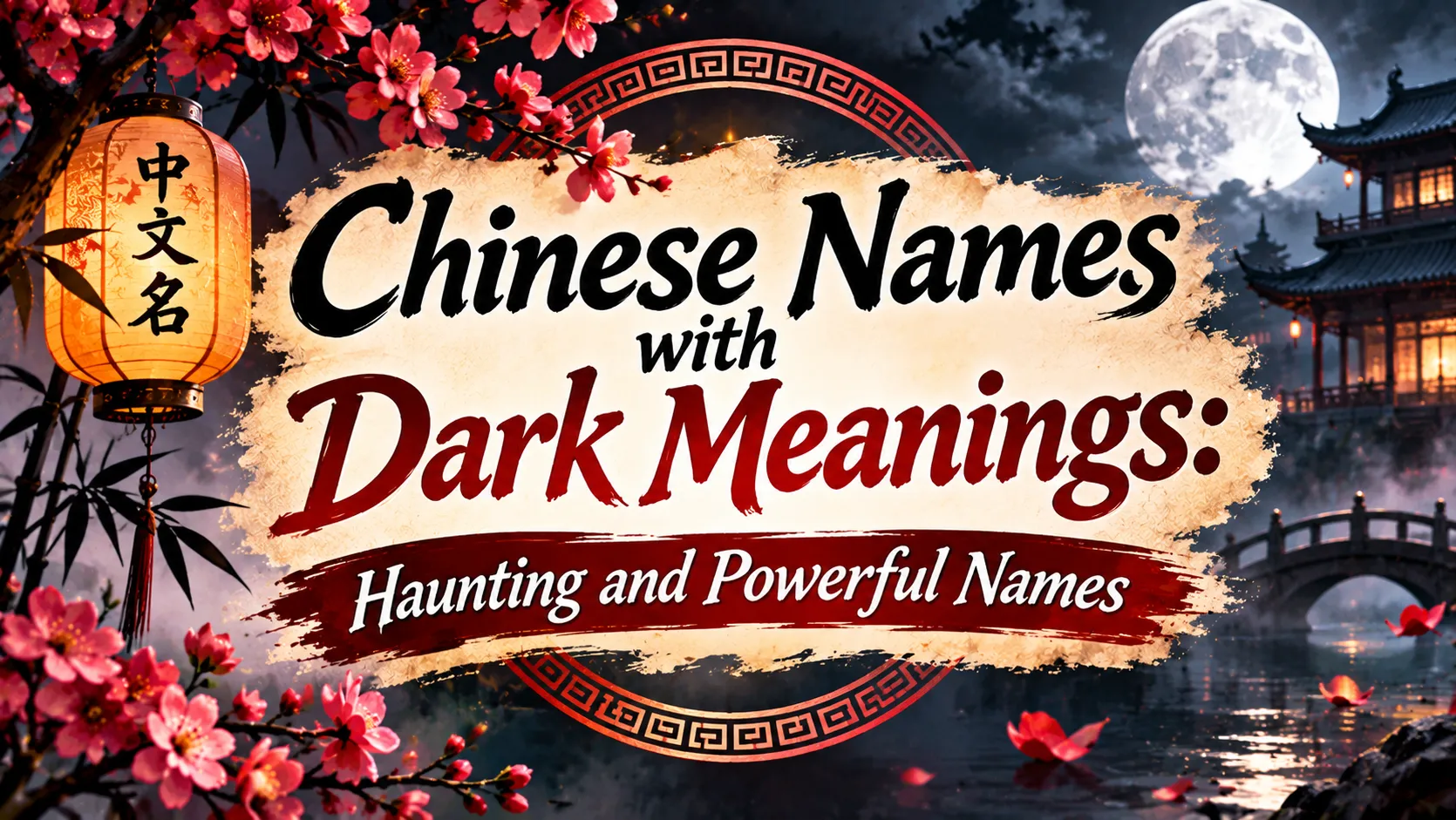
Chinese names with dark meanings offer a fascinating combination of ancient symbolism, mythology, poetic language, and cultural history. Some names evoke darkness, shadows, winter, and the night, while others suggest sorrow, loneliness, mystery, danger, or the supernatural. Their meanings can feel mysterious and powerful, making them interesting choices for fictional characters, fantasy stories, games, and creative writing.
Unlike many Western naming traditions, Chinese names are often formed using individual characters, or hanzi, that each carry their own meaning. The same pronunciation can represent different characters, and the meaning of a name depends on the specific characters selected. For example, 夜 (Yè) means night, while 影 (Yǐng) means shadow. Combining meaningful characters can create names with poetic or mysterious associations.
In this collection, you will discover Chinese names inspired by darkness, death, mythology, winter, ghosts, and mysterious emotions. You will also find male, female, gender-neutral, and fictional character name ideas, along with Chinese characters, Mandarin pronunciations, and English meanings. Some suggestions are established Chinese words or names, while others are creative combinations designed for fictional use rather than common traditional given names.
🌑 Understanding Chinese Names with Dark Meanings
Chinese names with dark meanings are names or character combinations that evoke themes such as night, shadows, sorrow, mystery, death, and supernatural imagery. Chinese characters have individual meanings, but their combinations can create a different poetic impression. This makes Chinese naming particularly interesting for writers who want a name with a layered meaning.
A character such as 暗 (Àn) means dark, while 夜 (Yè) means night and 幽 (Yōu) can suggest something secluded, quiet, or mysterious. These characters can inspire names with a gothic atmosphere. However, a combination that works beautifully in fantasy writing may sound unusual or unnatural as a real person’s name.
Before choosing a name, consider three things:
- Character meaning: Check the exact Chinese characters rather than relying only on their English pronunciation.
- Cultural naturalness: A poetic combination is not necessarily a conventional Chinese given name.
- Intended use: Fictional names can be more dramatic, while real-life names usually benefit from positive or balanced meanings.
The suggestions below distinguish between established words, meaningful character combinations, and creative fictional names wherever appropriate.
🖤 Chinese Names That Mean Darkness, Night, and Shadow
Chinese vocabulary offers several beautiful characters associated with darkness, nighttime, and shadows. These characters can form mysterious name ideas for fictional heroes, villains, supernatural beings, and gothic characters.
| Name | Chinese characters | Pronunciation | Meaning |
|---|---|---|---|
| Ye | 夜 | Yè | Night |
| An | 暗 | Àn | Dark or dim |
| Ying | 影 | Yǐng | Shadow or reflection |
| Hei | 黑 | Hēi | Black |
| You | 幽 | Yōu | Secluded, quiet, or mysterious |
| Ming | 冥 | Míng | Dark, obscure, or underworld-related |
| Ye Ying | 夜影 | Yè Yǐng | Night shadow |
| An Ye | 暗夜 | Àn Yè | Dark night |
| Hei Ying | 黑影 | Hēi Yǐng | Black shadow |
| You Ye | 幽夜 | Yōu Yè | Mysterious or secluded night |
| Ye Mu | 夜幕 | Yè Mù | Nightfall or curtain of night |
| Ying Yue | 影月 | Yǐng Yuè | Shadow moon |
| An Ying | 暗影 | Àn Yǐng | Dark shadow |
| You Ming | 幽冥 | Yōu Míng | The mysterious underworld |
| Ye Se | 夜色 | Yè Sè | Night scenery or nighttime atmosphere |
Naming note: Many entries above are ordinary Chinese words or poetic combinations rather than commonly used personal names. They are especially suitable for fictional characters, usernames, and fantasy settings.
🥀 Chinese Girl Names with Dark Meanings
Chinese girl names can combine graceful sounds with mysterious or melancholic imagery. For fictional characters, you can use characters associated with the moon, shadows, coldness, flowers, silence, and sorrow to create a name that feels elegant but haunting.
Here are Chinese-inspired female character names with their meanings.
| Name | Chinese characters | Pronunciation | Meaning |
|---|---|---|---|
| Yue Ying | 月影 | Yuè Yǐng | Moon shadow |
| An Yue | 暗月 | Àn Yuè | Dark moon |
| You Lan | 幽兰 | Yōu Lán | Secluded or mysterious orchid |
| Ye Lian | 夜莲 | Yè Lián | Night lotus |
| Han Yue | 寒月 | Hán Yuè | Cold moon |
| Xue Ying | 雪影 | Xuě Yǐng | Snow shadow |
| You Yue | 幽月 | Yōu Yuè | Mysterious moon |
| Mo Ying | 墨影 | Mò Yǐng | Ink shadow |
| Ling Ye | 凌夜 | Líng Yè | A poetic night-inspired combination |
| Wan Yue | 晚月 | Wǎn Yuè | Evening moon |
| Su Ying | 素影 | Sù Yǐng | Pale or simple shadow |
| Qing Han | 清寒 | Qīng Hán | Clear and cold |
| Luo Ying | 落影 | Luò Yǐng | Falling shadow |
| Xuan Yue | 玄月 | Xuán Yuè | Mysterious or profound moon |
| Mo Lan | 墨兰 | Mò Lán | Ink orchid |
| Ye Ning | 夜宁 | Yè Níng | Night peace |
| Han Shuang | 寒霜 | Hán Shuāng | Cold frost |
| You Xin | 幽心 | Yōu Xīn | Hidden or mysterious heart |
| Yue Han | 月寒 | Yuè Hán | Cold moonlight |
| Xue Mo | 雪墨 | Xuě Mò | Snow and ink |
These names are creative combinations, not a list of verified traditional Chinese female given names. Some may sound more literary than everyday. For a realistic character, consider using a natural family name and a carefully selected given name rather than choosing a dark phrase as a complete personal name.
🐉 Chinese Boy Names with Dark Meanings
Chinese boy names inspired by darkness often use imagery associated with strength, night, storms, shadows, coldness, and mystery. These combinations can suit fantasy warriors, mysterious protagonists, supernatural characters, or fictional villains.
| Name | Chinese characters | Pronunciation | Meaning |
|---|---|---|---|
| Ye Chen | 夜辰 | Yè Chén | Night and celestial time |
| Hei Feng | 黑风 | Hēi Fēng | Black wind |
| An Chen | 暗尘 | Àn Chén | Dark dust |
| Mo Ye | 墨夜 | Mò Yè | Ink-dark night |
| You Feng | 幽风 | Yōu Fēng | Mysterious wind |
| Han Feng | 寒风 | Hán Fēng | Cold wind |
| Xuan Ye | 玄夜 | Xuán Yè | Mysterious night |
| Ying Chen | 影尘 | Yǐng Chén | Shadow dust |
| Ye Han | 夜寒 | Yè Hán | Night coldness |
| Mo Xuan | 墨玄 | Mò Xuán | Dark ink and mystery |
| Cang Yue | 苍月 | Cāng Yuè | Pale or vast moon |
| Leng Feng | 冷风 | Lěng Fēng | Cold wind |
| You Chen | 幽尘 | Yōu Chén | Mysterious dust |
| Xue Feng | 雪风 | Xuě Fēng | Snow wind |
| An Feng | 暗风 | Àn Fēng | Dark wind |
| Hei Yu | 黑羽 | Hēi Yǔ | Black feather |
| Ye Xing | 夜星 | Yè Xīng | Night star |
| Mo Chen | 墨尘 | Mò Chén | Ink dust |
| Han Ye | 寒夜 | Hán Yè | Cold night |
| Xuan Feng | 玄风 | Xuán Fēng | Mysterious wind |
Some combinations, such as 黑风 (Hēi Fēng) and 寒夜 (Hán Yè), function more naturally as descriptive phrases or fictional titles than ordinary given names. They are included for their atmospheric meanings.
🌘 Chinese Gender-Neutral Names with Mysterious Meanings
Some Chinese characters do not have a strongly gendered meaning, which makes them useful for creating gender-neutral fictional names. Characters associated with the moon, stars, clouds, shadows, and the natural world can produce elegant names with a mysterious quality.
| Name | Chinese characters | Pronunciation | Meaning |
|---|---|---|---|
| Yue | 月 | Yuè | Moon |
| Ying | 影 | Yǐng | Shadow |
| Xuan | 玄 | Xuán | Mysterious or profound |
| Ye | 夜 | Yè | Night |
| Mo | 墨 | Mò | Ink |
| Han | 寒 | Hán | Coldness |
| Chen | 辰 | Chén | Celestial time or heavenly body |
| Yun | 云 | Yún | Cloud |
| Feng | 风 | Fēng | Wind |
| Shuang | 霜 | Shuāng | Frost |
| You | 幽 | Yōu | Secluded or mysterious |
| Lin | 林 | Lín | Forest |
| 星 | Xīng | Star | |
| Luo | 落 | Luò | Fall or descend |
| Cang | 苍 | Cāng | Deep blue, grey, or vast |
These are individual characters and name-building elements. Their suitability as real given names depends on the full combination, family preferences, and cultural context.
🕯️ Chinese Names Inspired by Death and the Underworld
Chinese mythology, folklore, and religious traditions contain many stories about the afterlife, spirits, judgment, and the world of the dead. These ideas provide inspiration for dark fictional names, especially in fantasy and supernatural storytelling.
| Name or term | Chinese characters | Pronunciation | Meaning or association |
|---|---|---|---|
| Fengdu | 酆都 | Fēng Dū | A legendary city associated with the underworld |
| Diyu | 地狱 | Dì Yù | Hell or the underworld |
| Mingjie | 冥界 | Míng Jiè | Realm of the dead |
| Huangquan | 黄泉 | Huáng Quán | Yellow Springs, the realm of the dead |
| Wangchuan | 忘川 | Wàng Chuān | River of Forgetfulness in Chinese afterlife traditions |
| Meng Po | 孟婆 | Mèng Pó | Figure who gives souls a forgetfulness potion before reincarnation |
| Heibai Wuchang | 黑白无常 | Hēi Bái Wúcháng | Black and White Impermanence, underworld guardians |
| Yanluo | 阎罗 | Yán Luó | A name associated with the ruler or judge of the underworld |
| Gui | 鬼 | Guǐ | Ghost or spirit |
| Hun | 魂 | Hún | Soul or spirit |
These are mythological names and terms, not conventional personal names. They are useful for understanding Chinese supernatural storytelling and for naming fictional locations or characters.
👻 Chinese Words and Names Associated with Ghosts and Spirits
Ghosts and spirits appear throughout Chinese folklore, traditional stories, and supernatural fiction. Some terms describe restless spirits, while others refer to souls, supernatural beings, or mysterious appearances.
| Word | Chinese characters | Pronunciation | Meaning |
|---|---|---|---|
| Gui | 鬼 | Guǐ | Ghost |
| Gui Hun | 鬼魂 | Guǐ Hún | Ghost or spirit of the dead |
| You Ling | 幽灵 | Yōu Líng | Ghost or phantom |
| Yuan Gui | 冤鬼 | Yuān Guǐ | Spirit of someone who died with a grievance |
| Li Gui | 厉鬼 | Lì Guǐ | Vengeful or fierce ghost |
| Yin Hun | 阴魂 | Yīn Hún | Spirit of the dead |
| Hun Po | 魂魄 | Hún Pò | Soul or spiritual essence |
| Meng Gui | 梦鬼 | Mèng Guǐ | Dream ghost; a descriptive fictional expression |
| Gui Ying | 鬼影 | Guǐ Yǐng | Ghostly shadow |
| Yin Qi | 阴气 | Yīn Qì | Yin energy or an atmosphere associated with darkness |
Some terms have strong supernatural or frightening connotations. They are more appropriate as descriptive vocabulary, story elements, or fictional titles than as everyday personal names.
🌑 Chinese Names Inspired by Winter, Frost, and Coldness
Coldness can create a powerful dark aesthetic because it is often associated with emotional distance, loneliness, silence, and isolation. Snow-covered landscapes and frozen nights also appear frequently in Chinese poetry, making winter-inspired names especially suitable for mysterious fictional characters.
| Name | Chinese characters | Pronunciation | Meaning |
|---|---|---|---|
| Han Yue | 寒月 | Hán Yuè | Cold moon |
| Xue Ying | 雪影 | Xuě Yǐng | Snow shadow |
| Han Ye | 寒夜 | Hán Yè | Cold night |
| Shuang Yue | 霜月 | Shuāng Yuè | Frost moon |
| Bing Xin | 冰心 | Bīng Xīn | Ice heart; also suggests purity and emotional clarity |
| Xue Chen | 雪尘 | Xuě Chén | Snow dust |
| Leng Yue | 冷月 | Lěng Yuè | Cold moon |
| Han Lin | 寒林 | Hán Lín | Cold forest |
| Bing Ying | 冰影 | Bīng Yǐng | Ice shadow |
| Shuang Han | 霜寒 | Shuāng Hán | Frost and coldness |
| Xue Ye | 雪夜 | Xuě Yè | Snowy night |
| Han Feng | 寒风 | Hán Fēng | Cold wind |
Winter imagery can be especially effective for characters who are emotionally distant, mysterious, or connected to magical landscapes. Some combinations may sound more like poetic descriptions than natural Chinese names.
🦇 Chinese Names Inspired by Darkness and the Moon
The moon is an important image in Chinese poetry, mythology, and traditional culture. It can symbolize beauty, longing, separation, reunion, and the passage of time. When combined with characters associated with shadows or darkness, it creates an especially mysterious atmosphere.
| Name | Chinese characters | Pronunciation | Meaning |
|---|---|---|---|
| An Yue | 暗月 | Àn Yuè | Dark moon |
| You Yue | 幽月 | Yōu Yuè | Mysterious moon |
| Ying Yue | 影月 | Yǐng Yuè | Shadow moon |
| Leng Yue | 冷月 | Lěng Yuè | Cold moon |
| Can Yue | 残月 | Cán Yuè | Waning or incomplete moon |
| Xuan Yue | 玄月 | Xuán Yuè | Mysterious moon |
| Ye Yue | 夜月 | Yè Yuè | Night moon |
| Mo Yue | 墨月 | Mò Yuè | Ink-dark moon |
| Cang Yue | 苍月 | Cāng Yuè | Pale or vast moon |
| Han Yue | 寒月 | Hán Yuè | Cold moon |
The waning moon is particularly effective as a symbol of endings, fading beauty, or separation. It does not have one fixed negative meaning in Chinese culture, but it can create a melancholic atmosphere in poetry and fiction.
🐍 Chinese Names Inspired by Poison, Danger, and Revenge
Some dark fictional characters need names that suggest danger, hostility, or hidden intentions. Chinese characters associated with poison, curses, blades, and destruction can provide inspiration, although such combinations are usually better suited to fictional titles than real names.
| Name or term | Chinese characters | Pronunciation | Meaning |
|---|---|---|---|
| Du | 毒 | Dú | Poison |
| Duyao | 毒药 | Dú Yào | Poisonous substance |
| Zuzhou | 诅咒 | Zǔ Zhòu | Curse |
| Shaqi | 杀气 | Shā Qì | Killing intent or threatening aura |
| Xue | 血 | Xuè | Blood |
| Sharen | 杀人 | Shā Rén | To kill a person |
| Fengren | 锋刃 | Fēng Rèn | Sharp blade |
| Lie Yan | 烈焰 | Liè Yàn | Fierce flames |
| Mo Sha | 魔煞 | Mó Shà | Demonic or destructive force in fantasy-style usage |
| Xue Ying | 血影 | Xuè Yǐng | Blood shadow |
These are intense expressions and are not recommended as ordinary personal names. They work better as villain titles, fantasy techniques, fictional organizations, or supernatural abilities.
🌹 Chinese Names with Sad, Poetic, and Melancholic Meanings
Not every dark name needs to involve ghosts or danger. Some of the most beautiful choices are connected to sadness, separation, longing, and memories. These combinations can suit tragic protagonists, mysterious heroines, and characters with complicated pasts.
| Name | Chinese characters | Pronunciation | Meaning |
|---|---|---|---|
| Bei Yue | 悲月 | Bēi Yuè | Sad moon |
| You Si | 幽思 | Yōu Sī | Deep or hidden thoughts |
| Xiang Si | 相思 | Xiāng Sī | Longing for someone |
| Li Hen | 离恨 | Lí Hèn | Sorrow of separation |
| Can Meng | 残梦 | Cán Mèng | Broken or incomplete dream |
| Luo Hua | 落花 | Luò Huā | Falling flowers |
| Duan Chang | 断肠 | Duàn Cháng | Extreme heartbreak or sorrow |
| Wang You | 忘忧 | Wàng Yōu | Forgetting worries |
| Qing Chou | 情愁 | Qíng Chóu | Romantic sorrow |
| Mu Li | 暮离 | Mù Lí | Evening separation; a poetic combination |
A few of these are established expressions rather than typical personal names. For example, 相思 (Xiāng Sī) means longing for someone and has a strong literary association with romantic separation.
🏯 Chinese Mythological Figures with Dark Associations
Chinese mythology and folklore include powerful supernatural figures, legendary rulers, and mysterious beings. Their stories can inspire names for fantasy characters, fictional kingdoms, and supernatural worlds.
| Figure | Chinese name | Association |
|---|---|---|
| Yanluo Wang | 阎罗王 | King of the underworld and judge of the dead |
| Meng Po | 孟婆 | Figure associated with forgetting past lives |
| Heibai Wuchang | 黑白无常 | Underworld guardians who escort souls |
| Zhong Kui | 钟馗 | Mythical figure known for subduing ghosts |
| Nüwa | 女娲 | Creator goddess in Chinese mythology |
| Xi Wangmu | 西王母 | Queen Mother of the West, a powerful mythological figure |
| Sun Wukong | 孙悟空 | Monkey King with supernatural powers |
| Nezha | 哪吒 | Mythological protective figure and warrior |
| Bai Wuchang | 白无常 | White Impermanence, one of the underworld guardians |
| Hei Wuchang | 黑无常 | Black Impermanence, one of the underworld guardians |
Not all these figures are evil or frightening. Some are protective, heroic, or complex characters. Their inclusion offers mythological inspiration rather than suggesting that every figure has a negative meaning.
✨ How to Create Your Own Chinese Name with a Dark Meaning
Creating a Chinese-inspired name is easier when you understand the meanings of individual characters. Start with a theme, choose two characters that communicate it, and check whether their combination sounds natural in Mandarin.
Here are some useful characters for building fictional names.
| Character | Pinyin | Meaning |
|---|---|---|
| 夜 | Yè | Night |
| 暗 | Àn | Dark |
| 影 | Yǐng | Shadow |
| 月 | Yuè | Moon |
| 幽 | Yōu | Secluded or mysterious |
| 玄 | Xuán | Profound or mysterious |
| 墨 | Mò | Ink |
| 寒 | Hán | Cold |
| 雪 | Xuě | Snow |
| 霜 | Shuāng | Frost |
| 冥 | Míng | Dark or underworld-related |
| 魂 | Hún | Soul |
| 梦 | Mèng | Dream |
| 血 | Xuè | Blood |
| 星 | Xīng | Star |
Simple creative combinations:
- 夜影 (Yè Yǐng) — Night shadow.
- 暗月 (Àn Yuè) — Dark moon.
- 雪影 (Xuě Yǐng) — Snow shadow.
- 墨夜 (Mò Yè) — Ink-dark night.
- 幽月 (Yōu Yuè) — Mysterious moon.
- 寒星 (Hán Xīng) — Cold star.
- 玄影 (Xuán Yǐng) — Mysterious shadow.
For a realistic Chinese personal name, use a recognized surname and consult a fluent Mandarin speaker about the complete name. A literal combination may be grammatically understandable but still sound unusual as a person’s name.
📖 Tips for Choosing a Chinese Name for a Fictional Character
A memorable character name should reflect personality, background, and the role the character plays in a story. A dark name can communicate mystery, but it should also feel appropriate for the fictional world.
Consider these tips before choosing one:
- Match the name to the character: A quiet and mysterious heroine might suit a moon-inspired name, while a dangerous villain may need a stronger, more dramatic title.
- Check the characters: Never rely on romanized spelling alone because different Chinese characters can share the same pronunciation.
- Use a suitable surname: Chinese names generally place the family name before the given name.
- Consider tone marks: Mandarin has four main tones and a neutral tone. Pinyin tone marks help readers pronounce names more accurately.
- Avoid accidental meanings: A combination may have an unintended association or sound strange to native speakers.
- Separate real names from fantasy titles: A phrase such as 黑影 (Hēi Yǐng, black shadow) may work as a fantasy title but not as a natural everyday given name.
- Consider cultural context: Mythological figures and underworld terms have specific histories. Use them respectfully and accurately.
❓ Frequently Asked Questions About Chinese Names with Dark Meanings
What Chinese name means darkness?
The character 暗 (Àn) means dark or dim. 夜 (Yè) means night, while 幽 (Yōu) can describe something secluded or mysterious. These characters can be used as inspiration for fictional names.
What is a Chinese name that means shadow?
影 (Yǐng) means shadow or reflection. A poetic combination such as 夜影 (Yè Yǐng) means night shadow, while 暗影 (Àn Yǐng) means dark shadow.
What Chinese name means death?
There is no single conventional Chinese personal name that should be used as a direct translation of death. 死 (Sǐ) means death or dying, while terms such as 冥界 (Míng Jiè) and 黄泉 (Huáng Quán) refer to the underworld or realm of the dead. These are not normal personal names.
What is a Chinese name associate with ghosts?
幽灵 (Yōu Líng) means ghost or phantom, while 鬼魂 (Guǐ Hún) means the spirit of a dead person. These are descriptive expressions rather than traditional personal names.
What Chinese name means night?
夜 (Yè) means night. It can inspire fictional combinations such as 夜星 (Yè Xīng), meaning night star, or 夜影 (Yè Yǐng), meaning night shadow.
What are some mysterious Chinese girl names?
For fictional characters, options include 月影 (Yuè Yǐng), 幽兰 (Yōu Lán), 暗月 (Àn Yuè), 雪影 (Xuě Yǐng), and 墨兰 (Mò Lán). These are poetic combinations, not necessarily common traditional given names.
What are some dark Chinese boy names?
Fictional options include 夜辰 (Yè Chén), 玄夜 (Xuán Yè), 寒风 (Hán Fēng), 黑羽 (Hēi Yǔ), and 墨尘 (Mò Chén). Their meanings are based on the individual characters.
What Chinese name means moon shadow?
月影 (Yuè Yǐng) means moon shadow. It is a poetic combination that can suit a fictional character or mysterious setting.
What is the Chinese underworld called?
The Chinese underworld is commonly call 地狱 (Dì Yù) or 冥界 (Míng Jiè). 黄泉 (Huáng Quán), meaning Yellow Springs, is another traditional expression associated with the realm of the dead.
Are Chinese names with dark meanings suitable for real babies?
Some dark-themed characters may sound poetic, but words meaning poison, ghosts, death, or curses are generally unsuitable as ordinary personal names. For a real baby, it is better to choose characters with positive, balanced, or meaningful associations and consult a native speaker.
🖤 Conclusion
Chinese names with dark meanings combine poetic language, ancient mythology, and mysterious symbolism. From 夜 (Yè), meaning night, and 影 (Yǐng), meaning shadow, to terms such as 黄泉 (Huáng Quán) and 幽灵 (Yōu Líng), Chinese vocabulary offers many fascinating ways to explore darkness, the supernatural, and human emotions.
Whether you are creating a mysterious fictional character, naming a fantasy villain, developing a supernatural story, or exploring Chinese mythology, the right characters can give your ideas a distinctive identity. Always remember that creative combinations are not automatically traditional Chinese given names. Check the characters, pronunciation, and cultural context before using a name in real life.

Olivia Bennett is a writer and language enthusiast at Vocabsteria. She is passionate about exploring word meanings, name origins, and cultural expressions from around the world.