Ancient Egyptian symbols tell fascinating stories about life, death, protection, love, power, and the afterlife. From the famous Eye of Horus to the mysterious Ankh, these ancient Egyptian symbols carried deep meanings in religious beliefs, royal traditions, artwork, and everyday life. Egyptians used them in temples, tombs, jewelry, amulets, and hieroglyphic inscriptions to express ideas that words alone could not capture.
Many Egyptian symbols remain popular today because of their beautiful designs and powerful associations. Some represent eternal life, while others symbolize wisdom, strength, rebirth, or divine protection. Whether you are researching Egyptian mythology, exploring ancient Egyptian culture, or looking for the meaning behind a particular symbol, this guide explains the history and symbolism of more than 35 well-known Egyptian symbols.
The Ankh (Symbol of Life) ☥
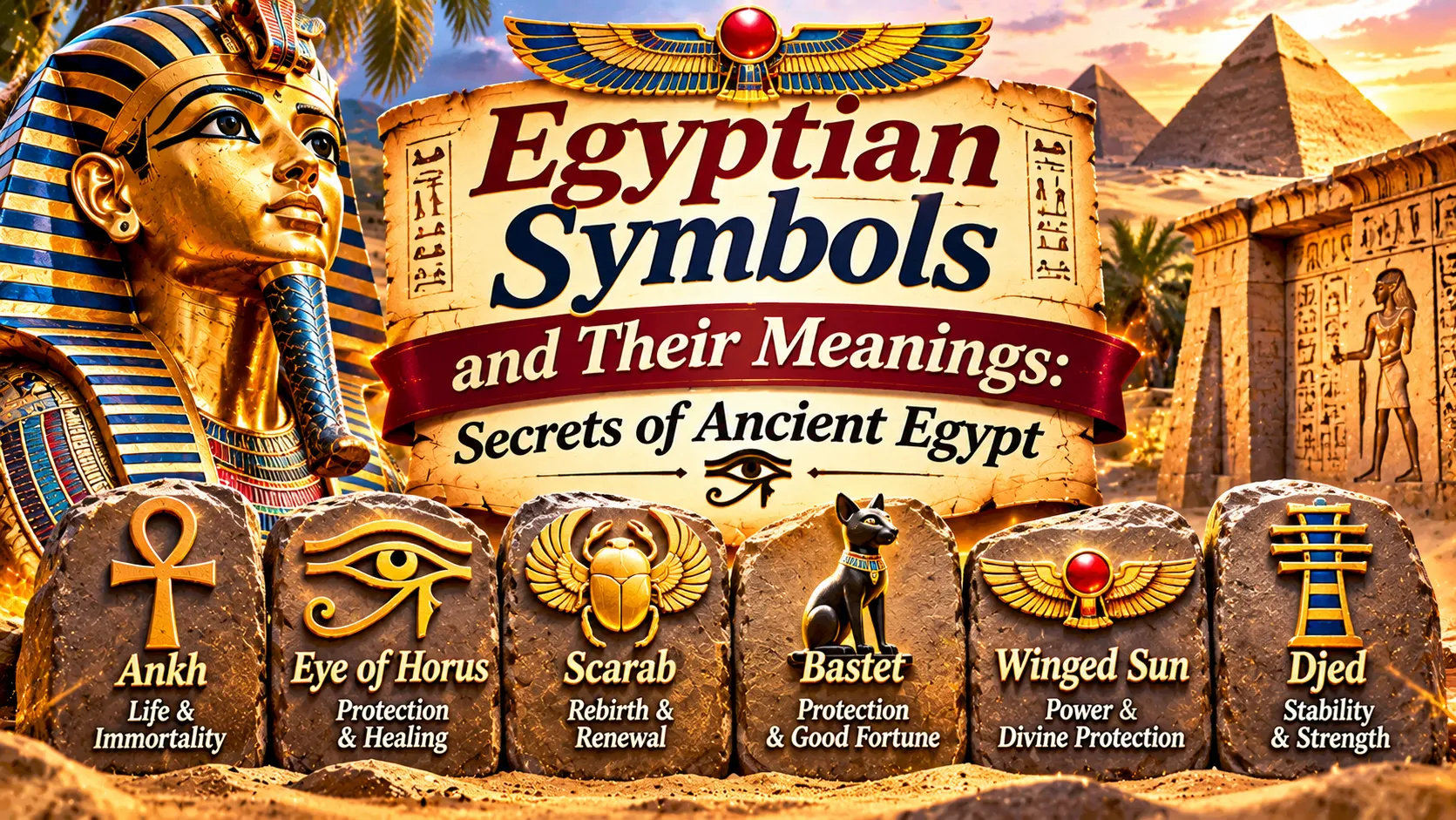
The Ankh ranks among the most recognizable symbols of ancient Egypt. Its distinctive shape resembles a cross with a loop at the top, and Egyptians used it to represent life, vitality, and immortality. Ancient artwork often shows gods holding an Ankh or offering it to pharaohs.
The symbol also connects with the Egyptian belief in eternal life. Egyptians placed Ankh designs on temple walls, tomb decorations, jewelry, and religious objects to express the hope of living beyond physical death.
Meaning: Life, eternal existence, vitality, and divine power.
The Eye of Horus (Protection and Healing) 👁️
The Eye of Horus, also called the Wedjat Eye, represents protection, healing, and restoration. Egyptian mythology connects this symbol with Horus, the falcon-headed god associated with kingship and the sky. According to the myth, Horus lost an eye during a conflict with Seth, and the god Thoth restored it.
This story helped establish the eye as a symbol of recovery and wholeness. Egyptians wore Eye of Horus amulets for protection and included the design in funerary objects. Today, people often associate it with spiritual awareness and safeguarding, although those modern interpretations differ from its ancient religious context.
Meaning: Protection, healing, restoration, and well-being.
The Eye of Ra (Power of the Sun) ☀️
The Eye of Ra symbolizes the powerful and protective force of the sun god Ra. Egyptian mythology sometimes describes the eye as a goddess who acts on Ra’s behalf, protects divine order, and punishes his enemies. Different myths connect this role with goddesses such as Sekhmet, Hathor, and Bastet.
Unlike the Eye of Horus, which commonly represents healing and restoration, the Eye of Ra often expresses royal authority, fierce protection, and destructive solar power. Artists frequently portrayed it as a human eye with a distinctive marking or as a cobra associated with royal protection.
Meaning: Solar power, authority, protection, and divine strength.
The Scarab Beetle (Rebirth and Transformation) 🪲
The scarab beetle became one of ancient Egypt’s most meaningful symbols. Egyptians connected the beetle’s behavior of rolling dung balls with the movement of the sun across the sky. This association linked the scarab with Khepri, a god who represented the rising sun and renewal.
Egyptians used scarab-shaped amulets, jewelry, and seals. They also placed heart scarabs inside some tombs, where the objects served a funerary purpose connected with judgment and the afterlife.
Meaning: Rebirth, transformation, renewal, and protection.
The Djed Pillar (Stability and Strength) 🏛️
The Djed pillar represents stability, endurance, and strength. Its design features a tall column with several horizontal bars near the top. Egyptian religious traditions associate it with Osiris, the god connected with death, resurrection, and the afterlife.
Egyptians used the Djed symbol in religious ceremonies, temple decorations, and funerary objects. The phrase “raising the Djed pillar” also referred to a ritual that symbolized stability and the renewal of order.
Meaning: Stability, endurance, strength, and resurrection.
The Was Scepter (Authority and Power) 👑
The Was scepter represents authority, dominion, and divine power. Its long staff usually features an animal-shaped head at the top and a forked base. Egyptian gods often carry this scepter in temple paintings and reliefs, while pharaohs also use it to express their royal authority.
The symbol connects with the Egyptian idea of maintaining order and controlling chaos. Its appearance in religious artwork emphasizes the power of gods and rulers.
Meaning: Authority, control, dominion, and power.
The Shen Ring (Eternity and Protection) ♾️
The Shen ring represents eternity and protection. Its circular form surrounds a small horizontal line, creating a shape associated with an unbroken loop. Ancient Egyptians used the Shen symbol in royal artwork and religious decoration to express the idea of everlasting existence.
Artists sometimes placed the symbol near the names of pharaohs to communicate a wish for long-lasting rule. Its circular shape also makes it a natural representation of continuity and completeness.
Meaning: Eternity, protection, continuity, and everlasting life.
The Lotus Flower (Rebirth and Creation) 🪷
The lotus flower holds an important place in Egyptian mythology. Egyptians associated the blue lotus especially with creation, the sun, and renewal because the flower opens during the day and closes at night. Some creation traditions describe the first sun emerging from a lotus flower rising from the primordial waters.
Artists included lotus designs in temple carvings, jewelry, columns, and tomb decorations. The flower also appeared in scenes of celebration and religious offerings.
Meaning: Creation, rebirth, purity, renewal, and the sun.
The Feather of Ma’at (Truth and Justice) 🪶
The Feather of Ma’at symbolizes truth, justice, balance, and cosmic order. Ma’at was both a goddess and the principle that governed harmony in the universe. Ancient Egyptians believed that people should live according to Ma’at by acting honestly and respecting social and divine order.
In funerary beliefs, the feather played a central role in the judgment of the dead. The heart of the deceased was weighed against the Feather of Ma’at. This scene represented the evaluation of a person’s life and moral conduct.
Meaning: Truth, justice, balance, and righteousness.
The Uraeus (Royal Protection) 🐍
The Uraeus represents a rearing cobra and symbolizes royal authority and divine protection. Egyptian artists commonly placed it on the crowns and headdresses of pharaohs to show that the ruler enjoyed the protection of powerful divine forces.
The cobra often connects with Wadjet, a protective goddess associated with Lower Egypt. The Uraeus also represents the dangerous power that could defend the king against enemies.
Meaning: Royal power, protection, authority, and divine defense.
The Bennu Bird (Renewal and Resurrection) 🐦
The Bennu bird appears in ancient Egyptian religious traditions as a symbol of creation, renewal, and rebirth. Egyptians associated it with the sun god Ra and the god Atum. Some traditions connect the Bennu with the beginning of creation and the repeated renewal of life.
The bird often appears in discussions of the origins of the phoenix tradition, although the two should not be treated as exactly identical. Egyptian religious art and texts gave the Bennu its own distinctive role.
Meaning: Creation, renewal, rebirth, and immortality.
The Crook and Flail (Kingship and Leadership) ⚱️
The crook and flail form a famous pair of royal objects in ancient Egyptian art. And The crook resembles a shepherd’s staff, while the flail looks like a tool with hanging strands. Together, they express the pharaoh’s responsibility to guide, protect, and maintain order.
Egyptian artwork frequently shows Osiris holding these objects. Their appearance in royal imagery also connects the king with divine authority and the responsibility to care for the people.
Meaning: Leadership, kingship, responsibility, and authority.
The Tyet Knot (Protection and Feminine Power) 🎀
The Tyet, also known as the Knot of Isis, resembles an Ankh with downward-curving arms. Egyptians associated it with Isis, a goddess connected with motherhood, magic, healing, and protection.
People used Tyet amulets in funerary traditions, and some examples came from red materials such as carnelian or red jasper. Egyptian religious texts connect the symbol with protection and the life-giving power of Isis.
Meaning: Protection, motherhood, healing, and feminine power.
The Amenta Symbol (The Western Land of the Dead) 🌅
Amenta refers to the western region associated with the setting sun and the realm of the dead in ancient Egyptian religious thought. Egyptians connected the west with death because the sun disappeared beyond the western horizon each evening.
The concept appears in funerary beliefs and religious imagery. It represents the journey into the afterlife rather than one universally standardized symbol with a single fixed design.
Meaning: The afterlife, death, transition, and the western horizon.
The Canopic Jars (Protection of the Organs) 🏺
Canopic jars played an important role in Egyptian mummification. Egyptians used them to store and protect the internal organs removed during the preparation of the body. The four jars traditionally associated with the process connected with the Four Sons of Horus.
Each son protected a particular organ and often appeared with a distinctive head. Imsety had a human head, Hapy had a baboon head, Duamutef had a jackal head, and Qebehsenuef had a falcon head.
Meaning: Preservation, protection, and preparation for the afterlife.
The Solar Disk (The Power of Ra) 🌞
The solar disk represents the sun and its life-giving power. Egyptians connected it with Ra, the powerful sun god, and with other solar deities. The disk frequently appears above the heads of gods and in temple artwork.
When artists placed a cobra around the solar disk, the combination could express divine protection and royal power. The sun’s daily journey also symbolized renewal and the continuing cycle of life.
Meaning: Life, creation, divine energy, and renewal.
The Sesen (Lotus Symbol) 🌸
Sesen is an ancient Egyptian word commonly associated with the lotus flower. Lotus designs appear throughout Egyptian art, especially in scenes that represent creation, beauty, and renewal. The flower’s daily opening and closing made it a powerful image of the sun’s cycle.
Egyptians decorated columns, furniture, jewelry, and tombs with lotus patterns. The symbol also appeared in artistic scenes involving water, offerings, and celebrations.
Meaning: Rebirth, beauty, creation, and renewal.
The Amentet (Goddess of the West) 🌄
Amentet personified the western necropolis and the realm associated with the dead. Egyptian religious beliefs connected the west with the setting sun and the transition into the afterlife.
Artists sometimes portrayed Amentet as a woman wearing a symbol of the west on her head. In funerary scenes, she could welcome or guide the deceased into the next world.
Meaning: Welcome in the afterlife, transition, and protection of the dead.
The Cartouche (Protection of Royal Names) 📜
A cartouche is an oval-shaped enclosure that surrounds the name of an Egyptian king or queen in hieroglyphic writing. A horizontal line at one end closes the oval and helps distinguish it from other hieroglyphic arrangements.
The cartouche carried an important royal function because Egyptians believed that preserving a ruler’s name helped preserve their identity and memory. Today, cartouches remain popular in Egyptian-inspired jewelry and souvenirs.
Meaning: Royal identity, protection, authority, and remembrance.
The Was Animal (Divine Strength) 🐾
The animal-shaped head on the Was scepter often resembles a stylized creature with a long curved snout and upright ears. Scholars continue to discuss the exact animal represented by this design. The figure connects the scepter with divine authority and the power to maintain order.
Ancient Egyptian gods and rulers appear with Was scepters in religious scenes, making the object a familiar symbol of control and strength.
Meaning: Divine authority, strength, and control.
The Nile River Symbol (Life and Fertility) 🌊
The Nile River shaped almost every part of ancient Egyptian life. Its annual flood deposited fertile soil along the riverbanks, helping farmers grow crops in an otherwise dry landscape. Egyptians therefore connected the Nile with abundance, fertility, and the continuation of life.
The god Hapy personified the Nile’s inundation. Artists often portrayed him with symbols of abundance, such as plants and offerings.
Meaning: Fertility, abundance, nourishment, and life.
The Double Crown (Unity of Egypt) 👑
The Double Crown, known as the Pschent, combined the White Crown of Upper Egypt with the Red Crown of Lower Egypt. Pharaohs wore it to represent their authority over the united Egyptian kingdom.
The two crowns preserved the identities of the country’s historical regions while presenting the king as the ruler of both. Egyptian reliefs and statues often use the Double Crown to communicate political unity.
Meaning: Unity, sovereignty, kingship, and national authority.
The White Crown (Upper Egypt) 🤍
The White Crown, called Hedjet, represented Upper Egypt. Its tall, rounded shape distinguished it from the Red Crown of Lower Egypt. Pharaohs wore it in royal images to show their authority over the southern region of the kingdom.
The White Crown also appeared in combinations with other royal symbols, especially the Double Crown.
Meaning: Upper Egypt, kingship, and royal authority.
The Red Crown (Lower Egypt) ❤️
The Red Crown, known as Deshret, represented Lower Egypt. Its distinctive shape includes a raised spiral-like element extending from the back. Pharaohs wore it to demonstrate their connection with the northern part of the kingdom.
When the White Crown and Red Crown appeared together, they formed the Double Crown, which represented the unity of Egypt.
Meaning: Lower Egypt, sovereignty, and royal power.
The Four Sons of Horus (Protection of the Dead) 🦅
The Four Sons of Horus protected the internal organs of the deceased during mummification. Ancient Egyptians connected each figure with a particular organ and a protective goddess.
- Imsety: Human-headed figure who protected the liver.
- Hapy: Baboon-headed figure who protected the lungs.
- Duamutef: Jackal-headed figure who protected the stomach.
- Qebehsenuef: Falcon-headed figure who protected the intestines.
Their images appeared on canopic jars and funerary objects to help safeguard the deceased during the journey into the afterlife.
Meaning: Protection, preservation, and safe passage into the afterlife.
The Serpent (Protection and Renewal) 🐍
Serpents carried several meanings in ancient Egyptian religion. Some represented dangerous forces, while others protected gods, kings, and sacred places. The cobra goddess Wadjet, for example, protected Lower Egypt and appeared in royal imagery.
The serpent also connected with cycles of renewal because snakes shed their skin. However, Egyptians did not assign one universal meaning to every serpent image; the specific deity and artistic context mattered.
Meaning: Protection, danger, renewal, and divine power.
The Falcon (Horus and Kingship) 🦅
The falcon represents Horus, one of ancient Egypt’s most important gods. Egyptians associated Horus with the sky, kingship, and divine protection. Pharaohs also connected themselves with Horus, which strengthened the religious foundation of royal authority.
Artists frequently portrayed Horus as a falcon or as a human figure with a falcon head. The bird’s strong flight and sharp vision made it a fitting image for a powerful sky deity.
Meaning: Kingship, protection, strength, and the sky.
The Jackal (Anubis and the Afterlife) 🐺
The jackal became closely associated with Anubis, the god of mummification and funerary protection. Egyptians observed jackals around desert burial grounds, which likely helped inspire the connection between the animal and the world of the dead.
Anubis often appears as a black jackal or a man with a jackal head. His role included protecting tombs and overseeing important stages of funerary rituals.
Meaning: Mummification, protection of tombs, and the afterlife.
The Crocodile (Power of Sobek) 🐊
The crocodile symbol connects with Sobek, a god associated with the Nile, fertility, strength, and royal power. Egyptians respected and feared crocodiles because these animals represented both the river’s life-giving environment and its dangers.
Sobek’s crocodile form expressed the power of nature. Some temples and religious sites honored the god through crocodile imagery and sacred practices.
Meaning: Strength, fertility, protection, and natural power.
The Vulture (Motherhood and Protection) 🦅
The vulture symbol connects with protective goddesses such as Nekhbet, who represented Upper Egypt. Egyptian artists frequently placed a vulture above the heads of pharaohs or showed the bird spreading its wings over royal figures.
The vulture also connected with motherhood and protection. Its presence in royal and funerary artwork communicated the protective power of the goddess.
Meaning: Motherhood, protection, guardianship, and royal authority.
The Papyrus Plant (Lower Egypt and Renewal) 🌿
The papyrus plant grew in the marshes of the Nile Delta and became an important symbol of Lower Egypt. Egyptians used papyrus stems to make writing material, boats, mats, and other everyday objects.
Its appearance in temple columns and decorative designs also connected it with creation, abundance, and the natural environment. Artists sometimes paired papyrus with the lotus to represent the unity of Upper and Lower Egypt.
Meaning: Lower Egypt, growth, abundance, and renewal.
The Waset Scepter (The Symbol of Thebes) 🏺
Waset was the ancient Egyptian name for Thebes, an important religious and political center. The name and its associated imagery should not be confused with the Was scepter, which represents authority and divine power.
Thebes became especially important during periods when its local god Amun rose to national prominence. Its temples, monuments, and religious traditions played a major role in Egyptian history.
Meaning: Thebes, religious authority, and cultural importance.
The Menat Necklace (Fertility and Divine Favor) 📿
The Menat was a necklace with a distinctive counterpoise, often associated with the goddess Hathor. Egyptians used it in religious ceremonies and depicted it in scenes involving music, dance, and offerings.
The necklace could serve as a ritual object that connected worshippers with divine favor, fertility, and protection. Its association with Hathor also linked it with joy, music, beauty, and motherhood.
Meaning: Fertility, protection, joy, and divine blessing.
The Sistrum (Music and Celebration) 🎶
The Sistrum was a sacred musical instrument that played an important role in worship, particularly in ceremonies honoring Hathor. It usually consisted of a handle and a frame with loose metal elements that produced a rattling sound.
Egyptians used the instrument during religious festivals and rituals. Its sound helped create a joyful atmosphere and expressed devotion to the gods.
Meaning: Celebration, music, worship, and divine joy.
The Ba Bird (The Soul and Personality) 🕊️
The Ba represents an important aspect of the individual in ancient Egyptian beliefs about the soul. Artists often depicted it as a bird with a human head, expressing the connection between a person’s identity and their ability to move between different realms.
Egyptians believed the Ba could travel beyond the tomb and reunite with the deceased. This idea formed part of their complex understanding of life after death.
Meaning: Individual identity, spiritual movement, and the afterlife.
The Akh (The Transfigured Spirit) ✨
The Akh represents a transformed spiritual state that a deceased person could achieve through proper funerary rituals and successful passage into the afterlife. Egyptian beliefs distinguished the Akh from other aspects of the person, including the Ba and Ka.
Rather than representing a simple picture or object, the Akh expresses an important religious concept. It reflects the Egyptian hope that the deceased could become an effective and enduring spirit.
Meaning: Spiritual transformation, lasting existence, and the afterlife.
The Ka (Life Force) 🌟
The Ka represents a person’s vital essence or life force. Egyptians believed it remained an important part of the individual after death and required continued nourishment through offerings.
Tombs and funerary practices helped provide for the Ka. This belief explains why Egyptians placed food, drink, and other offerings in burial spaces.
Meaning: Life force, vitality, nourishment, and spiritual continuity.
The Khepresh (Blue Crown of the Pharaoh) 🔵
The Khepresh, often called the Blue Crown, was a royal headdress that appeared in Egyptian art, particularly in scenes showing pharaohs performing military or ceremonial duties. Its surface often features a pattern of small circular decorations.
The crown communicated royal status and authority. Its exact use varied across different historical periods and artistic contexts.
Meaning: Royal power, kingship, and ceremonial authority.
The Benben Stone (Creation and the First Land) 🔺
The Benben stone connects with Egyptian creation traditions, especially those associated with Heliopolis. According to these traditions, the first mound of land emerged from the primordial waters, providing a foundation for creation.
Egyptians associated the Benben with the sun god and the beginning of existence. Its pointed form also influenced the design of pyramidions placed at the tops of some pyramids and obelisks.
Meaning: Creation, beginnings, solar power, and renewal.
Egyptian Symbols and Their Meanings: Quick Reference Table 📚
Ancient Egyptian symbols represented different aspects of religion, government, nature, and the afterlife. This quick reference table makes it easier to compare their most familiar meanings.
| Egyptian Symbol | Common Meaning |
|---|---|
| Ankh | Life and immortality |
| Eye of Horus | Protection and healing |
| Eye of Ra | Solar power and authority |
| Scarab Beetle | Rebirth and transformation |
| Djed Pillar | Stability and strength |
| Was Scepter | Power and authority |
| Shen Ring | Eternity and protection |
| Lotus Flower | Creation and renewal |
| Feather of Ma’at | Truth and justice |
| Uraeus | Royal protection |
| Bennu Bird | Rebirth and creation |
| Crook and Flail | Kingship and leadership |
| Tyet Knot | Protection and motherhood |
| Cartouche | Royal identity |
| Solar Disk | Life and divine energy |
| Double Crown | Unity of Egypt |
| White Crown | Upper Egypt |
| Red Crown | Lower Egypt |
| Falcon | Horus and kingship |
| Jackal | Anubis and the afterlife |
| Papyrus Plant | Lower Egypt and growth |
| Menat Necklace | Fertility and divine favor |
| Sistrum | Music and worship |
| Ba Bird | Individual soul |
| Akh | Transfigured spirit |
| Ka | Life force |
| Benben Stone | Creation and beginnings |
Frequently Asked Questions About Egyptian Symbols ❓
What is the most famous Egyptian symbol?
The Ankh is one of the most famous Egyptian symbols. Its distinctive looped cross shape represents life and eternal existence. People also recognize the Eye of Horus and the Scarab Beetle as important symbols of ancient Egyptian culture.
What does the Ankh symbolize?
The Ankh symbolizes life, vitality, and immortality. Ancient Egyptians used it in religious artwork, jewelry, and funerary objects to express the idea of eternal life.
What is the difference between the Eye of Horus and the Eye of Ra?
The Eye of Horus commonly represents protection, healing, and restoration. The Eye of Ra represents the powerful and sometimes destructive force of the sun, along with divine and royal protection.
What Egyptian symbol represents eternal life?
The Ankh is the best-known symbol of life and eternal existence. The Shen ring also represents eternity through its continuous circular form.
What does the Scarab Beetle mean in Egyptian culture?
The Scarab Beetle represents rebirth, renewal, and transformation. Egyptians connected it with Khepri, a deity associated with the rising sun and the renewal of creation.
What Egyptian symbol represents protection?
Several Egyptian symbols represent protection, including the Eye of Horus, the Uraeus, the Tyet Knot, and the Shen Ring. Each symbol has its own religious and historical associations.
What does the Djed Pillar represent?
The Djed Pillar represents stability, strength, and endurance. Egyptian religious traditions also connect it with Osiris and the renewal of life after death.
What does the lotus flower symbolize in ancient Egypt?
The lotus flower represents creation, rebirth, and renewal. Egyptians connected its daily opening with the sun’s movement and the continuing cycle of life.
What does the Feather of Ma’at represent?
The Feather of Ma’at represents truth, justice, balance, and cosmic order. Egyptian funerary beliefs describe the weighing of a deceased person’s heart against this feather during judgment.
Are Egyptian symbols still used today?
Yes. People use Egyptian-inspired symbols in jewelry, artwork, tattoos, fashion, and decorative designs. The Ankh, Eye of Horus, Scarab Beetle, and Cartouche remain especially recognizable. However, modern interpretations do not always match their original ancient meanings.
Conclusion 🏺
Egyptian symbols offer a fascinating look into the beliefs, traditions, and daily life of one of history’s most influential civilizations. The Ankh represents life, the Eye of Horus expresses protection and healing, and the Scarab Beetle connects with renewal and transformation. Other symbols reveal how Egyptians understood kingship, justice, nature, and the journey into the afterlife.
Although people still use many of these designs today, their original meanings often come from specific myths, religious practices, and historical periods. Understanding that context makes Egyptian symbols even more interesting and helps preserve the stories behind their timeless designs.

Olivia Bennett is a writer and language enthusiast at Vocabsteria. She is passionate about exploring word meanings, name origins, and cultural expressions from around the world.