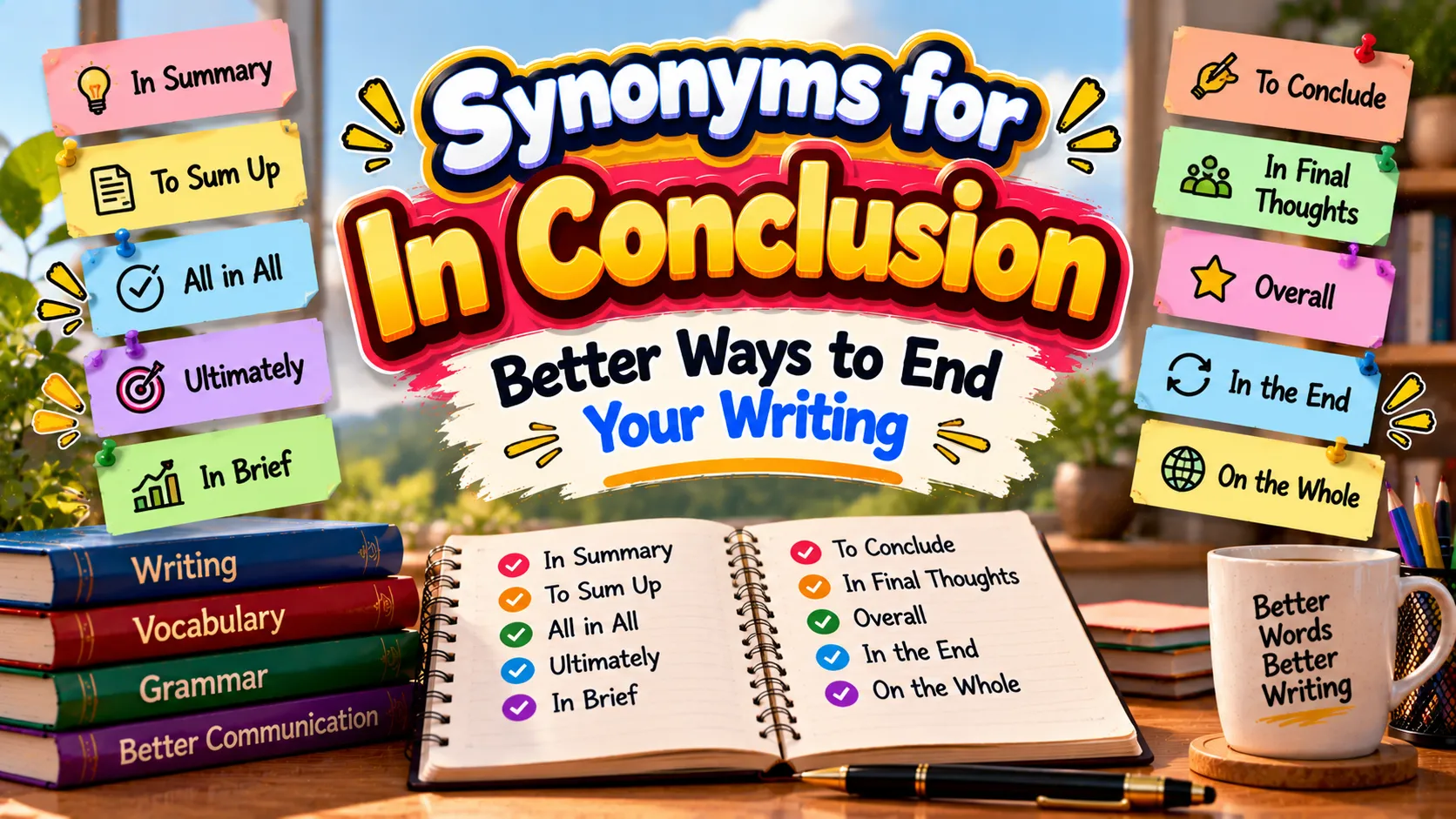
Finding useful synonyms for in conclusion can make your essays, reports, articles, speeches, and academic assignments sound more natural and polished. Although “in conclusion” is a familiar transition, repeating it can make your writing feel predictable. Alternatives such as to summarize, in summary, overall, ultimately, and to wrap up can create smoother transitions while matching different tones.
The best replacement depends on your purpose. Academic writing may require formal concluding phrases, while blog posts and everyday writing can use more conversational transitions. Learning several alternatives helps you signal that you are summarizing key points, presenting a final thought, or bringing an argument to an end.
📝 What Does “In Conclusion” Mean?
“In conclusion” is a transition phrase used near the end of a piece of writing to signal that the main discussion or argument is coming to an end. It often introduces a summary of important points or a final statement based on the information already presented.
Common contexts include essays, research papers, reports, presentations, speeches, and articles. While the phrase is grammatically correct, varying your concluding transitions can improve writing style, readability, flow, and academic vocabulary.
🔄 Best Synonyms for “In Conclusion”
The most useful alternatives to “in conclusion” include phrases that summarize information, emphasize a final point, or signal an overall judgment. Some are formal enough for academic writing, while others work better in conversational or general-purpose content.
| Alternative | Best For | Tone |
|---|---|---|
| In summary | Summarizing main points | Formal |
| To summarize | Essays and reports | Formal |
| To sum up | General writing | Neutral |
| Overall | General conclusions | Neutral |
| Ultimately | Final judgment | Formal |
| In short | Brief summaries | Neutral |
| In brief | Concise writing | Formal |
| All in all | General evaluation | Conversational |
| On the whole | Overall assessment | Formal |
| To conclude | Academic writing | Formal |
| In closing | Speeches and letters | Formal |
| Finally | Final point | Neutral |
| In the end | General writing | Conversational |
| Taking everything into account | Evaluations | Formal |
| In essence | Main idea | Formal |
| As a result | Consequence-focused conclusion | Neutral |
| Therefore | Logical conclusion | Formal |
| Thus | Academic writing | Formal |
| To wrap up | Casual writing | Informal |
| In a nutshell | Short informal summary | Casual |
🎓 Formal Alternatives to “In Conclusion”
Formal writing benefits from transitions that clearly indicate a final summary without sounding overly repetitive. Phrases such as in summary, to conclude, in brief, ultimately, and on the whole are useful in academic papers, business reports, and professional documents.
The choice should also reflect what the final paragraph actually does. If you are summarizing evidence, use a summary transition. If you are presenting a final judgment, ultimately or therefore may be more appropriate.
Formal options
- In summary
- To conclude
- To summarize
- In brief
- Ultimately
- On the whole
- In essence
- Taken together
- Overall
- In closing
- Upon consideration
- Taking everything into account
- In light of these findings
- Based on the evidence
- In the final analysis
- All things considered
- In the broader context
- As demonstrated above
- Considering these points
- From this perspective
Example:
In summary, the evidence demonstrates that consistent preparation improves long-term performance.
Or:
Taking everything into account, the findings support the proposed approach.
📚 Synonyms for “In Conclusion” in an Essay
Essay writing often requires a clear transition into the final paragraph. Instead of using “in conclusion” every time, writers can use phrases such as to summarize, overall, ultimately, in summary, and taking these points into account.
A strong essay conclusion should not simply repeat the introduction. The transition should lead naturally into a concise synthesis of the argument and, when appropriate, a final insight.
Useful essay transitions
- In summary
- To conclude
- To summarize
- Overall
- Ultimately
- In brief
- On the whole
- Taken together
- All things considered
- In the final analysis
- Considering these points
- Based on the evidence
- In light of the discussion
- From the evidence presented
- These points demonstrate that
Example:
Instead of:
In conclusion, social media has changed communication.
Try:
Overall, social media has fundamentally changed the way people communicate.
Or:
Taken together, these developments demonstrate how social media has transformed modern communication.
🎓 Academic Synonyms for “In Conclusion”
Academic writing generally favors clear, objective transitions rather than overly conversational expressions. Phrases such as in summary, to conclude, ultimately, taken together, and in the final analysis can help introduce a final synthesis.
However, academic conclusions do not always require an introductory phrase. In many cases, moving directly into the final synthesis creates a stronger and more sophisticated paragraph.
| Academic Transition | Example |
|---|---|
| In summary | In summary, the findings support the original hypothesis. |
| To conclude | To conclude, the evidence suggests a substantial relationship. |
| Ultimately | Ultimately, the results indicate that further research is necessary. |
| Taken together | Taken together, these findings reveal a consistent pattern. |
| In the final analysis | In the final analysis, several factors contributed to the outcome. |
| On the whole | On the whole, the evidence supports the proposed framework. |
| In essence | In essence, the study demonstrates the importance of early intervention. |
| Considering these findings | Considering these findings, the proposed model remains viable. |
✍️ Alternatives to “In Conclusion” for Essays Without Repetition
One of the easiest ways to improve an essay is to avoid beginning every final paragraph with the same transition. You can vary your wording while maintaining a clear logical connection.
Instead of relying exclusively on “in conclusion,” consider whether your final paragraph is summarizing, evaluating, emphasizing, predicting, or synthesizing. The appropriate transition can then reflect that purpose.
For summarizing
- In summary
- To summarize
- In brief
- To sum up
- Overall
For emphasizing
- Ultimately
- Most importantly
- Above all
- The key point is
- What matters most is
For evaluating
- On the whole
- All things considered
- Taking these factors into account
- Considering the evidence
- In the final analysis
For synthesizing
- Taken together
- Collectively
- Viewed as a whole
- These findings suggest
- The evidence indicates
💼 Professional Alternatives to “In Conclusion”
Professional reports, presentations, proposals, and business emails often need a polished closing transition. While “in conclusion” is acceptable, alternatives such as overall, in summary, ultimately, and based on these findings can make business communication more direct.
A professional conclusion should focus on the key result, recommendation, or implication rather than simply announcing that the document is ending.
Professional options
- In summary
- Overall
- To summarize
- Ultimately
- Based on these findings
- Taking these factors into account
- On balance
- On the whole
- In light of the above
- Considering the results
- Taken together
- In closing
- As demonstrated
- The key takeaway is
- The evidence indicates
Example:
Based on these findings, the organization should prioritize customer retention during the next planning cycle.
This is often more useful than simply writing:
In conclusion, the organization should prioritize customer retention.
🗣️ Casual Alternatives to “In Conclusion”
Casual writing does not always need a formal phrase such as “in conclusion.” Blog posts, emails, conversations, social media posts, and personal reflections can use more natural expressions.
These alternatives signal that you are wrapping up without making the writing sound overly academic.
- To sum up
- All in all
- In short
- In the end
- Overall
- To wrap things up
- To put it simply
- At the end of the day
- In a nutshell
- Long story short
- Bottom line
- When all is said and done
- All things considered
- Simply put
- In brief
For formal assignments, however, phrases such as long story short or bottom line may sound too conversational.
🧠 “In Conclusion” vs. “In Summary”
“In conclusion” and “in summary” are closely related, but they are not identical in every context. In summary primarily signals that you are briefly reviewing the main points. In conclusion more strongly signals that you are bringing an argument, discussion, or piece of writing to an end.
For example:
In summary, the three studies produced similar findings.
This focuses on summarizing information.
In conclusion, the evidence supports the proposed approach.
This emphasizes the final judgment or conclusion.
Understanding this distinction can help you select a transition that accurately matches your paragraph.
🔍 “In Conclusion” vs. “Ultimately”
Ultimately is useful when the final sentence presents the most important result, judgment, or consequence. Unlike “in conclusion,” it does not necessarily announce the end of an essay.
For example:
Ultimately, effective communication depends on understanding the audience.
Here, ultimately emphasizes the central takeaway rather than simply signaling that the paragraph is the last one.
It can also appear in the middle of an argument, which makes it more flexible than “in conclusion.”
📌 “In Conclusion” vs. “Overall”
Overall is one of the most versatile alternatives because it can introduce a broad assessment without explicitly announcing the ending. It works particularly well in reports, reviews, essays, and analytical writing.
Example:
Overall, the project achieved its primary objectives despite several unexpected challenges.
This sounds natural because the word summarizes the entire situation rather than simply marking the final paragraph.
🧾 Synonyms for “In Conclusion” in a Research Paper
Research papers often require precise transitions that connect findings with the broader significance of the study. Instead of repeatedly using “in conclusion,” researchers can use phrases such as taken together, the findings suggest, in light of these findings, or the evidence indicates.
These alternatives are particularly useful because they connect the conclusion directly to the evidence.
Research-focused alternatives
- In summary
- To conclude
- Taken together
- Collectively
- In light of these findings
- Based on the evidence
- The findings suggest
- The results indicate
- Overall
- On the whole
- In the final analysis
- Considering these results
- These findings demonstrate
- The evidence supports
- The study indicates
Example:
Taken together, these findings suggest that environmental factors play a substantial role in long-term outcomes.
This is more specific than simply saying:
In conclusion, environmental factors are important.
📝 Synonyms for “In Conclusion” in a Paragraph
If you are ending a single paragraph rather than an entire essay, “in conclusion” may actually sound too formal. Short transitions such as overall, therefore, thus, in short, or ultimately may fit better.
The correct choice depends on the logical relationship between the final sentence and the preceding information.
| If You Want To… | Use |
|---|---|
| Summarize | In short, in summary |
| Show a result | Therefore, thus |
| Emphasize a final idea | Ultimately |
| Give an overall view | Overall, on the whole |
| State a judgment | All things considered |
| Close a discussion | To conclude, in closing |
| Highlight evidence | The evidence indicates |
| Explain a consequence | As a result, consequently |
🔗 Other Ways to Start a Conclusion
A conclusion can begin in many ways without using an obvious phrase such as “in conclusion.” One effective approach is to start directly with the central finding or final insight.
For example:
The evidence clearly demonstrates the importance of early preparation.
Another option is to use a synthesis:
Taken together, these factors reveal a consistent relationship between preparation and performance.
You can also introduce a broader implication:
These findings have important implications for future research.
This approach often creates a smoother and more natural ending.
🎯 Strong Conclusion Transition Words
Transition words can make the relationship between ideas easier to understand. Some words indicate summary, while others communicate cause, consequence, emphasis, or final judgment.
Summary transitions
- Overall
- In summary
- In brief
- To summarize
- To sum up
Finality transitions
- Finally
- Ultimately
- In closing
- To conclude
- In the end
Logical conclusion transitions
- Therefore
- Thus
- Consequently
- Accordingly
- Hence
Evaluation transitions
- On the whole
- All things considered
- On balance
- Taking everything into account
- In the final analysis
Using the right transition makes the conclusion more logically connected to the rest of the writing.
📖 Example Sentences With “In Conclusion” Alternatives
Seeing different phrases in context makes it easier to understand their tone and function. Notice that each transition performs a slightly different job.
- In summary, the evidence supports the proposed solution.
- Overall, the project met its primary objectives.
- Ultimately, the decision depends on long-term sustainability.
- To conclude, preparation remains essential for success.
- Taken together, these findings reveal a clear pattern.
- On the whole, the benefits outweigh the disadvantages.
- In brief, the proposal offers several practical advantages.
- All things considered, the strategy remains viable.
- In the final analysis, several factors contributed to the outcome.
- In essence, the argument centers on effective communication.
- To sum up, the discussion highlights three major concerns.
- In closing, I would like to thank everyone who contributed.
- Based on these findings, further research is warranted.
- Considering these points, the proposed approach appears reasonable.
- Thus, the evidence provides strong support for the conclusion.
🚫 When You Should Avoid “In Conclusion”
Although “in conclusion” is grammatically correct, it can sometimes be unnecessary. If your final paragraph clearly summarizes the argument, you may not need a transition at all.
For example:
The evidence demonstrates that regular practice improves performance. Continued preparation can therefore provide substantial long-term benefits.
This ending is clear without beginning with “in conclusion.”
You should also avoid using a concluding transition merely to repeat everything already discussed. A strong conclusion should synthesize the main ideas and provide a meaningful final takeaway.
💡 How to Choose the Right Alternative
Choosing the right synonym depends on the purpose of your final statement. First, determine whether you are summarizing information, emphasizing an idea, explaining a consequence, or presenting a final judgment.
If you are summarizing, choose in summary or to sum up. If you are emphasizing the ultimate point, ultimately works well. If you are evaluating several factors, all things considered may be appropriate.
A useful rule is to choose the transition that describes what your sentence actually does rather than choosing the most formal-looking phrase.
❓ Frequently Asked Questions About Synonyms for “In Conclusion”
These common questions cover practical ways to replace “in conclusion” in essays, academic writing, professional communication, and everyday English.
What is another word for “in conclusion”?
Common alternatives include in summary, to conclude, to summarize, overall, ultimately, in brief, to sum up, on the whole, and all things considered.
What is a formal way to say “in conclusion”?
Formal options include in summary, to conclude, ultimately, in the final analysis, taken together, on the whole, and in light of these findings.
What can I say instead of “in conclusion” in an essay?
You can use overall, in summary, ultimately, to summarize, taken together, on the whole, or in the final analysis. You can also begin directly with your final argument without a transition.
What is a good synonym for “in conclusion” in academic writing?
In summary, to conclude, ultimately, taken together, and in light of these findings are useful academic alternatives.
What is a casual way to say “in conclusion”?
Casual options include to sum up, all in all, in short, in the end, to wrap things up, and in a nutshell.
Is “overall” the same as “in conclusion”?
Not exactly. Overall introduces a broad assessment, while in conclusion explicitly signals the ending of an argument or discussion. They can overlap, but they serve slightly different purposes.
Is “ultimately” a synonym for “in conclusion”?
Sometimes. Ultimately is especially useful when emphasizing the final or most important result. It does not necessarily indicate that the writing is ending.
Can I use “finally” instead of “in conclusion”?
Yes, but finally often introduces the last point in a sequence rather than a complete conclusion. If you are summarizing an entire argument, in summary or overall may be clearer.
What is the best alternative to “in conclusion” for a research paper?
There is no single universal choice. Taken together, in summary, in light of these findings, the evidence indicates, and the findings suggest can be useful because they connect the conclusion to the research evidence.
How do I avoid repeating “in conclusion”?
Vary your transition according to the purpose of the paragraph. Use in summary for summaries, ultimately for final judgments, overall for broad assessments, and taken together for synthesis.
🎯 Final Thoughts on Synonyms for “In Conclusion”
Using different synonyms for in conclusion can make your writing smoother, more precise, and less repetitive. While in conclusion remains perfectly acceptable, alternatives such as in summary, overall, ultimately, taken together, and to conclude allow you to match your transition to the purpose and tone of your final paragraph.
For academic writing, choose precise and objective expressions such as in summary, in the final analysis, or in light of these findings. For professional communication, overall, based on these findings, and ultimately often sound natural. In casual writing, to sum up, all in all, and in short may be better choices.
The strongest conclusions do not rely on transition phrases alone. They synthesize the main ideas, emphasize the central takeaway, and leave the reader with a clear understanding of why the discussion matters.

Olivia Bennett is a writer and language enthusiast at Vocabsteria. She is passionate about exploring word meanings, name origins, and cultural expressions from around the world.